
Ressources
Explorez une large gamme de ressources sur le GCED afin d’approfondir votre compréhension et de renforcer vos activités de recherche, de plaidoyer, d’enseignement et d’apprentissage.
2 résultats trouvés
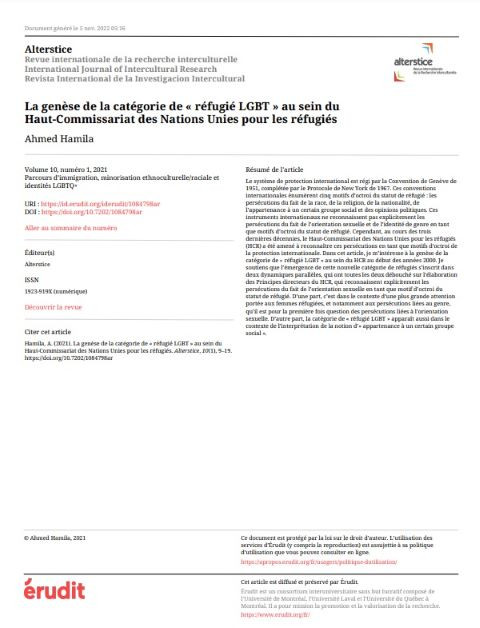 The Genesis of the Category of “LGBT Refugee” Within the United Nations High Commissioner for Refugees Année de publication: 2021 Auteur: Ahmed Hamila Auteur institutionnel: Alterstice The international protection system is governed by the Geneva Convention of 1951, supplemented by the New York Protocol of 1967. These international conventions list five grounds for granting refugee status: persecution based on race, religion, nationality, membership of a certain social group, and political opinions. These international instruments do not explicitly recognize persecution based on sexual orientation and gender identity as grounds for granting refugee status. However, over the past three decades, the Office of the United Nations High Commissioner for Refugees (UNHCR) has come to recognize such persecution as grounds for granting international protection. In this article, I focus on the genesis of the "LGBT refugee" category within the UNHCR in the early 2000s. The essay argue that the emergence of this new category of refugees is part of two parallel dynamics, which both led to the development of the UNHCR Guidelines, which explicitly recognize persecution based on sexual orientation as a ground for granting refugee status. On the one hand, it is in the context of greater attention paid to refugee women, and in particular to gender-related persecutions, that persecutions related to sexual orientation are for the first time discussed. On the other hand, the category of “LGBT refugee” also appears in the context of the interpretation of the notion of “belonging to a certain social group”. La genèse de la catégorie de « réfugié LGBT » au sein du Haut-Commissariat des Nations Unies pour les réfugiés Année de publication: 2021 Auteur: Ahmed Hamila Auteur institutionnel: Alterstice Le système de protection international est régi par la Convention de Genève de 1951, complétée par le Protocole de New York de 1967. Ces conventions internationales énumèrent cinq motifs d’octroi du statut de réfugié : les persécutions du fait de la race, de la religion, de la nationalité, de l’appartenance à un certain groupe social et des opinions politiques. Ces instruments internationaux ne reconnaissent pas explicitement les persécutions du fait de l’orientation sexuelle et de l’identité de genre en tant que motifs d’octroi du statut de réfugié. Cependant, au cours des trois dernières décennies, le Haut-Commissariat des Nations Unies pour les réfugiés (HCR) a été amené à reconnaître ces persécutions en tant que motifs d’octroi de la protection internationale. Dans cet article, je m’intéresse à la genèse de la catégorie de « réfugié LGBT » au sein du HCR au début des années 2000. Je soutiens que l’émergence de cette nouvelle catégorie de réfugiés s’inscrit dans deux dynamiques parallèles, qui ont toutes les deux débouché sur l’élaboration des Principes directeurs du HCR, qui reconnaissent explicitement les persécutions du fait de l’orientation sexuelle en tant que motif d’octroi du statut de réfugié. D’une part, c’est dans le contexte d’une plus grande attention portée aux femmes réfugiées, et notamment aux persécutions liées au genre, qu’il est pour la première fois question des persécutions liées à l’orientation sexuelle. D’autre part, la catégorie de « réfugié LGBT » apparaît aussi dans le contexte de l’interprétation de la notion d’« appartenance à un certain groupe social ».