
Ressources
Explorez une large gamme de ressources sur le GCED afin d’approfondir votre compréhension et de renforcer vos activités de recherche, de plaidoyer, d’enseignement et d’apprentissage.
10 résultats trouvés
 Asia-Pacific guidelines for the development of national ESD indicators Année de publication: 2007 Auteur: Daniella Tilbury | Sonja Janousek | Derek Elias | Joel Bacha Auteur institutionnel: UNESCO Bangkok UNESCO Bangkok, with assistance from the Commission on Education and Communication (CEC) of the World Conservation Union (IUCN) in conjunction with Macquarie University in Australia, implemented a project to assist with the important task of monitoring and assessing progress during the UN Decade of Education for Sustainable Development (DESD). This process has been funded by the generous contribution of the Ministry of Education, Culture, Sports, Science and Technology under the Japanese Funds-In-Trust for Education for Sustainable Development (ESD). The DESD provides an important opportunity to enhance the profile of ESD in both formal and informal learning spaces which in turn assists UNESCO Member States with the transformation into sustainable societies. Efforts to promote and integrate ESD at all levels will be key to advancing the reach of the Decade.Responding to the DESD International Implementation Scheme’s (IIS) recommendation to develop indicators (see Appendix 1), the Asia-Pacific DESD Indicators Project commenced in March 2006. The first stage of the project has resulted in the publication of this Guidelines document which assists UNESCO Member States in the Asia-Pacific region with the development of ESD indicators and monitoring systems at the national level.The document is intended to provide an important practical resource for UNESCO National Commissions, in addition to other stakeholders, in the area of ESD indicator development. By outlining how to develop national ESD indicators, the Guidelines offers an effective way of building knowledge and increasing ownership of the Decade among stakeholders. Rather than deliver a pre-packaged set of ESD indicators, this document provides countries with a foundation for developing indicators that are relevant to their national contexts.The objectives of the Guidelines are:• To assist with understanding the nature of ESD indicators and the different approaches for their use;• To identify the different types of ESD indicators and what they may reveal about progress;• To identify important sources, methods and planning tools for both data collection and reporting;• To encourage UNESCO Member States in the Asia-Pacific region to work collaboratively, share experiences and learn about meaningful monitoring and assessment during and beyond the DESD; and• To build national capacity to develop ESD indicators and ESD data collection mechanisms at the national level Orientations Asie-Pacifique pour l'élaboration d'indicateurs nationaux Année de publication: 2007 Auteur: Daniella Tilbury | Sonja Janousek | Derek Elias | Joel Bacha Auteur institutionnel: UNESCO Bangkok L'UNESCO Bangkok, avec l'aide de la Commission de l'Éducation et de la Communication (CEC) de l'Union mondiale pour la nature (UICN) en collaboration avec l'Université Macquarie en Australie, a mis en œuvre un projet pour aider à la tâche importante de suivi et d'évaluation des progrès de la Décennie des Nations Unies. Éducation pour le développement durable (DEDD). Ce processus a été financé par la contribution généreuse du ministère de l'Éducation, de la Culture, des Sports, des Sciences et de la Technologie au Fonds fiduciaire japonais pour l'éducation pour le développement durable. Le DEDD offre une occasion importante de rehausser le profil de l'EDD dans les espaces d'apprentissage formels et informels, ce qui aide les États membres de l'UNESCO à se transformer en sociétés durables. Les efforts déployés pour promouvoir et intégrer l'EDD à tous les niveaux seront essentiels pour faire progresser la portée de la Décennie.Répondant à la recommandation du DEDD International Implementation Scheme (IIS) pour l'élaboration d'indicateurs (voir Annexe 1), le Projet d'Indicateurs DEDD de l'Asie-Pacifique a débuté en mars 2006. La première étape du projet a abouti à la publication du présent document qui aide l'UNESCO Les États membres de la région Asie-Pacifique, avec l'élaboration d'indicateurs et de systèmes de suivi au niveau national.Le document est destiné à fournir une ressource pratique importante aux Commissions nationales de l'UNESCO, en plus des autres parties prenantes, dans le domaine de l'élaboration d'indicateurs de développement durable. En définissant la manière d'élaborer des indicateurs nationaux de développement économique durable, les Lignes directrices offrent un moyen efficace de renforcer les connaissances et d'accroître l'appropriation de la Décennie par les parties prenantes. Plutôt que de fournir un ensemble pré-emballé d'indicateurs EDD, ce document fournit aux pays une base pour développer des indicateurs qui sont pertinents à leur contexte national.Les objectifs des lignes directrices sont les suivants:• Aider à comprendre la nature des indicateurs EDD et les différentes approches pour leur utilisation;• Identifier les différents types d'indicateurs EDD et ce qu'ils peuvent révéler sur les progrès;• Identifier les sources, les méthodes et les outils de planification importants pour la collecte et le compte rendu des données;• Encourager les États membres de l'UNESCO de la région Asie-Pacifique à travailler en collaboration, à échanger leurs expériences et à en apprendre davantage sur le suivi et l'évaluation significatifs pendant et après le DEDD; et• Renforcer la capacité nationale d'élaborer des indicateurs EDD et des mécanismes de collecte de données EDD au niveau national Education pour le développement durable: étude réalisée par des experts sur les processus et l'apprentissage Année de publication: 2011 Auteur: Daniella Tilbury Auteur institutionnel: UNESCO A key objective of this expert review is to gather information to inform the choice of tools and the specific questions which need to be asked as part of the 2011 DESD monitoring and evaluation report. The review seeks clarification on: i) Which commonly accepted learning processes are aligned with ESD and should be promoted through ESD activities? ii) What are ESD and related learning opportunities contributing to sustainable development? Education for sustainable development: an expert review of processes and learning Année de publication: 2011 Auteur: Daniella Tilbury Auteur institutionnel: UNESCO A key objective of this expert review is to gather information to inform the choice of tools and the specific questions which need to be asked as part of the 2011 DESD monitoring and evaluation report. The review seeks clarification on: i) Which commonly accepted learning processes are aligned with ESD and should be promoted through ESD activities? ii) What are ESD and related learning opportunities contributing to sustainable development?
 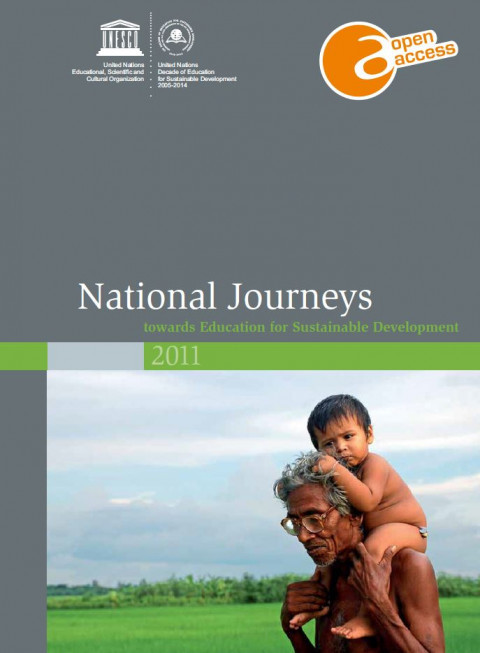 National journeys towards education for sustainable development, 2011: reviewing national experiences from Chile, Indonesia, Kenya, the Netherlands, Oman Année de publication: 2011 Auteur: I. Mulà | Daniella Tilbury Auteur institutionnel: UNESCO This publication has sourced information from a series of national reviews commissioned by UNESCO in 2010 and written by authoritative stakeholders in Chile, Indonesia, Kenya, the Netherlands and Oman. The selection of countries was based on: i) work showcased at the 2009 World Conference on Education for Sustainable Development held in Bonn, Germany; ii) submissions to the monitoring and evaluation process for the Decade of Education for Sustainable Development (DESD); as well as iii) through evaluation material submitted by UNESCO staff in regional bureaux of education.The countries showcased in this report are not necessarily the ‘best’ examples of the region, as many other countries are also progressing effectively towards implementing ESD. Rather, the countries selected illustrate the wide diversity of ESD approaches and initiatives taking place in different parts of the learnt world. The national studies were then edited and harmonized before common themes and lessons learned were identified to support other national efforts in moving towards the second half of the UN Decade of Education for Sustainable Development. Educación para el desarrollo sostenible: examen por los expertos de los procesos y el aprendizaje Année de publication: 2011 Auteur: Daniella Tilbury Auteur institutionnel: Organización de las Naciones Unidas para la Educación, la Ciencia y la Cultura (UNESCO) A key objective of this expert review is to gather information to inform the choice of tools and the specific questions which need to be asked as part of the 2011 DESD monitoring and evaluation report. The review seeks clarification on: i) Which commonly accepted learning processes are aligned with ESD and should be promoted through ESD activities? ii) What are ESD and related learning opportunities contributing to sustainable development? Recorridos nacionales rumbo a la educación para el desarrollo sostenible, 2011: análisis de las experiencias de los países Chile, Indonesia, Kenya, Omán, Países Bajos Année de publication: 2011 Auteur: I. Mulà | Daniella Tilbury Auteur institutionnel: UNESCO This publication has sourced information from a series of national reviews commissioned by UNESCO in 2010 and written by authoritative stakeholders in Chile, Indonesia, Kenya, the Netherlands and Oman. The selection of countries was based on: i) work showcased at the 2009 World Conference on Education for Sustainable Development held in Bonn, Germany; ii) submissions to the monitoring and evaluation process for the Decade of Education for Sustainable Development (DESD); as well as iii) through evaluation material submitted by UNESCO staff in regional bureaux of education. The countries showcased in this report are not necessarily the ‘best’ examples of the region, as many other countries are also progressing effectively towards implementing ESD. Rather, the countries selected illustrate the wide diversity of ESD approaches and initiatives taking place in different parts of the learnt world. The national studies were then edited and harmonized before common themes and lessons learned were identified to support other national efforts in moving towards the second half of the UN Decade of Education for Sustainable Development. Des pays en marche vers l'éducation pour le développement durable, 2011: examen des expériences nationales; Chili, Indonésie, Kenya, Oman, Pays-Bas Année de publication: 2011 Auteur: I. Mulà | Daniella Tilbury Auteur institutionnel: UNESCO This publication has sourced information from a series of national reviews commissioned by UNESCO in 2010 and written by authoritative stakeholders in Chile, Indonesia, Kenya, the Netherlands and Oman. The selection of countries was based on: i) work showcased at the 2009 World Conference on Education for Sustainable Development held in Bonn, Germany; ii) submissions to the monitoring and evaluation process for the Decade of Education for Sustainable Development (DESD); as well as iii) through evaluation material submitted by UNESCO staff in regional bureaux of education. The countries showcased in this report are not necessarily the ‘best’ examples of the region, as many other countries are also progressing effectively towards implementing ESD. Rather, the countries selected illustrate the wide diversity of ESD approaches and initiatives taking place in different parts of the learnt world. The national studies were then edited and harmonized before common themes and lessons learned were identified to support other national efforts in moving towards the second half of the UN Decade of Education for Sustainable Development.
 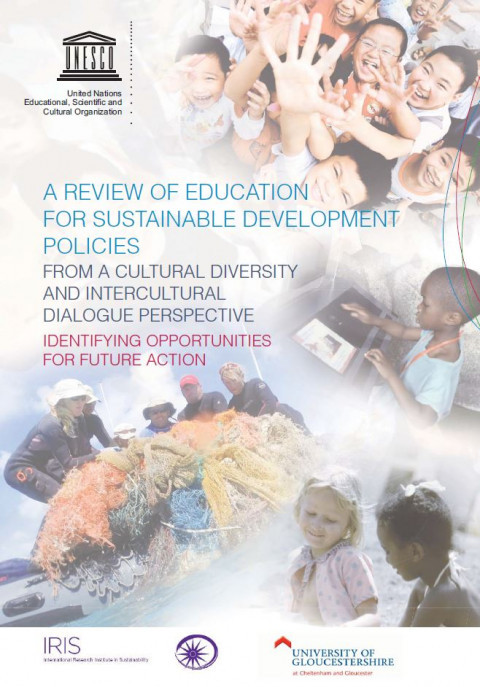 A Review of education for sustainable development policies from a cultural diversity and intercultural dialogue perspective: identifying opportunities for future action Année de publication: 2009 Auteur: Daniella Tilbury | I. Mulà Auteur institutionnel: UNESCO This review highlights the striking absence of culture in ESD, a gap also acknowledged by participants at the UNESCO World Conference on Education for Sustainable Development held in Bonn, Germany, from 31 March to 2 April 2009. The final declaration emphasizes that ESD is about 'creative and critical approaches, long-term thinking, innovation and empowerment for dealing with uncertainty', and for solving complex problems, highlighting in particular the interdependence of environment, economy, society, and cultural diversity from local to global levels. The review and its methodology provide an instructive example of ways to articulate the linkages between cultural diversity, intercultural dialogue and ESD, required for a sustainable future. Un examen de l'éducation pour les politiques de développement durable à partir d'une diversité culturelle et de la perspective d'un dialogue interculturel: l'identification des possibilités d'action future Année de publication: 2009 Auteur: Daniella Tilbury | I. Mulà Auteur institutionnel: Organisation des Nations Unies pour l'éducation, la science et la culture (UNESCO) Cet avis met en évidence l'absence frappante de la culture dans l'EDD, un écart aussi reconnu par les participants auconférencemondial de l'UNESCO sur l'éducation pour le développement durable tenu à Bonn, en Allemagne, du 31 Mars au 2 Avril 2009. La déclaration finale souligne que l'EDD est sur ' approches créatives et critiques, la pensée à long terme, l'innovation et l'autonomisation pour faire face à l'incertitude », et pour résoudre des problèmes complexes, en soulignant en particulier l'interdépendance de l'environnement, l'économie, la société et la diversité culturelle du niveau local au niveau mondial. L'examen et sa méthodologie fournissent un exemple instructif de façons d'articuler les liens entre la diversité culturelle, le dialogue interculturel et EDD, nécessaire pour un avenir durable.