
Ressources
Explorez une large gamme de ressources sur le GCED afin d’approfondir votre compréhension et de renforcer vos activités de recherche, de plaidoyer, d’enseignement et d’apprentissage.
5 résultats trouvés
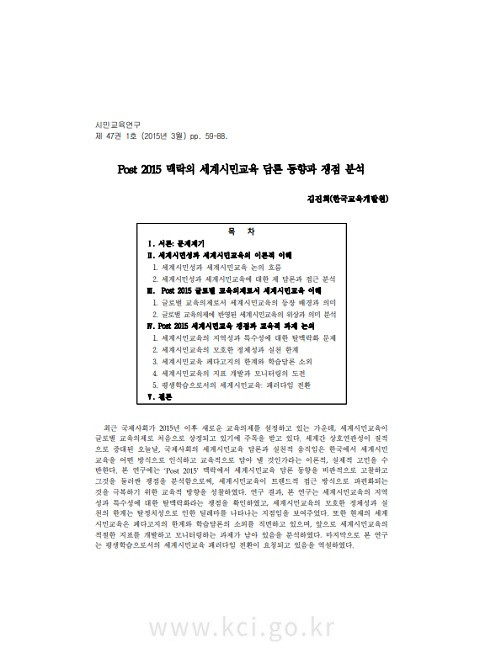 Critical Understanding on Global Citizenship Education in Post 2015 Context (Theory and Research in Citizenship Education; Vol. 57, No. 1) Année de publication: 2015 Auteur: Jinhee Kim Auteur institutionnel: Korea Association of Social Education It is notable that global citizenship education has recently gained prominence in Post 2015 context. This study attempted to explore diverse discourses of global citizenship education in theoretical dimension and it also analyzed the current status of global citizenship education as a new global education agenda. Major findings displayed issues and challenges; de-contextualization against local dimension; vague conceptualization of global citizenship education; limitation of transformative pedagogy and learning discourse; indicator development and monitoring issues; a paradigm shift for global citizenship education engaging with lifelong learning. Eventually, this study argues that comprehensive vision and long term road-map should be established to enhance global citizenship education. Lifelong learning approach is crucial to reshape global citizenship education while interacting with life-world context and life experience, which can promote an epistemology of learning to live together.
 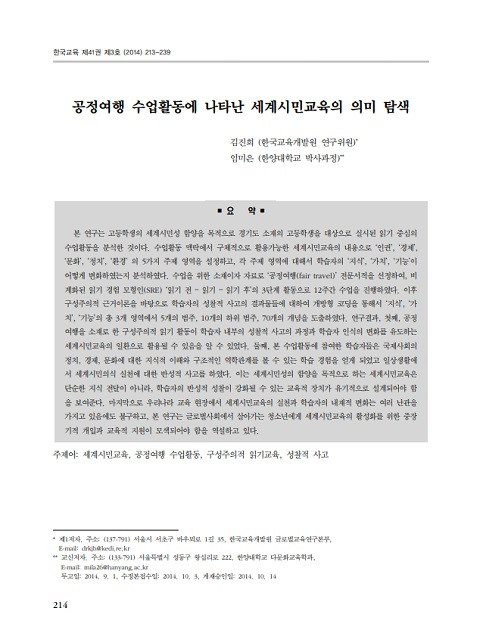 A Study on Global Citizenship Education Based on Scaffolded Reading Activities Utilizing a ‘fair travel’ Book in a High School (Journal of Korean Education; Vol. 41, No. 3) Année de publication: 2014 Auteur: Jinhee Kim | Mieun Lim Auteur institutionnel: Korean Educational Development Institute (KEDI) This study investigated the guiding principles associated with global citizenship education and their educational implications as they are engaged through scaffolded reading activities using a ‘fair travel’ book in a high school at Gyeonggi-do. The reading activities were designed to cultivate global citizenship for high school students. This study defined five major themes/subjects within global citizenship education such as ‘human rights,’ ‘economy,’ ‘culture,’ ‘politics,’ and ‘environment.’ The study sought to explore the learning domains of global citizenship education by considering the ‘knowledge,’ ‘value,’ and ‘function’ of each domain. To conduct this study, researchers selected a book with a specialized focus on ‘fair travel’ and analyzed how its contents if utilized in a 12 week program relate to the learning domains in global citizenship education. The activity stage of the program contained a ‘before reading,’ ‘on reading,’ and ‘after reading’ sections based on the Scaffolded Reading Experience Program. Embracing open-coding methodology, researchers produced 70 concepts within 10 subcategories of 5 categories in the 3 dimensions, ‘knowledge,’ ‘value,’ and ‘function.’ Major findings showed that the constructive model of scaffolded reading activities could be used as a meaningful program for global citizenship education at the high school level. This activity encouraged learners to engage in reflective thinking in a critical manner. Second, this study indicated that collective classroom activities using ‘fair travel’ contents enabled learners to acquire reshaped learning domains in the areas of global awareness, international knowledge, sense of global connectedness and local involvement. This study’s findings underscore the idea that practicing reflective critical thinking is required to enhance global citizenship education in practice. Lastly the findings support that the notion that effective educational provisioning and long-term implementation are both required to foster global citizenship education.
 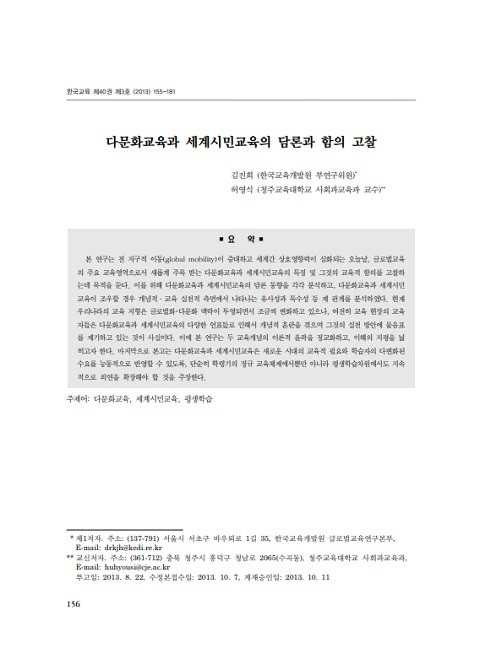 Understanding Multicultural Education and Global Citizenship Education: Characteristics, Conceptual Relations and Educational Implications (Journal of Korean Education; Vol. 40, No. 3) Année de publication: 2013 Auteur: Jinhee Kim | Jinhee Kim Auteur institutionnel: Korean Educational Development Institute (KEDI) Thanks to the impact of globalized educational discourses and the resulting changes, much attention has been paid to multicultural education and global citizenship education in Korea. This study attempted to demonstrate the characteristics and conceptual relations of similarity and differences between multicultural education and global citizenship education. Finally, the study sought to produce educational implications and policy recommendations in response to a change in global education discourse and the accompanying practices. The major findings of the study showed that multicultural education and global citizenship education could be conceptualized as mechanisms for “learning to live together,” emphasizing diversity, equality and involvement in a global community. This type of education should be promoted while espousing an epistemology of lifelong learning, not only within the formal education system, but also in society as a whole. Despite the differences between multicultural education and global citizenship education, both fields are capable of continuously complementing each other. The study shows that multicultural education and global citizenship education emphasize critical reflection and engagement (praxis) by the learner rather than the formulation of knowledge and skills. It was argued that teacher education and teacher training is a very important part of nurturing multicultural education and global citizenship education in practice, which can bring about changes for the better in the current field of education. As democratic citizenship education, both educations could play an important role in reshaping Korean education.
  The Theoretic Relationship Between Global Citizenship and Moral Education: An Analysis of Global Citizenship and the Moral Education Curriculum for Middle School Students in South Korea (The Journal of Korean Education; Vol.43, No.3) Année de publication: 2016 Auteur: Jinhee Kim | Seunghan Cha Auteur institutionnel: Korean Educational Development Institute (KEDI) This study explores the theoretical relationship between global citizenship and moral education to enhance global citizenship as espoused within a moral education context.
  Critical Understanding on Shrinkage and Limitation of UK’s Global Citizenship Education in the Era of Brexit (Journal of Education for International Understanding; Vol. 13, No. 2) Année de publication: 2018 Auteur: Jinhee Kim Auteur institutionnel: Korean Society of Education for International Understanding (KOSEIU) This study aims to analyze the shrinkage and limitation of Global Citizenship Education in the epoch of Brexit. It also attempts to examine a feature of positioning and direction of Global Citizenship Education which is confronted with a sceptical criticism of its' educational impact. In this vein, the major findings and arguments showed the practice and implementation of Global Citizenship Education under the pressure of Brexit faces complicated challenges across Europe including UK, since Brexit highly pursues national centred hegemony and nationalistic bloc. It could hinder the structural restriction of implementing of Global Citizenship Education in UK. Apparently, this study indicated that the phenomenon of Brexit and it's impact is functioning as dynamic learning contents, not for a teaching-learning resource. It has been discussed that Citizens of UK have strived to deal Brexit as a learning experience in life-world. Finally, this study suggests a direction to move forward of Global Citizenship Education in an ever-shrinking world of Brexit.