
Ressources
Explorez une large gamme de ressources sur le GCED afin d’approfondir votre compréhension et de renforcer vos activités de recherche, de plaidoyer, d’enseignement et d’apprentissage.
74 résultats trouvés
 Digital Citizenship Education Handbook (Edition 2022) Année de publication: 2022 Auteur: Janice Richardson | Elizabeth Milovidov Auteur institutionnel: Council of Europe Digital citizenship competences define how we act and interact online. They comprise the values, attitudes, skills and knowledge and critical understanding necessary to responsibly navigate the constantly evolving digital world, and to shape technology to meet our own needs rather than to be shaped by it. The Digital citizenship education handbook offers information, tools and good practice to support the development of these competences in keeping with the Council of Europe’s vocation to empower and protect children, enabling them to live together as equals in today’s culturally diverse democratic societies, both on- and offline.The Digital citizenship education handbook is intended for teachers and parents, education decision makers and platform providers alike. It describes in depth the multiple dimensions that make up each of 10 digital citizenship domains, and includes a fact sheet on each domain providing ideas, good practice and further references to support educators in building the competences that will stand children in good stead when they are confronted with the challenges of tomorrow’s digital world. The Digital citizenship education handbook is consistent with the Council of Europe’s Reference Framework of Competences for Democratic Culture and compatible for use with the Internet literacy handbook.
  The Impact of the COVID-19 Pandemic on Student Voice: Findings and Recommendations Année de publication: 2021 Auteur institutionnel: UNESCO | Council of Europe The COVID-19 pandemic has had serious consequences on the education of young people and their ability to engage and participate meaningfully. In 2020, UNESCO and the Council of Europe decided to collaborate on a research project with a view to examining the impact of the COVID-19 pandemic on student voice and particularly the consequences of the subsequent school closures on student voice opportunities in Europe and in the Middle East and North Africa (MENA). This publication details the findings of this study and provides recommendations for school directors and personnel, teachers, educators, policy-makers and young people to build on the lessons learned from the pandemic and help the education community work collectively towards promoting societies that are guided by human rights, with student voice and participation at the centre. It is primarily intended for policy-makers, educators, teachers working in formal school systems. It may also be of interest to professionals working in non-formal education settings or other sectors – namely the justice, social and health sectors – working with student.
  Competences for Democratic Culture: Living together as equals in culturally diverse democratic societies Année de publication: 2016 Auteur institutionnel: Council of Europe This document is a product of a Council of Europe project which is taking place in four phases during 2014-17. The first phase has been devoted to the development of a conceptual model of the competences which citizens require to participate effectively in a culture of democracy. This document describes the model and the methods that were used to develop it. The document is aimed at readers who wish to understand the underlying assumptions and technical details of the model. Phase two of the project will be devoted to the development of descriptors (i.e. statements or descriptions of what a person is able to do if they have mastered the various competences that are specified by the model), phase three to ascertaining whether it is possible to assign the descriptors to levels of proficiency, and phase four to the production of supporting documentation. This documentation will be addressed to educational practitioners and policy makers, and will provide a less technical description of the current competence model. It will also explain how the model and the descriptors can be used to assist curriculum design, pedagogical design and the development of new forms of assessment (for use in either selfassessment or assessment by others). All of the materials that are produced by the project will eventually be incorporated into a Council of Europe reference framework of competences for democratic culture. Further information about the project is available from the project website: www.coe.int/competences
  Media Literacy for Global Education: Toolkit for Youth Multipliers Année de publication: 2022 Auteur institutionnel: North-South Centre of the Council of Europe | Council of Europe | European Union (EU) This toolkit targets youth multipliers and educators and gathers practical and contextual information about Media Literacy (ML) and its contribution to the field of Global Education (GE). Its activities and fact sheets are focused on non-formal learning contexts, but they can also be implemented in schools since the toolkit combines the most recent developments in GE, ML and Digital Citizenship Education useful to enrich formal school curricula. All the practical activities proposed in the toolkit are in line with the Competences for Democratic Culture and the Human Rights approach of the Council of Europe.The toolkit’s main aim is to empower practitioners on ML, but also to provide the wider public with the knowledge and tools to become more responsible and active citizens, offering activities focused on the critical analysis and production of media messages, analysis of algorithms, active participation in societies, maintenance of privacy, maintenance of well-being and management of e-identity.
  Bank of Digital Task Sheets Auteur institutionnel: Council of Europe Around forty sheets of tasks anchored in real life and reflective tasks are available. The proposed tasks implement the didactic framework that promotes a socio-interactional approach and extends the usual typology of tasks with tasks anchored in real life.These tasks, carried out on online participatory sites, allow the people who carry them out to experience both authentic (inter)actions and digital citizenship.Alongside these tasks, reflective tasks invite learners to reflect on online practices and in particular on their own uses of digital technology. They are to be adapted according to the contexts of use and provide examples of the implementation of the approach defined in the Didactic Framework. Banque de fiches de tâches numériques Auteur institutionnel: Council of Europe Une quarantaine de fiches de tâches ancrées dans la vie réelle et de tâches réflexives sont disponibles. Les tâches proposées mettent en œuvre le cadre didactique qui promeut une approche socio-interactionnelle et étend la typologie habituelle des tâches avec des tâches ancrées dans la vie réelle.Ces tâches, réalisées sur des sites participatifs en ligne, permettent aux personnes qui les réalisent de faire l'expérience, à la fois, d'(inter)actions authentiques et de la citoyenneté numérique.A côté de ces tâches, des tâches réflexives invitent les apprenant·es à réfléchir sur les pratiques en ligne et notamment sur leurs propres usages du numérique. Elles sont à adapter en fonction des contextes d'utilisation et permettent de donner des exemples de mise en œuvre de l'approche définie dans le Cadre didactique.
 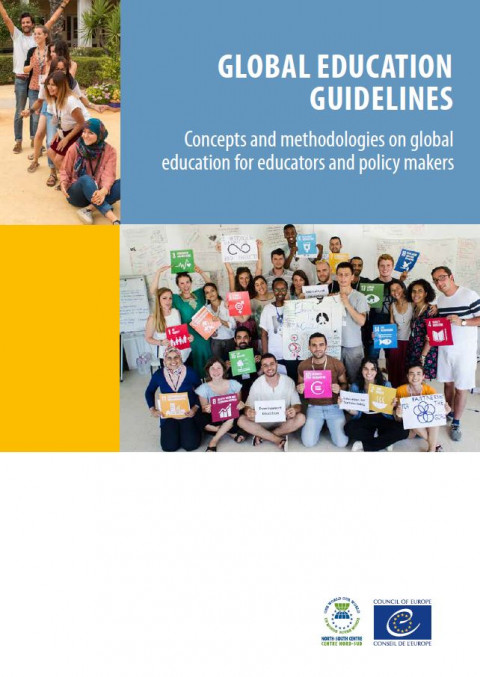 Global Education Guidelines 2019: Concepts and Methodologies on Global Education for Educators and Policy Makers Année de publication: 2019 Auteur institutionnel: North-South Centre of the Council of Europe | Council of Europe The Global Education Guidelines are an initiative of the Global Education Programme of the North South Centre of the Council of Europe, and answer a need expressed by the North-South Centre’s (NSC) network of global education practitioners – the Global Education network - to have a common tool, built on experience gained by the network and other partners, to support educators to comprehend and successfully design, implement and carry out global education initiatives and learning activities. This updated edition of the Guidelines includes novelties and responds to the challenge of being a user-friendly handbook, by (i) introducing the concept of competence-based learning, with the Council of Europe Reference Framework of Competences for Democratic Culture and the OECD concept of global competences, and explains in detail and with practical examples and user friendly tools how global education can make use of competence-based learning to empower learners; (ii) has broadened the content of the chapter on methodology and methods, with step by step guides for the daily work of practitioners, educators and facilitators, and further exemplifying the competence-based learning concept; and (iii) by including a new chapter on media literacy to support practitioners and learners to navigate today’s communication and digital challenges. Pautas para una Educación Global: Manual para que las y los educadores entiendan e implementen una educación global Année de publication: 2019 Auteur institutionnel: North-South Centre of the Council of Europe | Council of Europe Esta guía práctica para la educación para la ciudadanía mundial responde a una necesidad expresada por los profesionales de la red de la Semana de Educación para la Ciudadanía Mundial del Centro Norte-Sur (CNS) del Consejo de Europa, quienes expresaron su deseo de tener un instrumento común, configurado a la luz de la experiencia adquirida por la red y otros socios, que pueden ayudar a los educadores a diseñar y llevar a cabo iniciativas en GCED. Esta guía práctica para la educación para la ciudadanía mundial responde a una necesidad expresada por los profesionales de la red de la Semana de Educación para la Ciudadanía Mundial del Centro Norte-Sur (CNS) del Consejo de Europa, quienes expresaron su deseo de tener un instrumento común, configurado a la luz de la experiencia adquirida por la red y otros socios, que pueden ayudar a los educadores a diseñar y llevar a cabo iniciativas en GCED.
  CONTRIBUTION DU CONSEIL DE L'EUROPE AU PROGRAMME DE DÉVELOPPEMENT DURABLE A L’HORIZON 2030 DE L’ONU Auteur institutionnel: Council of Europe Le 1er janvier 2016, le monde a entrepris la mise en œuvre du «Programme de développement durable de l’ONU à l’horizon 2030», vision ambitieuse et universelle axée sur 17 Objectifs de Développement Durable (ODD) assortis de 169 cibles intégrées, indissociables et intimement liées. Les objectifs ont une application universelle et sont très pertinents pour le Conseil de l'Europe ; les États s’engagent à se les approprier et à définir des cadres nationaux de réalisation des 17 objectifs. La plupart des activités du Conseil de l'Europe, sinon toutes, peuvent contribuer à la mise en œuvre du Programme 2030 de l’ONU et à la réalisation des ODD. Reconnaissant les liens intrinsèques entre développement durable et protection des droits de l’homme, le Conseil de l'Europe s’attache à travailler avec ses 47 États membres et à les soutenir dans la mise en œuvre du Programme 2030 pour toute une série de mesures. Guide Pratique sur l’Éducation à la Citoyenneté Mondiale 2019: Concepts et méthodologies en matière d’éducation à la citoyenneté mondiale à l’usage d’éducateurs et de responsables politiques Année de publication: 2019 Auteur institutionnel: North-South Centre of the Council of Europe | Council of Europe Ce guide pratique sur l’éducation à la citoyenneté mondiale répond à un besoin exprimé par les praticiens du réseau de la Semaine de l’éducation à la citoyenneté mondiale du Centre Nord-Sud du Conseil de l’Europe (CNS), lesquels ont manifesté leur désir de disposer d’un instrument commun, façonné à la lumière de l’expérience acquise par le réseau et d’autres partenaires, susceptibles d’aider les éducateurs à concevoir et à mener à bien des initiatives en matière d’ECM. La présente édition mise à jour du Guide inclut des nouveautés et répond aux défis inhérents à la rédaction d’un manuel facile à utiliser en : (i) introduisant le concept d’apprentissage fondé sur les compétences, conformément au Cadre de référence des compétences pour une culture démocratique du Conseil de l’Europe et au concept de compétence globale de l’OCDE, et en recourant à des exemples pratiques détaillés et à des outils conviviaux pour expliquer comment l’éducation à la citoyenneté mondiale peut utiliser l’apprentissage fondé sur les compétences pour autonomiser les apprenants; (ii) élargissant le contenu du chapitre sur la méthodologie et les méthodes par le biais d’un guide étape par étape conçu pour aider les praticiens, les éducateurs et les facilitateurs dans leur travail quotidien et d’une meilleure illustration des avantages inhérents au concept d’apprentissage fondé sur les compétences; et (iii) en incluant un nouveau chapitre sur l’éducation aux médias pour aider les praticiens et les apprenants à relever les défis actuels associés à la communication et au numérique.