
Ressources
Explorez une large gamme de ressources sur le GCED afin d’approfondir votre compréhension et de renforcer vos activités de recherche, de plaidoyer, d’enseignement et d’apprentissage.
74 résultats trouvés
 European pack for visiting Auschwitz-Birkenau Memorial and museum - Guidelines for teachers and educators Année de publication: 2011 Auteur institutionnel: Council of Europe | Auschwitz-Birkenau Memorial and Museum | Poland. Ministry of Education Taking groups of students to the Auschwitz-Birkenau Memorial and Museum is a heavy responsibility, but it is a major contribution to citizenship if it fosters understanding of what Auschwitz stands for, particularly when the last survivors are at the end of their lives. This pack is designed for teachers wishing to organize student visits to authentic places of remembrance, and for the guides, academics and others who work every day with young people at Auschwitz. To avoid the risk of inappropriate reactions or the failure to benefit from a large investment in travel and accommodation, considerable preparation and discussion is necessary before the visit and serious reflection afterwards. This pack offers insights into the complexities of human behaviour so that students can have a better understanding of what it means to be a citizen. The young people who visit Auschwitz in the next few years will be witnesses of the last witnesses. Their generation will be the last to hear the survivors speaking on the spot. The Council of Europe, the Polish Ministry of Education and the Auschwitz-Birkenau Memorial and Museum are jointly sponsoring this project aimed at preventing crimes against humanity through Holocaust remembrance teaching. (By the Council of Europe) Peloton européen pour visiter Auschwitz-Birkenau Memorial et des musées - Lignes directrices pour les enseignants et les éducateurs Année de publication: 2011 Auteur institutionnel: Council of Europe | Auschwitz-Birkenau Memorial and Museum | Poland. Ministry of Education Prendre des groupes d'élèves au Mémorial d'Auschwitz-Birkenau et le musée est une lourde responsabilité, mais il est une contribution majeure à la citoyenneté si elle favorise la compréhension de ce que signifie Auschwitz, en particulier lorsque les derniers survivants sont à la fin de leur vie. Ce pack est conçu pour les enseignants qui souhaitent organiser des visites d'étudiants dans des lieux authentiques de mémoire, et pour les guides, les universitaires et les autres personnes qui travaillent tous les jours avec les jeunes à Auschwitz. Pour éviter le risque de réactions inappropriées ou l'échec de bénéficier d'un investissement important dans Voyage et hébergement, préparation et discussions est nécessaire avant la visite et de réflexion sérieuse après. Ce pack offre un aperçu de la complexité du comportement humain afin que les étudiants puissent avoir une meilleure compréhension de ce que signifie être un citoyen. Les jeunes gens qui visitent Auschwitz au cours des prochaines années seront témoins des derniers témoins. Leur génération sera la dernière pour entendre les survivants parlant sur place. Le Conseil de l'Europe, le ministère polonais de l'éducation et d'Auschwitz-Birkenau Memorial et Musée parrainent conjointement ce projet visant à la prévention des crimes contre l'humanité à travers l'enseignement de commémoration de l'Holocauste. (Par le Conseil de l'Europe)
  T-KIT 4: Intercultural Learning Année de publication: 2018 Auteur: Oana Nestian Sandu | Nadine Lyamouri-Bajja Auteur institutionnel: Council of Europe | European Commission Intercultural learning is an important topic for the priorities of both the European Commission and the Council of Europe, and of their partnership in the field of youth.Intercultural learning is an educational approach that can lead to social transformation, so that people from different cultural backgrounds can develop positive relations based on the values and principles of human rights and on seeing cultural differences as positive things. It is a form of political and social education that needs to pay attention not only to intercultural relations, but also to different understandings of culture and diversity, power relations, distribution of resources, political and social context, human rights, discrimination, history and daily interactions among different groups.This T-Kit was developed for the context of youth work and non-formal education with young people, both of which support the personal development, social integration and active citizenship of young people. Educators and youth workers have an important role in addressing intercultural learning in their work with young people. They can stimulate young people’s learning in their daily lives, so that they can question and extend their perception, develop competences to interact positively with people from different cultural backgrounds and embrace the values of diversity, equality and dignity. In today’s Europe, these values and skills are fundamental for young people and for society as a whole in order to continue building peace and mutual understanding.
 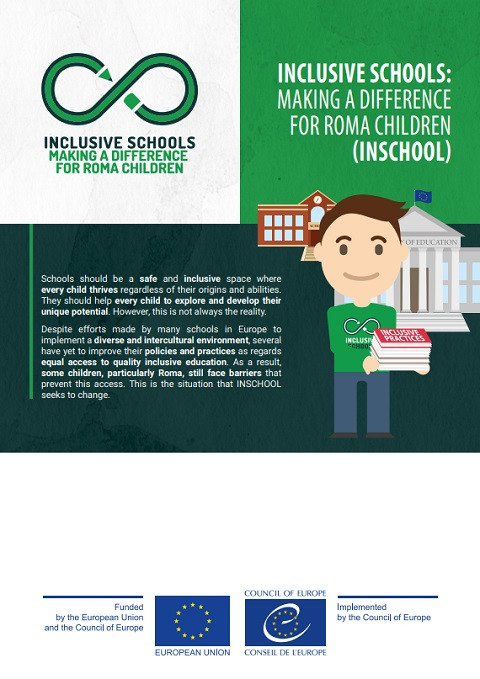 Inclusive Schools: Making a Difference for Roma Children (Inschool) Auteur institutionnel: European Union (EU) | Council of Europe This leaflet presents a joint project of the European Union and the Council of Europe on “Inclusive schools: making a difference for Roma children” targeting schools where Roma children learn, in the Czech Republic, Hungary, Romania, Slovak Republic and United Kingdom. The project aims at enhancing social inclusion of Roma by promoting inclusive education policies and practices in Europe.
  Digital Citizenship Education Handbook Année de publication: 2019 Auteur: Janice Richardson | Elizabeth Milovidov Auteur institutionnel: Council of Europe Digital citizenship and engagement involves a wide range of activities, from creating, consuming, sharing, playing and socialising, to investigating, communicating, learning and working. Competent digital citizens are able to respond to new and everyday challenges related to learning, work, employability, leisure, inclusion and participation in society, respecting human rights and intercultural differences.This Digital citizenship education handbook is designed to help educators and other interested adults understand and deal with them. It builds on the Council of Europe’s Reference Framework of Competences for Democratic Culture and the achievements of our longstanding Education for Democratic Citizenship programme, and complements the Internet literacy handbook as part of a coherent approach to educating citizens for the society of the future.
  Mapping of Media Literacy Practices and Actions in EU-28 Année de publication: 2016 Auteur institutionnel: European Audiovisual Observatory | Council of Europe The European Audiovisual Observatory provides the first major mapping of media literacy initiatives in Europe. A detailed analysis of the main trends is based on a selection of 547 projects imprelemented across EU member states.The authors found that initiatives to develop 'critical thinking' were the most prevalent, followed by 'media use' covering projects which aim to improve our ability to search, find and navigate and use media content and services.Other major findings include the very active role played by civil society with 'extra-curricular projects aimed at 'teens and older students' as the main target demographic for media literacy projects.The study is accompanied by a wealth of background media literacy research contained in its 4 annexes, including detailed national summaries, summaries of the 547 featured projects supplemented by 145 detailed case studies.
  Regulatory Authorities for Electronic Media and Media Literacy: Comparative Analysis of the Best European Practices Année de publication: 2018 Auteur: Robert Tomljenović Auteur institutionnel: Council of Europe This study analyses the best European practices of promoting media literacy, one of the key skills for living in the 21st century, highlighting the vital role of the regulatory authority for electronic media. The study indicates challenges and issues that come with living in a digitalized, hyper-technological mediated world, in which we are faced with countless information, issues of disinformation and fake news, algorithmic separation in ideological echo chambers, hate speech, clickbait journalism, and decreased trust in both mainstream media and the level of journalistic professionalism.
  All Aboard for DigiTown: A Learning Path for 9 -12 Year Olds to Become Smart Digital Citizens Année de publication: 2020 Auteur: Janice Richardson | Veronica Samara Auteur institutionnel: Council of Europe | Webwise “All Aboard for DigiTown!”is a fun, entertaining learning journey for young digital citizens through 10 digital themes centred on ‘Being online’, ‘Well-being online’ and ‘Rights online’. These are based on the Council of Europe’s successful Digital Citizenship Education model. As children progress through the stories, exercises and individual and group activities in the book, they will learn about using digital technology wisely, behaving respectfully and responsibly, and cooperating meaningfully online and offline. They end their journey with a backpack of badges to remind them of what being a digital citizen really means. A final section provides solutions, and offers teachers and parents a detailed overview of the competences their children are developing in order to better guide them on their path towards digital citizenship. The book can be used both in class, at home and in distance learning. It is adapted to the learning needs of children in the final years of elementary school (age around 9-12 years).
  Internet Literacy Handbook: Supporting Users in the Online World Année de publication: 2017 Auteur: Janice Richardson | Elizabeth Milovidov | Martin Schmalzried Auteur institutionnel: Council of Europe This new edition takes into account the myriad changes, although the object of the Handbook still remains, namely to offer families, educators and policy-makers sufficient technical know-how to allow them to navigate, with young people, through communication technology. The new edition also expands the scope of the Fact sheets anchoring previously “new” concepts of digital citizenship and digital parenting. This edition includes 26 Fact sheets arranged under 6 thematic headings including a heading specifically dedicated to “Looking Forward” towards the future of the Internet. The Handbook is designed to be easy to use and helpful, as illustrated by the Fact sheet entitled “Finding quality information on the Web”. It is also available online, where it can be downloaded either in its full format or per individual factsheet. Manuel de maîtrise de l'internet: Accompagner les utilisateurs dans le monde en ligne Année de publication: 2017 Auteur: Janice Richardson | Elizabeth Milovidov | Martin Schmalzried Auteur institutionnel: Council of Europe Depuis la publication de la première édition du Manuel de maîtrise d’Internet en 2003, le monde en ligne a beaucoup changé. Les Internautes sont de plus en plus jeunes, leur nombre a augmenté, leurs usages d’Internet et l’objet de leurs recherches évoluent et de nouveaux dangers, par exemple en matière de sécurité individuelle, apparaissent chaque jour. Cette nouvelle édition tient compte de ces nombreux changements mais conserve son objectif, qui est de donner aux familles, aux enseignants et aux décideurs politiques des connaissances techniques suffisantes pour pouvoir naviguer, avec les jeunes, dans le monde des technologies de la communication. La nouvelle édition étend également le contenu des Fiches d’information aux concepts qui étaient alors «nouveaux» de citoyenneté numérique et de parentalité numérique, ce qui porte le nombre de fiches à 26, organisées en six thématiques dont l’une est spécialement consacrée à l’avenir d’Internet. Le manuel se veut convivial et pratique, comme l’illustre la fiche intitulée « Trouver de l’information de qualité sur le web ». Il est également accessible en ligne où il peut être téléchargé dans son intégralité ou fiche par fiche.