
Ressources
Explorez une large gamme de ressources sur le GCED afin d’approfondir votre compréhension et de renforcer vos activités de recherche, de plaidoyer, d’enseignement et d’apprentissage.
89 résultats trouvés
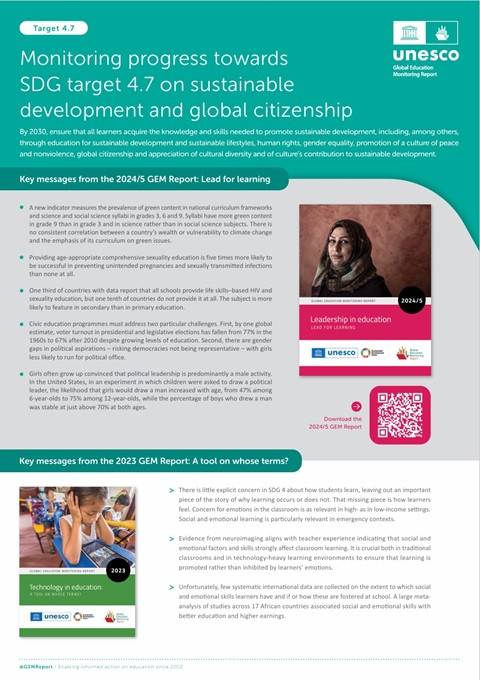 Monitoring Progress towards SDG Target 4.7 on Sustainable Development and Global Citizenship Année de publication: 2024 Auteur institutionnel: UNESCO | Global Education Monitoring Report Team This document introduces key messages from the GEM Reports and other related publications and online resources regarding the progress towards SDG Target 4.7.
  School Leadership Roles and Standards: Observations from the International Study of Teacher Leadership Année de publication: 2024 Auteur: Charles F. Webber | Dorothy Andrews | C.P. van der Vyver | Clelia Pineda-Báez | Janet M. Okoko | Edith J. Cisneros-Cohernour | José Gabriel Domínguez-Castillo | Mohammed Elmeski | Molly P. Fuller | Joan M. Conway | Cristina Moral-Santaella | Gloria Gratacós | Samira Idelcadi Auteur institutionnel: UNESCO | Global Education Monitoring Report Team This paper was commissioned by the Global Education Monitoring Report as background information to assist in drafting the 2024/5 GEM Report, Leadership in education. This report summarizes the findings of the International Study of Teacher Leadership(ISTL), conducted in 12 countries. The researchers share descriptions of the increasing interest in teacher leadershipas a factor in student learning and school improvement. ISTL researchers focus primarily on classroom-based teachers who—in collaboration with formal school leaders, parents, community members, and colleagues—impact school-wide decision making and pedagogical practices. The report offers insights related to teacher leader behaviours, the complexity of teacher leadership, how teacher leaders learn to lead, and the importance of contextual factors that support and impede teachers who provide informal leadership to schools and the communities they serve. The researchers compare cross-cultural requirements of good leadership and offer contextually situated analyses of leadership visions and goals, the impact of teacher leadership on educational outcomes, necessary preconditions for effective leadership, and policies that develop teacher leadership. The researchers also describe the readiness of school communities to embrace teacher leadership, described variously as parallel leadership, shared leadership, and distributed leadership. The report argues for a shift from considering standards for teacher leadership—too often based on the assumption that leadership is consistent across cultural and organizational settings—to the more flexible and contextualized conceptualization of leadership dimensions such as purpose, self-awareness, intentionality, and culture building. The ISTL researchers also argue that teacher leadership is but one component of an integrated approach to educational governance that addresses the complexities of teaching and learning in relation to rapid socioeconomic change, global migration, political tensions, and the emergence of new technologies. The ISTL also reinforces the ongoing importance of classroom teachers in the achievement of educational objectives. The ISTL team concludes this report with a set of research recommendations.
 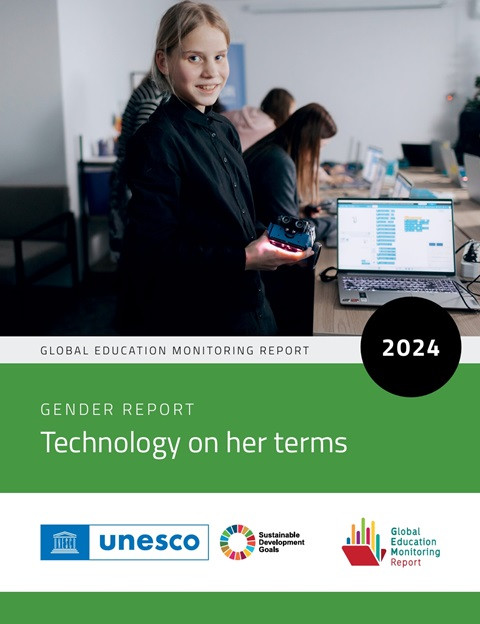 Global Education Monitoring Report 2024: Gender Report; Technology on Her Terms Année de publication: 2024 Auteur institutionnel: UNESCO | Global Education Monitoring Report Team The 2024 Gender Report tells the increasingly positive story of girls’ education access, attainment and achievement, which is helping reverse decades of discrimination. But there is much more to say on gender equality in and through education. A companion to the 2023 GEM Report, this report looks at the interaction between education and technology with a gender lens. First, it looks at the impact of technology on girls’ education opportunities and outcomes. Although many instances are seen of radio, television and mobile phones providing a learning lifeline for girls, particularly in crisis contexts, gender divides exist globally in both access to technology and in digital skills, although the latter are smaller among youth compared to among adults. Biased social and cultural norms inhibit equitable access to and engagement with technology in and outside of school, with girls always left on the wrong side of the divide. While technology offers many girls opportunities to access important education content in safe environments, for instance on comprehensive sexuality education, technology in practice often exacerbates negative gender norms or stereotypes. Social media usage impacts learners’ and particularly girls’ well-being and self-esteem. The ease with which cyberbullying can be magnified through the use of online devices in the school environment is a cause of concern, as is the biased design of artificial intelligence algorithms. Second, the report looks into the role of education on the shape of future technological development. It shows that women struggle to pursue STEM careers, which manifests from an early age in the form of anxiety in mathematics and develops into a reluctance to study STEM subjects, ultimately resulting in a lack of women in the technology workforce. Women make up only 35% STEM graduates, and hold only a quarter of science, engineering and ICT jobs. Ensuring women participate on equal terms in shaping the world’s ongoing digital transformation will ensure that technology works for everyone and takes into consideration the needs of all humanity.
 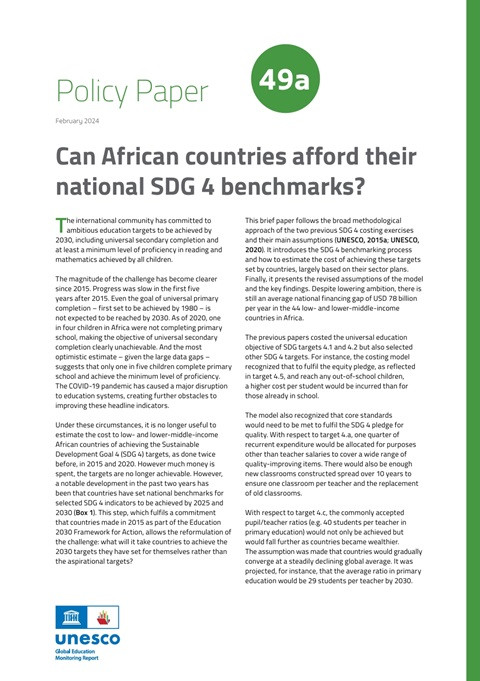 Can African Countries Afford Their National SDG 4 Benchmarks? Année de publication: 2024 Auteur institutionnel: UNESCO | Global Education Monitoring Report Team This brief paper follows the broad methodological approach of the two previous SDG 4 costing exercises and their main assumptions (UNESCO, 2015a; UNESCO, 2020). It introduces the SDG 4 benchmarking process and how to estimate the cost of achieving these targets set by countries, largely based on their sector plans. Finally, it presents the revised assumptions of the model and the key findings. Despite lowering ambition, there is still an average national financing gap of USD 78 billion per year in the 44 low- and lower-middle-income countries in Africa.
 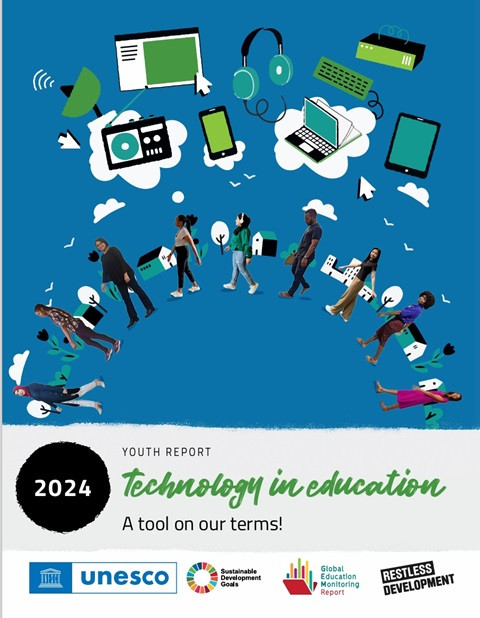 Youth Report 2024: Technology in Education; A Tool on Our Terms! Année de publication: 2024 Auteur institutionnel: UNESCO | Global Education Monitoring Report Team | Restless Development The 2024 Youth Report on technology in education is the result of an extensive consultation process in partnership with Restless Development involving +1500 youth and students across 8 regions. The consultations invited participants to reflect on the key challenges and opportunities for the use of technology in education in their regions through the lenses of the recommendations in the global 2023 Global Education Monitoring Report on technology in education: Technology on our terms. The discussions centred on the need for the use of technology in education to be appropriate for national and local contexts and to be equitable and leave no one behind. The report calls for decisions about technology in education to keep learners at the centre when deciding whether the use of technology in education would be appropriate, equitable, evidence-based, and sustainable. Through this report, young people have described what technology on their terms would look like. It concludes with a call to action calling which highlights concrete recommendations that governments can follow to ensure that technology in education is on youth terms.
  Assessment for Advocacy to Transform Communities, Programmes and Policies in the Global South Année de publication: 2024 Auteur institutionnel: UNESCO | Global Education Monitoring Report Team | PAL Network This paper was commissioned by the Global Education Monitoring Report as background information to assist in drafting the 2024 Spotlight Report on basic education completion and foundational learning in Africa. It has not been edited by the team. The views and opinions expressed in this paper are those of the author(s) and should not be attributed to the Global Education Monitoring Report or to UNESCO. The papers can be cited with the following reference: “Paper commissioned for the 2024 Spotlight Report on basic education completion and foundational learning in Africa”.
 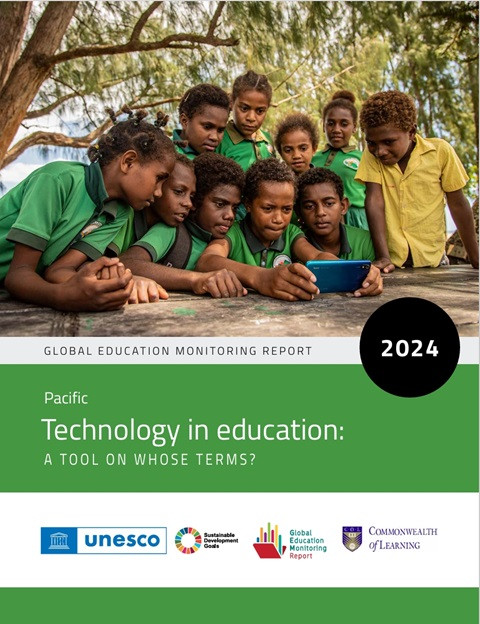 Global Education Monitoring Report 2024, Pacific: Technology in Education; A Tool on Whose Terms? Année de publication: 2024 Auteur institutionnel: UNESCO | Global Education Monitoring Report Team | Commonwealth of Learning Information transmission and connectivity is crucial in the Pacific, a region characterized by high geographic dispersion. While the application of ICT in education has significant potentials, it is hindered by the region's limited and costly infrastructure. This edition accompanies the 2023 Global Education Monitoring Report, which acknowledges technology as a useful tool but invites the education community to question on whose terms it is deployed. The report considered four key policy areas of the Pacific Regional Education Framework (PacREF) (2018–2030): In terms of quality and relevance, mobile technology has offered an affordable and flexible approach to learning, and social media have improved communication between institutions, parents and learners. Moodle is the most widely used digital platform in the region. Textbooks are being digitalised and digital resources made available. Yet content is not always developed or adapted to local languages and cultural contexts. Open and distance learning has historically expanded learning pathways in the Pacific, specially in higher education and as a response to natural hazards. The University of South Pacific is a leading example of open and distance learning connecting campus across 12 countries. With the aim to enhance student outcomes and well-being, efforts have been made to incorporate digital skills into curricula and initiatives have increased outside formal education. Yet regulations do not adequately address threats from the use of technology to privacy, safety and well-being. With a focus on the teaching profession, countries leverage technology to provide training opportunities and transform the teaching profession. However, ICT training varies greatly across the region and limited digital infrastructure hinders technology integration into classrooms and teacher training. Three conditions need to be met for technology's potential to be fulfilled: equitable access to technology, appropriate governance and regulation, and sufficient teacher capacity. Supporting this publication is seven background thematic studies that provide a comprehensive overview of education technology issues; Commonwealth of Learning’s short case studies on some of its projects; a survey administered to key informed respondents from the region; and a series of country profiles on PEER, a policy dialogue resource describing policies and regulations related to technology in the region’s education systems.
 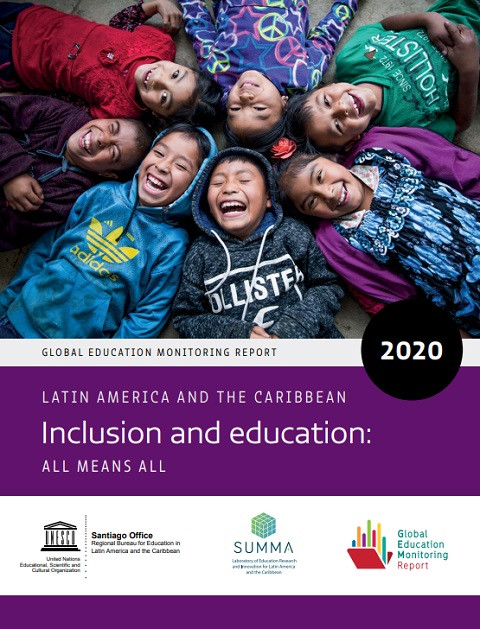 Latin America and the Caribbean 2020: Inclusion and Education; All Means All (Global Education Monitoring Report) Année de publication: 2020 Auteur institutionnel: Global Education Monitoring Report Team | UNESCO | Laboratory of Education Research and Innovation for Latin America and the Caribbean (SUMMA) Latin America and the Caribbean has the largest and most challenging socio-economic inequalities in the world, which have shaped its education systems over the decades. This report looks at everyone both in and excluded from education in the region, pinpointing barriers facing learners, especially when multiple disadvantages intersect. The report also explores challenges in education posed by COVID-19 and the need for urgent action to prevent an exacerbation of inequalities. Produced by the Global Education Monitoring (GEM) Report team, in partnership with the UNESCO Regional Bureau for Education in Latin America and the Caribbean (OREALC) and the Laboratory of Education Research and Innovation for Latin America and the Caribbean (SUMMA), the report assesses key solutions for greater inclusion through several case studies from the region. It provides in-depth analysis on challenges to inclusion in education arising from migration and displacement in Colombia and Costa Rica; remoteness in Brazil and Suriname; disability in Cuba and Nicaragua; gender in Peru and Jamaica; sexual orientation, gender identity and expression in Chile and Mexico; poverty in the Dominican Republic and Honduras; ethnicity in Bolivia and Ecuador; and incarceration in El Salvador and Uruguay. Building on the 2020 Global Education Monitoring Report, this regional edition concludes that strong laws and policies in Latin America and the Caribbean demonstrate a commitment to inclusion, but that the daily realities faced by learners suggest implementation is lagging. Recommendations are aimed at promoting more inclusive education systems to benefit all children and youth, no matter their background, identity or ability. The recommendations provide a systematic framework for identifying and dismantling barriers for vulnerable populations, according to the principle that ‘every learner matters and matters equally’. América Latina y el Caribe 2020: Inclusión y educación; Todos y todas sin excepción (Informe de seguimiento de la educación en el mundo) Année de publication: 2020 Auteur institutionnel: Global Education Monitoring Report Team | UNESCO | Laboratory of Education Research and Innovation for Latin America and the Caribbean (SUMMA) América Latina y el Caribe es la región con las mayores y más tenaces desigualdades socioeconómicas del mundo. Durante decenios estas desigualdades se han reflejado en sus sistemas educativos. El presente informe examina a quiénes incluyen y a quiénes excluyen estos sistemas y llama la atención sobre las barreras que enfrentan los educandos, especialmente cuando están expuestos a múltiples desventajas. El informe también explora los nuevos retos educativos que plantea la pandemia de la Covid-19 y la necesidad de actuar sin dilación para evitar que se agraven las desigualdades. El informe, elaborado por el equipo del Informe de Seguimiento de la Educación en el Mundo (Informe GEM), en colaboración con la Oficina Regional de Educación para América Latina y el Caribe (OREALC/ UNESCO Santiago) y el Laboratorio de Investigación e Innovación en Educación para América Latina y el Caribe -SUMMA, evalúa algunas de las principales iniciativas emprendidas para mejorar la inclusión, basándose en varios estudios de casos de la región. Analiza en profundidad algunos ejemplos de los grandes desafíos que amenazan la inclusión en la educación: migración y desplazamiento en Colombia y Costa Rica; aislamiento rural en el Brasil y Suriname; discapacidad en Cuba y Nicaragua; discriminación de género en el Perú y Jamaica; orientación sexual e identidad y expresión de género en Chile y México; pobreza en la República Dominicana y Honduras; etnicidad en Bolivia y el Ecuador; y jóvenes en situación de privación de libertad en El Salvador y el Uruguay. Esta edición regional del Informe de Seguimiento de la Educación en el Mundo 2020 concluye que, si bien las leyes y políticas de América Latina y el Caribe demuestran la firme determinación de promover la inclusión, la realidad cotidiana de los alumnos y las alumnas sugiere que la aplicación práctica lleva retraso. Se formulan recomendaciones con el objeto de promover sistemas de educación más inclusivos en beneficio de todos los niños, niñas y jóvenes, sin distinción de origen, identidad o capacidad. Las recomendaciones brindan un marco sistemático que permite identificar y eliminar barreras para las poblaciones marginadas, conforme al principio de que “cada alumno es importante y todos los alumnos importan por igual”.