
Ressources
Explorez une large gamme de ressources sur le GCED afin d’approfondir votre compréhension et de renforcer vos activités de recherche, de plaidoyer, d’enseignement et d’apprentissage.
288 résultats trouvés
 Principes directeurs de l'UNESCO pour l'éducation interculturelle Année de publication: 2006 Auteur institutionnel: Organisation des Nations Unies pour l'éducation, la science et la culture (UNESCO) These Guidelines have been prepared as a contribution to the understanding of the issues around intercultural education. They draw together the key standard-setting instruments and the results of numerous conferences, in particular, the Expert Meeting held at UNESCO Headquarters in March 2006, in order to present those concepts and issues which may be used to guide future activities and policy making in this area. The document refl ects UNESCO’s unique role as international standard setter and convenor of diverse cultural and ideological perspectives. Kit pédagogique pour les pays situés en zones montagneuses: une approche créative de l'éducation à l'environnement Année de publication: 2010 Auteur: Thomas Schaaf Auteur institutionnel: Organisation des Nations Unies pour l'éducation, la science et la culture (UNESCO) Entitled: A Teaching Resource Kit for Mountain Countries, it is a new environmental education kit similar to the Teaching Resource Kit for Dryland Countries published by UNESCO in 2008. It is based on the same innovative approach appealing to the creativity and artistic sensibility of pupils aged around 10 to 15, and is intended for secondary-school (and late primary-school) teachers and their pupils, this time living in mountain ecosystems, where climate and environmental conditions are harsh, often varying between extremes, and which are subject to the problems of erosion. As an educational tool, the kit offers a practical and attractive way of helping teachers and their pupils towards a better understanding of the environmental problems of their region and to stimulate their quest for possible solutions. In this respect, its content is a further contribution to the United Nations General Assembly’s resolution proclaiming 2002 the International Year of Mountains and is also consistent with the activities developed as part of the United Nations Decade of Education for Sustainable Development (2005-2014), the promotion of which is UNESCO’s responsibility. Kit pédagogique pour les pays situés en zones sèches: une approche créative de l'éducation à l'environnement Année de publication: 2007 Auteur: Thomas Schaaf Auteur institutionnel: UNESCO Entitled A Creative Approach to Environmental Education/Teaching Resource Kitfor Dryland Countries, the kit is intended for secondary-school teachers in countries affected by desertification and is based on an innovative approach appealing to the creativity and artistic sensibility of pupils aged 10 to 15 years. This approach favours discovery of the environment through the senses, and emphasizes the visual and exploratory aspects of environmental study. The idea of using creativity and artistic sensibility to promote ecological awareness may in the future become a source of collaboration to be explored in detail by the different sectors of UNESCO. L'Education au Changement Climatique en vue du Développement Durable: l'Initiative de l'UNESCO pour Faire Face au Changement Climatique Année de publication: 2010 Auteur institutionnel: UNESCO The UNESCO Climate Change Initiative was launched by Director-General Irina Bokova in Copenhagen during the 15th Conference of the Parties to the UN Framework Convention on Climate Change (UNFCCC COP15). It seeks to reinforce the scientific, mitigation and adaptation capacities of countries and communities that are most vulnerable to the effects of climate change. It focuses on a select number of strategic issues in line with The UN System Delivering as One on Climate Change action plan and The UNESCO Strategy for Action on Climate Change. The Initiative is based on four thematic areas: scientific, educational, environmental and ethical. Key objectives will be achieved through intersectoral and interdisciplinary cooperation, coordinated field activities, and networking. Special attention is given to UNESCO’s two global priorities, Africa and gender equality, as well as to the increased vulnerability of Small Island Developing States (SIDS). The UN System “Delivering as One” on Climate Change During the 13th session of the Conference of Parties to the UNFCCC in Bali, Indonesia, UN Secretary General Ban Ki-Moon presented an unprecedented coordination effort to bring together all the diverse perspectives, expertise and strengths of the UN system so as to deliver as one in the critical area of climate change. The initiative brings together expertise and ongoing work in diverse areas ranging from science and technology to agriculture, transport, forestry and disaster risk reduction, to address both mitigation and adaptation. It brings together the normative, standard setting and knowledge sharing capacities of the system with its operational reach in order to support the most vulnerable. The overall objective is to maximize existing synergies, eliminate duplication and overlap, and optimize the impact of the collective effort of the UN system. To ensure better coordination, convening responsibilities were assigned to UN system entities with a large volume of activities in the five focus areas and four cross-cutting areas. Focus areas ㆍAdaptation – High-Level Committee on Programmes collectively ㆍ Technology transfer – UNIDO, UN-DESA ㆍReduction of emissions from deforestation and degradation (REDD) – UNDP, FAO, UNEP ㆍ Financing mitigation and adaptation action – UNDP, World Bank Group ㆍCapacity building – UNDP, UNEP Cross-cutting areas ㆍClimate knowledge: science, assessment, monitoring and early warning – WMO, UNESCO ㆍSupporting global, regional and national action – UN-DESA, UN Regional Commissions, UNDP ㆍClimate-neutral UN – UNEP ㆍPublic awareness – UNCG, UNEP. Éducation sur droits de l'homme: les chiffres d'apprentissage! Année de publication: 2006 Auteur institutionnel: Organisation des Nations Unies pour l'éducation, la science et la culture (UNESCO) Cette affiche a été initialement publié en 2006 et réédité pour l'UNESCO Works pour les droits de l'homme: une exposition d'affiches sur la rue, tenue à l'UNESCO, Paris, le 2 Décembre 2008 au 27 Février de 2009. The round table: putting human rights into practice-the role of education; report Année de publication: 2008 Auteur institutionnel: Organisation des Nations Unies pour l'éducation, la science et la culture (UNESCO) Cette publication met en lumière quelques-unes des idées et des caractéristiques des événements clés sur le thème "60 ans d'Éducation aux Droits de l’Homme" au siège de l'UNESCO à Paris du 2 Décembre 2008 au 27 Février 2009. En plus importante ouverture et de fermeture sessions, la Table Ronde se composait de quatre panneaux, les rapports de chaque compose de Résumé, Introduction, Étude de Cas, Discussion et Recommandations. Cette publication peut être lue sur un certain nombre de niveaux: comme une commémoration rétrospective de l'éducation des droits de l'homme; comme une célébration de la bonne pratique actuelle; et, à travers la discussion et des recommandations, comme une source de conseils pour les orientations futures en matière d'éducation droit humain. Déclaration d'Aichi-Nagoya sur l'Education au Développement Durable Année de publication: 2014 Auteur institutionnel: UNESCO We, the participants of the UNESCO World Conference on Education for Sustainable Development held in AichiNagoya, Japan, from 10 to 12 November 2014, adopt this Declaration and call for urgent action to further strengthen and scale up Education for Sustainable Development (ESD), in order to enable current generations to meet their needs while allowing future generations to meet their own, with a balanced and integrated approach regarding the economic, social and environmental dimensions of sustainable development. This Declaration recognises that people are at the centre of sustainable development and builds on the achievements of the United Nations (UN) Decade of ESD (2005-2014); the deliberations of the UNESCO World Conference on ESD in Aichi-Nagoya; and the Stakeholder Meetings held in Okayama, Japan, from 4 to 8 November 2014, namely, UNESCO ASPnet International ESD events, the UNESCO ESD Youth Conference, the Global Regional Centres of Expertise Conference, and other relevant events and consultation processes, including regional ministerial meetings. We express our sincere gratitude to the Government of Japan for hosting the UNESCO World Conference on ESD. Déclaration d'Aichi-Nagoya sur l'Éducation pour le Développement Durable Année de publication: 2014 Auteur institutionnel: UNESCO Développement durable tenu à Aichi Nagoya, au Japon, du 10 au 12 Novembre 2014, adopte la présente Déclaration et appel à une action urgente pour renforcer et intensifier l'éducation pour le développement durable (EDD), afin de permettre aux générations actuelles de répondre à leurs besoins tout en permettant l'avenir générations à répondre à leurs propres, avec une approche équilibrée et intégrée en ce qui concerne les dimensions économiques, sociales et environnementales du développement durable. Cette Déclaration reconnaît que les gens sont au centre du développement durable et se fonde sur les résultats de la Décennie des Nations Unies (ONU) de l'EDD (2005-2014); les délibérations de la conférence mondiale sur EDD UNESCO à Aichi-Nagoya; et les réunions des parties prenantes tenues à Okayama, au Japon, du 4 au 8 Novembre 2014, à savoir, le réseau des écoles associées à l'UNESCO (réSEAU), les événements JED International, la Conférence des jeunes de l'UNESCO sur l'EDD, la Conférence des centres régionaux d'expertise, et d'autres événements pertinents et les processus de consultation, y compris les réunions ministérielles régionales. Nous exprimons notre sincère gratitude au Gouvernement du Japon pour avoir accueilli la Worldconférenceon EDD UNESCO.
 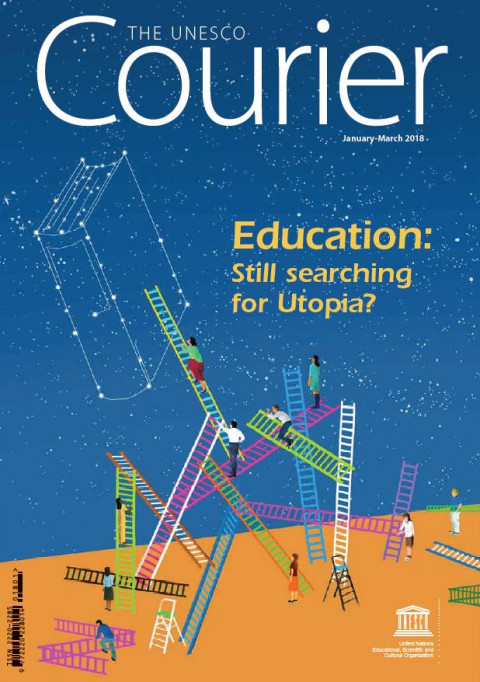 Education: en quête d'une utopie nécessaire (Le Courrier de l’UNESCO no. 1, Janvier-Mars 2018) Année de publication: 2018 Auteur institutionnel: UNESCO À une époque où la tension ne cesse de croître, où les droits de l'homme, la liberté d'expression, la paix et l'avenir de la planète semblent plus que jamais remis en question, le pouvoir de transformation véhiculé par l'éducation revêt une importance cruciale.L’éducation est une « utopie nécessaire », elle est « un atout indispensable pour permettre à l’humanité de progresser vers les idéaux de paix, de liberté et de justice sociale », lit‑on dans le rapport historique de l’UNESCO, L’éducation : un trésor est caché dedans, élaboré par la Commission internationale sur l'éducation pour le XXIe siècle, présidée en 1996 par Jacques Delors.L'éducation n'y est présentée ni comme miracle, ni comme baguette magique, mais comme le meilleur moyen de favoriser un climat permettant à l'humanité de s’améliorer.Notre humanité est confrontée à un paradoxe très étrange : la population mondiale n’a jamais été aussi instruite, alors que, selon l’Institut de statistiques de l’UNESCO, 263 millions d’enfants et de jeunes ne sont pas scolarisés, que 617 millions d’enfants et d’adolescents dans le monde n’atteignent pas le seuil minimal de compétence en lecture et en mathématiques, qu’au moins 750 millions d’adultes sont analphabètes, et que les filles demeurent plus susceptibles que les garçons de ne jamais mettre les pieds dans une classe. Cependant l’éducation est toujours appelée à remédier aux inégalités, à la pauvreté, au terrorisme et aux conflits. Elle est considérée comme une des clés essentielles de la citoyenneté mondiale et du développement durable, deux domaines d’action de l’UNESCO, qui a aussi pour mandat de diriger l’agenda mondial Éducation2030 en veillant tout particulièrement à ce que personne ne soit laissé pour compte.Sous le titre « Éducation : en quête d'une utopie nécessaire », Le Courrier de l'UNESCO porte un regard panoramique sur l'éducation dans le monde et explore comment elle peut répondre à certains grands défis.
 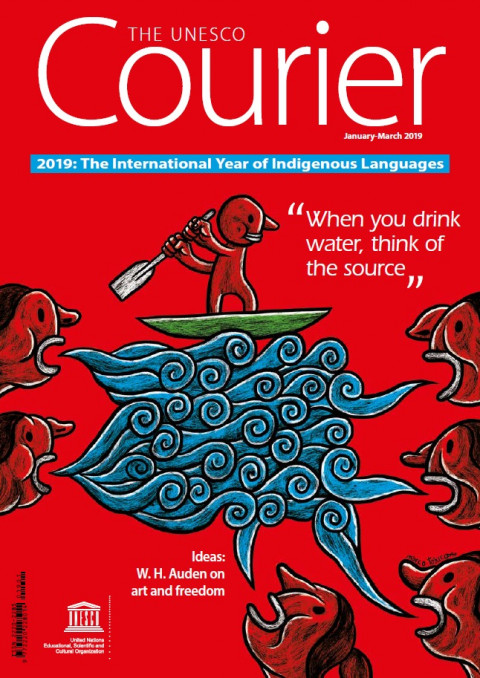 2019 : Année internationale des langues autochtones Année de publication: 2019 Auteur institutionnel: UNESCO À une époque où la tension ne cesse de croître, où les droits de l'homme, la liberté d'expression, la paix et l'avenir de la planète semblent plus que jamais remis en question, le pouvoir de transformation véhiculé par l'éducation revêt une importance cruciale.Avec la désignation de 2019 comme Année internationale des langues autochtones(IYIL2019), lancée officiellement à l’UNESCO le 28 janvier, la communauté internationale réaffirme sa volonté de soutenir les peuples autochtones dans leurs efforts de préserver leurs savoirs et de jouir de leurs droits.Depuis l’adoption de la Déclaration sur les droits des peuples autochtones, par l’Assemblée générale des Nations Unies, le 13 septembre 2007, des avancées considérables ont été faites dans ce sens. Il n’en reste pas moins que les peuples autochtones ont encore un long chemin à parcourir avant de sortir de la marginalisation et de surmonter les nombreux obstacles auxquels ils doivent faire face. Un tiers des personnes qui vivent dans l’extrême pauvreté à travers le monde appartiennent à des communautés autochtones, de même que dans un bon nombre de pays, les législations en faveur des peuples autochtones demeurent incompatibles avec d’autres lois qui traitent notamment de l’agriculture, de la terre, de la conservation et des industries forestières ou minières, selon Victoria Tauli-Corpuz, Rapporteuse spéciale des Nations Unies sur les droits des peuples autochtones. Le dossier Grand angle de ce numéro du Courrier leur est consacré. Il emprunte son titre au proverbe chinois : « Quand tu bois de l’eau, pense à la source », pour rappeler que les savoirs autochtones, source de tous les savoirs, méritent une place prééminente dans la modernité. Il s’associe également à la célébration de la Journée internationale de la langue maternelle, le 21 février.