
Ressources
Explorez une large gamme de ressources sur le GCED afin d’approfondir votre compréhension et de renforcer vos activités de recherche, de plaidoyer, d’enseignement et d’apprentissage.
2 résultats trouvés
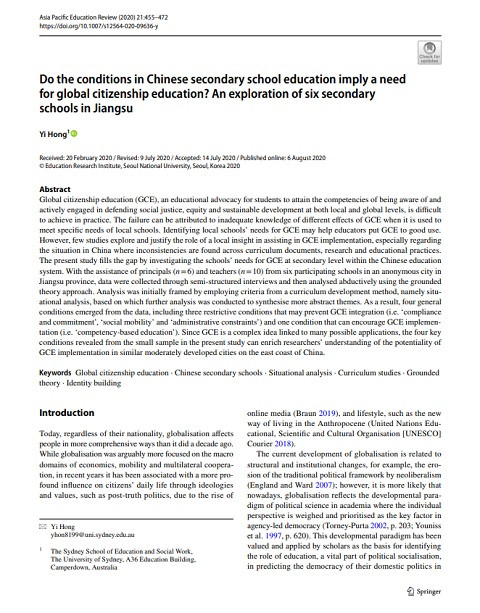 Do the Conditions in Chinese Secondary School Education Imply a Need for Global Citizenship Education? an Exploration of Six Secondary Schools in Jiangsu (Asia Pacifc Education Review; Rev. 21) Année de publication: 2020 Auteur: Yi Hong Auteur institutionnel: Seoul National University. Education Research Institute Global citizenship education (GCE), an educational advocacy for students to attain the competencies of being aware of and actively engaged in defending social justice, equity and sustainable development at both local and global levels, is difficult to achieve in practice. The failure can be attributed to inadequate knowledge of different effects of GCE when it is used to meet specific needs of local schools. Identifying local schools’ needs for GCE may help educators put GCE to good use. However, few studies explore and justify the role of a local insight in assisting in GCE implementation, especially regarding the situation in China where inconsistencies are found across curriculum documents, research and educational practices. The present study fills the gap by investigating the schools’ needs for GCE at secondary level within the Chinese education system. With the assistance of principals (n = 6) and teachers (n = 10) from six participating schools in an anonymous city in Jiangsu province, data were collected through semi-structured interviews and then analysed abductively using the grounded theory approach. Analysis was initially framed by employing criteria from a curriculum development method, namely situational analysis, based on which further analysis was conducted to synthesise more abstract themes. As a result, four general conditions emerged from the data, including three restrictive conditions that may prevent GCE integration (i.e. ‘compliance and commitment’, ‘social mobility’ and ‘administrative constraints’) and one condition that can encourage GCE implementation (i.e. ‘competency-based education’). Since GCE is a complex idea linked to many possible applications, the four key conditions revealed from the small sample in the present study can enrich researchers’ understanding of the potentiality of GCE implementation in similar moderately developed cities on the east coast of China.
 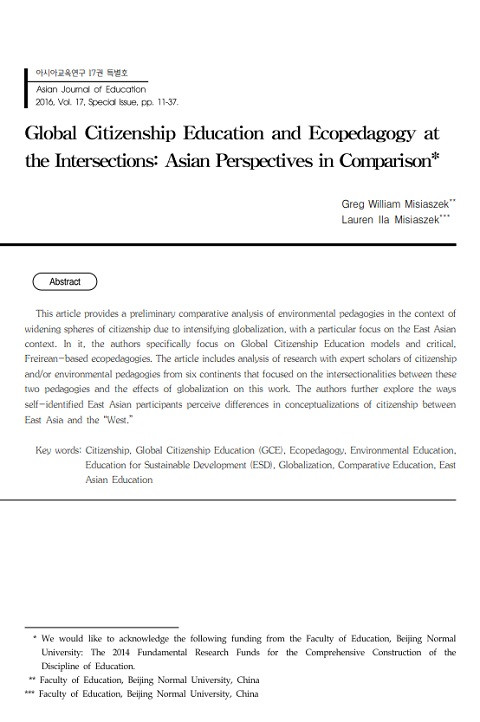 Global Citizenship Education and Ecopedagogy at the Intersections: Asian Perspectives in Comparison (Asian Journal of Education; Vol. 17, Special Issue) Année de publication: 2016 Auteur: Greg William Misiaszek | Lauren Ila Misiaszek Auteur institutionnel: Seoul National University. Education Research Institute This article provides a preliminary comparative analysis of environmental pedagogies in the context of widening spheres of citizenship due to intensifying globalization, with a particular focus on the East Asian context. In it, the authors specifically focus on Global Citizenship Education models and critical, Freirean-based ecopedagogies. The article includes analysis of research with expert scholars of citizenship and/or environmental pedagogies from six continents that focused on the intersectionalities between these two pedagogies and the effects of globalization on this work. The authors further explore the ways self-identified East Asian participants perceive differences in conceptualizations of citizenship between East Asia and the “West.”