
Ressources
Explorez une large gamme de ressources sur le GCED afin d’approfondir votre compréhension et de renforcer vos activités de recherche, de plaidoyer, d’enseignement et d’apprentissage.
804 résultats trouvés
 Ensuring the right to equitable and inclusive quality Education: results of the ninth consultation of Member States on the implementation of the UNESCO Convention and Recommendation against Discrimination in Education Année de publication: 2017 Auteur institutionnel: UNESCO The Convention and Recommendation against Discrimination in Education reflect UNESCO’s constitutional mission of instituting collaboration among nations to ‘advance the ideal of equality of educational opportunities without regard to race, sex, or any distinctions, economic or social.’ The purpose of these instruments, recently recognized as a cornerstone of the Education 2030 Agenda, is not only the elimination of discrimination in education, but also the adoption of concrete measures aimed at promoting equality of opportunities and treatment in this field. They cover the right to education comprehensively. The purpose of reporting is to illustrate the steps taken to implement the instruments, the progress made and the difficulties encountered by Member States. Eight Member State consultations have been conducted on the measures taken for the implementation of the 1960 Convention and Recommendation since the adoption of these instruments by the General Conference of UNESCO. Each of the consultations led to a global report containing the results of the consultation for submission to the UNESCO Executive Board’s Committee on Conventions and Recommendations and for consideration by the General Conference.
  [Summary] Accountability in Education: Meeting Our Commitments: Global Education Monitoring Report Summary, 2017/8 Année de publication: 2017 Auteur institutionnel: UNESCO This summary of the 2017/8 GEM Report shows the entire array of approaches to accountability in education. It ranges from countries unused to the concept, where violations of the right to education go unchallenged, to countries where accountability has become an end in itself instead of a means to inclusive, equitable and high-quality education and lifelong learning for all.The report emphasizes that education is a shared responsibility. While governments have primary responsibility, all actors – schools, teachers, parents, students, international organizations, private sector providers, civil society and the media – have a role in improving education systems. The report emphasizes the importance of transparency and availability of information but urges caution in how data are used. It makes the case for avoiding accountability systems with a disproportionate focus on narrowly defined results and punitive sanctions. In an era of multiple accountability tools, the report provides clear evidence on those that are working and those that are not.
 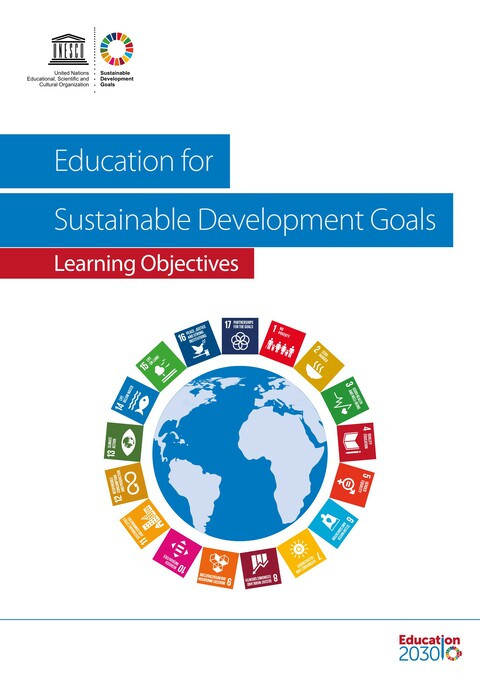 Education for Sustainable Development Goals: Learning Objectives Année de publication: 2017 Auteur institutionnel: UNESCO UNESCO has been promoting Education for Sustainable Development (ESD) since 1992. It led the UN Decade for ESD from 2005 to 2014 and is now spearheading its follow-up, the Global Action Programme (GAP) on ESD. The momentum for ESD has never been stronger. Global issues – such as climate change – urgently require a shift in our lifestyles and a transformation of the way we think and act. To achieve this change, we need new skills, values and attitudes that lead to more sustainable societies. Education systems must respond to this pressing need by defining relevant learning objectives and learning contents, introducing pedagogies that empower learners, and urging their institutions to include sustainability principles in their management structures. The new 2030 Agenda for Sustainable Development clearly reflects this vision of the importance of an appropriate educational response. Education is explicitly formulated as a stand-alone goal – Sustainable Development Goal 4. Numerous educationrelated targets and indicators are also contained within other Sustainable Development Goals (SDGs). Education is both a goal in itself and a means for attaining all the other SDGs. It is not only an integral part of sustainable development, but also a key enabler for it. That is why education represents an essential strategy in the pursuit of the SDGs. This publication is designed as a guide for education professionals on the use of ESD in learning for the SDGs, and consequently to contribute to achieving the SDGs. The guide identifies indicative learning objectives and suggests topics and learning activities for each SDG. It also presents implementation methods at different levels, from course design to national strategies. The guide does not aim to be prescriptive in any way, but to provide guidance and suggestions that educators can select and adapt to fit concrete learning contexts
 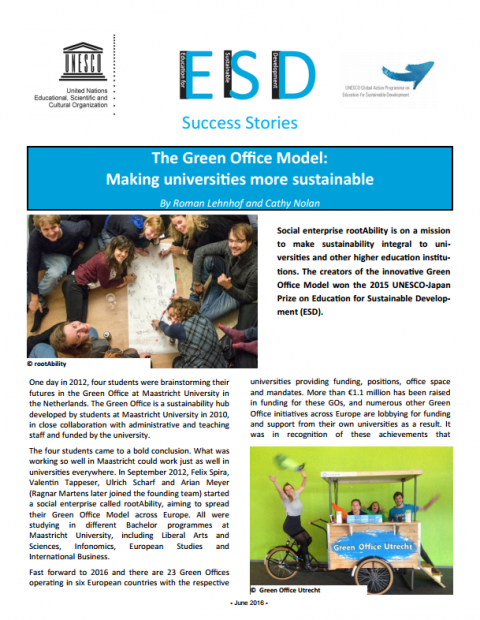 The Green office model: making universities more sustainable Année de publication: 2016 Auteur: Roman Lehnhof | Cathy Nolan Auteur institutionnel: UNESCO ESD Success Stories are showcasing compelling stories with a personal/human dimension from all five UNESCO regions (Africa, Arab States, Asia and Pacific, Europe & North America and Latin America & the Caribbean). The stories illustrate the wide diversity of ESD approaches and initiatives taking place in different parts of the world. They show how involvement with ESD has changed the lives of specific individual persons and how they have become more active in their community. Each story centers on one individual or a group of individuals.The rootAbility, a social enterprise, is planned by four students at Maastricht University, aiming to spread Green Office Model across Europe. The Green Office can effectively drive a dynamic sustainability process in universities and other institutions of higher education by collaboratively working with students and university staffs and integrating sustainability into university’s teaching and research.
  Incheon Declaration: Education 2030: Towards inclusive and equitable quality education and lifelong learning for all Année de publication: 2015 Auteur institutionnel: UNESCO The "Incheon Declaration: Education 2030: Towards inclusive and equitable quality education and lifelong learning for all" was signed and adopted at the end of the World Education Forum 2015 (WEF 2015) by over 130 Education Ministers and more than 1500 participants. The Declaration marks an important step in the development of international education policy, continuing the Education for All (EFA) movement started in Jomtien in 1990 and formalized in Dakar in 2000. The Declaration also reaffirms the commitment to realize the SDG4, “Ensure inclusive and equitable quality education and promote life-long learning opportunities for all” and the willingness to invest efforts on access, equity and inclusion, quality and learning outcomes, within a lifelong learning approach.
 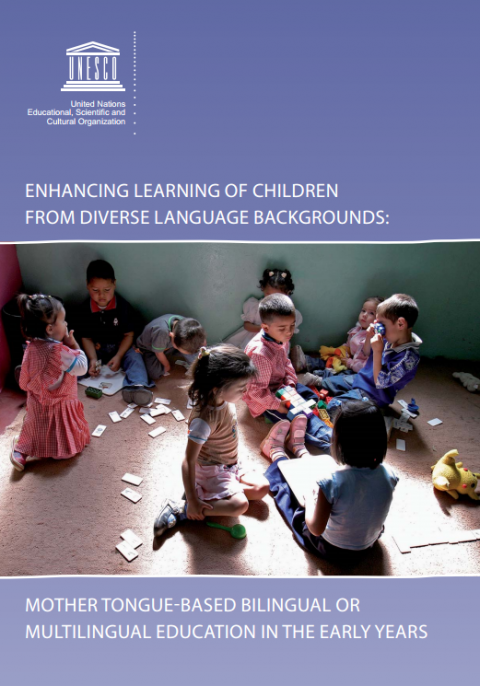 Enhancing learning of children from diverse language backgrounds: mother tongue-based bilingual or multilingual education in the early years Année de publication: 2011 Auteur: Jessica Ball Auteur institutionnel: UNESCO This literature review discusses mother tongue based bilingual or multilingual education for children starting in early childhood. The report: (1) informs policy-makers of existing research and practices in mother-tongue instruction in early childhood and early primary school years; and (2) raises awareness of the value of maintaining the world’s languages and cultures by promoting and resourcing mother tongue-based education for young children. This analysis of current literature is framed within UNESCO’s mandate and strong commitment to quality education for all and to cultural and linguistic diversity in education (UNESCO, 2003a). This discussion is especially timely, given the slow and uneven progress (UNESCO, 2000) in meeting international targets for universal education articulated in the Education for All Goals 1 (ECCE), Goal 2 (Primary Education), and Goal 6 (Quality of Education) (World Declaration on Education for All, 1990).1 Impetus for the current report is provided by the UNESCO (2008a) ‘Global Monitoring Report on Education for All: Will we make it?’ The 2008 GMR report calls for unwavering political will to ensure that education from early childhood onwards is a priority of national governments, civil society and the private sector in order to ensure educational inclusion for the 72 million children out of school and to reduce the numbers of young learners who leave school without acquiring essential skills and knowledge. The report calls for increased investments in the provision of pre-primary education for children aged 3 and above, and for policy measures to provide care and education to children below age 3. UNESCO (2007a) emphasizes the role of early childhood care and development in laying the foundation for learning and setting the stage for successful engagement in formal education. UNESCO has encouraged mother tongue instruction in early childhood and primary education since 1953 (UNESCO, 1953). Yet, monolingualism in official or dominant languages is still the norm around the world (Arnold, Bartlett, Gowani, & Merali, 2006; Wolff & Ekkehard, 2000). In its report, ‘Strong Foundations: Early Childhood Care and Education’, UNESCO (2007a) points out the overlooked advantages of multilingual education in the early years. When children are offered opportunities to learn in their mother tongue, they are more likely to enrol and succeed in school (Kosonen, 2005) and their parents are more likely to communicate with teachers and participate in their children’s learning (Benson, 2002). Mother tongue based education especially benefits disadvantaged groups, including children from rural communities (Hovens, 2002), and girls, who tend to have less exposure to an official language and tend to stay in school longer, achieve better, and repeat grades less oft en when they are taught in their mother tongue (UNESCO Bangkok, 2005).
  Regional overview: Latin America and the Caribbean Année de publication: 2011 Auteur institutionnel: UNESCO The past decade has seen mixed progress towards Education for All (EFA) in Latin America and the Caribbean. More children are participating in pre-school education, many countries have achieved universal primary education and more students are moving from primary to secondary education. Gender parity has been achieved at the primary level in the majority of countries and adult literacy rates are improving. The region invests a relatively high share of national income in education and external aid to basic education has increased in recent years. However, challenges remain. The Caribbean has seen a decline by nearly one-tenth in primary enrolment ratios and 2.9 million children were not enrolled in school in the region as a whole in 2008. Some 36 million adults are still illiterate and levels of learning achievement are low in many countries. The 2011 EFA Global Monitoring Report puts the spotlight on armed conflict and one of its most damaging yet least reported consequences: its impact on education. Conflict-affected states have some of the world’s worst indicators for education. The Report documents the scale of this hidden crisis in education, looks at its underlying causes and explores the links between armed conflict and education. It also presents recommendations to address identified failures that contribute to the hidden crisis. It calls on governments to demonstrate greater resolve in combating the culture of impunity surrounding attacks on schoolchildren and schools, sets out an agenda for fixing the international aid architecture and identifies strategies for strengthening the role of education in peacebuilding.
  Education for All (EFA) in Latin America and the Caribbean: Assessment of Progress and Post-2015 Challenges, 30-31 October 2014, Lima, Peru: Lima Statement Année de publication: 2014 Auteur institutionnel: UNESCO The Ministers of Education of Latin America and the Carribean (LAC), high-level government officials, UN agencies, representatives of civil society organizations and development partners, gathered at th meeting on "Education for All (EFA) in Latin America and the Carribean: Assessment of progress and post-2015 challenges", in Lima, Peru, from 30 to 31 October 2014. Having deliberated on progress towards EFA in the region, the Muscat Agreement adopted at the Global EFA Meeting (GEM) in Muscat, Oman, 12-14 May 2014, and the outcome document of the UN General Assembly Open Working Group for Sustainable Development Goals, and having examined the unfinished EFA tasks in the region, as well as the challenges and priorities that will configure the post-2015 education agenda for the region, the Lima Statement was adopted.
  The Influence of education on conflict and peace building Année de publication: 2010 Auteur: Alan Smith Auteur institutionnel: UNESCO The purpose of this paper is to identify aspects of education that may have a positive influence on the dynamics of conflict or make a contribution to peacebuilding. The UN Secretary-General’s (2009) report on peacebuilding identifies a number of recurring priorities in conflict-affected situations, ‘establishing security, building confidence in a political process, delivering initial peace dividends and expanding core national capacity’. These priorities include ‘the provision of basic services, such as water and sanitation, health and primary education’. However, in conflict-affected situations education is also about more than service delivery because it is a means of socialization and identity development through the transmission of knowledge, skills, values and attitudes across generations. Education may therefore be a driver of conflict (fuelling grievances, stereotypes, xenophobia and other antagonisms), but can also be a way of contributing to ‘conflict transformation’ and ‘peacebuilding’.
 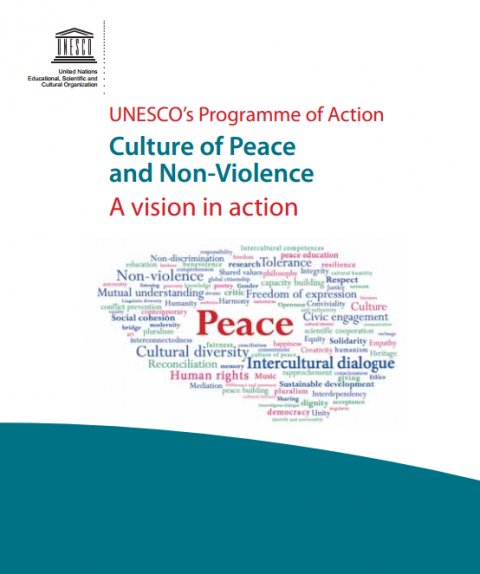 UNESCO's programme of action: culture of peace and non-violence, a vision in action Année de publication: 2013 Auteur institutionnel: UNESCO This document builds upon the experience and resources of the Intersectoral Platform for a Culture of Peace and Non-Violence and has benefited from the contribution of Professor Arjun Appadurai. This document shows the UNESCO's mission; Buidling the defences of peace in the minds of men and women and Culture of peace and Non-violence which is positive values, attitudes and behaviours for everyday peace. This document pointed out today's multiple crisis, and then introduced the programme of action on a culture of peace and non-violence. After drew the UNESCO's strategies, UNESCO's peace activities were followed.