
Ressources
Explorez une large gamme de ressources sur le GCED afin d’approfondir votre compréhension et de renforcer vos activités de recherche, de plaidoyer, d’enseignement et d’apprentissage.
792 résultats trouvés
 Issues and Trends in Education for Sustainable Development Année de publication: 2018 Auteur: Alexander Leicht | Julia Heiss | Wonjung Byun Auteur institutionnel: UNESCO Education for Sustainable Development (ESD) is globally acknowledged as a powerful driver of change, empowering learners to take the decisions and actions needed to build a just and economically viable society respectful of both the environment and cultural diversity.This publication comes at a moment of heightened global interest in addressing sustainability challenges through education in order to achieve the targets of the 2030 Sustainable Development Agenda. ESD is not only recognized as a key enabler of sustainable development but an integral element of all quality education. By exploring key issues related to ESD policy and practice, UNESCO aims to help accelerate the reorientation of education towards achieving a sustainable and resilient world.
  International Task Force on Teachers for Education 2030 Strategic Plan 2018–2021 Année de publication: 2018 Auteur institutionnel: UNESCO With the end of the EFA era, the TTF has decided to articulate its activities around the newly adopted international education goals. The Strategic Plan 2018–2021 builds on the Sustainable Development Goals (SDGs), especially the SDG 4.c target on teachers, and the Education 2030 Incheon Declaration and Framework for Action adopted in 2015.
  Sustainability Education Principal Training Manual Année de publication: 2012 Auteur institutionnel: UNESCO | Beijing Sustainable Development Education Association | China National Council for Sustainable Development Education Secretariat This article is devoted to explaining the application of sustainable development in China.
 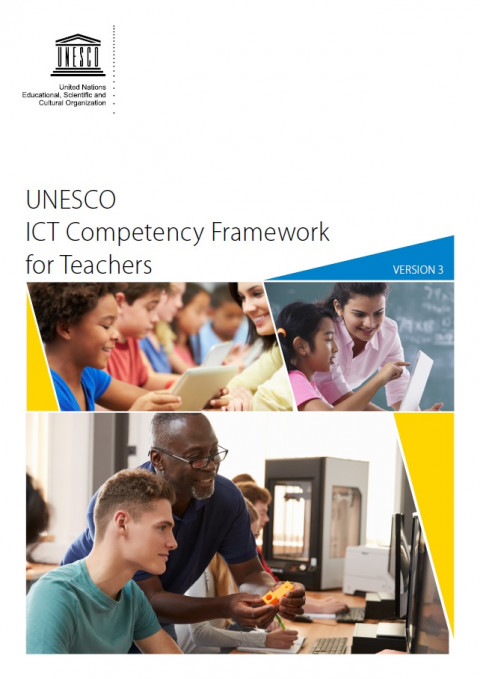 UNESCO ICT Competency Framework for Teachers (ver.3) Année de publication: 2018 Auteur institutionnel: UNESCO UNESCO has developed the ICT Competency Framework for Teachers (ICT CFT) as a tool to guide pre- and in-service teacher training on the use of ICTs across the education system. The ICT CFT is intended to be adapted to support national and institutional goals by providing an up-to-date framework for policy development and capacity building in this dynamic area.The ICT Competency Framework for Teachers (ICT CFT) Version 3 is a response to recent technological and pedagogical developments in the field of ICT and Education, and incorporates in its structure inclusive principles of non-discrimination, open and equitable information accessibility and gender equality in the delivery of education supported by technology. It addresses the impacts of recent technological advances on education and learning, such as Artificial Intelligence (AI), Mobile Technologies, the Internet of Things and Open Educational Resources, to support the creation of inclusive Knowledge Societies. The ICT CFT provides a comprehensive set of competencies teachers need to integrate ICT into their professional practice in order to facilitate students’ achievement of curricular objectives. Strong political commitments and sustained investment in teacher education, and concerted actions between pre- and in-service teacher trainings form the foundation of the successful implementation of this Framework as it is contextualized to national and institutional goals. For this reason, this document underlines the importance of steadfast commitment to supporting teachers’ continuous professional development including through ICT, and includes examples to illustrate how ICT CFT could be used to facilitate teachers’ development in diverse contexts. We look forward to strengthening our collaboration with all stakeholders everywhere to leverage ICT to develop the skills required to thrive within the fast-changing inclusive Knowledge Societies.
  Strengthening the Rule of Law Through Education: A Guide for Policymakers Année de publication: 2019 Auteur institutionnel: UN. Office on Drugs and Crime (UNODC) | UNESCO The new joint publication by UNESCO and UNODC Strengthening the Rule of Law through Education: A Guide for Policymakers explores the role that education institutions can play in promoting the rule of law and building new forms of engagement based on global citizenship, human rights and inclusion -- all of which are vital to take forward the Sustainable Development Goal 4 on education, at the heart of the 2030 Agenda for Sustainable Development. Strengthening the Rule of Law through Education: A Guide for Policymakers is intended for education policymakers and other professionals working in the formal education sector, within and outside Ministries of Education, and who are seeking to promote the rule of law and a culture of lawfulness.The guide may also be of interest to professionals working in non-formal education settings or other sectors – namely the justice, social and health sectors - in the area of crime and violence prevention, who are seeking to work more closely with the education sector. In particular, the guide offers:An explanation of key concepts, such as the rule of law and a culture of lawfulness, as well as outlining the role of education in upholding and promoting the rule of law; Guidance on how the education sector is able to strengthen and promote the rule of law, for instance, by speaking to the real learning needs of children and youth, and by ensuring that places of learning “practice what they preach”; A map of the necessary support systems needed to strengthen the rule of law at the school and classroom levels and outside formal education settings, including curricular support, classroom pedagogies, teacher training and development and school-family-community partnerships.
 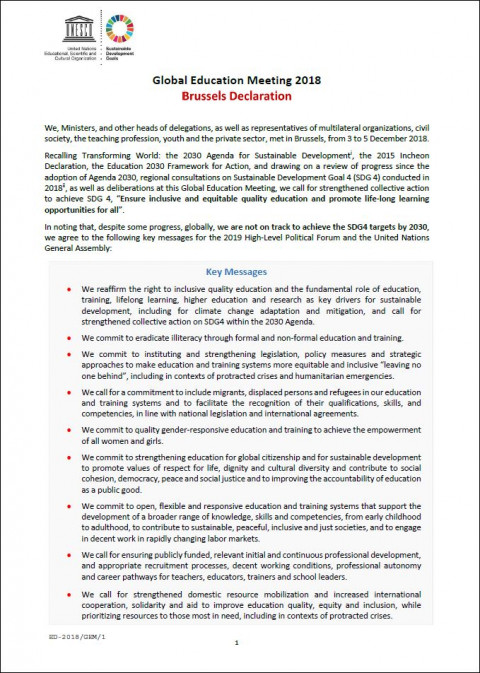 Global Education Meeting 2018: Brussels Declaration Année de publication: 2018 Auteur institutionnel: UNESCO Ministers, and other heads of delegations, as well as representatives of multilateral organizations, civil society, the teaching profession, youth and the private sector, met in Brussels, from 3 to 5 December 2018. This document describes key messsages and commitments for the 2019 High-Level Political Forum and the United Nations General Assembly.
  The Intersections Between Education, Migration and Displacement are not gender-neutral (Global Education The Intersections between Education, Migration and Displacement Monitoring Report, 2019) Année de publication: 2019 Auteur institutionnel: UNESCO The 2019 Global Education Monitoring Report emphasized the need to include migrants and refugees in national education systems, and also called for more planning to respond to the needs of these populations. As this short review has outlined, many of these needs have gender dimensions. These range from the vulnerability of rural‑to‑urban migrant girls who end up as domestic workers deprived of education opportunities to the vulnerability of refugee boys, often unaccompanied, who have limited opportunities to develop their skills. They encompass the deskilling of international migrant women in the ‘global care chain’ as well as the increasing chore burden that left‑behind girls face when a parent migrates.Still, research on the experiences of girls and women or boys and men in migration and displacement contexts – and how these can be affected by education – remains limited. More analysis on the intersection of gender, education, migration and displacement is needed on a wide variety of issues, including the gender-specific dimensions of remittance use, gender-responsive teaching practices and the empowerment impact of non-formal education opportunities. To fulfil their potential for instilling resilience, education systems need to recognize these needs and respond to them.
  Preventing Violent Extremism through Education: Effective Activities and Impact; Policy Brief Année de publication: 2018 Auteur institutionnel: UNESCO Since 2015, UNESCO has driven forward the importance of education in preventing violent extremism (PVE-E) in the framework of its efforts to advance Global Citizenship Education (GCED). Despite the growing number of PVE-E activities globally, there is a lack of evidence on their effectiveness and impact.This Policy Brief seeks to provide answers to two questions: (i) What types of PVE-E activities tend to be more effective in having impact? and (ii) What is the proven impact of PVE-E activities?The aim is to help education stakeholders undertake programmes with stronger positive impact and take evidenced-informed decisions on spending priorities.The Policy Brief shows that PVE-E does work, highlighting various kinds of activities proven to be particularly effective, and recommending ways forward to develop stronger evidence on what works and does not.
  Guidebook on Education for Sustainable Development for Educators: Effective Teaching and Learning in Teacher Education Institutions in Africa Année de publication: 2018 Auteur institutionnel: UNESCO The guidebook on Education for Sustainable Development for Educators: Effective teaching and learning in teacher education institutions in Africa has been conceived as a tool to mainstream sustainability into all aspects of teacher education and training with useful information concerning teaching, learning and assessment approaches to help achieve the ESD goals and learning outcomes.
  International Day against Homophobia & Transphobia: Lesson Plan Année de publication: 2014 Auteur institutionnel: UNESCO Each year, the world celebrates the International Day Against Homophobia and Transphobia (IDAHO) on May 17th. During the days surrounding IDAHO, private and public actors, ranging from the United Nations agencies, to city councils, police stations, human rights organiza-tions, individual citizens, schools and others, implement activities to mark the day. The theme of this year’s IDAHO is “Fighting homophobia and transphobia IN and THROUGH education”. This theme was selected in response to a growing awareness that homophobic and transphobic bullying in schools which are manifestations of homophobia and transphobia, are serious issues that students and educational staff face every day across the world.Over the years, teachers around the world have been developing activities in their classrooms, with the help of various organizations working on efforts to address and homophobia and transphobia in educational institutions. Building on the success of these experiences, UNESCO and the IDAHO Committee propose teachers take advantage of the International Day Against Homophobia and Transphobia to conduct an ‘IDAHO Lesson’. The four activities proposed below are aimed at both primary and secondary level classes. A list of resources from other organizations for teachers, for all subjects and all grades is included below to enable greater choice of possible activities. By conducting an “IDAHO Lesson”, you can create safer learning environments, address discrimination and encourage respect and tolerance between and amongst learners.(Title: International Day against Homophobia and Transphobia: Lesson Plan)