
Ressources
Explorez une large gamme de ressources sur le GCED afin d’approfondir votre compréhension et de renforcer vos activités de recherche, de plaidoyer, d’enseignement et d’apprentissage.
792 résultats trouvés
 The King Abdullah bin Abdulaziz International Programme for a Culture of Peace and Dialogue: Key Achievements of Phase I Année de publication: 2016 Auteur institutionnel: UNESCO The King Abdullah bin Abdulaziz International Programme for a Culture of Peace and Dialogue arose from the institutional framework of UNESCO’s Programme for a Culture of peace and non-violence. More than a concept, the Culture of Peace is a commitment to make peace a tangible reality for all. It denotes “a set of values, attitudes, traditions and modes of behaviour and ways of life based on respect for life, ending of violence and […] adherence to the principles of freedom, justice, democracy, tolerance, solidarity, cooperation, pluralism, cultural diversity, dialogue and understanding at all levels of society and among nations” (Article 1, Declaration and Programme of Action of a Culture of Peace, UNESCO, 1999). UNESCO continue its work to nurture a Culture of Peace, with development considerations, by joining forces with committed stakeholders in education, the sciences, culture, and communication and information.
 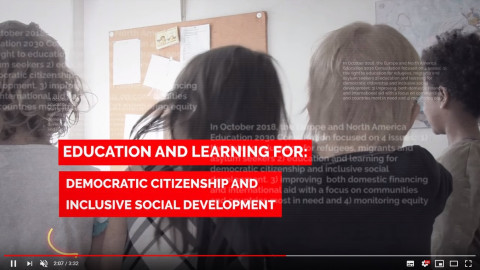 [Video] Snapshot on Education - Global & Regional Perspectives on Progress and Current Challenges Année de publication: 2018 Auteur institutionnel: UNESCO The video is a snapshot of the reflection on progress and challenges for education. Taking into consideration the global and regional SDG4-Education 2030 consultations throughout 2018. More at https://en.unesco.org/themes/education/globaleducationmeeting2018
 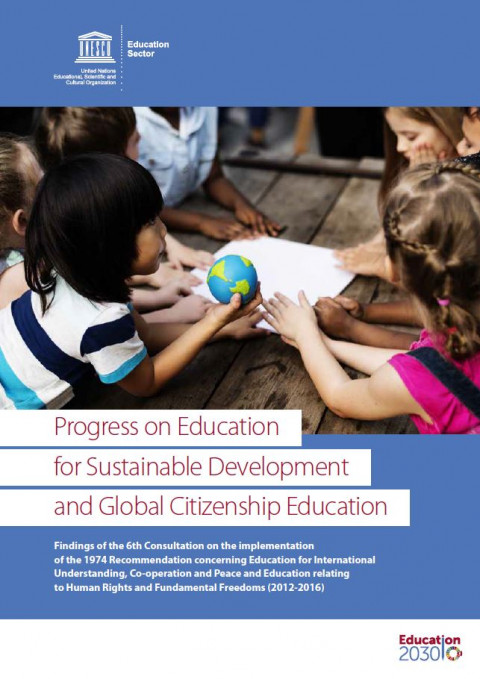 Progress on Education for Sustainable Development and Global Citizenship Education: Findings of the 6th Consultation on the Implementation of the 1974 Recommendation Année de publication: 2018 Auteur institutionnel: UNESCO Findings of the 6th Consultation on the implementation of the 1974 Recommendation concerning Education for International Understanding, Co-operation and Peace and Education relating to Human Rights and Fundamental Freedoms (2012-2016) Progress on Education for Sustainable Development and Global Citizenship Education “The Recommendation concerning Education for International Understanding, Co-operation and Peace and Education relating to Human Rights and Fundamental Freedoms” was adopted by UNESCO’s General Conference at its 18th session in 1974. Every four years, Member States report to UNESCO on measures taken to implement the Recommendation in pre-primary, primary, secondary and post-secondary/tertiary education. This document summarizes and analyses the main findings of the 6th Consultation on the implementation of the 1974 Recommendation, covering the period of 2012 to 2016. The findings of the 6th Consultation provide important insight into how Member States are implementing the 1974 Recommendation as well as how they are progressing towards Target 4.7 of Sustainable Development Goal 4 on Education. Target 4.7 concerns Education for Sustainable Development and Global Citizenship Education, which are closely related to the 1974 Recommendation. Supporting Member States in implementing Target 4.7 is a UNESCO priority and essential to progress across the 2030 Agenda for Sustainable Development.
 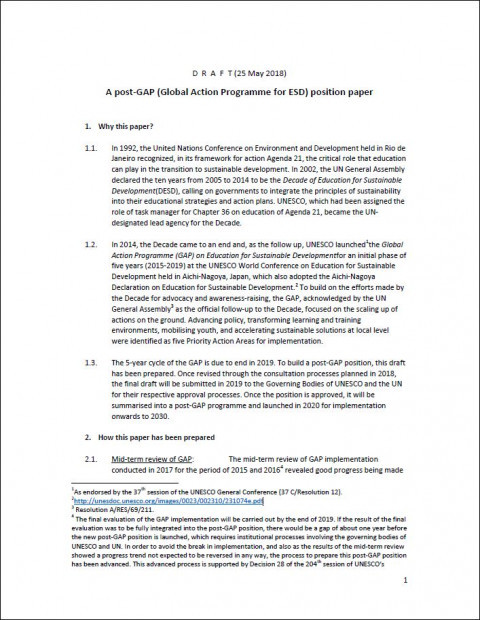 A Post-GAP (Global Action Programme for ESD) Position Paper Année de publication: 2018 Auteur institutionnel: UNESCO The 5-year cycle of the GAP is due to end in 2019. To build a post-GAP position, this draft position paper has been prepared. Once revised through the consultation processes planned in 2018, the final draft will be submitted in 2019 to the Governing Bodies of UNESCO and the UN for their respective approval processes. Once the position is approved, it will be summarised into a post-GAP programme and launched in 2020 for implementation onwards to 2030.
  Global Citizenship Education: Taking It Local Année de publication: 2018 Auteur institutionnel: UNESCO UNESCO is leading global efforts on Global Citizenship Education (GCED), which is at the core of Target 4.7 of Sustainable Development Goal 4 on Education. To address the perception that the concept of GCED is concerned mainly with global matters and maybe dissociated from local needs and realities, UNESCO has identified local/national/traditional precepts and concepts that are similar to the UNESCO understanding of global citizenship.As culturally relevant expressions of GCED and to contribute to building peace through the implementation of GCED, the concepts identified here can serve as entry-points to teach and learn about GCED in more locally relevant ways.
 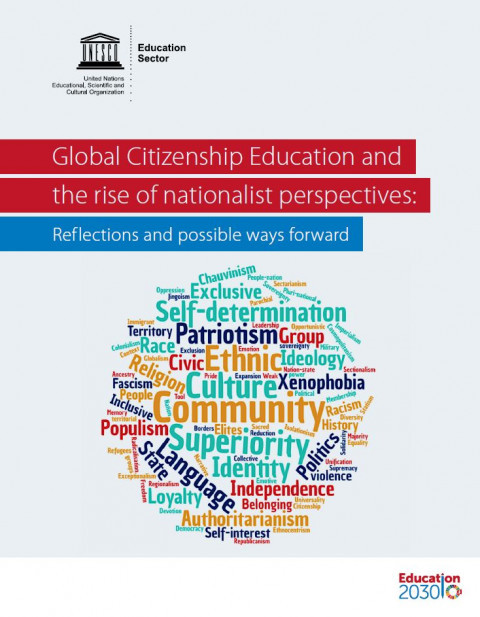 Global Citizenship Education and the Rise of Nationalist Perspectives: Reflections and Possible Ways Forward Année de publication: 2018 Auteur institutionnel: UNESCO | APCEIU Over the past few years, many have observed a rise in nationalist perspectives across the world. These trends raise questions about the role of education and, in particular, one of UNESCO’s key areas of work in the field of education, namely Global Citizenship Education (GCED), which seeks to equip learners with the skills, values and attitudes needed to contribute to the development of peaceful and just societies. This paper seeks to clarify the evidence of the rise of nationalist perspectives and its causes, and to lay out how GCED is challenged by this phenomenon. It recommends ways forward for education stakeholders in promoting GCED, in order to strengthen ‘learning to live together’ by embedding GCED meaningfully in local and country contexts.
  [Video] Global Citizenship Education: Taking it Local! Année de publication: 2018 Auteur institutionnel: UNESCO | APCEIU Societies across the world have long lived according to principles that emphasize solidarity, dialogue and respect for diversity. It is from this rich well of practices that UNESCO’s Global Citizenship Education (GCED) programme draws inspiration -- to instill in learners the skills, values, attitudes and behaviors to ‘live together’ and help shape more peaceful, sustainable societies and world. GCED is not a new concept, but an aspiration long-held across the world.
  UNESCO: Promise of Gender Equality; Key Actions of 2018 and 2019 Année de publication: 2020 Auteur institutionnel: UNESCO This is the first UNESCO Annual Report on Gender Equality that highlights the key initiatives implemented in 2018-2019. The advancement of gender equality through education, the sciences, culture, information and communication, at the heart of UNESCO’s mandate, aims to equip both women and men to address the challenges of sustainable development in a fast-changing world.
 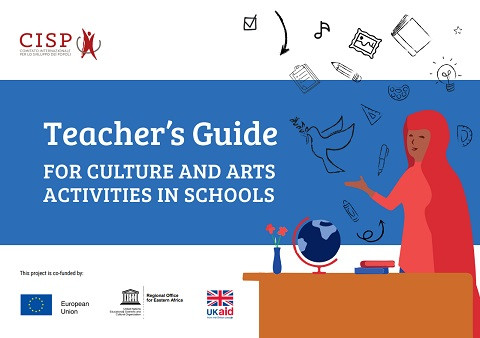 Teacher’s Guide for Culture and Arts Activities in Schools Année de publication: 2019 Auteur: Beatrice Polato | Xavier Verhoest Auteur institutionnel: Comitato Internazionale per lo Sviluppo dei Popoli (CISP) | European Union (EU) | UNESCO | UK aid This guide was designed as a curriculum to be used by teachers and mentors who facilitate modules and sessions aiming at involving school children in the study of cultural heritage, peace, inclusion and gender equity through artistic expressions. It has been tested and used by teachers in 24 schools in Somalia between 2018 and 2019, involving a total of 48 teachers and about 700 children. It contains text in Somali for activities.
 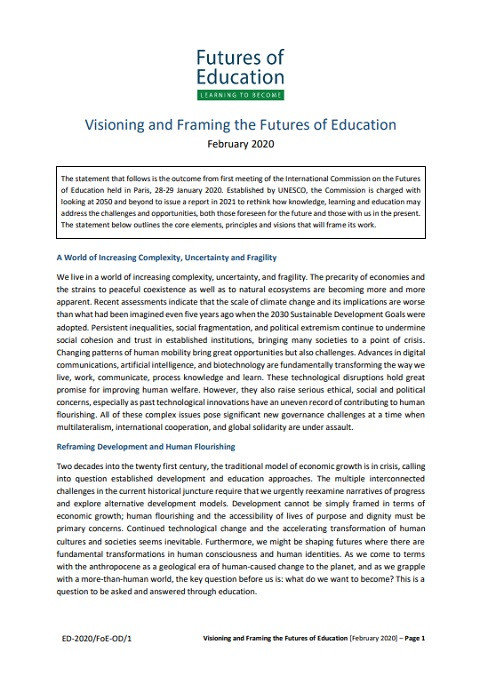 Visioning and Framing the Futures of Education: February 2020 Année de publication: 2020 Auteur institutionnel: UNESCO This statement is the outcome from first meeting of the International Commission on the Futures of Education held in Paris, 28-29 January 2020. Established by UNESCO, the Commission is charged with looking at 2050 and beyond to issue a report in 2021 to rethink how knowledge, learning and education may address the challenges and opportunities, both those foreseen for the future and those with us in the present.