
Ressources
Explorez une large gamme de ressources sur le GCED afin d’approfondir votre compréhension et de renforcer vos activités de recherche, de plaidoyer, d’enseignement et d’apprentissage.
792 résultats trouvés
 UNESCO's role in promoting education as a tool to prevent violent extremism Année de publication: 2015 Auteur institutionnel: UNESCO This item has been included in the provisional agenda of the 197th session of the Executive Board at the request of the United States of America and co-sponsored by Bosnia and Herzegovina, Bulgaria, Costa Rica, Côte d’Ivoire, Djibouti, Finland, France, Germany, Jordan, Kenya, Latvia, Nigeria, Norway, Pakistan, Philippines, Republic of Korea, Rwanda, Senegal, Slovenia, Suriname, Switzerland and Turkey
  Climate change education for sustainable development in small island developing states: report and recommendations Année de publication: 2012 Auteur institutionnel: UNESCO This report summarizes the key outcomes of a three-day meeting of around one hundred climate change education (CCE) experts, primarily from Small Island Developing States (SIDS) in the Caribbean, the Pacific Ocean and the Indian Ocean, representing a multi-disciplinary and diverse group of stakeholders. The meeting discussed and reflected on the challenges that climate change poses to education systems in SIDS, and on the role that education must play in adaptation to climate change. It was held from 21 to 23 September 2011 in Nassau, with the support of the Commonwealth of the Bahamas, the Government of Denmark and the Government of Japan. SIDS in the Caribbean Sea, the Indian Ocean and the Pacific Ocean are among the most vulnerable countries with regard to climate change. SIDS are already confronted with the effects of climate change, including rising sea levels and changes in weather and climate extremes such as droughts, floods and tropical cyclones/hurricanes. With current and future impacts of climate change representing a real danger to SIDS communities and livelihoods – whether based on agriculture, fisheries, forestry, tourism or trade – the need for SIDS to reduce their vulnerability to climate change by strengthening their adaptive capacity is a matter of urgency. Moving further along the path to sustainable development and achieving sustainable development objectives will depend on the ability of SIDS to strengthen this adaptive capacity. Adaptation to climate change requires individuals to be aware of potential changes in the climate and to understand the implications of changes for their lives. It requires them to assess the risks such changes hold for their identity and future, and to make informed decisions on how to adapt their livelihoods, homes and communities. Education plays an essential role in increasing the adaptative capacity of communities and nations by enabling individuals to make informed decisions. In particular, the education of girls and women has proven to have a significant impact on the capacity of communities to adapt to climate change and develop sustainably. Quality education designed for the purpose of empowering people to address climate change and live sustainably improves the adaptation capacity at the community level. This implies educational programmes that explicitly prepare communities for natural disasters. Climate change education for sustainable development (CCESD) needs also to incorporate indigenous knowledge, and promote sustainable lifestyles in which the importance of heritage is recognised as an integral part of community identity and a key asset that can help build resilience. Finally, CCESD should stress the unique cultural and natural heritage of SIDS, which plays a major role in the building of community resilience. Tenth Meeting of the High-level Group on Education for All (EFA), 22-24 March 2011, Jomtien, Thailand: Jomtien Statement Année de publication: 2011 Auteur institutionnel: UNESCO This statement is the outcome of 10th meeting of the High-level Group on Education for All. The meeting was held from 22 to 24 March 2011 in Jomtien, Thailand to urge to progress towards the EFA goals.
  UNESCO Global Action Programme on Education for Sustainable Development: information folder Année de publication: 2017 Auteur institutionnel: UNESCO This is a comprehensive folder containing 13 information sheets on different aspects of the Global Action Programme on ESD (GAP) and its key actors and partners. It aims to familiarize educators, learners and the general public with the GAP and advise them on how to spread the word. Eleventh meeting of the working group on Education for All, 2-3 February 2011, Paris, France: summary report Année de publication: 2011 Auteur institutionnel: UNESCO The eleventh meeting of the Working Group (WG) on Education for All (EFA) took place on 2 and 3 February 2011 at UNESCO headquarters in Paris. The meeting brought together people representing governments, bilateral and multilateral organizations, regional organizations, civil society organizations (CSOs), research institutes, foundations and the private sector. Consisting of seven sessions, the meeting aimed to review the world’s progress towards EFA and identify policy actions that can accelerate EFA progress, in particular as regards quality education, effective advocacy for education, violent conflicts and education and financing for education. The recommendations of the meeting were to be taken to the tenth meeting of the High Level Group (HLG) on EFA (Jomtien, Thailand, 22–24 March 2011). Recommendation concerning Education for International Understanding, Cooperation and Peace and Education Relating to Human Rights and Fundamental Freedoms, adopted by the General Conferences at its 18th session, Paris, 19 November 1974 Année de publication: 1974 Auteur institutionnel: UNESCO Following is the authentic text of the Recommendation duly adopted by the General Conference of the United Nations Educational, Scientific and Cultural Organization during its eighteenth session, which was held in Paris and declared closed the twenty-third day of November 1974. The General Conference recommends that Member States should submit to provisions as follows: to apply the following provisions by taking whatever legislative or other steps may be required in conformity with the Constitutional practice of each State to give effect within their respective territories to the principles set forth in this recommendation; to bring this recommendation to the attention of the authorities, departments or bodies responsible for school education, higher education and out-of-school education, of the various organizations carrying out educational work among young people and adults such as student and youth movements, associations of pupils’ parents, teachers’ unions and other interested parties; to submit to it, by dates and in the form to be decided upon by the Conference, reports concerning the action taken by them in pursuance of this recommendation.
  Evaluation of UNESCO's Capacity Development for Education for All (CapEFA) Programme Année de publication: 2016 Auteur institutionnel: UNESCO The main purpose of this evaluation is to determine the relevance and effectiveness of the Capacity Development for Education for All (CapEFA) programme’s overall contribution to progress towards the realization of the Education for All (EFA) goals in its target countries, and to provide actionable and timely recommendations to the United Nations Educational, Scientific and Cultural Organization (UNESCO) on the positioning of the Programme to meet future needs and challenges related to the adoption of the Sustainable Development Goals (SDG) in September 2015, and more specifically to the SDG 4 to ‘Ensure inclusive and equitable quality education and promote lifelong learning opportunities for all’. The focus of this evaluation is on assessing the CapEFA programme’s relevance, effectiveness, efficiency, and sustainability. This evaluation does not focus on how the programme impacts on the EFA goals, due to the challenge in assessing the causality between the programme’s goals and the EFA indicators. The focus of the assessment is on whether the right conditions at the systemic and institutional levels are created to have an impact on these EFA macro-indicators. Declaração e Plano de Ação Integrado sobre a Educação para a Paz, os Direitos Humanos e a Democracia Année de publication: 1995 Auteur institutionnel: UNESCO This document is Declaration of the 44th session of the International Conference on Education (Geneva, October 1994) endorsed by the General Conference Declaration of the 44th session of the International Conference on Education (Geneva, October 1994) endorsed by the General Conference of UNESCO at its twenty-eight session Paris, November 1995 of UNESCO at its twenty-eight session Paris, November 1995.
 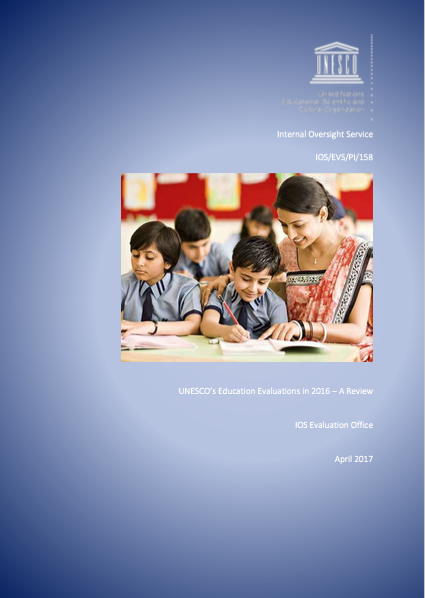 UNESCO's Education Evaluation in 2016: A Review Année de publication: 2017 Auteur institutionnel: UNESCO UNESCO completed 12 education related evaluations in 2016. Part A of this review presents the key insights and lessons learned from those evaluations. These learnings are designed to help enhance UNESCO’s leadership and coordination of the SDG 4 – Education 2030 Agenda. Part B of the review provides an assessment of the quality and usefulness of these evaluations based on the UNEG and OECD quality standards for evaluation reports.
  UNESCO and Education Année de publication: 2017 Auteur institutionnel: UNESCO Education is a fundamental human right and
a public good and, as such, has been at the core of UNESCO’s work since its inception.Education is also the path to sustainability – to poverty alleviation, better health, environmental protection and gender equality.As the only United Nations agency with a mandate to cover all aspects of education, UNESCO was entrusted in 2015 to lead the coordination and monitoring of Sustainable Development Goal 4, as part of the new Global Education 2030 Agenda.Goal 4 aims to “ensure inclusive and equitable quality education and promote lifelong learning opportunities for all,” and renewed UNESCO’s and Member States’ commitment to a vision of education that is holistic, inspirational and which leaves no one behind.This commitment is reflected in the size and scope of the Education Sector, the largest in UNESCO, with staff working at its Paris Headquarters and spread across a global network of field offices and specialized institutes and centres. With its close links with education ministries and other partners, UNESCO is strongly placed to press for action and change.UNESCO’s Education Sector supports Member States in developing education systems that foster high-quality and inclusive lifelong learning for all, empowering learners to be creative and responsible global citizens while leading the debate to help shape the future international education agenda.There is no stronger, no more lasting, investment a country can make than educating its citizens. The Education Sector exists to further this collective vision worldwide by transforming lives one by one.
UNESCO and Education Année de publication: 2017 Auteur institutionnel: UNESCO Education is a fundamental human right and
a public good and, as such, has been at the core of UNESCO’s work since its inception.Education is also the path to sustainability – to poverty alleviation, better health, environmental protection and gender equality.As the only United Nations agency with a mandate to cover all aspects of education, UNESCO was entrusted in 2015 to lead the coordination and monitoring of Sustainable Development Goal 4, as part of the new Global Education 2030 Agenda.Goal 4 aims to “ensure inclusive and equitable quality education and promote lifelong learning opportunities for all,” and renewed UNESCO’s and Member States’ commitment to a vision of education that is holistic, inspirational and which leaves no one behind.This commitment is reflected in the size and scope of the Education Sector, the largest in UNESCO, with staff working at its Paris Headquarters and spread across a global network of field offices and specialized institutes and centres. With its close links with education ministries and other partners, UNESCO is strongly placed to press for action and change.UNESCO’s Education Sector supports Member States in developing education systems that foster high-quality and inclusive lifelong learning for all, empowering learners to be creative and responsible global citizens while leading the debate to help shape the future international education agenda.There is no stronger, no more lasting, investment a country can make than educating its citizens. The Education Sector exists to further this collective vision worldwide by transforming lives one by one.