
Ressources
Explorez une large gamme de ressources sur le GCED afin d’approfondir votre compréhension et de renforcer vos activités de recherche, de plaidoyer, d’enseignement et d’apprentissage.
792 résultats trouvés
 Rethinking Education: Towards a Global Common Good? Année de publication: 2015 Auteur institutionnel: UNESCO The changes in the world today are characterized by new levels of complexity and contradiction. These changes generate tensions for which education is expected to prepare individuals and communities by giving them the capability to adapt and to respond. This publication contributes to rethinking education and learning in this context. It builds on one of UNESCO’s main tasks as a global observatory of social transformation with the objective of stimulating public policy debate.It is a call for dialogue among all stakeholders. It is inspired by a humanistic vision of education and development, based on respect for life and human dignity, equal rights, social justice, cultural diversity, international solidarity, and shared responsibility for a sustainable future. These are the fundamentals of our common humanity. This book enhances the vision provided by the two landmark UNESCO publications: Learning to Be: The world of education today and tomorrow (1972), the ‘Faure Report’, and Learning: The treasure within (1996), the ‘Delors Report’.
  All human beings... a manual for human rights education Année de publication: 1998 Auteur: Kaisa Savolainen | Francine Best | Patrice Meyer-Bisch | Betty Reardon Auteur institutionnel: UNESCO The World Conference on Human Rights (Vienna, 1993) took the position that human rights education, training and public information were essential in order to create and promote stable and harmonious relations among different communities and to foster mutual understanding, tolerance and peace.UNESCO has prepared this Manual for Human Rights Education as a contribution to the fiftieth anniversary of the Universal Declaration of Human Rights on 10 December 1998 and to the United Nations Decade for Human Rights Education (1995–2004). While intended mainly for educators, it may also be useful to secondary-school students and in the context of non-formal education.The Manual is the result of teamwork, with participation by numerous educators and experts from various regions of the world. A preliminary version was submitted to the delegates of UNESCO Member States at the 29th session of the Organization’s General Conference and has since been tested in several schools throughout the world.The Manual is addressed to primary- and secondary-school teachers and to instructors in non-formal education for children and adults. It is a teaching aid providing both theory and practical advice. However, parts of it can be used directly, without any teacher, by young people from the age of 14 upwards.Part 1 sets out an approach to the concepts essential if human rights education is to be rigorous, have a scientific basis, expand knowledge and promote thought. This part is to be read by teachers who wish to impart human rights education. It can be understood by secondary students aged 14 and over. It incorporates the basic components of the Declaration and Integrated Framework of Action on Education for Peace, Human Rights and Democracy (1994).Part 2 is addressed to schoolteachers and those in positions of responsibility. It is essentially a tool for teaching. It opens up avenues, makes suggestions and gives advice on how all educational disciplines can embrace the objectives inherent in human rights education. Obviously all teachers are free, in the light of their own cultures and individual pedagogical choices, to invent and create approaches and situations different from those suggested here.Part 3 presents a number of pedagogical examples that have been tried out and that provide an approach for educational work concerning a specific right. The plan follows that of the Universal Declaration of Human Rights, which is quoted and referred to at length. This part may be regarded as an educational demonstration of the features of this declaration, the fiftieth anniversary of which is being celebrated by UNESCO and the United Nations in 1998.All teachers and organizers can be guided by the experiments presented here to encourage information, training and reflection. There is no need to follow any particular order. As the need arises, a particular right (such as the right to health care or the right to live in a well-balanced environment) can be introduced before or after another right, or the focus may be on a single right.The Manual does not seek to be exhaustive but rather to propose material which can be developed and supplemented in an ongoing process. It will be for educators and learners, in their own cultural contexts, to discover how human rights can acquire meaning in their daily lives.
  A Decade of progress on education for sustainable development: reflections from the UNESCO Chairs Programme Année de publication: 2017 Auteur: Michelsen, Gerd | Wells, Peter J. Auteur institutionnel: UNESCO The UNITWIN/UNESCO Chairs Programme, launched in 1992, today forms an extensive network of inter-university cooperation involving more than 700 higher education institutions in 128 countries worldwide. Through knowledge sharing and collaborative research in the priority areas of UNESCO’s work in education, the natural and social sciences, culture, communication and information, the Chairs provide a vital contribution to the Organization’s mission. The current volume focuses on the activities undertaken by UNESCO Chairs dedicated to the field of Education for Sustainable Development (ESD) within the context of the UN Decade of ESD which culminated in the UNESCO World Conference on ESD, held in AichiNagoya, Japan, 2014. The case studies included, showcase the good practices, applied research and curricula innovations pioneered by the individual UNESCO Chairs, as well as highlighting the challenges and lessons learned both for the new follow-up Global Action Programme (GAP) on ESD and the wider Education 2030 Agenda.
 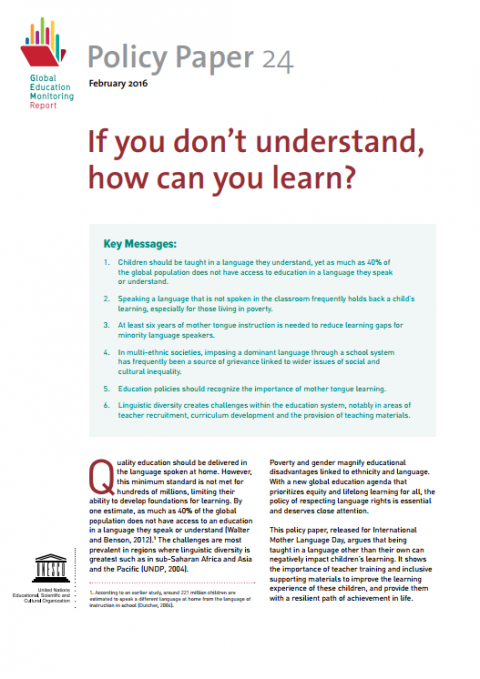 If you don't understand, how can you learn? Année de publication: 2016 Auteur institutionnel: UNESCO Key Messages:1. Children should be taught in a language they understand, yet as much as 40% of the global population does not have access to education in a language they speak or understand.2. Speaking a language that is not spoken in the classroom frequently holds back a child’s learning, especially for those living in poverty.3. At least six years of mother tongue instruction is needed to reduce learning gaps for minority language speakers.4. In multi-ethnic societies, imposing a dominant language through a school system has frequently been a source of grievance linked to wider issues of social and cultural inequality.5. Education policies should recognize the importance of mother tongue learning. 6. Linguistic diversity creates challenges within the education system, notably in areas of teacher recruitment, curriculum development and the provision of teaching materials.
  Education 2030: Incheon Declaration and Framework for Action for the Implementation of Sustainable Development Goal 4: Ensure Inclusive and Equitable Quality Education and Promote Lifelong Learning Opportunities for All Année de publication: 2016 Auteur institutionnel: UNESCO The Incheon Declaration articulates the collective vision and commitment of the international community on global education. The 2030 Framework for Action provides guidance for the implementation of Sustainable Development Goal 4.
 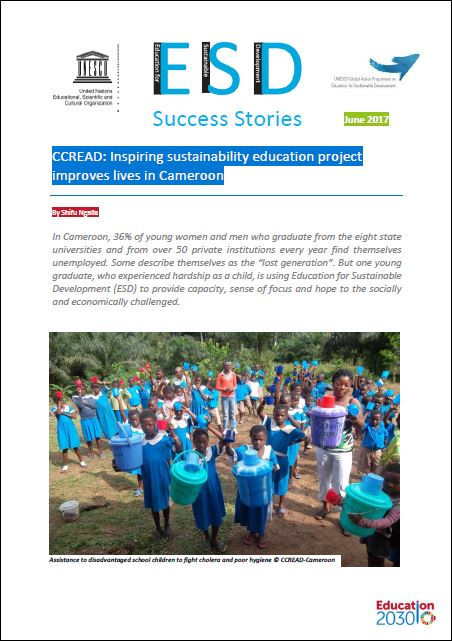 CCREAD: Inspiring Sustainability Education Project Improves Lives in Cameroon Année de publication: 2017 Auteur: Shifu Ngalla Auteur institutionnel: UNESCO This article is about sustainability education project in Cameroon. In Cameroon, 36% of young women and men who graduate from the eight state universities and from over 50 private institutions every year find themselves unemployed. Some describe themselves as the “lost generation”. But one young graduate, who experienced hardship as a child, is using Education for Sustainable Development (ESD) to provide capacity, sense of focus and hope to the socially and economically challenged.
  La enseñanza del Holocausto en América Latina - Los desafios para los educadores y legisladores Année de publication: 2015 Auteur institutionnel: UNESCO The Holocaust has become a point of reference worldwide to raise awareness about violations of human rights and state violence. What is the importance of Holocaust education in regions of the world that have no direct relation to the history of the Jewish people and the crimes of Nazism, especially in Latin America? Is there a rise of relevant educational practices internationally as a result of the expansion of education about the Holocaust ? How can educators address a subject so complex and emotionally charged in changing multicultural societies ? This UNESCO publication brings together the contributions of important historians and educators around the world and frames current debates in the field, emphasizing the issues that educators in Latin America are facing and revealing the reasons why it is vital to continue teaching Holocaust history in the world today, regardless of where we live. (By the publisher - Translation)
  The International status of education about the Holocaust : A global mapping of textbooks and curricula Année de publication: 2015 Auteur institutionnel: UNESCO This publication by UNESCO and the Georg Eckert Institute documents ways in which the Holocaust is presented in secondary school level history and social studies curricula worldwide, and conceptualized and narrated in textbooks from twenty-six countries, with all continents represented. Historical understandings of the Holocaust are defined in terms of the spatial and temporal scales with which the event is portrayed, the protagonists involved, interpretative patterns (according to definitions, comprehensiveness, causes, relativization or banalization), narrative techniques and viewpoints, didactic methods, and national idiosyncrasies. The study is based on 272 currently valid curricula from 135 countries, and on 89 textbooks published in 26 countries since 2000. The aim of the study is primarily to document information in such a way that it reflects local understandings of the Holocaust, principally by recording concepts and narratives of the Holocaust found in educational media currently in use in schools. The findings show both convergence and divergence in the representations analysed. The Holocaust is subject to shared patterns of representation, which include selectivity, personalization, appropriation, screening and omission. It is also subject to narrative idiosyncrasies. One of the main trends worldwide is domestication, a process whereby countries place emphasis on the local significance of the event or appropriate them in the interests of local populations. Drawing on such national and international patterns of representation, the publication concludes by formulating recommendations for future curricula and textbook narratives about the Holocaust. These recommendations relate to such issues as the use of terms, the comprehensiveness of historical facts, the definition of causes, the combination of universal and local approaches, and the development of historical literacy. (By the publisher)
  Collection des meilleures pratiques en éducation pour une citoyenneté mondiale en Afrique centrale Année de publication: 2015 Auteur institutionnel: UNESCO This collection of best practices in human rights education in Central Africa and Ethiopia was prepared in order to respond to UNESCO’s demand to promote such initiatives and to ensure a multiplier effect considering human rights education in the region. The objective is to support the concept of UNESCO’s ‘Global Citizenship Education’ in the field of human rights education in identifying its best practices. In order to identify the best practices, UNESCO’s activities in the field of human rights education in the region were mapped out. This mapping out has shown big differences in implementing the initiatives focused on achieving global citizenship education through human rights education, particularly in primary and secondary education, as indicated in the first phase of the World Programme for human rights education. Nevertheless, various initiatives collected are either conducted/supported by UNESCO or not, in terms of three themes: citizenship education, intercultural dialogue, and the peace and security which are considered to be relevant to Africa in general and particularly to Central Africa, in order to address the main theme of global citizenship education. The selected best practices deal with the tertiary level and are in line with the second phase of the World Programme for human rights education, covering the period between 2009 and 2014 and focusing on higher and vocational education. The practices include 1) citizenship education which supports the principles set out in the Universal Declaration of Human Rights and which is reiterated in the two phases of the World Programme for human rights education, 2) the intercultural dialogue which supports education for understanding and evaluating unity in diversity, and which fits well with the objectives of the UN Decade of Education for Sustainable Development proclaimed by the UN General Assembly and managed by UNESCO, and 3) education for peace and security.It is obvious that many linkages exist among the three subjects mentioned above. Therefore, the examples presented in this collection can affect one or several problems. Each example is presented with the following sequence: identification, background, implementation, and results.
 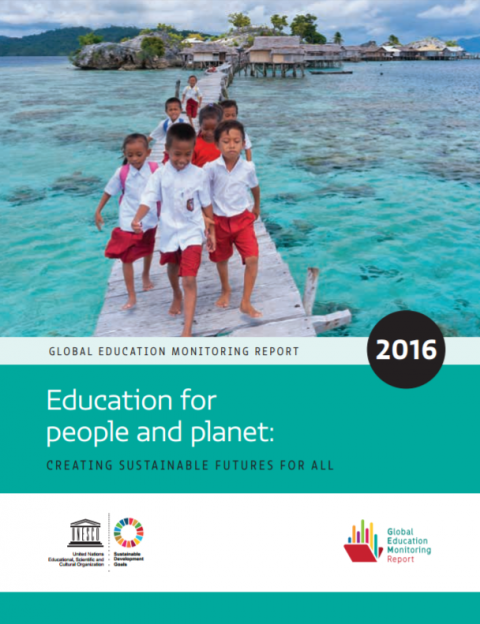 Education for People and Planet: Creating Sustainable Futures for All, Global Education Monitoring Report, 2016 Année de publication: 2016 Auteur institutionnel: UNESCO | Global Education Monitoring Report Team Education for People and Planet: Creating Sustainable Futures for All explores the complex relationship between education and the new 2030 Agenda for Sustainable Development, covering six fundamental pillars – Planet, Prosperity, People, Peace, Place and Partnerships. This report shows that education will not deliver its full potential unless participation rates increase dramatically and sustainable development guides education system reform. It also warns of the destructive impact that climate change, conflict, unsustainable consumption and the increasing gap between rich and poor have on education. A huge transformation is needed if we are to create sustainable futures for all.