
Ressources
Explorez une large gamme de ressources sur le GCED afin d’approfondir votre compréhension et de renforcer vos activités de recherche, de plaidoyer, d’enseignement et d’apprentissage.
792 résultats trouvés
 Teaching resource kit for dryland countries: a creative approach to environmental education Année de publication: 2007 Auteur: Thomas Schaaf Auteur institutionnel: UNESCO Entitled A Creative Approach to Environmental Education/Teaching Resource Kitfor Dryland Countries, the kit is intended for secondary-school teachers in countries affected by desertification and is based on an innovative approach appealing to the creativity and artistic sensibility of pupils aged 10 to 15 years. This approach favours discovery of the environment through the senses, and emphasizes the visual and exploratory aspects of environmental study. The idea of using creativity and artistic sensibility to promote ecological awareness may in the future become a source of collaboration to be explored in detail by the different sectors of UNESCO.
  YouthXchange guidebook series: climate change and lifestyles Année de publication: 2011 Auteur: Adam Cade | Rob Bowden Auteur institutionnel: UNESCO | United Nations Environment Programme (UNEP) Climate Change and Lifestyles is the first in a series of guidebooks supporting the UNESCO/ UNEP YouthXchange (YXC) Initiative, which was created in 2001 to promote sustainable lifestyles among youth (15-24 years) through education, dialogue, awareness raising and capacity building. The series is being produced for young people and people working with youth, such as educators, teachers, trainers and youth leaders in both developed and developing countries. Almost half of the world’s population is under the age of 25, and nearly 90 per cent of them live in developing countries. Youth is a critical stakeholder in the global economy and will be the main actor and motor for change in the near future. Thus, the energy, motivation and creativity of youth are essential assets to stimulating change. Aims of the YXC Guidebook on Climate Change and Lifestyles: • Explore the links between lifestyles and climate change; • Help young people consider the actions they should take towards more sustainable lifestyles; • Support courses and actions that promote greater understanding of climate change and lifestyles among youth. The guidebook: • Considers the causes and effects of climate change and its human impacts and responses, while connecting them to lifestyle choices and the technical and social infrastructures of a society; • Provides scientific, political, economic, social, ethical and cultural perspectives on climate change; • Explains complex issues in accessible language supported by facts, graphics, images, examples and web links; • Develops the critical skills young people need to make personal choices to address the challenges of climate change. Proceedings of the international congresses of: education for shared values for intercultural and interfaith understanding, (and) religion in peace and conflict: responding to militancy and fundamentalism Année de publication: 2005 Auteur institutionnel: UNESCO The results of this conference, and its direct linkages with the Associated Schools Project Network in your region, will support efforts to mould education so that it becomes more conducive to the development of world citizens, proud of their identities and able to contribute to a sustainable and peaceful future for the world’s peoples. Expert meeting on intercultural education, Paris, 20-22 March 2006; report Année de publication: 2006 Auteur institutionnel: UNESCO This report will give for each panel a summary of the presentation, the ensuing debates and a synthesis. The discussions of the draft UNESCO Guidelines and of the database on Intercultural Education, including the results and next steps to be taken are also presented. In addition, the report provides a summary of the debate around the presentation of the UNESCO World Report on Cultural Diversity.
  UNESCO guidelines on intercultural education Année de publication: 2006 Auteur institutionnel: UNESCO This paper aims to synthesize the central issues surrounding Intercultural Education, and presents the fundamental guiding principles for an intercultural approach to education as viewed by UNESCO. It is divided into three parts. Part I outlines the key issues surrounding Intercultural Education, as well as its objectives and basic operating principles. Part II contains a short presentation of the normative framework for Intercultural Education, based on an analysis of international standard-setting instruments that make reference to education and intercultural issues, and on outcomes from International Conferences. Part III synthesizes the international position on this issue and provides a set of three basic principles that should guide educational policies with regard to Intercultural Education. A teaching resource kit for mountain countries: a creative approach to environmental education Année de publication: 2010 Auteur: Thomas Schaaf Auteur institutionnel: UNESCO Entitled: A Teaching Resource Kit for Mountain Countries, it is a new environmental education kit similar to the Teaching Resource Kit for Dryland Countries published by UNESCO in 2008. It is based on the same innovative approach appealing to the creativity and artistic sensibility of pupils aged around 10 to 15, and is intended for secondary-school (and late primary-school) teachers and their pupils, this time living in mountain ecosystems, where climate and environmental conditions are harsh, often varying between extremes, and which are subject to the problems of erosion. As an educational tool, the kit offers a practical and attractive way of helping teachers and their pupils towards a better understanding of the environmental problems of their region and to stimulate their quest for possible solutions. In this respect, its content is a further contribution to the United Nations General Assembly’s resolution proclaiming 2002 the International Year of Mountains and is also consistent with the activities developed as part of the United Nations Decade of Education for Sustainable Development (2005-2014), the promotion of which is UNESCO’s responsibility.
 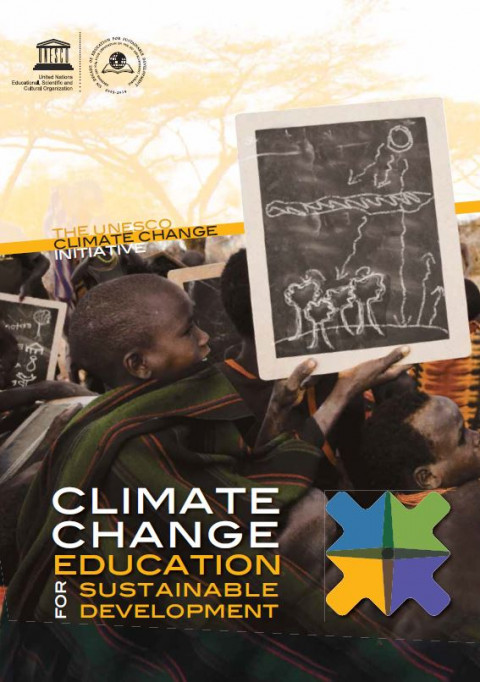 Climate Change Education for Sustainable Development: the UNESCO Climate Change Initiative Année de publication: 2010 Auteur institutionnel: UNESCO The UNESCO Climate Change Initiative was launched by Director-General Irina Bokova in Copenhagen during the 15th Conference of the Parties to the UN Framework Convention on Climate Change (UNFCCC COP15). It seeks to reinforce the scientific, mitigation and adaptation capacities of countries and communities that are most vulnerable to the effects of climate change. It focuses on a select number of strategic issues in line with The UN System Delivering as One on Climate Change action plan and The UNESCO Strategy for Action on Climate Change. The Initiative is based on four thematic areas: scientific, educational, environmental and ethical. Key objectives will be achieved through intersectoral and interdisciplinary cooperation, coordinated field activities, and networking. Special attention is given to UNESCO’s two global priorities, Africa and gender equality, as well as to the increased vulnerability of Small Island Developing States (SIDS).The UN System “Delivering as One” on Climate Change During the 13th session of the Conference of Parties to the UNFCCC in Bali, Indonesia, UN Secretary General Ban Ki-Moon presented an unprecedented coordination effort to bring together all the diverse perspectives, expertise and strengths of the UN system so as to deliver as one in the critical area of climate change. The initiative brings together expertise and ongoing work in diverse areas ranging from science and technology to agriculture, transport, forestry and disaster risk reduction, to address both mitigation and adaptation. It brings together the normative, standard setting and knowledge sharing capacities of the system with its operational reach in order to support the most vulnerable. The overall objective is to maximize existing synergies, eliminate duplication and overlap, and optimize the impact of the collective effort of the UN system.To ensure better coordination, convening responsibilities were assigned to UN system entities with a large volume of activities in the five focus areas and four cross-cutting areas. Focus areas ㆍAdaptation – High-Level Committee on Programmes collectively ㆍ Technology transfer – UNIDO, UN-DESA ㆍReduction of emissions from deforestation and degradation (REDD) – UNDP, FAO, UNEP ㆍ Financing mitigation and adaptation action – UNDP, World Bank Group ㆍCapacity building – UNDP, UNEP Cross-cutting areas ㆍClimate knowledge: science, assessment, monitoring and early warning – WMO, UNESCO ㆍSupporting global, regional and national action – UN-DESA, UN Regional Commissions, UNDP ㆍClimate-neutral UN – UNEP ㆍPublic awareness – UNCG, UNEP. Human rights education: learning counts! Année de publication: 2006 Auteur institutionnel: UNESCO This poster was originally published in 2006 and reissued for UNESCO Works for Human Rights: a Poster Exhibition on the Street, held at UNESCO, Paris, 2 December 2008 to 27 February 2009. The round table: putting human rights into practice-the role of education; report Année de publication: 2008 Auteur institutionnel: UNESCO This publication highlights some of the key ideas and features of the events based on the theme “60 years of Human Rights Education” at UNESCO headquarters in Paris from the 2nd of December 2008 till the 27th of February 2009. In addition to substantial opening and closing sessions, the Round Table consisted of four panels, the reporting of each consists of Summary, Introduction, Case Studies, Discussion and Recommendations. This publication can be read on a number of levels: as a retrospective commemoration of human rights education; as a celebration of current good practice; and, through its discussion and recommendations, as a source of guidance for future directions in human right education. Aichi-Nagoya Declaration on Education for Sustainable Development Année de publication: 2014 Auteur institutionnel: UNESCO We, the participants of the UNESCO World Conference on Education for Sustainable Development held in AichiNagoya, Japan, from 10 to 12 November 2014, adopt this Declaration and call for urgent action to further strengthen and scale up Education for Sustainable Development (ESD), in order to enable current generations to meet their needs while allowing future generations to meet their own, with a balanced and integrated approach regarding the economic, social and environmental dimensions of sustainable development. This Declaration recognises that people are at the centre of sustainable development and builds on the achievements of the United Nations (UN) Decade of ESD (2005-2014); the deliberations of the UNESCO World Conference on ESD in Aichi-Nagoya; and the Stakeholder Meetings held in Okayama, Japan, from 4 to 8 November 2014, namely, UNESCO ASPnet International ESD events, the UNESCO ESD Youth Conference, the Global Regional Centres of Expertise Conference, and other relevant events and consultation processes, including regional ministerial meetings. We express our sincere gratitude to the Government of Japan for hosting the UNESCO World Conference on ESD.