
Ressources
Explorez une large gamme de ressources sur le GCED afin d’approfondir votre compréhension et de renforcer vos activités de recherche, de plaidoyer, d’enseignement et d’apprentissage.
792 résultats trouvés
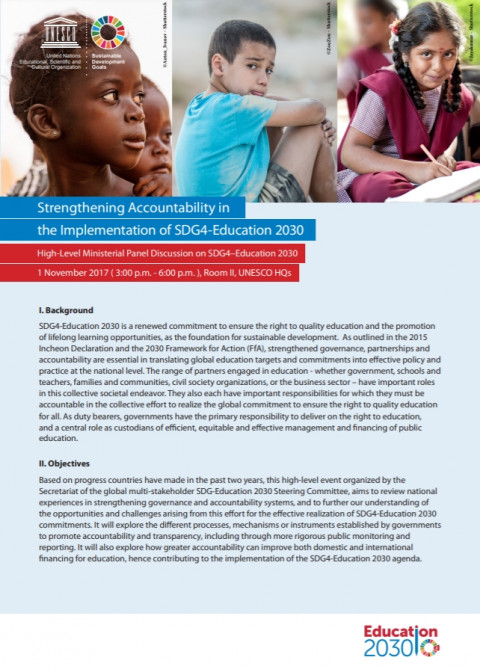 Strengthening accountability in the implementation of SDG4 - Education 2030 Année de publication: 2017 Auteur institutionnel: UNESCO SDG4-Education 2030 is a renewed commitment to ensure the right to quality education and the promotion of lifelong learning opportunities, as the foundation for sustainable development. As outlined in the 2015 Incheon Declaration and the 2030 Framework for Action (FfA), strengthened governance, partnerships and accountability are essential in translating global education targets and commitments into effective policy and practice at the national level. The range of partners engaged in education - whether government, schools and teachers, families and communities, civil society organizations, or the business sector – have important roles in this collective societal endeavor. They also each have important responsibilities for which they must be accountable in the collective effort to realize the global commitment to ensure the right to quality education for all. As duty bearers, governments have the primary responsibility to deliver on the right to education, and a central role as custodians of efficient, equitable and effective management and financing of public education.
  Inclusive Education for Persons with Disabilities - Are We Making Progress? Année de publication: 2019 Auteur institutionnel: UNESCO | Leonard Cheshire (UK) The paper ‘Inclusive education for persons with disabilities – Are we making progress?’ has been developed as a background paper for the UNESCO International Forum on inclusion and equity in education – Every learner matters, being held in Cali, Colombia from 11-13 September 2019. The Forum is being organised in commemoration of the 25th anniversary of the passing of the Salamanca Statement and Framework for Action. The paper will explore the global progress towards inclusive education, the successes achieved and learnings observed specifically in countries of the global South. In these countries the concerns of universal access to and retention in education is still a concern for many governments, but large-scale exclusion of children with disabilities (an estimated 32 million or 1 out of 3 are out of school) remains the order of the day and is not always high on government agendas.
  UNESCO, Climate Change Education and COP22 Année de publication: 2016 Auteur institutionnel: UNESCO Education is a key vector to prepare societies for global changes. It plays a critical role in achieving sustainable development goals and putting into practice a global agreement on climate change. Education plays a paramount role in raising awareness and promoting behavioural change for climate change mitigation and adaption. It helps increase the climate change mitigation and adaptation capacity of communities by enabling individuals to make informed decisions.
  Futures of Education: learning to become Année de publication: 2019 Auteur institutionnel: UNESCO UNESCO’s Futures of Education initiative aims to rethink education and shape the future. The initiative is catalyzing a global debate on how knowledge, education and learning need to be reimagined in a world of increasing complexity, uncertainty, and precarity. Looking to 2050 and beyond, the Futures of Education initiative seeks to reimagine how education and knowledge can contribute to the global common good. The initiative will catalyze a global debate on how knowledge and learning can shape the future of humanity and the planet.
 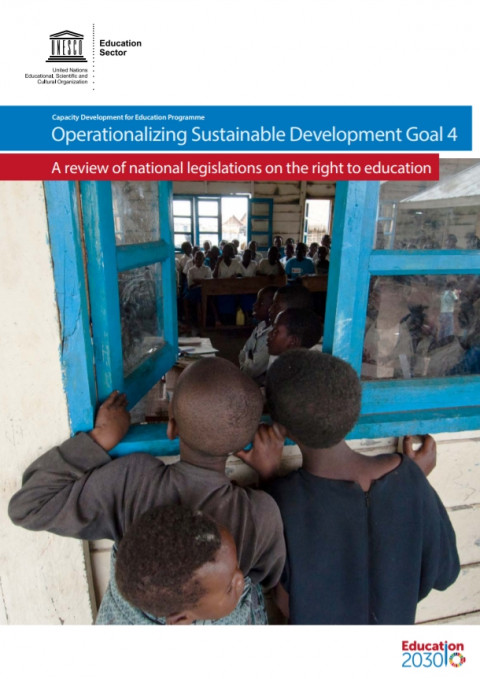 Operationalizing Sustainable Development Goal 4: a review of national legislations on the right to education Année de publication: 2017 Auteur: Santini, Delphine Auteur institutionnel: UNESCO As part of a wider Capacity Development for Education (CapED) Programme on operationalizing SDG4 at the country level, this paper examines the instrumental role that legislation on the right to education can play in view of achieving the SDG4 targets in Least Developed Countries. It does it by reviewing national legal frameworks relating to the right to education in 11 countries, suggesting some lessons of global interest, both for policy-making and normative work.
  UNESCO and the right to education Année de publication: 2018 Auteur institutionnel: UNESCO Education is a fundamental human right of every woman, man and child. For UNESCO, this right is an absolute priority and at the heart of its global mission to ensure equal access to quality education for everyone.
 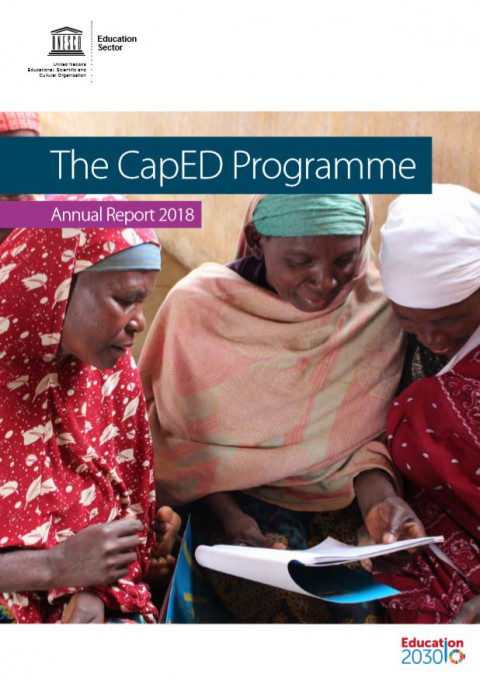 The CapED Programme: annual report 2018 Année de publication: 2019 Auteur institutionnel: UNESCO UNESCO is the United Nation’s specialized agency for education and is mandated to lead and coordinate progress towards Sustainable Development Goal 4 – “Ensure inclusive and equitable quality education and promote lifelong learning opportunities for all”. The CapED Programme is central to delivering on this mandate through capacity development. It mobilizes UNESCO’s worldwide network of specialized Institutes and offices and works with partners to assist countries as they develop and implement national plans to deliver on SDG4 commitments. The Annual Report 2018 provides information on achievements and progress made in the 25 countries where CapED is operational.
  Casebook on human dignity and human rights Année de publication: 2011 Auteur institutionnel: UNESCO Article 3 of the Declaration reads as follows:1. Human dignity, human rights and fundamental freedoms are to be fully respected.2. The interests and welfare of the individual should have priority over the sole interest of science or society
 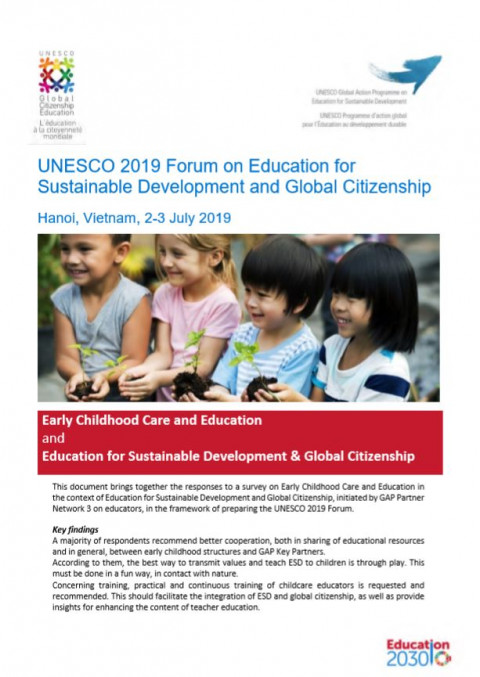 Early childhood care and education and education for sustainable development & global citizenship Année de publication: 2019 Auteur institutionnel: UNESCO This document brings together the responses to a survey on Early Childhood Care and Education in the context of Education for Sustainable Development and Global Citizenship, initiated by GAP Partner Network 3 on educators, in the framework of preparing the UNESCO 2019 Forum. Key findings A majority of respondents recommend better cooperation, both in sharing of educational resources and in general, between early childhood structures and GAP Key Partners. According to them, the best way to transmit values and teach ESD to children is through play. This must be done in a fun way, in contact with nature. Concerning training, practical and continuous training of childcare educators is requested and recommended. This should facilitate the integration of ESD and global citizenship, as well as provide insights for enhancing the content of teacher education.
  Bringing it out in the open: Monitoring school violence based on sexual orientation, gender identity or gender expression in national and international surveys Année de publication: 2019 Auteur institutionnel: UNESCO This technical brief has been developed by the United Nations Educational, Scientific and Cultural Organization (UNESCO) to strengthen the routine monitoring of school violence that is based on sexual orientation, gender identity or gender expression (SOGIE). It is informed by best practice from large institutional surveys that have been successfully conducted at the international or national level. The Brief provides recommendations on: • Questions to capture data on the sexual orientation or gender identity of students.• Questions to capture data on school violence that is specifically based on SOGIE. The Brief also gives guidance on: • The challenges in collecting data on school violence based on SOGIE• Identifying and fulfilling indicators on school violence based on SOGIE