
Ressources
Explorez une large gamme de ressources sur le GCED afin d’approfondir votre compréhension et de renforcer vos activités de recherche, de plaidoyer, d’enseignement et d’apprentissage.
792 résultats trouvés
 Unmasking Racism: Guidelines for Educational Materials Année de publication: 2024 Auteur institutionnel: UNESCO These Guidelines developed by UNESCO provide recommendations on how to combat racism in textbooks and to develop learning materials that are free of prejudice and bias and do not perpetuate stereotypes or legitimize unequal social structures. Through a comprehensive analysis of recent studies of textbooks and other educational materials, the guide also demonstrates how countries around the world address racism and racialization. It increases awareness and improves our understanding of how racism manifests in educational materials, and aims to support education stakeholders to promote just, peaceful and multicultural societies.
  Peace Education in the 21st Century: An Essential Strategy for Building Lasting Peace Année de publication: 2024 Auteur institutionnel: UNESCO This report provides an overview of the importance of peace education, highlighting the challenges and opportunities for using it in efforts to bring about lasting global peace. It reviews key research and is heavily inspired by the discussions held in the context of the revision process of the 1974 Recommendation concerning education for international understanding, co-operation and peace and education relating to human rights and fundamental freedoms. More specifically, this report draws from the following notes developed by UNESCO in 2022: “Current understandings, and threats to lasting peace”, “New understandings of education’s contributions to peace”, and “The role of non-state actors in the promotion of peace through education”.
  Human Rights Education: Key Success Factors Année de publication: 2023 Auteur institutionnel: UNESCO This study, commissioned by the UNESCO in cooperation with the United Nations Office of the High Commissioner for Human Rights (OHCHR), examines the impact of human rights education (HRE) pedagogies and good practices worldwide, with a specific focus on the primary and secondary levels in formal education. Using a data-driven approach that includes a literature review and surveys and interviews with informants, the study identifies key success factors for impactful HRE and provides recommendations for future research and practice. The study finds that HRE can have a positive impact on learners’ knowledge and understanding of human rights, as well as their attitudes and behaviours related to human rights. It is an essential resource for education stakeholders looking to promote HRE at all levels of society and through a lifelong learning lens.
  Revision Process of the 1974 Recommendation concerning Education for International Understanding, Co-operation and Peace and Education relating to Human Rights and Fundamental Freedoms: Comments from Observers to the Plenary Meetings of the International Expert Group (IEG) Année de publication: 2023 Auteur institutionnel: UNESCO Adopted in 1974, the Recommendation concerning education for international understanding, co-operation and peace and education relating to human rights and fundamental freedoms is considered a landmark legal instrument that brings together for the first time peace, international understanding, human rights, fundamental freedoms and education. In line with the Resolution adopted at UNESCO’s General Conference at its 41st Session in November 2021 (41C/Resolution 17), UNESCO launched the revision of the Recommendation and convened an International Expert Group (IEG) to advise the Organization on the changes. The work of the IEG took place between May and June 2022. Though the meetings of the IEG were technical in nature (category VI), in order to ensure an open and transparent process, the Permanent Delegations were invited to listen-in to the deliberations of the IEG online, as observers, along with a select number of non-governmental organizations, intergovernmental organizations, and United Nations entities. At the end of each plenary meeting, observers to the IEG plenary meetings could submit written comments. This document compiles the comments received from observers during this process and submitted to the IEG members for their consideration.
  Because youth perspectives matter: UNESCO toolbox for youth policy and programming Année de publication: 2023 Auteur institutionnel: UNESCO <Short summary>Placing trust in youth voicesYoung people fear for their future. Pandemics, conflict, climate change, inequality – these are the issues defining their reality.Yet their potential to provide solutions to the multiple crises is not realized. From low representation and tokenistic approaches, to institutional obstacles to participation and limited civic spaces, young people are disconnected from influencing decisions and actions that affect their lives. They need real opportunities to participate in decision-making and contribute to practical solutions.Policy-makers, public officials and practitioners – as well as development sector and civil society actors – can and should create such opportunities for youth. This Toolbox is a comprehensive go-to resource to make that possible. It is intended to support these stakeholders in designing and implementing effective policies and programmes to address the multidimensional needs of youth at national and local levels.It consists of:• A guide for participatory youth policy design;• Intergenerational dialogue tools on holistic youth development and youth civic engagement; and• A training tool on meaningful youth engagement. Together, we can prove that youth perspectives matter.
 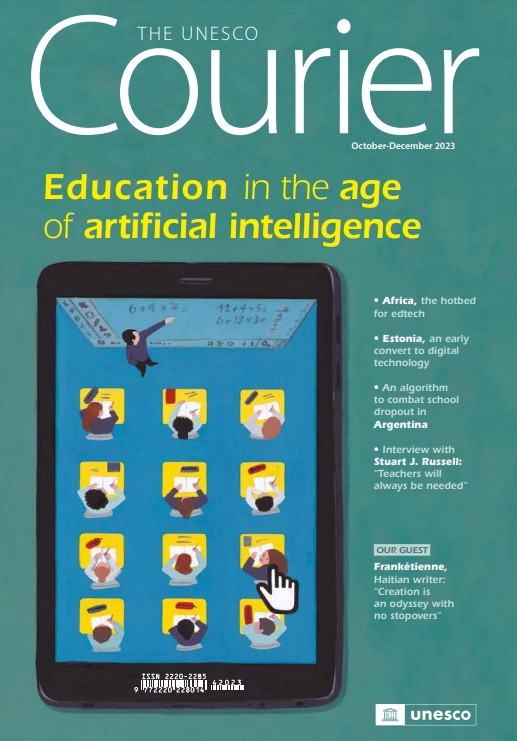 Eduaction in the Age of Articial Intelligence (The UNESCO Courier no. 4, October-December 2023) Année de publication: 2023 Auteur institutionnel: UNESCO At a time when the field of education is in worldwide ferment, a single instructional phenomenon has captured the attention not only of professionals but of laymen.” Does the innovation in question refer to artificial intelligence (AI), or to the use of augmented reality in the classroom? Neither one. This quote is from an article in The UNESCO Courier about “teaching machines”, a set of programmes developed in the USA to guide students in their learning. It dates back to… March 1965. Which just goes to show that pondering the role of computers in learning is nothing new. Whether lauded or decried, technologies are increasingly part of the school landscape, at least in industrialized countries. Digital learning games, online tutorials or massive open online courses (MOOCs) have become a reality for a growing number of pupils and students. The COVID-19 pandemic has only accelerated the phenomenon, spurring the rise, including in Africa, of companies specializing in digital educational services, the so-called “edtechs”. Yet no matter how sophisticated these technologies may be, they have not challenged the founding principle of a teacher giving a class simultaneously to a group of students. Artificial intelligence could be a game-changer. Does the arrival of content-generating tools like ChatGPT and intelligent tutorials mean the oft-heralded revolution has started? In any case, the use of generative AI in learning presents unprecedented challenges to education systems. As UNESCO’s Global Education Monitoring Report 2023 highlights, these new tools can prove invaluable in providing personalized support for students, particularly those with disabilities or living in remote areas. But they also raise questions about the digital divide, data confidentiality and the preponderance of major global corporations in this sector. And for the moment, safeguards are lacking. It is therefore urgent that regulations be adopted to ensure the use of AI in education remains human-centred, in the best interests of students. To support this, UNESCO published in September 2023 the first-ever Guidance for generative AI in education and research, designed to address the disruptions caused by these technologies. It complements other tools produced by the Organization, including the Recommendation on the ethics of artificial intelligence and a guidance for policy-makers on AI and education, both published in 2021.
 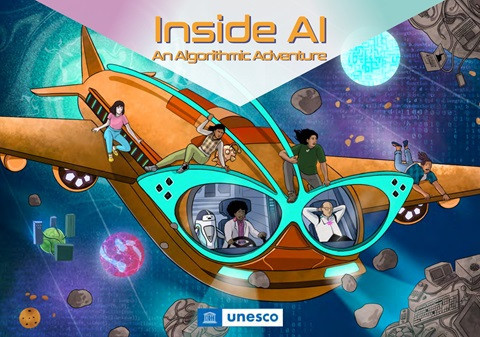 Inside AI - An Algorithmic Adventure Année de publication: 2022 Auteur: Katherine Evans Auteur institutionnel: UNESCO In the framework of UNESCO’s work to harness emerging technologies for sustainable development, this graphic novel for policymakers as well as youth explores the impact of Artificial Intelligence on humankind. Dive into the world of AI and follow the adventures of four characters whose lives are affected by algorithmic hazards: By following characters in four different corners of the globe as they grapple with the limits of AI technologies, the audience jointly embarks on a mission in an algorithmic galaxy called Plethor.A.I.. There, they have but one option: travel across this hidden world behind our screens to learn about the social, technical, ethical and human rights impacts of Artificial Intelligence, and help the characters find a way back to reality.UNESCO’s first graphic novel on Artificial Intelligence (AI) aims at providing an educational media to policymakers, adults and youth who are curious and interested in learning more about AI, its challenges and stakes.
  Re|shaping Policies for Creativity: Addressing Culture as a Global Public Good Année de publication: 2023 Auteur institutionnel: UNESCO The Global Report series monitors the implementation of the 2005 Convention on the Protection and Promotion of the Diversity of Cultural Expressions, as well as progress towards achieving the United Nations 2030 Agenda for Sustainable Development, within and with the cultural and creative sectors. Its 2022 edition revolves around two major questions: What is the state of the cultural and creative sectors? What policy changes to promote sustainable, human rights-based systems of governance for culture and equitable access to cultural opportunities and resources have resulted from stakeholders’ implementation and ownership of the Convention? In line with the 2015 and 2018 editions, this third edition of the Report presents the latest policy developments to support creativity and sheds light on current and future challenges in areas such as the digital environment, media diversity, sustainable development, mobility of artists and cultural professionals, gender equality and artistic freedom. The trends, innovative practices, gaps and recommendations that emerge from the 2022 edition provide valuable evidence to inform the policy dialogue leading up to the UNESCO World Conference on Cultural Policies and Sustainable Development – MONDIACULT 2022. With the mission to contribute to the 2030 Agenda, it feeds into a renewed vision of cultural policies based on a better understanding of what impacts the diversity of cultural expressions and the avenues for anchoring culture and creativity in the broader public policy spectrum.
  Freedom of Expression Toolkit: A Guide for Students Année de publication: 2013 Auteur institutionnel: UNESCO Everyone should have all the necessary tools and mechanism to allow the free flow of information. Much has been written about freedom of expression, indeed it is one of the most debated concepts and issues of our times. However, few such publications are written with youth as the main target readers, especially for young women and men still in high schools and pre-university level. This Toolkit is one such tool targeted at high schools and pre-university students. Young women and men must be empowered and literate in the issues and concepts of freedom of expression in order to become a discerning citizen in a democracy.
 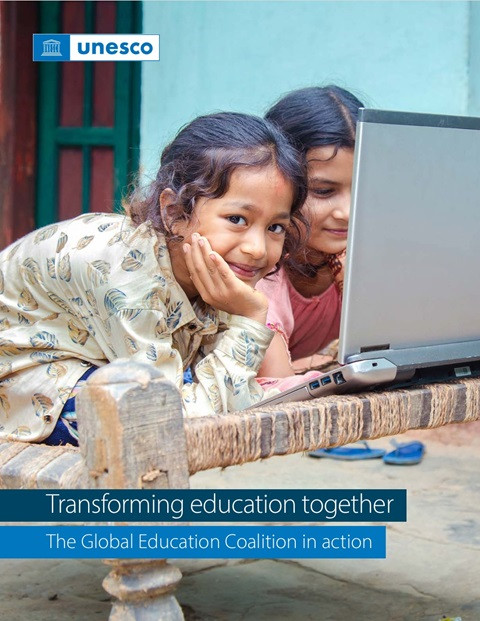 Transforming Education Together: The Global Education Coalition in Action Année de publication: 2023 Auteur institutionnel: UNESCO The Global Education Coalition, launched by UNESCO, is a platform for col-laboration and exchange to protect the right to education during this unprec-edented disruption and beyond. This is the fourth progress report of the Coalition and builds on the inaugural document released in September 2020 and the first annual report published in March 2021. This document covers activity between November 2021 and March 2023.