
Ressources
Explorez une large gamme de ressources sur le GCED afin d’approfondir votre compréhension et de renforcer vos activités de recherche, de plaidoyer, d’enseignement et d’apprentissage.
845 résultats trouvés
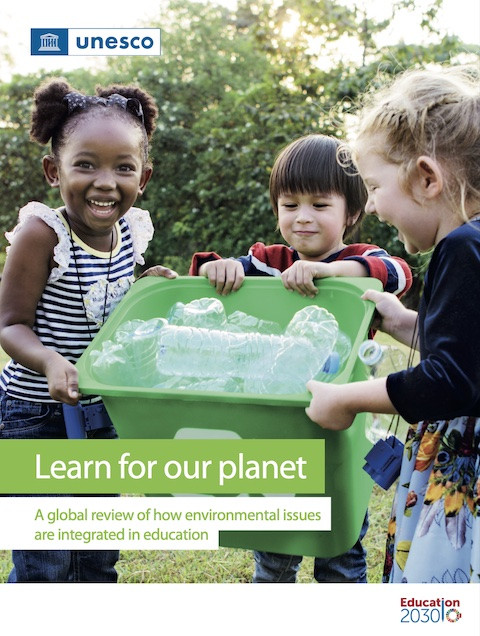 Learn For Our Planet: A Global Review Of How Environmental Issues Are Integrated In Education Année de publication: 2021 Auteur institutionnel: UNESCO 2020 was the equal hottest year on record. One million species are at risk of extinction. We use more resources than the planet can generate each year - if we continue to live the way we do today, we will need three earths by 2050. The way we currently live is not sustainable. Urgent change is needed, but lasting change is impossible without education.This publication presents the extent to which environmental issues are integrated in primary and secondary education policies and curricula across 46 UNESCO Member States. Over half of education policies and curricula studied made no mention of climate change. Only 19 per cent made reference to biodiversity. Countries have made progress: 83 per cent of education policies and curricula studied addressed the environment at least once, and 69 per cent mentioned sustainability - but it is clear that more needs to be done to prepare learners with the knowledge, skills, values and attitudes to act for our planet. Governments, education policy-makers, academics, and education and environmental stakeholders need to further commit to Education for Sustainable Development.
 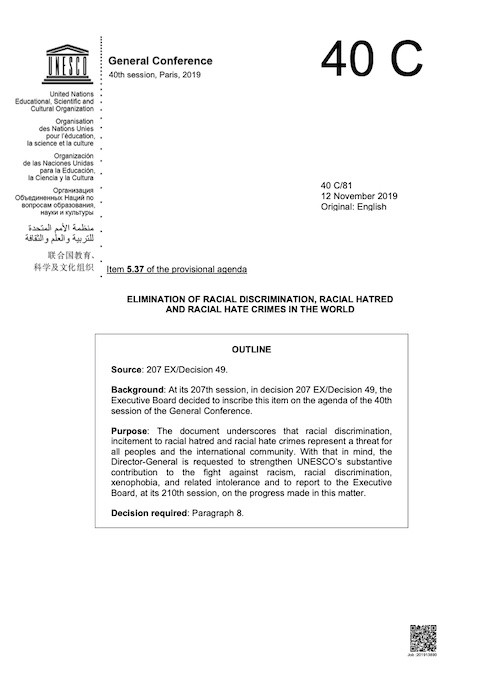 Ликвидация расовой дискриминации, расовой ненависти и преступлений на почве расовой ненависти во всем мире (Генеральная конференция; 40-я сессия) Année de publication: 2019 Auteur institutionnel: Организация Объединенных Наций по вопросам образования, науки и культуры (UNESCO) На своей 207-й сессии Исполнительный совет в решении 207 EX/49 постановил включить данный пункт в повестку дня 40-й сессии Генеральной конференции. В настоящем документе отмечается, что расовая дис- криминация, подстрекательство к расовой ненависти и преступления на почве расовой ненависти представляют собой угрозу для всех народов и международного сообщества. С учетом этого Генераль- ному директору предлагается укрепить содержательный вклад ЮНЕСКО в борьбу с расизмом, расовой дискриминацией, ксенофо- бией и связанной с ними нетерпимостью и представить Исполнитель- ному совету на его 210-й сессии доклад о достигнутых в данной обла- сти результатах. 消除世界上的种族歧视、种族仇恨和种族仇恨犯罪 Année de publication: 2019 Auteur institutionnel: 联合国教科文组织 (UNESCO) 本文件强调,种族歧视、煽动种族仇恨和种族仇恨犯罪对各国人民和国际社会构成威胁。考虑到这一点,兹要求总干事加大教科文组织对打击种族主义、种族歧视、仇外心理及相关不容忍行为的实质性贡献,并向执行局第二一〇届会议报告在这一事项上取得的进展。
 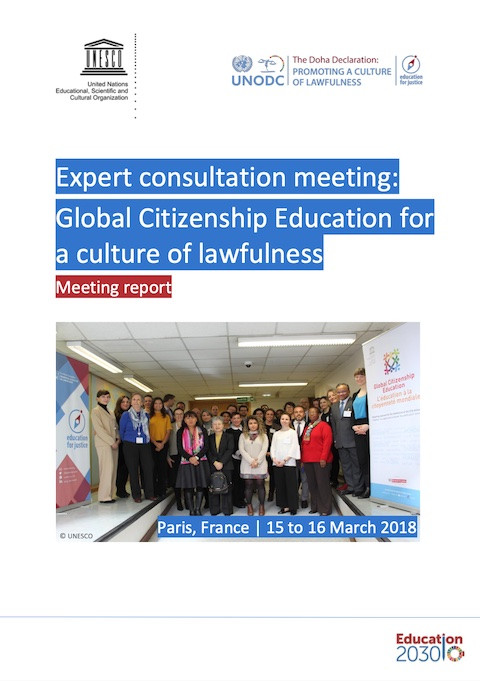 Expert Consultation Meeting: Global Citizenship Education for a Culture of Lawfulness; Meeting Report Année de publication: 2018 Auteur institutionnel: UNESCO | UN. Office on Drugs and Crime (UNODC) In the context of a UNESCO/UNODC partnership on “Global Citizenship Education for a Culture of Lawfulness”, an expert consultation meeting was held in Paris on March 15 and 16 of 2018. The purpose of the partnership is to strengthen the capacities of educational systems to promote the rule of law. To this end, the partnership aims to empower and equip learners to act and engage in society as constructive and ethically responsible agents of change, supporting peace, justice, and strong institutions. This notably contributes to the achievement of the 2030 Agenda for Sustainable Development, and in particular Sustainable Development Goals 4 and 16. Additionally, the partnership intends to enable learners to be both motivated and capable to respond resiliently to crime and violence. The meeting had three broad objectives: To help clarify the conceptual foundation of the partnership; to identify the measures that can be taken in the education sector to promote a culture of lawfulness; and to identify effective educational approaches. Thus, the meeting is meant to elucidate core concepts and identify promising educational approaches in the promotion of a culture of lawfulness by asking fundamental questions, including: What constitutes the rule of law and a culture of lawfulness? How do we create demand for the rule of law? How do we ensure learners apply these principles? How do we ensure they survive in a context where there is no rule of law?
  Social Contract Pedagogy: A Dialogical and Deliberative Model for Global Citizenship Education (Background paper for the Futures of Education initiative) Année de publication: 2020 Auteur: Richard Desjardins | Carlos Alberto Torres | Susan Wiksten Auteur institutionnel: UNESCO We propose that together Social Contract Pedagogy (SCP) and Global Citizenship Education (GCE) offer a comprehensive vision including key principles and core elements that are important for rethinking education and shaping the future of the world. We introduce the novel concept of Social Contract Pedagogy (SCP) as a means to adapt the social contract in liberal democracies which has been (conceptually) located at the level of the state, to the level of the classroom and other pedagogically relevant contexts. A key feature of this pedagogy is the negotiation of values and norms in ways that maintain cohesion and inclusion and avoids too much power in the hands of sectarian extremes (of any kind) which tend to impose their views on others, oppress and exclude. This includes using fake news, denying scientific debates and/or any extremely politicized interpretations of evidence and facts to obfuscate or deny consequences of individual and group choices and behavior, but also ‘othering’ of any kind whether from the political right or the political left. In our view, this is an essential premise for the education of democratic citizens. Citizenship education of this kind is seen as essential for the survival and growth of liberal democracies in the future.
 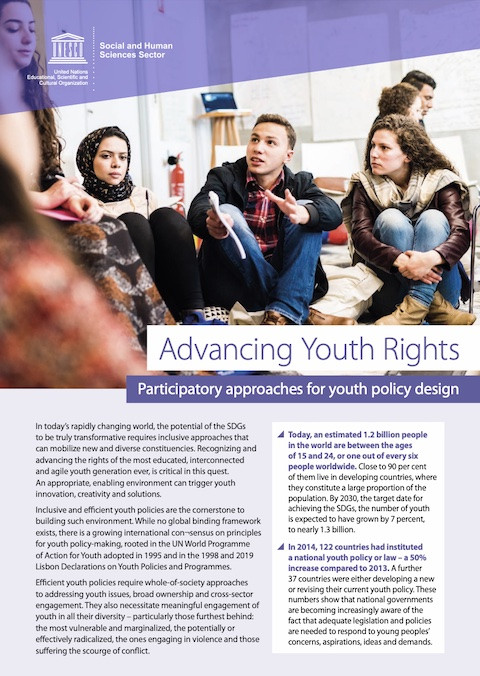 Promover los derechos de las personas jóvenes: Enfoques participativos para diseñar políticas de juventud Année de publication: 2019 Auteur institutionnel: Organización de las Naciones Unidas para la Educación, la Ciencia y la Cultura (UNESCO) Para crear este entorno, es esencial contar con políticas públicas de juventud inclusivas y eficientes. Si bien no existe un marco vinculante a nivel mundial, existe un consenso internacional cada vez mayor en lo que respecta a los principios que deben guiar la formulación de políticas de juventud. Dicho consenso dimana del Programa de Acción Mundial de las Naciones Unidas para los Jóvenes, aprobado en 1995, y de las Declaraciones de Lisboa sobre Políticas y Programas relativos a la Juventud de 1998 y 2019. Para que las políticas públicas de juventud sean eficientes, los enfoques deben englobar a toda la sociedad para abordar los problemas de la juventud y contar con una colaboración intersectorial. También se requiere la verdadera participación e inclusión las juventudes en toda su diversidad incluyendo quienes que han quedado atrás: jóvenes en situación de vulnerabilidad, marginado/as, que podrían radicalizarse o ya lo han hecho, que cometen actos violentos y quienes sufren el flagelo de los conflictos. Faire progresser les droits des jeunes: Approches participatives pour la conception des politiques de jeunesse Année de publication: 2019 Auteur institutionnel: Organisation des Nations Unies pour l'éducation, la science et la culture (UNESCO) Des politiques de jeunesse inclusives et efficaces sont la pierre angulaire du développement d’un tel environnement. Bien qu’il n’existe pas de cadre mondial contraignant, il y a un consensus international grandissant sur les principes de l’élaboration des politiques de jeunesse, enracinés dans le Programme d’action mondial des Nations Unies pour la jeunesse, adopté en 1995 et dans les Déclarations de Lisbonne de 1998 et 2019 sur les politiques et programmes en faveur de la jeunesse. Pour être efficaces, les politiques en faveur de la jeunesse doivent s’appuyer sur une approche globale de la société pour traiter les problèmes des jeunes, une large appropriation et un engagement intersectoriel. Elles nécessitent également un engagement significatif envers les jeunes dans toute leur diversité - en particulier envers les plus démunis : les plus vulnérables et marginalisés, ceux qui sont potentiellement ou effectivement radicalisés, ceux qui s’engagent dans la violence et ceux qui souffrent des situations de conflit.
 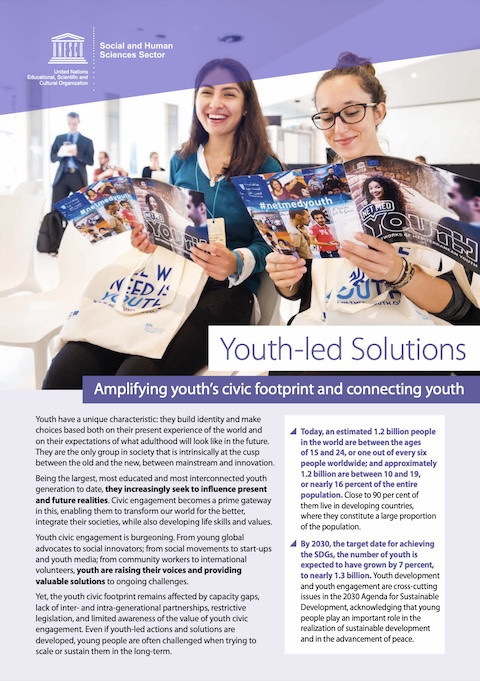 Youth-Led Solutions: Amplifying Youth’s Civic Footprint and Connecting Youth Année de publication: 2019 Auteur institutionnel: UNESCO UNESCO believes in the value of youth civic engagement and youth‐led solutions. In line with our Operational Strategy on Youth (2014‐2021), our approach to meaningfully engaging with youth entails working with youth as change‐makers and partners, and not solely as beneficiaries. We apply cutting‐edge approaches and programmes that contribute to shaping an enabling ecosystem for meaningful, effective and sustainable youth civic engagement. Soluciones impulsadas por las juventudes: Ampliar la huella cívica de las personas jóvenes y ponerles en contacto Année de publication: 2019 Auteur institutionnel: Organización de las Naciones Unidas para la Educación, la Ciencia y la Cultura (UNESCO) La Organización de las Naciones Unidas para la Educación, la Ciencia y la Cultura (UNESCO) cree en el valor de la participación cívica de las personas jóvenes y en las soluciones que generan . Con el fin de colaborar de forma productiva con las juventudes, trabajamos con ellas considerándolas generadoras del cambio y socias, no meras beneficiarias, en consonancia con nuestra Estrategia Operacional sobre la Juventud (2014-2021). Aplicamos estrategias y programas de punta que contribuyen a conformar un ecosistema propicio para una participación cívica significativa, eficaz y sostenible de las personas jóvenes. Solutions pilotées par les jeunes: Renforcer la responsabilité civique des jeunes et les connecter entre eux Année de publication: 2019 Auteur institutionnel: Organisation des Nations Unies pour l'éducation, la science et la culture (UNESCO) L’UNESCO reconnaît la valeur de l’engagement civique des jeunes et des solutions proposées par ces derniers. Dans la continuité de sa Stratégie opérationnelle sur la jeunesse (2014-2021), l’UNESCO est voué à associer les jeunes en tant que partenaires et porteurs de changements, et pas seulement en tant que bénéficiaires. Nous mettons en place des approches et des programmes de pointe qui contribuent à façonner un écosystème propice à un engagement civique significatif, efficace et durable des jeunes.