
Ressources
Explorez une large gamme de ressources sur le GCED afin d’approfondir votre compréhension et de renforcer vos activités de recherche, de plaidoyer, d’enseignement et d’apprentissage.
845 résultats trouvés
 Artificial Intelligence and Gender Equality: Key Findings of UNESCO’s Global Dialogue Année de publication: 2020 Auteur institutionnel: UNESCO The purpose of the UNESCO’s Dialogue on Gender Equality and AI was to identify issues, challenges, and good practices to help: Overcome the built-in gender biases found in AI devices, data sets and algorithms; Improve the global representation of women in technical roles and in boardrooms in the technology sector; and Create robust and gender-inclusive AI principles, guidelines and codes of ethics within the industry. This Summary Report sets forth proposed elements of a Framework on Gender Equality and AI for further consideration, discussion and elaboration amongst various stakeholders. It reflects experts’ inputs to the UNESCO Dialogue on Gender Equality and AI, as well as additional research and analysis. This is not a comprehensive exploration of the complexities of the AI ecosystem in all its manifestations and all its intersections with gender equality. Rather, this is a starting point for conversation and action and has a particular focus on the private sector. It argues for the need to 1. Establish a whole society view and mapping of the broader goals we seek to achieve in terms of gender equality;2. Generate an understanding of AI Ethics Principles and how to position gender equality within them; 3. Reflect on possible approaches for operationalizing AI and Gender Equality Principles; and4. Identify and develop a funded multi-stakeholder action plan and coalition as a critical next step.
  UNESCO Women for Ethical AI: Outlook Study on Artificial Intelligence and Gender Année de publication: 2024 Auteur institutionnel: UNESCO The gender chapter of the UNESCO Recommendation on the Ethics of AI is a concrete commitment by 194 Member States to advance gender equality in the AI ecosystem. To track progress in the implementation of the gender provisions of UNESCO’s Recommendation, and to assess the impacts of AI on gender equality, the UNESCO Women for Ethical AI (W4EAI) Platform has been established. This report advances the workstream through evidence-based insights in three critical areas: women’s participation in AI development and deployment, the inclusion of gender equality concerns in AI governance and the impact of AI on gender equality. It highlights the significant underrepresentation of women in AI, the lack of gender-disaggregated data, and the compounded challenges women face in the field. The report also addresses the neglect of gender dimensions in AI policy, the risks posed by AI systems to women, and the need for responsible and ethical AI governance to promote gender equality. Finally, it outlines actionable recommendations to enhance gender equality through and in AI, emphasizing the importance of comprehensive data collection, targeted interventions, and inclusive policy-making.
  Youth Can Move the World Année de publication: 2021 Auteur institutionnel: UNESCO The COVID-19 pandemic brought unprecedented educational disruption with 1.2 billion children and youth impacted by school closures. Yet, despite these challenges, there is hope. This documentary focuses on the power and agency of youth. It is developed under the framework of the long-term partnership between UNESCO's Global Citizenship and Peace Education and UNODC that bridges the justice and education sectors to guide young people towards building strong, just and democratic societies. Youth’s voices are in the forefront with sentiments echoed by world leaders, policy makers, justice actors and educators to deliver a compelling message on the power of youth to move the world.
  Reimagining Our Futures Together: A New Social Contract for Education Année de publication: 2021 Auteur institutionnel: International Commission on the Futures of Education | UNESCO Our humanity and planet Earth are under threat. The pandemic has only served to prove our fragility and our interconnectedness. Now urgent action, taken together, is needed to change course and reimagine our futures. This report by the International Commission on the Futures of Education acknowledges the power of education to bring about profound change. We face a dual challenge of making good on the unfulfilled promise to ensure the right to quality education for every child, youth and adult and fully realizing the transformational potential of education as a route for sustainable collective futures. To do this, we need a new social contract for education that can repair injustices while transforming the future.This new social contract must be grounded in human rights and based on principles of non-discrimination, social justice, respect for life, human dignity and cultural diversity. It must encompass an ethic of care, reciprocity, and solidarity. It must strengthen education as a public endeavour and a common good.This report, two years in the making and informed by a global consultation process engaging around one million people, invites governments, institutions, organizations and citizens around the world to forge a new social contract for education that will help us build peaceful, just, and sustainable futures for all.The visions, principles, and proposals presented here are merely a starting point. Translating and contextualizing them is a collective effort. Many bright spots already exist. This report attempts to capture and build on them. It is neither a manual nor a blueprint but the opening up of a vital conversation.
 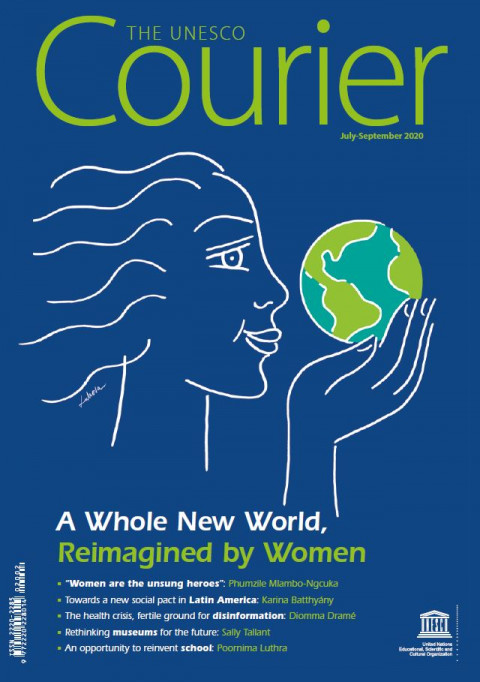 A Whole New World, Reimagined by Women (The UNESCO Courier no. 2, July-September 2020) Année de publication: 2020 Auteur institutionnel: UNESCO In this issue, the UNESCO Courier gives women a voice. Political scientists, journalists, sociologists, researchers, writers, and teachers have drawn the contours of the post-pandemic era – whether it is the future of museums, changes in schools, the rise of disinformation, or the challenges of scientific research.This issue paints a sobering picture of our times – highlights the fault-lines exposed by the health crisis, and shows the magnitude of the challenges ahead. It also underlines the potential for scientific, cultural and educational co-operation that this unprecedented event has revealed. If the reflections, the desire for change, and the movements of mutual aid that have emerged are not short-lived, the world really could become a more united, more sustainable and more egalitarian place.