
Ressources
Explorez une large gamme de ressources sur le GCED afin d’approfondir votre compréhension et de renforcer vos activités de recherche, de plaidoyer, d’enseignement et d’apprentissage.
114 résultats trouvés
 Promoting inclusive teacher education: Introduction Année de publication: 2013 Auteur: Ian Kaplan | Ingrid Lewis Auteur institutionnel: UNESCO Bangkok ‘Promoting Inclusive Teacher Education’ is a series of five advocacy guides. The guides discuss challenges and barriers to inclusive education in different areas of teacher education and offer related strategies and solutions for effective advocacy towards more inclusive practices. The series begins with this introductory guide. It provides an overview of inclusive teacher education and of what advocacy means in this context. It also provides an introduction to the topics covered in the four other guides in the series. These are ‘Policy’, ‘Curriculum’, ‘Materials’, and ‘Methodology’.Advocacy Guide 1: Introduction – This introductory guide begins by providing a brief introduction to inclusive education. Readers should not, however, see this introductory guide as their only guide for understanding inclusive education. It is assumed that advocates will either have existing knowledge of inclusive education or will refer to other more comprehensive sources of information to learn about the concept. This guide goes on to explain the benefits of integrating awareness and understanding of inclusive education throughout pre-service teacher education. Finally, it provides a practical introductory guide to advocacy.
  Education and Training in a Changing Word: What Skills Do We Need? Année de publication: 2015 Auteur institutionnel: UNESCO Bangkok What skills do learners need in today’s world? While academic skills have often been the focus of education systems, other skills that help us to better learn to live together and prepare us for the world of work must not be underestimated. This video highlights key messages on the importance of these skills, such as critical thinking, creativity, teamwork and empathy among many others as we enter a new era for Education 2030: towards inclusive and quality education and lifelong learning for all.
  Promoting inclusive teacher education: curriculum Année de publication: 2013 Auteur: Ian Kaplan | Ingrid Lewis Auteur institutionnel: UNESCO Bangkok ‘Promoting Inclusive Teacher Education’ is a series of five advocacy guides. The guides discuss challenges and barriers to inclusive education in different areas of teacher education and offer related strategies and solutions for effective advocacy towards more inclusive practices. The series begins with this introductory guide. It provides an overview of inclusive teacher education and of what advocacy means in this context. It also provides an introduction to the topics covered in the four other guides in the series. These are ‘Policy’, ‘Curriculum’, ‘Materials’, and ‘Methodology’.Advocacy Guide 3: Curriculum – changing the overall organization and sequencing of teacher education. Curriculum refers to the overall courses of study at pre-service teacher education institutions. A curriculum is a way of organizing and sequencing learning experiences with the aim of achieving specified learning outcomes. It guides what will be learned, and why, and how this learning is facilitated. The curriculum reflects connections between society, politics and schools/teachers, so the development of inclusive curricula reflects 2 ADVOCACY GUIDE 1 3 a desire to develop an equitable, non-discriminatory society1 through attention to the overall structuring of teaching and learning within teacher education.
  Promoting inclusive teacher education: materials Année de publication: 2013 Auteur: Ian Kaplan | Ingrid Lewis Auteur institutionnel: UNESCO Bangkok ‘Promoting Inclusive Teacher Education’ is a series of five advocacy guides. The guides discuss challenges and barriers to inclusive education in different areas of teacher education and offer related strategies and solutions for effective advocacy towards more inclusive practices. The series begins with this introductory guide. It provides an overview of inclusive teacher education and of what advocacy means in this context. It also provides an introduction to the topics covered in the four other guides in the series. These are ‘Policy’, ‘Curriculum’, ‘Materials’, and ‘Methodology’.Advocacy Guide 4: Materials – changing the materials that are used to support teaching and learning within teacher education. Materials refer to the resources (e.g. textbooks) which are used in pre-service teacher education institutions. Teacher education utilizes a wide range of materials, including those used by teacher educators as an aid to teaching, and those used by student teachers as an aid to learning.
  Promoting inclusive teacher education: methodology Année de publication: 2013 Auteur: Ian Kaplan | Ingrid Lewis Auteur institutionnel: UNESCO Bangkok ‘Promoting Inclusive Teacher Education’ is a series of five advocacy guides. The guides discuss challenges and barriers to inclusive education in different areas of teacher education and offer related strategies and solutions for effective advocacy towards more inclusive practices. The series begins with this introductory guide. It provides an overview of inclusive teacher education and of what advocacy means in this context. It also provides an introduction to the topics covered in the four other guides in the series. These are ‘Policy’, ‘Curriculum’, ‘Materials’, and ‘Methodology’.Advocacy Guide 5: Methodology – changing teaching methodology within teacher education institutions. Methodology refers to the theory and practice of teaching and learning. This addresses how teaching and learning is understood, organized, and conducted. Methodology, then, is the overall framework or approach to teaching which encompasses specific teaching methods. For example, an overall inclusive teaching methodology involves specific approaches to individualized/personalized instruction, and learner-centred teaching. These four advocacy guides are structured so that they: • break the issue down into several key challenges; • analyse the broad situation in the region, and suggest questions that advocates could ask to help them investigate the situation in their specific context; and • suggest pertinent advocacy goals, and the messages that advocates may want to convey, as well as indicators for deciding whether advocacy on the issue is having any impact. Tables at the end of each advocacy guide summarize the advocacy messages and suggest potential targets for each message, and then offer space for readers to make notes about how they might convey these messages to each target (drawing on advice provided in the brief guide to advocacy in this introductory guide). Illustrative case studies are provided wherever possible, and readers are encouraged to use their own investigations within their context to identify local case studies that they can use to back up their advocacy messages.
  Promoting inclusive teacher education: policy Année de publication: 2013 Auteur: Ian Kaplan | Ingrid Lewis Auteur institutionnel: UNESCO Bangkok ‘Promoting Inclusive Teacher Education’ is a series of five advocacy guides. The guides discuss challenges and barriers to inclusive education in different areas of teacher education and offer related strategies and solutions for effective advocacy towards more inclusive practices. The series begins with this introductory guide. It provides an overview of inclusive teacher education and of what advocacy means in this context. It also provides an introduction to the topics covered in the four other guides in the series. These are ‘Policy’, ‘Curriculum’, ‘Materials’, and ‘Methodology’.Advocacy Guide 2: Policy – raising awareness of existing policies for inclusive education and changing/adapting policies at different levels in the education system (e.g. at the ministry, teacher education institution and school levels). Policy refers mainly to the guiding rules, laws and principles of education at the national level and within teacher education institutions. Policy guides the practices of individuals, groups and institutions on various inclusive education issues.
  Regional Capacity Development Resource Book on Monitoring SDG4-Education 2030 in Asia-Pacific Année de publication: 2019 Auteur institutionnel: UNESCO Bangkok | UNICEF East Asia and the Pacific The Education 2030 Agenda calls for robust monitoring, reporting, and evaluating indicators from Early Childhood Education (ECE) to adult education. The new agenda demands clear indicators and measurement to generate evidence-based international discourses and advocacy. Ensuring availability of education data and statistics for evidence based policy making and planning is also crucial. Countries’ capacity to respond to these demands will depend on quality mechanism for monitoring in place and technical capacity of data providers and users. The modules included in the this Regional Capacity Development Resource Book on Monitoring SDG 4-Education 2030 in Asia Pacific covers various topics that are relevant to building an effective national monitoring system, such as the creation of a national indicator framework and the development of national strategies for education statistics; strengthening the administrative data production system; and increasing the household survey application in monitoring education at the national level, as well as reporting at the global level.
 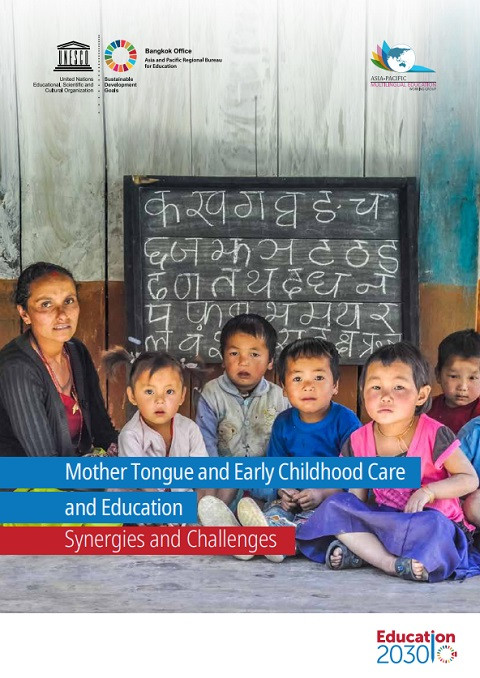 Mother Tongue and Early Childhood Care and Education: Synergies and Challenges Année de publication: 2020 Auteur: Sheldon F. Shaeffer Auteur institutionnel: UNESCO Bangkok Evidence tells us that learning first in one’s MT leads to better outcomes in the future – for individuals, cultures, and nations. But MT is used rarely in ECCE programmes and the early grades of primary school so that many children are forced to learn in a language they poorly understand, and in an environment which neglects and even represses their cultural identity and the language which “carries” it. Evidence also tells us that good quality ECCE programmes enhance the well-being of young children. But many governments spend few resources on ECCE and put very little effort into creating a developmentally and linguistically appropriate curriculum and pedagogy for young pre-school children. The challenge is that while the most disadvantaged children benefit the most from ECCE programmes, these children participate in them the least. Thus, for both cultural and educational reasons, and as a child’s right, ECCE and initial literacy should be provided in a child’s MT, and actions can be taken at both macro- and micro-levels to ensure that this is achieved. In other words, the long and often difficult process of revitalising, maintaining, and further developing endangered languages of indigenous peoples must begin first in families and communities – but then must continue into ECCE programmes and into the wider education system. Without this, indigenous, minority languages and cultures will never thrive – and many will not survive.
 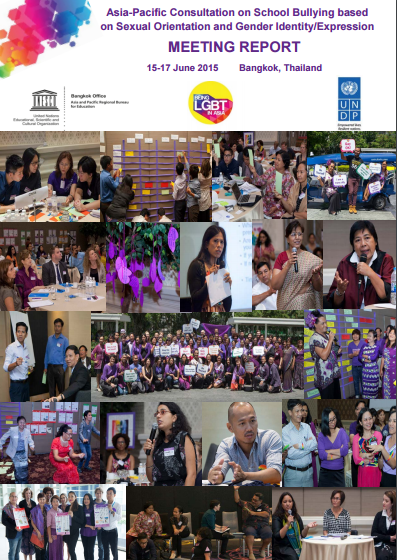 Asia-Pacific Consultation on School Bullying Based on Sexual Orientation and Gender Identity/Expression Année de publication: 2015 Auteur institutionnel: UNESCO Bangkok This report documents the presentations and discussions made during the Asia-Pacific Consultation on School Bullying based on Sexual Orientation and Gender Identity/Expression held from 15-17 June 2015 at the Pullman King Power Hotel in Bangkok, Thailand.
  School-related violence and bullying on the basis of Sexual Orientation and Gender Identity or Expression (SOGIE): synthesis report on China, the Philippines, Thailand and Viet Nam Année de publication: 2018 Auteur institutionnel: UNESCO Bangkok School related violence and bullying is a problem in all countries. UNESCO is committed to ensuring that all children and young people have access to safe, inclusive, health-promoting learning environments as part of its strategy on education for health and well-being. This synthesis report on school related violence and bullying on the basis of Sexual Orientation and Gender Identity or Expression (SOGIE), covering China, the Philippines, Thailand and Viet Nam, was developed to broaden awareness and understanding about this issue, while also identifying best practices and policies. It also aims to mobilize support for advocacy among educators, research institutions, policy makers and activists at the national and regional levels.