
Ressources
Explorez une large gamme de ressources sur le GCED afin d’approfondir votre compréhension et de renforcer vos activités de recherche, de plaidoyer, d’enseignement et d’apprentissage.
68 résultats trouvés
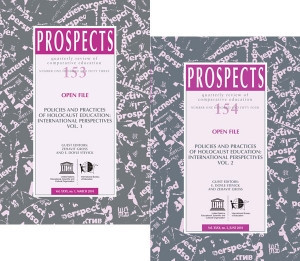 Politiques et pratiques de l'éducation holocauste: perspectives internationales (Vol 40) Émission 153-154 Année de publication: 2010 Auteur institutionnel: UNESCO International Bureau of Education (IBE) Ce double numéro de Perspectives (UNESCO / BIE) comprend des contributions importantes et de nouvelles perspectives de chercheurs qui ont examiné les pratiques de l'éducation de l'Holocauste dans diverses parties du monde. Un appel à communications pour cette question a plus de 30 contributions, un pool de documents de qualité qui ont largement dépassé les attentes, conduisant à la production d'un numéro double sur le sujet. L'intérêt général et de nouvelles recherches sont un témoignage à la fois l'importance du champ et à ses défis. Les articles dans le premier volume contribuent la recherche empirique sur les politiques et les pratiques réelles de l'Holocauste et portent des enseignements directs de pratiques scolaires et en classe, non seulement pour les pays d'Europe, mais aussi pour les droits de l'homme et éducation à la paix à travers le monde. Le deuxième volume continue de refléter l'engagement pratique et intellectuel de ses auteurs avec les conséquences de l'Holocauste pour les droits de l'homme, multiculturel, la paix et l'éducation civique. (Par l'éditeur)
  What Makes a Quality Curriculum?: In-Progress Reflection No.2 on Current and Critical Issues in Curriculum and Learning Année de publication: 2016 Auteur: Philip Stabback Auteur institutionnel: UNESCO International Bureau of Education (IBE) Sustainable Development Goal Four has to do with education in the post-2015 development agenda. It aims to “ensure inclusive and equitable quality education and promote lifelong learning opportunities for all”.Given the essential role of curriculum in enabling quality learning and in articulating and supporting education that is relevant to holistic development, our purpose in this paper is to identify what makes a quality curriculum, so as to support curricular innovation in UNESCO Member States to the end of the realization of Sustainable Development Goal Four.In this we are assuming that curriculum, given its essential role in the provision of quality learning for all children and young people, and in articulating and supporting education that is relevant to holistic development, is critical in the realization of SDG 4. It is the curriculum that determines to a large extent whether education is inclusive, thus playing a significant role in ensuring that provision is equitable. It is the curriculum that provides the structure for the provision of quality learning, especially where teachers might be under-qualified and inexperienced, their classrooms under-resourced, and their students lacking the prior frameworks within which to situate their learning. And it is the curriculum that articulates both the competencies necessary for lifelong learning and the competencies needed for holistic development.We thus argue that curriculum lies at the crossroads of these four key aspects of SDG 4: that education should be (1) inclusive and equitable, (2) characterized by quality learning, (3) promoting lifelong learning, and (4) relevant to holistic development. Curriculum, in other words, provides the bridge between education and development – and it is the competencies associated with lifelong learning and aligned with development needs, in the broadest, holistic sense of the term, that span that bridge.
  Content, Comprehensiveness and Coherence in Policies for Early Childhood: How the Curriculum Can Contribute Année de publication: 2016 Auteur: María Isabel Díaz Auteur institutionnel: UNESCO International Bureau of Education (IBE) In the context of international agreements and commitments concerning early childhood, the purpose of this document is to review and renew the challenges that are involved in forging educational and curriculum policies for the first level of education. In the light of early childhood being increasingly included in the public agenda, countries are making sustained efforts to increase equity and quality in the design and implementation of policies for the early years.These are policies that are in the process of changing by including quality and participation criteria; fine-tuning monitoring and assessment mechanisms; going beyond the lack of sectoral and territorial coordination, among other limitations; moving from a needs-based approach to a rights-based approach; and adopting a comprehensive view. The document analyses, from a long-term public policy perspective, some of the challenges that second-generation policies face, positioning the curriculum as the articulating factor for the development of comprehensive policies for early childhood.
  Personalized Learning within Teacher Education: A Framework and Guidelines Année de publication: 2020 Auteur institutionnel: UNESCO International Bureau of Education (IBE) This paper explores the theoretical and practice elements that together inform the concept of personalised learning. These insights are then used to develop a Framework for Personalized Learning within Teacher Education. In addition, the final chapter outlines pedagogical strategies to support the development of personalised learning that were tested during the project within the participating universities.The Framework and Guidelines are intended for use by to teacher educators and their students, as well as by teachers and students in schools, to support the on‐going shift towards a personalised learning and collaborative paradigm which forefronts learner agency and autonomy and encourages learners of all ages to assume increased responsibility for their own learning and achievements.
  Global Citizenship Concepts in Curriculum Guidelines of 10 Countries: Comparative Analysis Année de publication: 2017 Auteur: Cristián Cox Auteur institutionnel: UNESCO International Bureau of Education (IBE) This paper reports on a study of concepts associated with the new construct of global citizenship education (GCED) in school curricula. We compared the national school curricula of ten countries with markedly different cultures and levels of development across different regions of the world (Africa, Asia, Europe, Latin America, and Southeast Asia) on the presence of concepts associated with GCED. The curricula of both primary and secondary education, in the areas of history and social sciences, and civics and moral education, were compared using a set of categories constructed for this study and derived from UNESCO’s definitions of GCED as well as from the International Association for the Evaluation of Educational Achievement’s (IEA) international assessment studies of civic and citizenship education. Patterns of presence/absence of GCED and related content were identified. The main finding is that only two of the ten countries’ curricula consistently included global citizenship concepts. At the same time, all ten countries, to the extent that the analysis distinguished, included content related to knowledge, values and attitudes that have the world or humanity as referent.
  Repositioning and reconceptualizing the curriculum for the effective realization of Sustainable Development Goal Four, for holistic development and sustainable ways of living Année de publication: 2015 Auteur institutionnel: UNESCO International Bureau of Education (IBE) The purpose of this discussion paper is two-fold, it is to reposition curriculum at the center of the national and the global development dialogue and to highlight its power to give effect to national and to global aspirational statements on the role of education in holistic development. When well designed and effectively enacted, curriculum determines the quality, inclusiveness and development-relevance of education.Second, is to reconceptualize curriculum as a fundamental force of integration of education systems and as an operational tool for giving effect to policies on lifelong learning. Curriculum leads all core aspects of education that are known to determine quality, inclusion, and relevance such as content, learning, teaching, assessment and the teaching and learning environments among others. Its horizontal and vertical articulation, as well as its articulation across learning settings is what gives effect to lifelong learning policies.This paper therefore seeks to reposition curriculum as an indispensable tool for giving effect to SDG Goal 4. Repositionnement et reconceptualiser le programme d'études pour l'utilisation Efficace du Développement Durable Objectif Quatre, pour le développement holistique et modes de vie durables Année de publication: 2015 Auteur institutionnel: UNESCO International Bureau of Education (IBE) Le but de ce document de travail est double, il est de repositionner curriculum au centre national et le dialogue mondial du développement et de mettre en évidence son pouvoir pour donner effet aux nationaux et aux états ambitieux mondiaux sur le rôle de l'éducation dans le développement holistique . Quand bien conçu et efficacement adopté, le curriculum détermine la qualité, l'inclusion et le développement-pertinence de l'éducation. Deuxièmement, il faut reconceptualiser programme comme une force fondamentale de l'intégration des systèmes d'éducation et comme un outil opérationnel pour donner effet aux politiques sur l'apprentissage continu. Curriculum conduit tous les aspects essentiels de l'éducation qui sont connus pour déterminer la qualité, l'inclusion et la pertinence tels que le contenu, l'apprentissage, l'enseignement, l'évaluation et l'enseignement et des environnements d'apprentissage entre autres. Son articulation horizontale et verticale, ainsi que son articulation dans tous les milieux d'apprentissage est ce qui donne effet aux politiques d'apprentissage continu. Ce document vise donc à repositionner programme comme un outil indispensable pour donner effet à ODD Objectif 4.
  Education for Citizenship in the Caribbean: A Study on Curricular Policy and Teacher Training in Cuba, Haiti and the Dominican Republic Année de publication: 2005 Auteur: Cheila Valera Acosta Auteur institutionnel: UNESCO International Bureau of Education (IBE) | Facultad Latinoamericana de Ciencias Sociales (FLACSO) This study aims to describe teacher training and curricular policy for the primary and secondary levels in relation to education for citizenship in Cuba, Haiti and the Dominican Republic and make practical recommendations for improvements in the quality of design and implementation of these initiatives in the three countries.The following are some of the conclusions: At the start of the twenty-first century, Cuba, the Dominican Republic and Haiti share a context in which the processes of democratization have encountered obstacles connected with their colonial heritage, the hegemony of the European nations and the influence and direct interference from United States geopolitical, economic and cultural power.These democracies have developed from long and violent political dictatorships, which established authoritarian and restrictive institutional mechanisms for the day-to-day administration of public affairs. Public policies on education for citizenship should therefore take account of the contradictions faced by the democratizing processes and of the complex cultural impact on the development of social identities brought about by the phenomenon of mass migration.These issues and the tensions arising from social and economic inequalities are inadequately addressed in the three countries’ curricula and teacher training policies.There are legal bases integrating education for citizenship as part of the State’s educational responsibilities in all three countries. Education for citizenship is intended as a specific subject for the primary and secondary school levels.Educational proposals are required that can provide the population with greater understanding of community life, skills for confronting traditional ideological indoctrination, and for learning to live together while recognizing differences, and for helping to educate the imagination for a broader view of human affairs and our responsibilities with regard to them.The actors involved in teacher training in the three countries consider it a key tool for the democratic development of societies. Their main criticisms indicate that there is a need to improve the contents and the approaches to teacher training so that they can respond to the current challenges of these societies from an interdisciplinary standpoint consistent with the stated educational goals. Education à la citoyenneté dans les Caraïbes: une étude sur la politique des programmes et la formation des enseignants à Cuba, en Haïti et en République Dominicaine Année de publication: 2005 Auteur: Cheila Valera Acosta Auteur institutionnel: UNESCO International Bureau of Education (IBE) | Facultad Latinoamericana de Ciencias Sociales (FLACSO) Cette étude vise à décrire la formation des enseignants et de la politique des programmes d'études pour les niveaux primaire et secondaire par rapport à l'éducation à la citoyenneté à Cuba, en Haïti et en République dominicaine et faire des recommandations pratiques pour l'amélioration de la qualité de la conception et la mise en œuvre de ces initiatives dans les trois pays .Voici quelques-unes des conclusions:Au début du XXIe siècle, Cuba, la République Dominicaine et Haïti partagent un contexte dans lequel les processus de démocratisation ont rencontré des obstacles liés à leur héritage colonial, l'hégémonie des nations européennes et l'influence et l'ingérence directe de Etats-Unis puissance géopolitique, économique et culturelle.Ces démocraties ont développé des dictatures politiques longues et violentes, qui ont établi des mécanismes institutionnels autoritaires et contraignantes pour l'administration des affaires publiques au jour le jour. Les politiques publiques en matière d'éducation à la citoyenneté doivent donc tenir compte des contradictions rencontrées par les processus de démocratisation et de l'impact culturel complexe sur le développement des identités sociales provoquées par le phénomène de la migration de masse.Ces questions et les tensions résultant des inégalités sociales et économiques ne sont pas suffisamment abordés dans les programmes scolaires et la formation des enseignants des politiques des trois pays.Il y a des bases juridiques intégrant l'éducation à la citoyenneté dans le cadre des responsabilités éducatives de l'Etat dans les trois pays. Education à la citoyenneté est conçue comme un sujet spécifique pour les niveaux primaire et secondaire.propositions pédagogiques sont nécessaires qui peuvent fournir à la population avec une plus grande compréhension de la vie communautaire, les compétences pour faire face à l'endoctrinement idéologique traditionnelle, et pour apprendre à vivre ensemble, tout en reconnaissant les différences, et pour aider à éduquer l'imagination pour une vision plus large des affaires humaines et nos responsabilités en ce qui concerne eux.Les acteurs impliqués dans la formation des enseignants dans les trois pays considèrent comme un outil clé pour le développement démocratique des sociétés. Leurs principales critiques indiquent qu'il ya un besoin d'améliorer le contenu et les approches de la formation des enseignants afin qu'ils puissent répondre aux défis actuels de ces sociétés à partir d'un point de vue interdisciplinaire cohérent avec les objectifs éducatifs énoncés Educación para la ciudadanía en el Caribe: estudio sobre política curricular y de formación docente en Cuba, Haití y República Dominicana Année de publication: 2005 Auteur: Cheila Valera Acosta Auteur institutionnel: UNESCO International Bureau of Education (IBE) | Facultad Latinoamericana de Ciencias Sociales (FLACSO) Este documento describe la política curricular de los niveles primarios y secundarios así como la formación docente relacionada con educación para la ciudadanía en Cuba, Haití y República Dominicana con el propósito de realizar recomendaciones prácticas que puedan mejorar la calidad en el diseño e implementación de estas iniciativas en los tres países seleccionados.