
Ressources
Explorez une large gamme de ressources sur le GCED afin d’approfondir votre compréhension et de renforcer vos activités de recherche, de plaidoyer, d’enseignement et d’apprentissage.
52 résultats trouvés
 Inequidad de género en los logros de aprendizaje en educación primaria ¿Qué nos puede decir TERCE?; resumen ejecutivo Année de publication: 2016 Auteur: Denisse Gelber, Ernesto Treviño, Pamela Inostroza Auteur institutionnel: UNESCO Santiago This premise of work clearly establishes that promoting learning opportunities for all will be one of the priorities in the Education 2030. Within this framework, UNESCO Santiago has its own instrument that allows delivering diagnosis and analysis in depth about the learning inequality within the region; the Thrid Regional Comparative and Explanatory Study, TERCE - carried out by the Latin American Laboratory for Assessment of the Quality of Education, LLECE, body bringing together 15 countries and coordinated by our Office.
 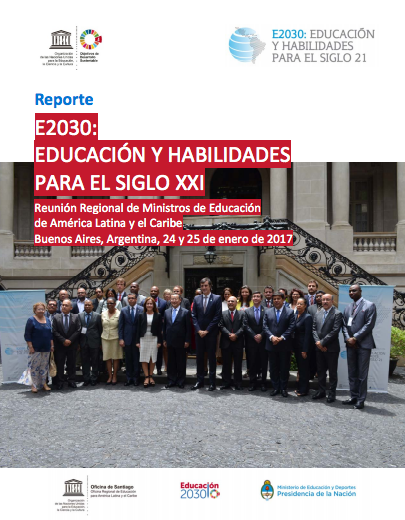 E2030: education and skills for the 21st century, report Année de publication: 2017 Auteur institutionnel: UNESCO Santiago The UNESCO Regional Bureau for Education in Latin America and the Caribbean, OREALC/UNESCO Santiago, in collaboration with the Ministry of Education and Sport of the Republic of Argentina, organized the Regional Meeting of Ministers of Education of Latin America and the Caribbean – “E2030: Education and skills for the 21st century”. Ministers of Education and high-level representatives of the education sector of the Member States of LAC; bilateral, regional and multilateral organizations; United Nations agencies; representatives of civil society; stakeholders and UNESCO experts participated in the meeting, which was held on 24-25 January 2017 in Buenos Aires, Argentina. This was the first ministerial meeting to be organized within the framework of the 2030 Agenda for Sustainable Development and its 17 Sustainable Development Goals (SDGs), in particular SDG 4 – “Ensure inclusive and quality education for all and promote lifelong learning”. It provided a space for dialogue between ministers of education and other stakeholders to debate SDG 4 in the context of the 2030 SDG Agenda. Discussions and information sharing on various topics related to the SDG 4 targets, and on the coordination mechanisms and monitoring instruments conducive to the achievement of E2030 enabled LAC Member States to reach a common vision and understanding of E2030 in the region. This joint approach on E2030 for the region is laid down in the Declaration of Buenos Aires, which ministers adopted at the end of the meeting.
  La Enseñanza del Holocausto en América Latina: los desafíos para los educadores y legisladores Année de publication: 2017 Auteur institutionnel: UNESCO Santiago La Enseñanza del Holocausto en América Latina: los desafíos para los educadores y legisladores E2030: educación y habilidades para el siglo XXI; reporte Année de publication: 2017 Auteur institutionnel: UNESCO Santiago The UNESCO Regional Bureau for Education in Latin America and the Caribbean, OREALC/UNESCO Santiago, in collaboration with the Ministry of Education and Sport of the Republic of Argentina, organized the Regional Meeting of Ministers of Education of Latin America and the Caribbean – “E2030: Education and skills for the 21st century”. Ministers of Education and high-level representatives of the education sector of the Member States of LAC; bilateral, regional and multilateral organizations; United Nations agencies; representatives of civil society; stakeholders and UNESCO experts participated in the meeting, which was held on 24-25 January 2017 in Buenos Aires, Argentina. This was the first ministerial meeting to be organized within the framework of the 2030 Agenda for Sustainable Development and its 17 Sustainable Development Goals (SDGs), in particular SDG 4 – “Ensure inclusive and quality education for all and promote lifelong learning”. It provided a space for dialogue between ministers of education and other stakeholders to debate SDG 4 in the context of the 2030 SDG Agenda. Discussions and information sharing on various topics related to the SDG 4 targets, and on the coordination mechanisms and monitoring instruments conducive to the achievement of E2030 enabled LAC Member States to reach a common vision and understanding of E2030 in the region. This joint approach on E2030 for the region is laid down in the Declaration of Buenos Aires, which ministers adopted at the end of the meeting. E2030: education and skills for the 21st century, report Année de publication: 2017 Auteur institutionnel: UNESCO Santiago The UNESCO Regional Bureau for Education in Latin America and the Caribbean, OREALC/UNESCO Santiago, in collaboration with the Ministry of Education and Sport of the Republic of Argentina, organized the Regional Meeting of Ministers of Education of Latin America and the Caribbean – “E2030: Education and skills for the 21st century”. Ministers of Education and high-level representatives of the education sector of the Member States of LAC; bilateral, regional and multilateral organizations; United Nations agencies; representatives of civil society; stakeholders and UNESCO experts participated in the meeting, which was held on 24-25 January 2017 in Buenos Aires, Argentina. This was the first ministerial meeting to be organized within the framework of the 2030 Agenda for Sustainable Development and its 17 Sustainable Development Goals (SDGs), in particular SDG 4 – “Ensure inclusive and quality education for all and promote lifelong learning”. It provided a space for dialogue between ministers of education and other stakeholders to debate SDG 4 in the context of the 2030 SDG Agenda. Discussions and information sharing on various topics related to the SDG 4 targets, and on the coordination mechanisms and monitoring instruments conducive to the achievement of E2030 enabled LAC Member States to reach a common vision and understanding of E2030 in the region. This joint approach on E2030 for the region is laid down in the Declaration of Buenos Aires, which ministers adopted at the end of the meeting. E2030: education and skills for the 21st century, report Année de publication: 2017 Auteur institutionnel: UNESCO Santiago The UNESCO Regional Bureau for Education in Latin America and the Caribbean, OREALC/UNESCO Santiago, in collaboration with the Ministry of Education and Sport of the Republic of Argentina, organized the Regional Meeting of Ministers of Education of Latin America and the Caribbean – “E2030: Education and skills for the 21st century”. Ministers of Education and high-level representatives of the education sector of the Member States of LAC; bilateral, regional and multilateral organizations; United Nations agencies; representatives of civil society; stakeholders and UNESCO experts participated in the meeting, which was held on 24-25 January 2017 in Buenos Aires, Argentina. This was the first ministerial meeting to be organized within the framework of the 2030 Agenda for Sustainable Development and its 17 Sustainable Development Goals (SDGs), in particular SDG 4 – “Ensure inclusive and quality education for all and promote lifelong learning”. It provided a space for dialogue between ministers of education and other stakeholders to debate SDG 4 in the context of the 2030 SDG Agenda. Discussions and information sharing on various topics related to the SDG 4 targets, and on the coordination mechanisms and monitoring instruments conducive to the achievement of E2030 enabled LAC Member States to reach a common vision and understanding of E2030 in the region. This joint approach on E2030 for the region is laid down in the Declaration of Buenos Aires, which ministers adopted at the end of the meeting.
  Education and Cultural Diversity Lessons from Innovative Practice in Latin America Année de publication: 2008 Auteur: Carolina Hirmas R. Auteur institutionnel: UNESCO Santiago This publication, which is the second volume of the collection, is the result of analysis and reflection on a series of innovative educational experiences from several Latin American countries, which respond with pedagogical relevance to the students' cultural context and offer an education oriented towards knowledge, understanding and dialogue between people of different cultures. The significant contribution of the aforementioned experiences lies in the recognition and appreciation of the ethnic and cultural diversity of its students and communities, as a starting point for the development of new learning and affirmation of their identity. In turn, life in educational centers promotes intercultural relations of respect and fraternity in a local and subregional sociogeographic context, characterized by multiculturalism.
  VII Days of Educational Corperation with Iberian America on Special Education and Educational Inclusion: Secondary Education Année de publication: 2011 Auteur: Daniela Eroles Auteur institutionnel: UNESCO Santiago | Spain. Ministry of Education The publication that we deliver contains some of the main papers and reflections emanating from the VII Conference on Educational Cooperation with Ibero-America on Special Education and Educational Inclusion, organized by the Ministry of Education of Spain and the Regional Office of Education for Latin America and the Caribbean ( OREALC / UNESCO Santiago). This publication has the inclusion in secondary education as a central theme, since it was the axis of the VII Conference. It is a particularly critical issue in our region since it establishes the minimum level necessary to escape poverty, to access decent employment and to exercise citizenship. However, access to secondary education is still very low in some countries and is especially low in the case of the most vulnerable populations, being those who most require access to this level of studies to overcome their situation of inequality. VII Jornadas de Cooperación Educativa con Iberoamérica sobre Educación Especial e Inclusión Educativa: Educación Secundaria Année de publication: 2011 Auteur: Daniela Eroles Auteur institutionnel: UNESCO Santiago | Spain. Ministry of Education La publicación que entregamos contiene algunas de las principales ponencias y reflexiones emanadas de las VII Jornadas de Cooperación Educativa con Iberoamérica sobre Educación Especial e Inclusión Educativa, organizadas por el Ministerio de Educación de España y la Oficina Regional de Educación para América Latina y el Caribe (OREAL C/UNESCO Santiago). Esta publicación tiene a la inclusión en la educación secundaria como tema central, pues constituyó el eje de las VII Jornadas. Es un tema especialmente crítico en nuestra región ya que establece el nivel mínimo necesario para salir de la pobreza, para acceder a un empleo digno y para ejercer la ciudadanía. Sin embargo, el acceso a la educación secundaria todavía es muy bajo en algunos países y es especialmente bajo en el caso de las poblaciones en situación de mayor vulnerabilidad, siendo quienes más requieren acceder a este nivel de estudios para superar su situación de desigualdad.
  Global Citizenship Education in Latin America and the Caribbean: Towards a World without Walls: Global Citizenship Education in the SDG 4 - E2030 Agenda Année de publication: 2018 Auteur institutionnel: UNESCO Santiago The Latin America and the Caribbean Regional Network Meeting on Global Citizenship Education “Towards a World without Walls: Global Citizenship Education in SDG 4 – Agenda E2030”, was organized by the UNESCO Regional Bureau for Education in Latin America and the Caribbean (OREALC / UNESCO Santiago) and the Asia – Pacific Centre of Education for International Understanding (APCEIU), in collaboration with the Chilean Observatory of Educational Policies (OPECH) of the University of Chile. The event, held on October 23 and 24, 2017, in Santiago, Chile, brought together regional researchers, members of civil society organizations and activists, educational communities, social movements, government educational authorities and universities. The objective of the meeting was to promote dialogue on the concept of Global Citizenship Education (GCED), deepen the regional perspective on the topic and create a network that helps strengthen the implementation of GCED in the context of the Latin America and the Caribbean region. This document summarizes the main topics addressed and issues discussed at the meeting. Subsequently, the founding document of the Regional Global Citizenship Education Network for Latin America and the Caribbean, which was elaborated in light of the meeting’s discussions, is presented.