
Ressources
Explorez une large gamme de ressources sur le GCED afin d’approfondir votre compréhension et de renforcer vos activités de recherche, de plaidoyer, d’enseignement et d’apprentissage.
52 résultats trouvés
 Initial Teacher Education in Citizenship in Latin America: A Comparative Analysis of Six Countries Année de publication: 2017 Auteur institutionnel: UNESCO Santiago This document reports on a study of initial teacher education in citizenship education in Latin America undertaken as an initiative of the OREALC-UNESCO Regional Strategy on Teacher Policies. Its purpose is to examine citizenship education in the teacher education curricula of six countries in the region –Argentina, Chile, Colombia, Guatemala, Mexico and Peru – researching the general contents of the programs, their organization, and the topics covered, and analyzing teacher preparation in this crucial dimension of the formative experience provided. La formación inicial docente en educación para la ciudadanía en América Latina: Análisis comparado de seis casos nacionales Année de publication: 2017 Auteur institutionnel: UNESCO Santiago El presente informe da cuenta de un estudio impulsado por la Estrategia Regional sobre Políticas Docentes de OREALC-UNESCO, acerca de la Formación Inicial Docente en educación para la ciudadanía en América Latina. Su propósito es examinar la presencia de la educación ciudadana en el currículum de la formación de docentes de seis países de la Región –Argentina, Chile, Colombia, Guatemala, México y Perú-, interrogando acerca de qué contenidos, organizados en qué forma, y cubriendo qué temáticas, caracterizan la preparación de maestros y maestras en esta crucial dimensión de la experiencia formativa que provee la escolaridad.
  Education in the Time of COVID-19 (COVID-19 Report; ECLAC-UNESCO) Année de publication: 2020 Auteur institutionnel: Economic Commission for Latin America and the Caribbean (ECLAC) | UNESCO Santiago The coronavirus disease (COVID-19) pandemic has caused an unprecedented crisis in all areas. In the field of education, this emergency has led to the massive closure of face-to-face activities of educational institutions in more than 190 countries in order to prevent the spread of the virus and mitigate its impact. The Economic Commission for Latin America and the Caribbean (ECLAC) has argued that even before the pandemic hit, the social situation in the region was deteriorating, owing to rising rates of poverty and extreme poverty, the persistence of inequalities and growing social discontent. In this context, the crisis will have a profoundly negative impact on the various social sectors, particularly health and education, as well as on employment and poverty. Meanwhile, UNESCO has identified major gaps in educational outcomes, which are related to the unequal distribution of teachers in general, and of the best qualified teachers in particular, to the detriment of lower-income countries and regions and of rural areas, where indigenous and migrant populations tend to be concentrated.In the sphere of education, many of the measures that the region’s countries have adopted in response to the crisis are related to the suspension of face-to-face classes at all levels, which has given rise to three main areas of action: the deployment of distance learning modalities through a variety of formats and platforms (with or without the use of technology); the support and mobilization of education personnel and communities; and concern for the health and overall well-being of students.The aim of this document is to shed light on various consequences that these measures will have on educational communities in the short and medium term, and to offer key recommendations on how to manage those consequences in the best possible manner, drawing attention to opportunities for learning and innovation in the post-pandemic education system. La educación en tiempos de la pandemia de COVID-19 (Inform COVID-19; CEPAL-UNESCO) Année de publication: 2020 Auteur institutionnel: Economic Commission for Latin America and the Caribbean (ECLAC) | UNESCO Santiago La pandemia de enfermedad por coronavirus (COVID-19) ha provocado una crisis sin precedentes en todos los ámbitos. En la esfera de la educación, esta emergencia ha dado lugar al cierre masivo de las actividades presenciales de instituciones educativas en más de 190 países con el fin de evitar la propagación del virus y mitigar su impacto.La Comisión Económica para América Latina y el Caribe (CEPAL) ha planteado que, incluso antes de enfrentar la pandemia, la situación social en la región se estaba deteriorando, debido al aumento de los índices de pobreza y de pobreza extrema, la persistencia de las desigualdades y un creciente descontento social. En este contexto, la crisis tendrá importantes efectos negativos en los distintos sectores sociales, incluidos particularmente la salud y la educación, así como en el empleo y la evolución de la pobreza. Por su parte, la UNESCO ha identificado grandes brechas en los resultados educativos, que se relacionan con una desigual distribución de los docentes, en general, y de los docentes mejor calificados, en particular, en desmedro de países y regiones con menores ingresos y de zonas rurales, las que suelen concentrar además a población indígena y migrante.En el ámbito educativo, gran parte de las medidas que los países de la región han adoptado ante la crisis se relacionan con la suspensión de las clases presenciales en todos los niveles, lo que ha dado origen a tres campos de acción principales: el despliegue de modalidades de aprendizaje a distancia, mediante la utilización de una diversidad de formatos y plataformas (con o sin uso de tecnología); el apoyo y la movilización del personal y las comunidades educativas, y la atención a la salud y el bienestar integral de las y los estudiantes.El objetivo de este documento es visibilizar la diversidad de consecuencias que estas medidas tendrán sobre las comunidades educativas a corto y mediano plazo, así como plantear las principales recomendaciones para sobrellevar el impacto de la mejor manera posible, proyectando oportunidades para el aprendizaje y la innovación en la educación posterior a la pandemia.
  UNESCO regional consultation in Latin America on Holocaust and genocide education: report Année de publication: 2014 Auteur institutionnel: UNESCO Santiago This consultation with Latin American Member States sought to raise awareness amongst policymakers and education specialists of the region about the history of the Holocaust, as it can contribute to the prevention of genocide, following United Nations General Assembly resolution 60/7 on Holocaust remembrance. The meeting also aimed at fostering concrete cooperation between UNESCO and Member States on education about the history of genocide and mass atrocities, notably the Holocaust, with a view of introducing the subject in the curriculum and of developing relevant educational programmes in the region. The overall objectives of the project were as follows:▶ Strengthen educational leaders’ awareness and support for Holocaust remembrance and education about the history of genocide and mass atrocities, in line with regional efforts to foster education for peace and human rights.▶ Increase the implementation of education programmes about the history of the Holocaust and other genocides, and support interested Ministries of Education to introduce these subjects in the curriculum.▶ Foster regional exchanges about this topic and facilitate access to good practices regarding Holocaust and genocide related issues and peace education.
  Educación para el desarrollo sostenible: aportes didácticos para docentes del Caribe Année de publication: 2008 Auteur: Gillian Cambers | Grace Chapman | Paul Diamond | Lorna Down | Anthony D. Griffith | Winthrop Wiltshire Auteur institutionnel: UNESCO Santiago The publication “Teachers’ Guide for Education for Sustainable Development in the Caribbean” is geared towards regional teacher-trainers and teachers active at every level of education. Its purpose is two-fold: contribute to the integration of education for sustainable development into teaching practices through education initiatives, originally implemented in the Caribbean that may be feasible to replicate in the various classrooms, schools and communities; promote reflection, discussion and creation of innovative practices that involve all teachers in Decade activities and contribute to the making of sustainable societies. This document illustrates how different wills can come together moved by a desire to materialise common projects. Thus, this effort represents the work of regional specialists working in close cooperation with UNESCO Regional Bureau for Education in Latin America and the Caribbean, as well as the financial support of the Government of Japan.
  Gender Inequality in Learning Achievement in Primary Education: What can TERCE Tell Us? Année de publication: 2016 Auteur institutionnel: UNESCO Santiago Existing research identifies several significant, subject-based gender inequalities in education. Male learners have significant advantages in mathematics and female learners have no less significant advantages in reading and writin. Such considerable differences in achievement may have important consequences for the future wellbeing of students. In order to shed light on this phenomenon in Latin America, this report analyzes the gender gaps in educational achievement in the Third Regional Comparative and Explanatory Study (TERCE) led by the Latin American Laboratory for Assessment of the Quality of Education (LLECE). Inequidad de género en los logros de aprendizaje en educación primaria ¿Qué nos puede decir TERCE? Année de publication: 2016 Auteur institutionnel: UNESCO Santiago Existing research identifies several significant, subject-based gender inequalities in education. Male learners have significant advantages in mathematics and female learners have no less significant advantages in reading and writin. Such considerable differences in achievement may have important consequences for the future wellbeing of students. In order to shed light on this phenomenon in Latin America, this report analyzes the gender gaps in educational achievement in the Third Regional Comparative and Explanatory Study (TERCE) led by the Latin American Laboratory for Assessment of the Quality of Education (LLECE).
 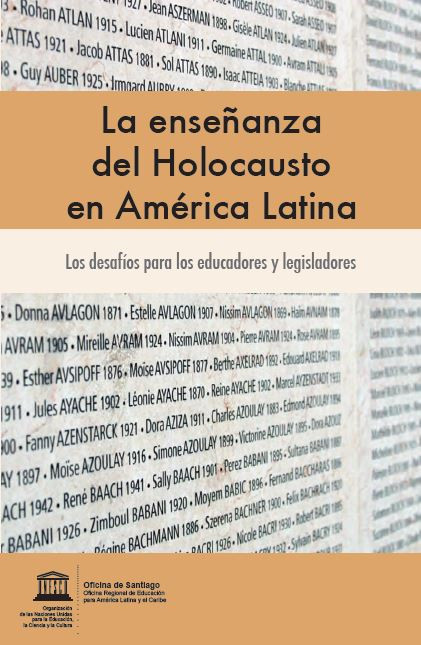 The Teaching of the Holocaust in Latin America the Challenges for Educators and Legislators Année de publication: 2017 Auteur: María Celeste Adamoli | Emmanuel Kahan, Pablo Luzuriaga | Ministerio de Educación Auteur institutionnel: UNESCO Santiago This book provides an overview of opportunities that may arise from educating about the Holocaust in diverse cultural contexts and educational situations, with a special focus on Latin American countries. We can actually be away from the places where the genocide against the Jewish people was perpetrated, but Latin America is still taking charge of its own past of violence and crimes against humanity. With this publication, Latin American educators will have at their fingertips an updated account of the most outstanding topics that are discussed on pedagogy and policy making. You can also explore how, even today in Europe, education about the Holocaust shapes a culture of memory. On the other hand, you can see how in other places the memory of the Holocaust can be a starting point to relate to other difficult pasts. UNESCO is convinced that the prevention of genocide begins at school. In a world where mass violence is possible, this publication will show the importance of teaching young people about the Holocaust and about other genocides in history. It is a condition to prevent similar crimes from happening in the future. La Enseñanza del Holocausto en América Latina: los desafíos para los educadores y legisladores Année de publication: 2017 Auteur: María Celeste Adamoli | Emmanuel Kahan, Pablo Luzuriaga | Ministerio de Educación Auteur institutionnel: UNESCO Santiago Este libro proporciona un panorama de oportunidades que pueden surgir de educar sobre el Holocausto en diversos contextos culturales y situaciones educativas, con un foco especial en los países latinoamericanos. Podemos en realidad estar lejos de los lugares donde el genocidio contra el pueblo judío fue perpetrado, pero también América Latina está todavía haciéndose cargo de su propio pasado de violencia y crímenes contra la humanidad. Con esta publicación, los educadores latinoamericanos van a tener al alcance de la mano un recuento actualizado de los temas más destacados que se discuten sobre pedagogía y construcción de políticas. También podrán explorar cómo, todavía hoy en Europa, la educación sobre el Holocausto da forma a una cultura de la memoria. Por otra parte, pueden ver cómo en otros lugares la memoria del Holocausto puede ser un punto de partida para relacionarse con otros pasados difíciles. La UNESCO está convencida de que la prevención del genocidio comienza en la escuela. En un mundo en donde la violencia masiva es posible, esta publicación mostrará lo importante de enseñar a los jóvenes sobre el Holocausto y sobre otros genocidios en la historia. Es una condición para prevenir que crímenes similares sucedan en el futuro.