
Ressources
Explorez une large gamme de ressources sur le GCED afin d’approfondir votre compréhension et de renforcer vos activités de recherche, de plaidoyer, d’enseignement et d’apprentissage.
26 résultats trouvés
 Une Vie meilleure, un avenir meilleur: partenariat mondial de l'UNESCO pour l'éducation des filles et des femmes Année de publication: 2015 Auteur institutionnel: UNESCO Since its inception, UNESCO has been a strong advocate, promoter and defender of the right to quality education for all, especially for girls and women. Gender equality and education are fundamental human rights, which stand at the core of UNESCO’s mandate. UNESCO launched the Global Partnership for Girls’ and Women’s Education in 2011, guided by the conviction that by educating girls and women, we can break persistent cycles of poverty and in turn foster greater social justice. The Partnership aims to increase learning opportunities for adolescent girls and women and to find solutions to some of the biggest challenges and obstacles to their education. The partnership addresses two weakest links which are secondery education and literacy.
  L'UNESCO et l'égalité des Genres en Afrique Subsaharienne: Des Programmes Novateurs, des Résultats Perceptibles Auteur institutionnel: UNESCO Depuis plus d’une vingtaine d’années l’UNESCO a inscrit son action dans un cadre spécial assorti d’un ensemble de mécanismes institutionnels conçus pour appuyer l’opérationnalisation de ses Priorités: l’Afrique et l’égalité des genres. Au cours de cette période, l’UNESCO a été à l’origine d’importantes réalisations dans les domaines relevant de son mandat à travers la mise en oeuvre des programmes et activités novateurs.La présente publication met en exergue la contribution de l’UNESCO à la mise en oeuvre de l’Agenda 2063 de l’Union africaine et du Programme de développement durable à l’horizon 2030 dans le domaine de l’égalité des genres en Afrique, à travers des exemples de bonnes pratiques, de leçons apprises ainsi que des suggestions et recommandations pour le futur.
 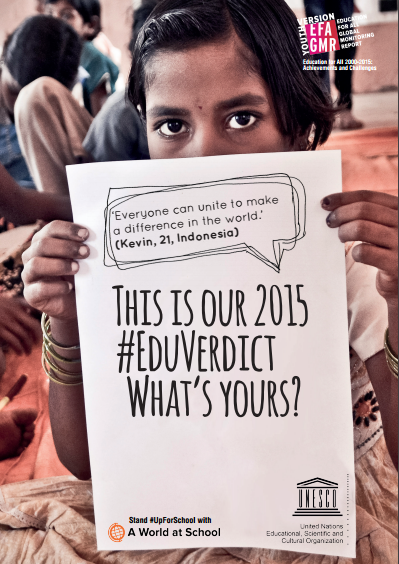 L'Education pour tous 2000-2015: progrès et enjeux, rapport mondial de suivi sur l'EPT, 2015, youth version Année de publication: 2015 Auteur institutionnel: UNESCO This report highlights the progress and challenges that countries have faced over 15 years, brining together the voices of young people to show how Education for All (EFA) has affected their lives.
 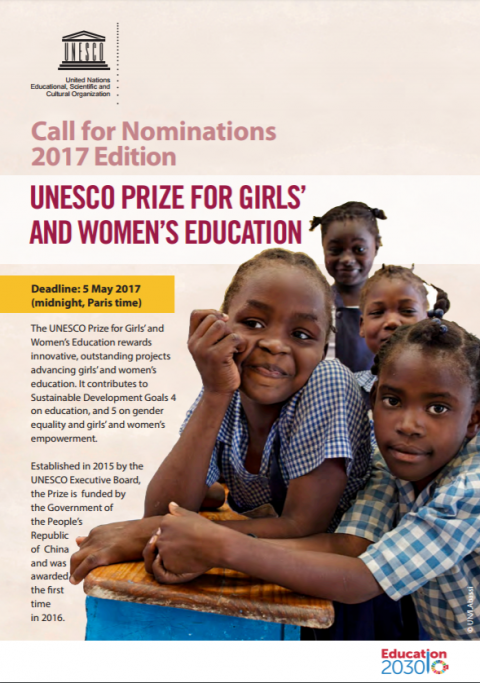 Prix UNESCO pour l'éducation des filles et des femmes, édition 2017: appel à candidatures Année de publication: 2017 Auteur institutionnel: UNESCO The UNESCO Prize for Girls’ and Women’s Education rewards innovative, outstanding projects advancing girls’ and women’s education. It contributes to Sustainable Development Goals 4 on education, and 5 on gender equality and girls’ and women’s empowerment.
 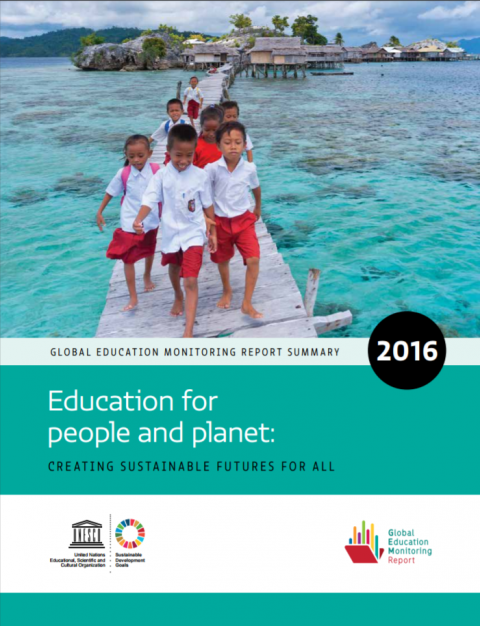 L'Education pour les peuples et la planète: créer des avenirs durables pour tous, résumé du rapport mondial de suivi sur l'éducation, 2016 Année de publication: 2016 Auteur institutionnel: UNESCO The GEM Report provides an authoritative account of how education is the most vital input for every dimension of sustainable development. Better education leads to greater prosperity, improved agriculture, better health outcomes, less violence, more gender equality, higher social capital and an improved natural environment. Education is key to helping people around the world understand why sustainable development is such a vital concept for our common future. Education gives us the key tools – economic, social, technological, even ethical – to take on the SDGs and to achieve them. These facts are spelled out in exquisite and unusual detail throughout the report. Yet the report also emphasizes the remarkable gaps between where the world stands today on education and where it has promised to arrive as of 2030.
 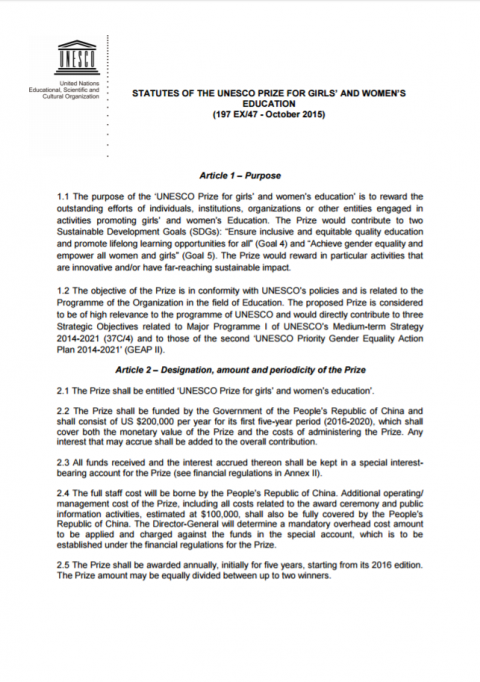 Statuts du Prix UNESCO pour l'éducation des filles et des femmes (197 EX/17, 14 octobre 2015) Année de publication: 2016 Auteur institutionnel: Organisation des Nations Unies pour l'éducation, la science et la culture (UNESCO) The purpose of the ‘UNESCO Prize for girls’ and women’s education’ is to reward the outstanding efforts of individuals, institutions, organizations or other entities engaged in activities promoting girls’ and women’s Education. The Prize would contribute to two Sustainable Development Goals (SDGs): “Ensure inclusive and equitable quality education and promote lifelong learning opportunities for all” (Goal 4) and “Achieve gender equality and empower all women and girls” (Goal 5). The Prize would reward in particular activities that are innovative and/or have far-reaching sustainable impact.
 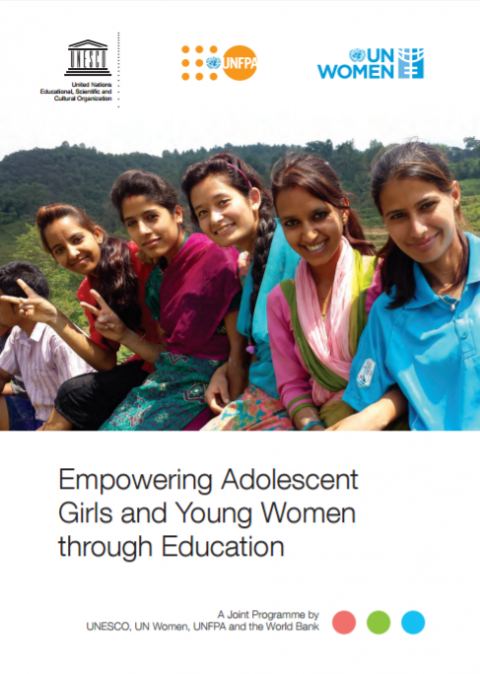 L'Autonomisation des adolescentes et des jeunes femmes par l'éducation Année de publication: 2015 Auteur institutionnel: Organisation des Nations Unies pour l'éducation, la science et la culture (UNESCO)
  L'UNESCO et l'éducation Année de publication: 2017 Auteur institutionnel: UNESCO Education is a fundamental human right and
a public good and, as such, has been at the core of UNESCO’s work since its inception.Education is also the path to sustainability – to poverty alleviation, better health, environmental protection and gender equality.As the only United Nations agency with a mandate to cover all aspects of education, UNESCO was entrusted in 2015 to lead the coordination and monitoring of Sustainable Development Goal 4, as part of the new Global Education 2030 Agenda.Goal 4 aims to “ensure inclusive and equitable quality education and promote lifelong learning opportunities for all,” and renewed UNESCO’s and Member States’ commitment to a vision of education that is holistic, inspirational and which leaves no one behind.This commitment is reflected in the size and scope of the Education Sector, the largest in UNESCO, with staff working at its Paris Headquarters and spread across a global network of field offices and specialized institutes and centres. With its close links with education ministries and other partners, UNESCO is strongly placed to press for action and change.UNESCO’s Education Sector supports Member States in developing education systems that foster high-quality and inclusive lifelong learning for all, empowering learners to be creative and responsible global citizens while leading the debate to help shape the future international education agenda.There is no stronger, no more lasting, investment a country can make than educating its citizens. The Education Sector exists to further this collective vision worldwide by transforming lives one by one.
L'UNESCO et l'éducation Année de publication: 2017 Auteur institutionnel: UNESCO Education is a fundamental human right and
a public good and, as such, has been at the core of UNESCO’s work since its inception.Education is also the path to sustainability – to poverty alleviation, better health, environmental protection and gender equality.As the only United Nations agency with a mandate to cover all aspects of education, UNESCO was entrusted in 2015 to lead the coordination and monitoring of Sustainable Development Goal 4, as part of the new Global Education 2030 Agenda.Goal 4 aims to “ensure inclusive and equitable quality education and promote lifelong learning opportunities for all,” and renewed UNESCO’s and Member States’ commitment to a vision of education that is holistic, inspirational and which leaves no one behind.This commitment is reflected in the size and scope of the Education Sector, the largest in UNESCO, with staff working at its Paris Headquarters and spread across a global network of field offices and specialized institutes and centres. With its close links with education ministries and other partners, UNESCO is strongly placed to press for action and change.UNESCO’s Education Sector supports Member States in developing education systems that foster high-quality and inclusive lifelong learning for all, empowering learners to be creative and responsible global citizens while leading the debate to help shape the future international education agenda.There is no stronger, no more lasting, investment a country can make than educating its citizens. The Education Sector exists to further this collective vision worldwide by transforming lives one by one. 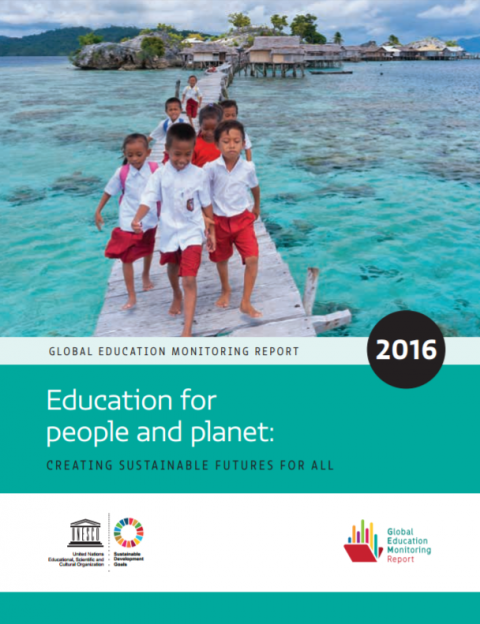 L'Education pour les peuples et la planète: créer des avenirs durables pour tous; Rapport mondial de suivi sur l'éducation, 2016 Année de publication: 2016 Auteur institutionnel: Organisation des Nations Unies pour l'éducation, la science et la culture (UNESCO) | Global Education Monitoring Report Team The GEM Report provides an authoritative account of how education is the most vital input for every dimension of sustainable development. Better education leads to greater prosperity, improved agriculture, better health outcomes, less violence, more gender equality, higher social capital and an improved natural environment. Education is key to helping people around the world understand why sustainable development is such a vital concept for our common future. Education gives us the key tools – economic, social, technological, even ethical – to take on the SDGs and to achieve them. These facts are spelled out in exquisite and unusual detail throughout the report. Yet the report also emphasizes the remarkable gaps between where the world stands today on education and where it has promised to arrive as of 2030.
  Lutte contre la violence de genre en milieu scolaire: orientations mondiales: Année de publication: 2016 Auteur institutionnel: UNESCO | United Nations Entity for Gender Equality and the Empowerment of Women (UN Women) More than 246 million children are subjected to gender-based violence in or around schools every year. This is a violation of their human rights, and a form of gender-discrimination that has far-reaching physical, psychological and educational consequences. Ending schoolrelated gender-based violence (SRGBV) is a priority for countries wishing to achieve ambitious global goals on inclusive and quality education for all and gender equality.WHAT IS THE AIM OF THIS GUIDANCE? This guidance aims to provide a comprehensive, one-stop resource on school-related gender-based violence (SRGBV), including clear, knowledge-based operational guidance, diverse case studies drawn from examples of promising practice and recommended tools for the education sector and its partners working to eliminate gender-based violence. It distils programme knowledge based on existing global literature, promising practices, expert recommendations and practitioner consensus.WHO IS THIS GUIDANCE FOR? The primary audience for this global guidance is the national education sector, including government policy-makers, education ministries, school administrators, educators and other school staff. The guidance may also have wider interest for other national and international stakeholders that are interested in addressing SRGBV, including NGOs, bilateral and multilateral agencies, teachers’ trade unions and policy-makers in other domestic sectors. The guidance is intended primarily for use in low- and middle-income settings, but is based on norms and principles that are universally applicable.WHAT IS COVERED IN THIS GUIDANCE? Promising practice case studies and recommended tools are embedded throughout the relevant sub-sections of the guidance. These provide readers with illustrative examples of implementation in real-life contexts and can serve as resources that have been successfully used – and can be adapted – for application in different contexts.This guidance complements other existing tools and materials for specific bilateral, multilateral and NGO audiences on violence against women and girls, and violence in schools. An expanded online version, which will be regularly updated, is available at www.endvawnow.org