
Ressources
Explorez une large gamme de ressources sur le GCED afin d’approfondir votre compréhension et de renforcer vos activités de recherche, de plaidoyer, d’enseignement et d’apprentissage.
144 résultats trouvés
 Décennie des Nations Unies pour l'Education en vue du Développement Durable, 2005-2014: la DEDD en bref Année de publication: 2005 Auteur institutionnel: UNESCO This document briefs on the Decade of Education for Sustainable Development (DESD), detailing its objectives, the implementation plans, good practices, and challenges that DESD faces. Éducation pour le développement durable: bonnes pratiques dans l'éducation de la petite enfance Année de publication: 2012 Auteur institutionnel: UNESCO To support the growing interest in early childhood issues and ESD, UNESCO is publishing this volume containing 12 examples of programmes addressing ESD in early childhood settings and practices. These good practices and shared experiences, which were provided by a range of different stakeholders, are concrete examples of successful implementation of ESD in different fields and sectors, from the political to the school level, and including formal, nonformal and informal learning situations. Sandwatch: s'adapter au changement climatique et éduquer pour le développement durable Année de publication: 2010 Auteur: Gillian Cambers | Paul Diamond Auteur institutionnel: UNESCO Sandwatch provides a framework for children, youth and adults, with the help of teachers and local communities, to work together to critically evaluate the problems and conflicts facing their beach environments, and to develop sustainable approaches to address these issues. It also helps beaches become more resilient to climate change. The preliminary chapters of this publication focus on how to get started with Sandwatch activities and examine ways to address climate change impacts. The principle aim of this publication is to document the Sandwatch methodology: monitoring, analysing, sharing and taking action. An activities-orientated approach is used to provide step-by-step instructions to cover monitoring methods and data analysis, including observation and recording, erosion and accretion, beach composition, human activities, beach debris, water quality, waves, longshore currents, plants and animals. The activities are related to (a) sustainable development issues, including: beach ownership, mining beaches for construction material, conflict resolution between different beach users, pollution, conservation of endangered species, and (b) climate change adaptation issues: sea level rise, rising temperatures, ocean acidification and increased extreme events. Ways to share findings and create a Sandwatch network are detailed including methods such as the use of local media, websites, social networking and video production. Finally, ways are discussed to design, plan and implement a Sandwatch project to fulfill one or all of the following criteria: (a) addressing a particular beach-related issue, (b) enhancing the beach, and (c) promoting climate change adaptation. Sandwatch stands as an example of Education for Sustainable Development in action, and is being targeted as one of several flagship projects for the United Nations Decade of Education for Sustainable Development (2005–2014). As the world confronts the growing threat of climate change, Sandwatch presents an opportunity to help people and ecosystems respond to present and future changes in a practical manner. Beaches are among the ecosystems most at risk from climate change as they face rising sea levels and increased more intense storms. By contributing to ecosystem health and resilience, Sandwatch can help people from all walks of life learn about climate change and how their actions can contribute to the adaptation process.
  Feuille de route de l'UNESCO pour la mise en œuvre du programme d'action mondiale sur l'éducation pour le développement durable Année de publication: 2014 Auteur institutionnel: UNESCO Les défis mondiaux interconnectés d'aujourd'hui exigent des réponses qui sont enracinées dans l'esprit de notre humanité collective. Je crois que les risques et les opportunités auxquels nous sommes confrontés appellent à un changement de paradigme qui ne peut être intégré dans nos sociétés par le biais de l'éducation et de l'apprentissage. Le rôle de l'éducation en tant que catalyseur pour la construction d'un avenir meilleur et plus durable pour tous a acquis une reconnaissance croissante, ce qui conduit à la déclaration de la Décennie des Nations Unies pour l'éducation pour le développement durable en 2005. Cet engagement a gagné davantage de force lorsque les États membres se sont engagés à promouvoir Education pour le développement durable au-delà de la fin de la Décennie au Royaume-Nationsconférenceon développement durable 2012 - Rio + 20. Pour tirer profit des réalisations et de créer un nouvel élan lorsque la Décennie des Nations Unies se ferme en 2014, l'UNESCO, en tant qu'organisme chef de file de la Décennie, a mis au point un programme d'action mondiale sur l'éducation pour le développement durable. Sur la base de larges consultations et des contributions d'un large éventail de parties prenantes, le programme a été approuvé par le Generalconférencein UNESCO 2013. Elle intervient à un moment où la communauté internationale est chargé de proposer un nouvel ensemble d'objectifs de développement durable qui sont orientés vers l'action, global dans la nature et universellement applicable.En tant que suivi de la Décennie, le Programme d'action mondial est également conçu comme un béton, contribution tangible à l'après 2015 développement et d'éducation agendas L'. Le Programme d'action mondial est livré avec une feuille de route de mise en œuvre détaillé. Il est destiné à toutes les parties prenantes - gouvernements, les organisations de la société civile, le secteur privé, les médias, la communauté universitaire et de recherche, les organisations intergouvernementales et d'autres institutions pertinentes qui facilitent et appuyer l'apprentissage et la formation, tout le chemin aux enseignants et aux apprenants individuels. La feuille de route explique le Programme de but, les objectifs et les domaines d'action prioritaires afin de permettre l'orientation stratégique et l'engagement des parties prenantes, ainsi que des stratégies de mise en œuvre et de Suivi. Je souhaite que le Programme d'action mondial, qui sera lancé à l'éducation Worldconférenceon pour le développement durable à Aichi-Nagoya, au Japon (Novembre 2014), sera successed dans la mobilisation de la communauté des acteurs de l'éducation pour le développement durable et de fournir des conseils pratiques pour sa mise en œuvre effective . Nous avons tous un intérêt profond dans son succès. Avant-propos Introduction - A Better Tomorrow Begins Today - De la Décennie de l'EDD au programme d'action mondial - Esquisse d'une vision commune - Comprendre EDD Feuille de route - But et objectifs - Domaines d'action prioritaires - Stratégies - Mécanismes - Ressources - Suivi et évaluation Annexe - Action Globale Programme sur l'éducation pour le développement durable comme le suivi de la Décennie des Nations Unies pour le développement durable après 2014.
  [vidéo] Les Dix Cibles de l’Objectif de Développement Durable 4...avec Elyx ! Année de publication: 2017 Auteur institutionnel: UNESCO Regardez cette nouvelle animation expliquant les dix cibles de l'Objectif de développement durable 4. Avec Elyx, le premier ambassadeur numérique de l'ONU, découvrez comment garantir une éducation inclusive et de qualité pour tous et promouvoir l'apprentissage tout au long de la vie.
  Déchiffrer le Code: L'Éducation des Filles et des Femmes aux Sciences, Technologie, Ingénierie et Mathématiques (STEM) Année de publication: 2017 Auteur institutionnel: Organisation des Nations Unies pour l'éducation, la science et la culture (UNESCO) Malgrédes améiorations notables ces dernièes déennies, l’éucation n’est pas universellement disponible et les inéalité entre les genres persistent, souvent en déaveur des filles. Des facteurs socio-culturels et éonomiques complexes et lié entre eux pèent non seulement sur les possibilité de scolarisation des filles mais aussi sur la qualitéde l’éucation qu’elles recevront, les éudes qu’elles suivront et, au bout du chemin, leurs carrièes et leurs parcours de vie. Une préccupation majeure tient àla faiblesse de la participation et des réultats des filles dans les éudes de sciences, technologie, ingéierie et mathéatiques (STEM). Les STEM sous-tendent le Programme de déeloppement durable àl’horizon 2030 et l’éucation aux STEM peut apporter aux apprenants les connaissances, les compéences et les comportements néessaires àdes sociéé inclusives et durables. Laisser les filles et les femmes àl’éart de l’éucation et des professions des STEM non seulement les prive de la possibilitéde contribuer aux STEM et d’en bééicier, mais aussi perpéue le fosséentre les sexes et, plus gééalement, les inéalité sociales et éonomiques. Le présent rapport vise à« déhiffrer le code » en déryptant les facteurs qui entravent ou facilitent la participation, la réssite et la réention des filles et des femmes dans l’éucation aux STEM et, en particulier, ce que peut faire le secteur de l’éucation pour promouvoir l’intéê et l’engagement des filles et des femmes dans l’éucation aux STEM et finalement dans les carrièes des STEM. Il entend constituer une ressource pour les parties prenantes de l’éucation et autres personnes qui travaillent àpromouvoir l’éalitédes genres.
 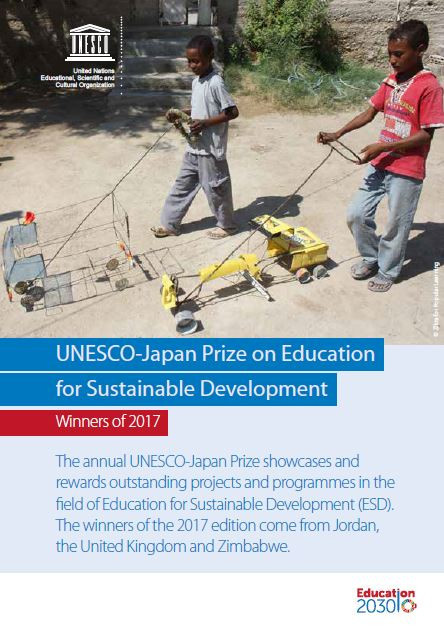 Prix UNESCO-Japon D'éducation en vue du Développement Durable: Lauréats de 2017 Année de publication: 2017 Auteur institutionnel: UNESCO L’année 2017 marque la troisième édition du Prix UNESCO-Japon. Les lauréats ont été sélectionnés parmi plus de 100 candidatures présentées par des gouvernements d’États membres de l’UNESCO et par des organisations non gouvernementales en partenariat officiel avec l'UNESCO. Les candidatures ont été évaluées par un jury indépendant composé de cinq experts internationaux de l’EDD, qui ont recommandé les trois lauréats à la Directrice générale de l’UNESCO.Parmi les lauréats de cette année figurent une école, une entreprise et une organisation à but non lucratif oeuvrant à la promotion de l’EDD, respectivement à l’échelle locale, régionale et internationale : l’école primaire Sihlengeni (République du Zimbabwe) ; l’entreprise sociale Zikra (Royaume hachémite de Jordanie) ; et le projet Hard Rain (Royaume-Uni de Grande-Bretagne et d'Irlande du Nord). Chaque lauréat recevra une récompense d’un montant de 50,000 dollars des États-Unis.La Directrice générale de l’UNESCO et le Ministre de l’éducation japonais remettront le Prix aux trois lauréats au cours d’une cérémonie qui se tiendra le 3 novembre 2017 au Siège de l’UNESCO à Paris, lors de la 39e session de la Conférence générale.
 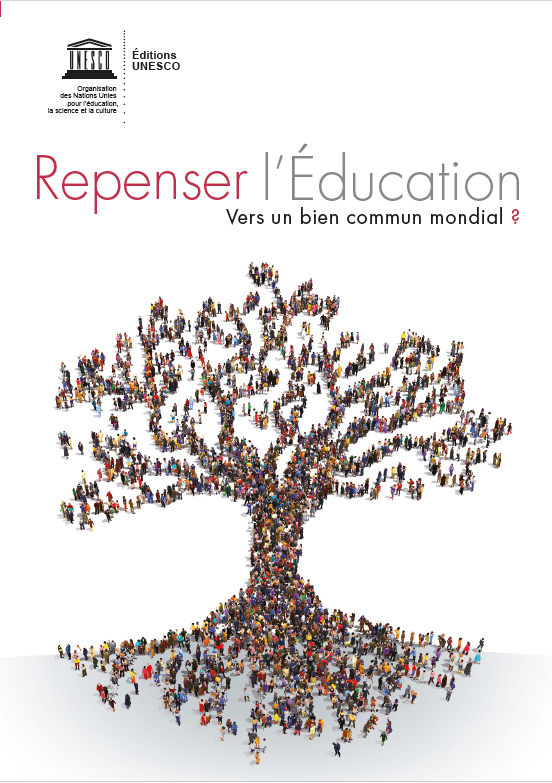 Repenser l'éducation: vers un bien commun mondial? Année de publication: 2015 Auteur institutionnel: UNESCO Les changements dans le monde d'aujourd'hui sont caractérisés par de nouveaux niveaux de complexité et de contradiction. Ces changements génèrent des tensions pour lesquelles il est prévu l'éducation pour préparer les individus et les communautés en leur donnant la possibilité d'adaptation et de réponse. Cette publication contribue à repenser l'éducation et l'apprentissage dans ce contexte. Elle se fonde sur l'une des principales tâches de l'UNESCO comme un observatoire mondial de la transformation sociale dans le but de stimuler le débat sur les politiques publiques. Il est un appel au dialogue entre tous les intervenants. Il est inspiré par une vision humaniste de l'éducation et du développement, fondée sur le respect de la vie et la dignité humaine, l'égalité des droits, la justice sociale, la diversité culturelle, la solidarité internationale et la responsabilité partagée pour un avenir durable. Ce sont les fondements de notre humanité commune. Ce livre améliore la vision fournie par les deux publications de point de repère de l'UNESCO: Apprendre à être: Le monde de l'éducation aujourd'hui et demain (1972), le «Rapport Faure», et l'apprentissage: Le trésor est caché dedans (1996), le «Rapport Delors».
  A Decade of progress on education for sustainable development: reflections from the UNESCO Chairs Programme Année de publication: 2017 Auteur: Michelsen, Gerd | Wells, Peter J. Auteur institutionnel: UNESCO The UNITWIN/UNESCO Chairs Programme, launched in 1992, today forms an extensive network of inter-university cooperation involving more than 700 higher education institutions in 128 countries worldwide. Through knowledge sharing and collaborative research in the priority areas of UNESCO’s work in education, the natural and social sciences, culture, communication and information, the Chairs provide a vital contribution to the Organization’s mission. The current volume focuses on the activities undertaken by UNESCO Chairs dedicated to the field of Education for Sustainable Development (ESD) within the context of the UN Decade of ESD which culminated in the UNESCO World Conference on ESD, held in AichiNagoya, Japan, 2014. The case studies included, showcase the good practices, applied research and curricula innovations pioneered by the individual UNESCO Chairs, as well as highlighting the challenges and lessons learned both for the new follow-up Global Action Programme (GAP) on ESD and the wider Education 2030 Agenda.
 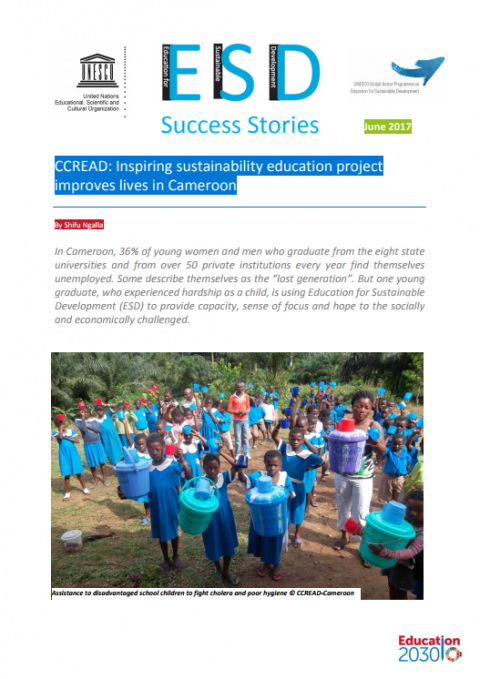 CCREAD: un projet d'éducation au développement durable améliore des vies au Cameroun Année de publication: 2017 Auteur: Shifu Ngalla Auteur institutionnel: UNESCO In Cameroon, 36% of young women and men who graduate from the eight state universities and from over 50 private institutions every year find themselves unemployed. Some describe themselves as the “lost generation”. But one young graduate, who experienced hardship as a child, is using Education for Sustainable Development (ESD) to provide capacity, sense of focus and hope to the socially and economically challenged.