
Ressources
Explorez une large gamme de ressources sur le GCED afin d’approfondir votre compréhension et de renforcer vos activités de recherche, de plaidoyer, d’enseignement et d’apprentissage.
27 résultats trouvés
 Languages in adult literacy: policies and practices during the 15 years of EFA (2000-2015) Année de publication: 2015 Auteur: Clinton Robinson Linguistic diversity characterises many countries with large literacy needs. Meeting these needs will require a multilingual approach based on learning initial literacy in the learner’s mother tongue, with other languages used subsequently. This paper identifies five major challenges in implementing multilingual programmes, and traces the international policy developments over the 15 years of the EFA period. Four case studies – Mexico, Morocco, Papua New Guinea and Senegal – illustrate a range of policies, showing differing approaches and levels of commitment in providing literacy acquisition based on the mother tongue. The paper concludes with six policy orientations to guide action as part of the post- 2015 agenda.
 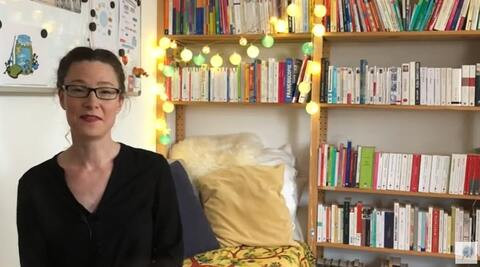 Freinet Pedagogy Adapted to French as a Foreign Language (FLE) Année de publication: 2021 Auteur: Alice Lenesley | Marianne Viader Auteur institutionnel: Culture FLE Interview with Alice Lenesley, who presents the Freinet method adapted to French as a Foreign Language (FLE) classes. In this video, she presents the teaching tools developed by Célestin Freinet, a teacher who adapted his way of teaching to his pupils and their physical constraints. Here are the tools presented in the video: getting out into nature, the "quoi de neuf", non-masterly teaching, the unexpected and spontaneity, autonomy, free text and little books. La pédagogie Freinet adaptée au FLE Année de publication: 2021 Auteur: Alice Lenesley | Marianne Viader Auteur institutionnel: Culture FLE Interview d'Alice Lenesley qui présente la méthode Freinet adaptée aux cours de Français Langue Étrangère (FLE), elle y présente les outils pédagogiques développés par Célestin Freinet, un instituteur qui a adapté sa manière d'enseigner aux élèves et à ses contraites physiques. Voici les outils présentés dans la vidéo : sortir dans la nature, le "quoi de neuf", un enseignement non magistral, l'imprévu et la spontanéité, l'autonomie, le texte libre et les petits livres.
  Bonjourjesuis Année de publication: 2021 Auteur: Alice Lenesley Auteur institutionnel: Bonjourjesuis Ce site internet recense plusieurs outils et des pédagogies alternatives pour enseigner le français langue étrangère ou l'alphabétisation. Ces outils issus de l'éducation populaire favorisent l'apprentissage des apprenants via une implication des étudiants dans les cours et les discussions, les apprenants ne sont plus en position de passivité mais deviennent acteurs du cours d'alphabétisation ou de français langue étrangère.Ces outils sont inspirés de la méthode Freinet. This website lists several tools and alternative pedagogies for teaching French as a foreign language or literacy. These popular education tools encourage learner learning by involving students in lessons and discussions. Learners are no longer in a passive position, but become actors in the literacy or French as a foreign language course. These tools are inspired by the Freinet's method.
 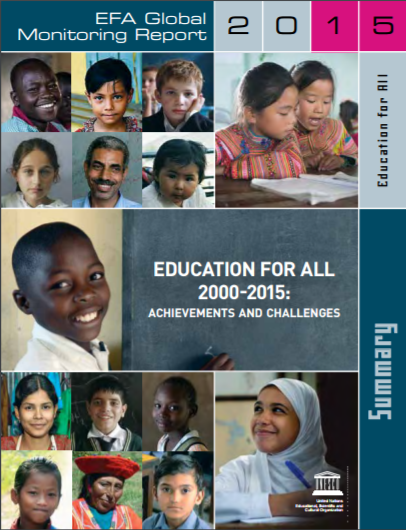 모두를 위한 교육 2000-2015: 성과와 과제; EFA 세계 현황 보고서, 2015; 요약본 Année de publication: 2015 Auteur institutionnel: 유네스코 At the World Education Forum in Dakar, Senegal, in 2000, governments from 164 countries, together with representatives of regional groups, international organizations, donor agencies, non-government organizations (NGOs) and civil society, adopted a Framework for Action to deliver Education for All (EFA) commitments. The Dakar Framework comprised 6 goals and their associated targets to be achieved by 2015, and 12 strategies to which all stakeholders would contribute. The EFA Global Monitoring Report (GMR) has monitored progress on an almost annual basis towards the EFA goals and the two education-related Millennium Development Goals (MDGs). The 2015 GMR provides a complete assessment of progress since 2000 towards the target date for reaching the Dakar Framework’s goals. It takes stock of whether the world achieved the EFA goals and stakeholders upheld their commitments. It explains possible determinants of the pace of progress. Finally, it identifies key lessons for shaping the post-2015 global education agenda.
 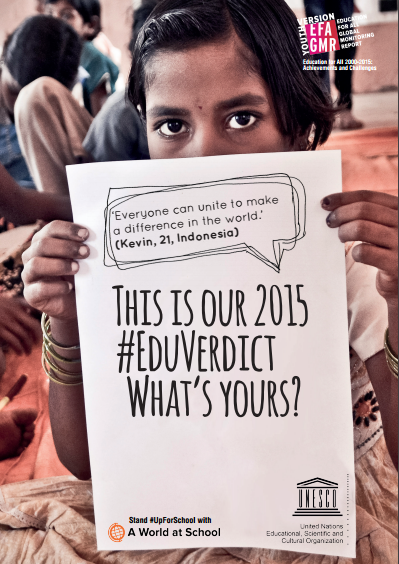 Education for All 2000-2015: Achievements and Challenges; Education for All Global Monitoring Report, 2015; Youth Version Année de publication: 2015 Auteur institutionnel: UNESCO This report highlights the progress and challenges of education that countries have faced over 15 years, brining together the voices of young people to show how Education for All (EFA) has affected their lives and hope for the future. L'Education pour tous 2000-2015: progrès et enjeux, rapport mondial de suivi sur l'EPT, 2015, youth version Année de publication: 2015 Auteur institutionnel: Organisation des Nations Unies pour l'éducation, la science et la culture (UNESCO) This report highlights the progress and challenges that countries have faced over 15 years, brining together the voices of young people to show how Education for All (EFA) has affected their lives. La Educación para Todos, 2000-2015: logros y desafíos, informe de seguimiento de la EPT en el mundo, 2015: youth version Année de publication: 2015 Auteur institutionnel: Organización de las Naciones Unidas para la Educación, la Ciencia y la Cultura (UNESCO) This report highlights the progress and challenges that countries have faced over 15 years, brining together the voices of young people to show how Education for All (EFA) has affected their lives. 这是我们的2015 教育回望#EduVerdict 你的呢? Année de publication: 2015 Auteur institutionnel: 联合国教科文组织 (UNESCO) This report highlights the progress and challenges that countries have faced over 15 years, brining together the voices of young people to show how Education for All (EFA) has affected their lives. Other lang. title: L'Education pour tous 2000-2015: progrès et enjeux, rapport mondial de suivi sur l'EPT, 2015, résumé; La Educación para Todos, 2000-2015: logros y desafíos, informe de seguimiento de la EPT en el mundo, 2015, resumen Année de publication: 2015 Auteur institutionnel: Organización de las Naciones Unidas para la Educación, la Ciencia y la Cultura (UNESCO) At the World Education Forum in Dakar, Senegal, in 2000, governments from 164 countries, together with representatives of regional groups, international organizations, donor agencies, non-government organizations (NGOs) and civil society, adopted a Framework for Action to deliver Education for All (EFA) commitments. The Dakar Framework comprised 6 goals and their associated targets to be achieved by 2015, and 12 strategies to which all stakeholders would contribute. The EFA Global Monitoring Report (GMR) has monitored progress on an almost annual basis towards the EFA goals and the two education-related Millennium Development Goals (MDGs). The 2015 GMR provides a complete assessment of progress since 2000 towards the target date for reaching the Dakar Framework’s goals. It takes stock of whether the world achieved the EFA goals and stakeholders upheld their commitments. It explains possible determinants of the pace of progress. Finally, it identifies key lessons for shaping the post-2015 global education agenda.