
Ressources
Explorez une large gamme de ressources sur le GCED afin d’approfondir votre compréhension et de renforcer vos activités de recherche, de plaidoyer, d’enseignement et d’apprentissage.
31 résultats trouvés
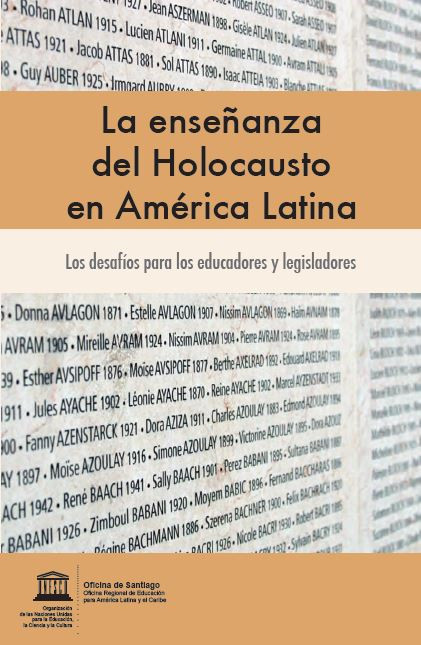 The Teaching of the Holocaust in Latin America the Challenges for Educators and Legislators Année de publication: 2017 Auteur: María Celeste Adamoli | Emmanuel Kahan, Pablo Luzuriaga | Ministerio de Educación Auteur institutionnel: UNESCO Santiago This book provides an overview of opportunities that may arise from educating about the Holocaust in diverse cultural contexts and educational situations, with a special focus on Latin American countries. We can actually be away from the places where the genocide against the Jewish people was perpetrated, but Latin America is still taking charge of its own past of violence and crimes against humanity. With this publication, Latin American educators will have at their fingertips an updated account of the most outstanding topics that are discussed on pedagogy and policy making. You can also explore how, even today in Europe, education about the Holocaust shapes a culture of memory. On the other hand, you can see how in other places the memory of the Holocaust can be a starting point to relate to other difficult pasts. UNESCO is convinced that the prevention of genocide begins at school. In a world where mass violence is possible, this publication will show the importance of teaching young people about the Holocaust and about other genocides in history. It is a condition to prevent similar crimes from happening in the future. La Enseñanza del Holocausto en América Latina: los desafíos para los educadores y legisladores Année de publication: 2017 Auteur: María Celeste Adamoli | Emmanuel Kahan, Pablo Luzuriaga | Ministerio de Educación Auteur institutionnel: UNESCO Santiago Este libro proporciona un panorama de oportunidades que pueden surgir de educar sobre el Holocausto en diversos contextos culturales y situaciones educativas, con un foco especial en los países latinoamericanos. Podemos en realidad estar lejos de los lugares donde el genocidio contra el pueblo judío fue perpetrado, pero también América Latina está todavía haciéndose cargo de su propio pasado de violencia y crímenes contra la humanidad. Con esta publicación, los educadores latinoamericanos van a tener al alcance de la mano un recuento actualizado de los temas más destacados que se discuten sobre pedagogía y construcción de políticas. También podrán explorar cómo, todavía hoy en Europa, la educación sobre el Holocausto da forma a una cultura de la memoria. Por otra parte, pueden ver cómo en otros lugares la memoria del Holocausto puede ser un punto de partida para relacionarse con otros pasados difíciles. La UNESCO está convencida de que la prevención del genocidio comienza en la escuela. En un mundo en donde la violencia masiva es posible, esta publicación mostrará lo importante de enseñar a los jóvenes sobre el Holocausto y sobre otros genocidios en la historia. Es una condición para prevenir que crímenes similares sucedan en el futuro.
 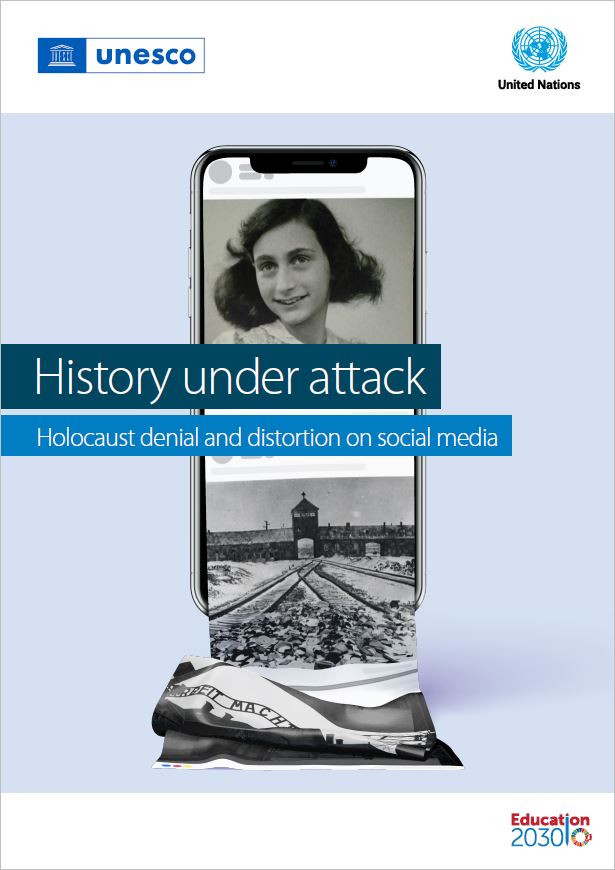 History Under Attack: Holocaust Denial and Distortion on Social Media Année de publication: 2022 Auteur institutionnel: 联合国教科文组织 (UNESCO) | United Nations (UN) A new United Nations and UNESCO study together with the support of the World Jewish Congress investigates Holocaust denial and distortion on social media, measuring their extent and nature on Facebook, Instagram, Telegram, Twitter and TikTok, at a time when the memory and fundamental facts of the Holocaust are under threat from lies, smears and the spread of violent ideologies. It provides recommendations that governments, online platforms, educators and researchers can implement to counter denial and distortion, prevent antisemitism and uphold human rights.This report aims to provide a wide-ranging assessment of the extent to which Holocaust-related content on social media and online platforms denies its factual basis or distorts the Holocaust by minimizing or misrepresenting its history. The report seeks to identify content that has evaded content moderation (on platforms that seek to remove content which denies and distorts the Holocaust). Perhaps more importantly, it also aims to provide an understanding of how denial and distortion about the Holocaust are communicated by people on online platforms.
  Countering Holocaust Denial and Distortion through Education: A Guide for Teachers Année de publication: 2025 Auteur institutionnel: UNESCO Antisemitic hate speech, disinformation, and conspiracy theories thrive during crises, making it vital for teachers to address these issues in school curricula. Social media has significantly amplified the spread of such harmful content, including Holocaust denial and distortion. These falsehoods, rooted in antisemitic prejudice and conspiratorial thinking, threaten our shared historical memory and promote hatred. To effectively combat these issues, it is essential to have a comprehensive understanding of the Holocaust —how and why the genocide of the Jewish people occurred. This knowledge helps us recognize the causes and risk factors, contributing to the prevention of future atrocity crimes and the fight against antisemitism. In the digital age, it is also imperative to be able to decipher the manipulation of history, and the misrepresentation of the past.The guide provides teachers with the necessary tools and guidance to prevent the spread of Holocaust denial and distortion. It equips teachers with knowledge, teaching principles, and strategies to foster digital literacy, historical understanding, and critical thinking in learners. Aimed primarily at history and social sciences teachers, it outlines key concepts, teaching methods, and approaches to counter Holocaust denial and distortion.
  Countering Holocaust Denial and Distortion through Education: Lesson Activities for Secondary Education Année de publication: 2025 Auteur institutionnel: UNESCO Adaptable lessons to foster critical thinking, empathy and tolerance Holocaust denial rejects historical facts outright, while distortion manipulates the narrative. Both phenomena undermine historical truth, fuel antisemitism, and attack democratic values. By addressing these issues, this set of lesson activities for secondary education seeks to build students’ resilience against falsehoods through fostering critical thinking, empathy, and global citizenship. It was developed by UNESCO and funded by the European Commission to equip educators with tools to confront the dangerous spread of Holocaust denial and distortion. With 12 engaging lessons, students aged 14 to 18 will explore the historical facts of the Holocaust while learning to critically evaluate misinformation in today’s digital world. From analyzing survivor testimonies to deconstructing harmful memes and conspiracy theories, this resource features 12 adaptable lessons that focus on historical literacy, media analysis, and social-emotional competencies. Topics range from identifying denial and distortion, evaluating media and online sources, analyzing primary evidence like survivor testimonies, and understanding the misuse of Holocaust history in memes and conspiracy theories. Activities are scaffolded with questions, examples, and practical exercises to encourage analytical skills and promote meaningful classroom discussions. The lessons also include suggestions for incorporating primary sources, visiting memorial sites, and addressing broader issues of genocide and hate. In doing so, the guide aims to not only preserve Holocaust memory but also strengthen the values of truth, empathy, and tolerance in younger generations.
  Strategies to Counter Antisemitism: A Handbook for Educators Année de publication: 2025 Auteur institutionnel: UNESCO Education is the first line of defence against hate and prejudice. By targeting the root causes of hate ideologies, deconstructing the stereotypes that underlie them from an early age, and promoting inclusive models, education is the keystone of a holistic approach to combating discrimination. Tackling antisemitism through education requires tailored content that addresses its complex, shifting and multilayered forms, both past and present.Acknowledging the topic’s complexity and the paucity of resources available to education stakeholders, this concise guide developed by UNESCO and funded by the European Commission aims to provide a roadmap for policymakers, curriculum developers and educators on current approaches and initiatives. It presents ten educational practices, each grounded in academic literature and illustrated by a promising educational initiative that operationalizes core pedagogical principles. The handbook is built around the three core learning domains which inform UNESCO’s approach to Global Citizenship Education: cognitive, socio-emotional, and behavioural learning.Conceived as an accessible operational guide for practitioners, this resource sets out to start a larger conversation about the needs of educators for tackling contemporary forms of antisemitism. It aims to encourage investments in high-quality empirical research that can pave the way for a better approach to combat antisemitism.
 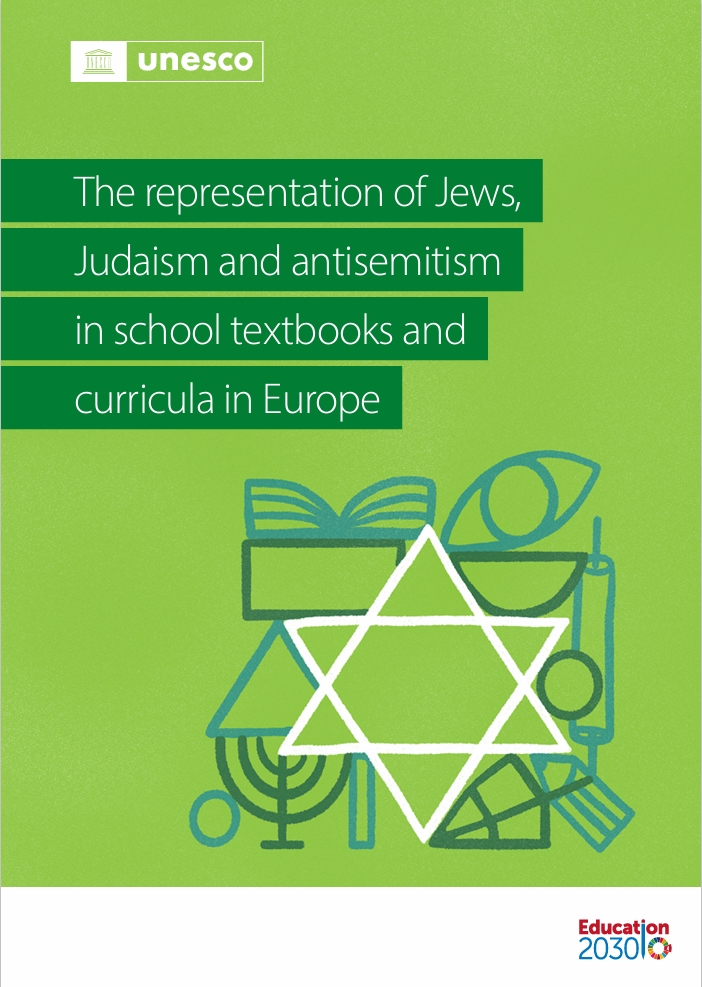 The Representation of Jews, Judaism and Antisemitism in School Textbooks and Curricula in Europe Année de publication: 2025 Auteur institutionnel: UNESCO Jewish communities have been integral to Europe’s social fabric for centuries, preserving rich religious and cultural traditions while facing recurring periods of exclusion, persecution, and resilience. School textbooks are important vantage points to understand how this history and heritage is represented, (de)constructed and embedded into a shared historical and cultural memory. They are also important practical tools used daily by students, teachers, and parents.This comprehensive research, carried out by UNESCO in collaboration with the Georg-Eckert-Institute and supported by funding from the European Commission, examines the ways in which Jewish culture, history, life, and anti-Jewish prejudice are represented in secondary school materials across eight European nations.The publication highlights opportunities within curricula to address Jewish experiences and antisemitism, reviews how these themes are incorporated into textbooks, and analyzes the narratives and portrayals that arise. The study also looks at the use of visual sources and assesses whether Jewish viewpoints and agency are sufficiently reflected. The findings highlight both recurring stereotypes and promising practices. By showcasing these contrasts, the study provides targeted recommendations to guide the creation of more inclusive educational materials.
  Addressing Anti-semitism in Schools: Training Curriculum for Primary Education Teachers Année de publication: 2020 Auteur institutionnel: UNESCO | OSCE. Office for Democratic Institutions and Human Rights (ODIHR) This OSCE/ODIHR and UNESCO co-publication aims to help primary school teachers to prevent and respond to anti-Semitism. The curriculum, intended for teacher trainers, is designed to be comprehensive, robust, practical and adaptable. It suggests concrete ways to address anti-Semitism and counter prejudice in and through education, while promoting human rights, global citizenship education, and gender equality.The co-publication is part of a series of four training curricula, designed for trainers of (1) primary school teachers, (2) secondary school teachers, (3) vocational school teachers, and (4) school directors.
  Addressing Anti-semitism in Schools: Training Curriculum for Secondary Education Teachers Année de publication: 2020 Auteur institutionnel: UNESCO | OSCE. Office for Democratic Institutions and Human Rights (ODIHR) This OSCE/ODIHR and UNESCO co-publication aims to help secondary school teachers to prevent and respond to anti-Semitism. The curriculum, intended for teacher trainers, is designed to be comprehensive, robust, practical and adaptable. It suggests concrete ways to address anti-Semitism and counter prejudice in and through education, while promoting human rights, global citizenship education, and gender equality.The co-publication is part of a series of four training curricula, designed for trainers of (1) primary school teachers, (2) secondary school teachers, (3) vocational school teachers, and (4) school directors.
  Addressing Anti-semitism in Schools: Training Curriculum for Vocational Education Teachers Année de publication: 2020 Auteur institutionnel: UNESCO | OSCE. Office for Democratic Institutions and Human Rights (ODIHR) This OSCE/ODIHR and UNESCO co-publication aims to help vocational school teachers to prevent and respond to anti-Semitism. The curriculum, intended for teacher trainers, is designed to be comprehensive, robust, practical and adaptable. It suggests concrete ways to address anti-Semitism and counter prejudice in and through education, while promoting human rights, global citizenship education, and gender equality.The co-publication is part of a series of four training curricula, designed for trainers of (1) primary school teachers, (2) secondary school teachers, (3) vocational school teachers, and (4) school directors.