
Ressources
Explorez une large gamme de ressources sur le GCED afin d’approfondir votre compréhension et de renforcer vos activités de recherche, de plaidoyer, d’enseignement et d’apprentissage.
15 résultats trouvés
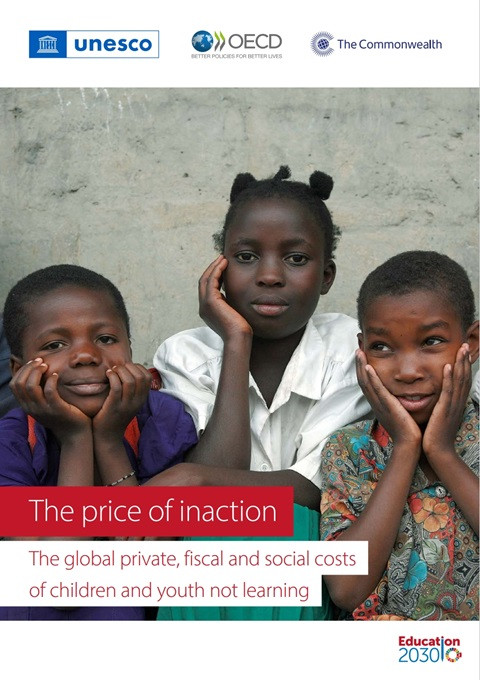 The Price of Inaction: The Global Private, Fiscal and Social Costs of Children and Youth Not Learning Année de publication: 2024 Auteur: Giorgio Brunello | Lorenzo Rocco | Matthias Eck Auteur institutionnel: UNESCO | Organisation for Economic Co-operation and Development (OECD) | Commonwealth Secretariat Despite efforts by countries, the number of out-of-school children remains significant, with 128 million boys and 122 million girls excluded from schooling. Educational skills deficits are also immense – 57 per cent of the world’s children have not gained basic skill levels. UNESCO, OECD and the Commonwealth Secretariat have developed the first global report to illustrate the monetary costs to economies around the world of leaving children and youth behind in education. Using available evidence, the report calculates the costs, globally and by region, of children and youth that are not in school or gaining basic skills. Calculations are also provided for twenty selected countries in which there are gender disparities in education at either girls’ or boys’ expense. If governments were to increase efforts so that every child was in school and achieving basic skills, the future world GDP would raise by more than US$6.5 trillion annually, not to mention eliminating the social costs of failure. This publication offers the evidence and insights that show that for economic development to accelerate, so must prioritizations and investments in education and gender-transformative action.
 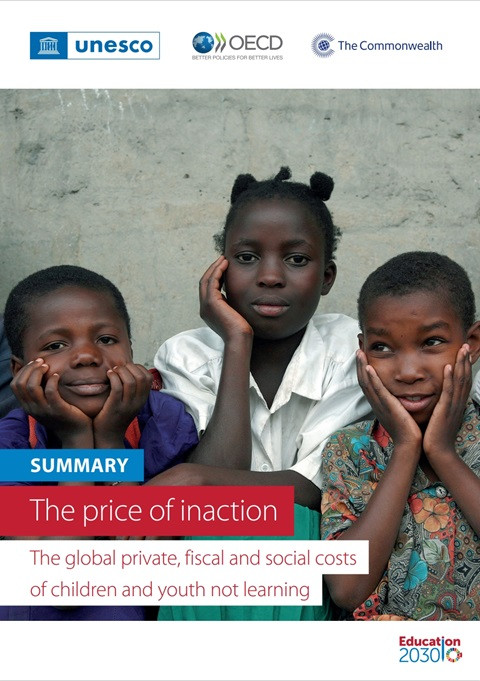 [Summary] The Price of Inaction: The Global Private, Fiscal and Social Costs of Children and Youth Not Learning Année de publication: 2024 Auteur institutionnel: UNESCO | Organisation for Economic Co-operation and Development (OECD) | Commonwealth Secretariat Education is a fundamental human right for all. The United Nations Sustainable Development Goal (SDG) 4 on education has received considerable attention since its adoption in 2015. But more than halfway through the implementation period, achieving the ambitious agenda of inclusive and equitable quality education for all by 2030 remains a significant challenge for countries around the globe. As this report shows, the US$10 trillion social cost of failing to educate all the world’s children is just too high. This is the summary of The Price of Inaction: The Global Private, Fiscal and Social Costs of Children and Youth Not Learning. [Resumen] El precio de la inacción: el costo global privado, fiscal y social de que los niños, niñas y jóvenes no aprendan Année de publication: 2024 Auteur institutionnel: UNESCO | Organisation for Economic Co-operation and Development (OECD) | Commonwealth Secretariat La educación es un derecho humano fundamental para todas y todos. El Objetivo de Desarrollo Sostenible (ODS) 4 de las Naciones Unidas sobre educación ha recibido una atención considerable desde su adopción en 2015. Sin embargo, a más de la mitad del periodo de implementación, la consecución de la ambiciosa agenda de una educación de calidad inclusiva y equitativa para todos en 2030 sigue siendo un desafío considerable para los países del mundo entero. Como muestra este estudio, el costo social de 10 billones de dólares de no educar a todas las niñas y todos los niños del mundo es demasiado elevado. [Résumé] Le prix de l’inaction : les coûts privés, fiscaux et sociaux à l’échelle mondiale des enfants et des jeunes qui n’apprennent pas Année de publication: 2024 Auteur institutionnel: UNESCO | Organisation for Economic Co-operation and Development (OECD) | Commonwealth Secretariat L'éducation est un droit humain fondamental pour tous. L'objectif de développement durable (ODD) 4 des Nations Unies sur l'éducation a suscité une attention considérable depuis son adoption en 2015. Cependant, à plus de la moitié de la période de mise en œuvre, atteindre l'ambitieux objectif d'une éducation de qualité, inclusive et équitable pour tous d'ici 2030 reste un défi majeur pour les pays du monde entier. Comme le montre ce rapport, le coût social de 10 000 milliards de dollars américains lié à l'échec de l'éducation de tous les enfants dans le monde est tout simplement trop élevé.
  Assessment for Advocacy to Transform Communities, Programmes and Policies in the Global South Année de publication: 2024 Auteur institutionnel: UNESCO | Global Education Monitoring Report Team | PAL Network This paper was commissioned by the Global Education Monitoring Report as background information to assist in drafting the 2024 Spotlight Report on basic education completion and foundational learning in Africa. It has not been edited by the team. The views and opinions expressed in this paper are those of the author(s) and should not be attributed to the Global Education Monitoring Report or to UNESCO. The papers can be cited with the following reference: “Paper commissioned for the 2024 Spotlight Report on basic education completion and foundational learning in Africa”.