
Ressources
Explorez une large gamme de ressources sur le GCED afin d’approfondir votre compréhension et de renforcer vos activités de recherche, de plaidoyer, d’enseignement et d’apprentissage.
49 résultats trouvés
 Lucha contra la violencia y el acoso en el entorno escolar: la labor de la UNESCO Année de publication: 2017 Auteur institutionnel: UNESCO This item has been included in the provisional agenda of the 201st session of the Executive Board at the request of Morocco, with the support of Algeria, Cambodia, Côte d’Ivoire, Egypt, France, Italy, Lebanon, Qatar and Sudan.
  Global guidance on addressing school related gender based violence Année de publication: 2016 Auteur institutionnel: UNESCO | United Nations Entity for Gender Equality and the Empowerment of Women (UN Women) More than 246 million children are subjected to gender-based violence in or around schools every year. This is a violation of their human rights, and a form of gender-discrimination that has far-reaching physical, psychological and educational consequences. Ending schoolrelated gender-based violence (SRGBV) is a priority for countries wishing to achieve ambitious global goals on inclusive and quality education for all and gender equality.WHAT IS THE AIM OF THIS GUIDANCE? This guidance aims to provide a comprehensive, one-stop resource on school-related gender-based violence (SRGBV), including clear, knowledge-based operational guidance, diverse case studies drawn from examples of promising practice and recommended tools for the education sector and its partners working to eliminate gender-based violence. It distils programme knowledge based on existing global literature, promising practices, expert recommendations and practitioner consensus.WHO IS THIS GUIDANCE FOR? The primary audience for this global guidance is the national education sector, including government policy-makers, education ministries, school administrators, educators and other school staff. The guidance may also have wider interest for other national and international stakeholders that are interested in addressing SRGBV, including NGOs, bilateral and multilateral agencies, teachers’ trade unions and policy-makers in other domestic sectors. The guidance is intended primarily for use in low- and middle-income settings, but is based on norms and principles that are universally applicable.WHAT IS COVERED IN THIS GUIDANCE? Promising practice case studies and recommended tools are embedded throughout the relevant sub-sections of the guidance. These provide readers with illustrative examples of implementation in real-life contexts and can serve as resources that have been successfully used – and can be adapted – for application in different contexts.This guidance complements other existing tools and materials for specific bilateral, multilateral and NGO audiences on violence against women and girls, and violence in schools. An expanded online version, which will be regularly updated, is available at www.endvawnow.org Lutte contre la violence de genre en milieu scolaire: orientations mondiales: Année de publication: 2016 Auteur institutionnel: UNESCO | United Nations Entity for Gender Equality and the Empowerment of Women (UN Women) More than 246 million children are subjected to gender-based violence in or around schools every year. This is a violation of their human rights, and a form of gender-discrimination that has far-reaching physical, psychological and educational consequences. Ending schoolrelated gender-based violence (SRGBV) is a priority for countries wishing to achieve ambitious global goals on inclusive and quality education for all and gender equality.WHAT IS THE AIM OF THIS GUIDANCE? This guidance aims to provide a comprehensive, one-stop resource on school-related gender-based violence (SRGBV), including clear, knowledge-based operational guidance, diverse case studies drawn from examples of promising practice and recommended tools for the education sector and its partners working to eliminate gender-based violence. It distils programme knowledge based on existing global literature, promising practices, expert recommendations and practitioner consensus.WHO IS THIS GUIDANCE FOR? The primary audience for this global guidance is the national education sector, including government policy-makers, education ministries, school administrators, educators and other school staff. The guidance may also have wider interest for other national and international stakeholders that are interested in addressing SRGBV, including NGOs, bilateral and multilateral agencies, teachers’ trade unions and policy-makers in other domestic sectors. The guidance is intended primarily for use in low- and middle-income settings, but is based on norms and principles that are universally applicable.WHAT IS COVERED IN THIS GUIDANCE? Promising practice case studies and recommended tools are embedded throughout the relevant sub-sections of the guidance. These provide readers with illustrative examples of implementation in real-life contexts and can serve as resources that have been successfully used – and can be adapted – for application in different contexts.This guidance complements other existing tools and materials for specific bilateral, multilateral and NGO audiences on violence against women and girls, and violence in schools. An expanded online version, which will be regularly updated, is available at www.endvawnow.org
  School-related gender-based violence: global guidance (Infographic) Année de publication: 2016 Auteur institutionnel: UNESCO | United Nations Entity for Gender Equality and the Empowerment of Women (UN Women) School-related gender-based violence: global guidance (Infographic) Lutte contre la violence de genre en milieu scolaire: orientations mondiales (Infographique) Année de publication: 2016 Auteur institutionnel: UNESCO | United Nations Entity for Gender Equality and the Empowerment of Women (UN Women) Lutte contre la violence de genre en milieu scolaire: orientations mondiales (Infographique)
  Orientaciones Técnicas Internacionales sobre Educación en Sexualidad: un enfoque basado en evidencia orientado a escuelas, docentes y educadores de la salud Année de publication: 2009 Auteur institutionnel: UNESCO El presente documento Orientaciones Técnicas Internacionales, basado en un riguroso análisis de la evidencia existente sobre programas de educación en sexualidad, está orientado a profesionales y a personas responsables de la toma de decisiones de los sectores salud y educación. Este documento (Volumen 1) se centra en aquellos elementos que justifican la educación en sexualidad y ofrece sólidas recomendaciones técnicas sobre las características que todo programa efectivo debe tener. El documento acompañante (Volumen 2) cubre los temas y objetivos de aprendizaje que se deben abordar en los diferentes tramos etarios en un programa básico de educación en sexualidad destinado a niños, niñas y jóvenes entre las edades de 5 a 18 y más años e incluye una bibliografía de referencias. El documento Orientaciones Técnicas Internacionales es relevante no sólo para los países más afectados por el VIH y el SIDA, sino también para los que exhiben una epidemia de baja prevalencia y alta concentración. Principes directeurs internationaux sur l'éducation sexuelle: une approche factuelle à l'intention des établissements scolaires, des enseignants et des professionnels de l'éducation à la santé Année de publication: 2009 Auteur institutionnel: UNESCO S’appuyant sur un examen rigoureux et actuel des donnees de programmes d’education sexuelle, ces Principes directeurs internationaux sur l’education sexuelle s’adressent aux decideurs et professionnels des secteurs de l’education et de la sante. Ils sont destines a aider les autorites en charge de ces deux secteurs et autres secteurs connexes a elaborer et mettre en oeuvre des programmes et des materiels d’education sexuelle en milieu scolaire. Le Volume I met l’accent sur le bien-fonde d’une education sexuelle et fournit des conseils techniques avises sur les caracteristiques des programmes efcaces. Il s’accompagne d’un document parallele (Volume II) qui decrit les themes a aborder et les objectifs d’apprentissage a atteindre dans le cadre d’un ‘cours de base minimum’ d’education sexuelle destine aux enfants et aux jeunes ages de 5 a 18 ans et plus, et qui contient une bibliographique de ressources utiles. Ces Principes directeurs internationaux sont d’une grande utilite non seulement pour les pays les plus affectes par le VIH et le SIDA, mais aussi pour les pays qui connaissent une prevalence faible et un contexte d’epidemie concentree.
  EIU Best Practices Series No.34: 2Bs Program: 'I'm a Buddy, not a Bully' Année de publication: 2013 Auteur institutionnel: Азиатско-Тихоокеанский центр образования для международного понимания (APCEIU) This issue is one of APCEIU's EIU Best Practices Series, which aims to encourage educators, scholars, and activists to implement and share local initiatives on EIU. The Series No.34 introduces the 2Bs Program implemented in boarding schools in Malaysia, highlighting the importance of education in preventing bullying behavior. The program involves three phases, such as employing creative and fun pedagogy approaches, rehabilitation, and student potential development to effectively raise awareness surrounding the issue and encourage behavior change. Such initiative is exemplary in combatting challenges that arise from cultural differences, and in fostering understanding.
 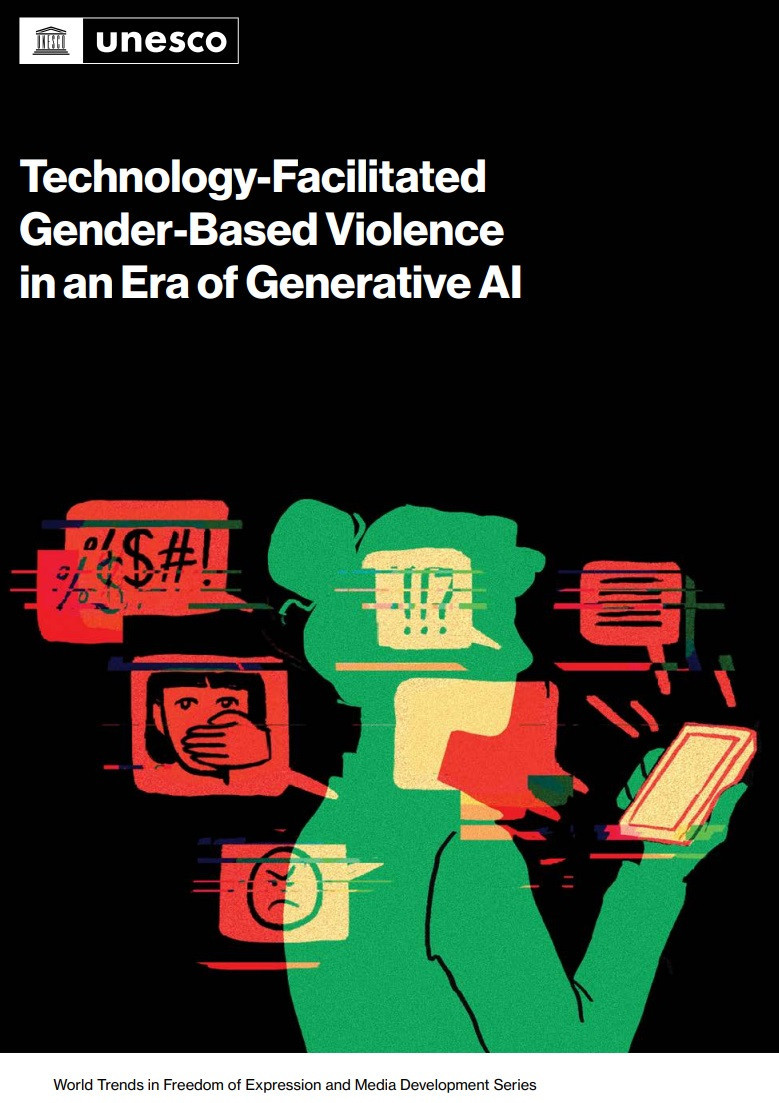 Technology-facilitated gender-based violence in an era of generative AI Année de publication: 2023 Auteur institutionnel: UNESCO <Short summary>Experiments reveal how generative AI facilitates gender-based violence Generative Artificial Intelligence (AI) — deep-learning models that create voice, text, and image — are revolutionizing the way people access information and produce, receive and interact with content. While technological innovations like ChatGPT, DALL-E and Bard offer previously unimaginable gains in productivity, they also present concerns for the overall protection and promotion of human rights and for the safety of women and girls.The arrival of generative AI introduces new, unexplored questions: what are the companies’ policies and normative cultures that perpetuate technology-facilitated gender-based violence and harms? How do AI-based technologies facilitate gender-specific harassment and hate speech? What “prompt hacks” can lead to gendered disinformation, hate speech, harassment, and attacks? What measures can companies, governments, civil society organisations and independent researchers take to anticipate and mitigate these risks?A combination of measures are proposed to be put in place by generative AI companies and the technology companies that platform them, regulators and policy makers, by civil society organisations and independent researchers, as well as users.