
Ressources
Explorez une large gamme de ressources sur le GCED afin d’approfondir votre compréhension et de renforcer vos activités de recherche, de plaidoyer, d’enseignement et d’apprentissage.
154 résultats trouvés
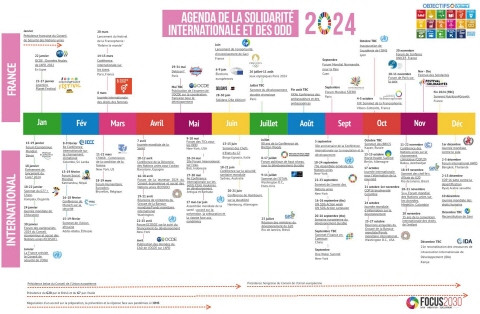 Solidarité Internationale 2024: Les grandes étapes à venir Année de publication: 2023 Auteur institutionnel: Focus 2030 2024 : fin du multilatéralisme ou renouveau ? Les Objectifs de développement durable en suspens. L’année à venir sera l’occasion de mobiliser de manière régulière la communauté internationale autour de nombreux sommets internationaux et rencontres dont les résultats seront susceptibles de changer la face du monde. 2024: End of Multilateralism or Renewal? Sustainable Development Goals in Limbo. The upcoming year will provide a regular platform for mobilizing the international community through numerous international summits and meetings, the outcomes of which have the potential to reshape the world.
 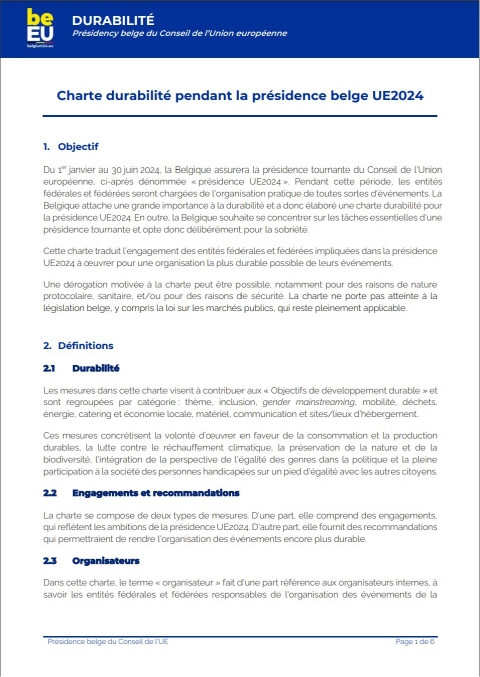 Charte durabilité pendant la présidence belge UE2024 Année de publication: 2023 Auteur institutionnel: Présidence belge du Conseil de l’UE La Belgique attache une grande importance à la durabilité et a donc élaboré une charte durabilité pour la Présidence UE2024. En outre, la Belgique souhaite se concentrer sur les tâches essentielles d'une présidence tournante et opte donc délibérément pour la sobriété. Cette charte traduit l’engagement des entités fédérales et fédérées impliquées dans la Présidence UE2024 à œuvrer pour une organisation la plus durable possible de leurs événements Sustanibility has a great importance for Belgium and so, it greated a sustainibility charter for Presidency EU2024. Moreover, Belgium wish to concetrate on essential tasks a rotating presidency and therefore deliberately opts for sobriety. This Charter reflects the commitment of federal and federated entities involved in Presidency EU2024 to work for an organisation as sustainable as possible during their events.
  Participatory Planning to Achieve Structural Change with Equality: Citizen Participation Strategies in Multi-scale Planning Processes Année de publication: 2015 Auteur: Alicia Williner | Andrea Sanhueza | Carlos Sandoval Auteur institutionnel: United Nations (UN) This manual that ILPES places at the disposal of public officials and non-governmental agents working in the community, has the purpose of sharing a brief theoretical reflection on the current socio-political context through which this manual becomes important; and a set of methodological instruments that will bring the user closer to the social practice of a citizen participation process in the construction of a public management instrument. The manual is divided into two chapters: The first conceptualizes participatory multiscale planning, while also briefly introducing three topics of great importance to be incorporated into any participatory planning process and construction of public management instruments: the perspective of gender, the use of Convention 169 and Principle 10. The second chapter systematizes a set of methodological instruments that describe the stages of a citizen participation strategy to incorporate the multiscale public management instruments. The manual closes with two annexes, the last of which incorporates a set of tools that can be used in the stages of the construction of a citizen participation strategy. La Planificación Participativa para Lograr un Cambio Estructural Con igualdad: Las Estrategias de Participación Ciudadana en los Procesos de Planificación Multiescalar Année de publication: 2015 Auteur: Alicia Williner | Andrea Sanhueza | Carlos Sandoval Auteur institutionnel: United Nations (UN) Este manual que ILPES coloca a disposición de funcionarios públicos y agentes no gubernamentales que trabajan en la comunidad, tiene el propósito de compartir una breve reflexión teórica sobre el contexto socio-político actual por el cual este manual cobra importancia; y un conjunto de instrumentos metodológicos que acercarán al usuario a la práctica social de un proceso de participación ciudadana en la construcción de un instrumento de gestión pública. El manual se estructura en dos capítulos: El primero de ellos conceptualiza la planificación multiescalar participativa, a la vez que realiza una breve introducción a tres temas de suma relevancia a incorporar en todo proceso de planificación participativa y construcción de instrumentos de gestión pública: la perspectiva de género, el uso del Convenio 169 y del Principio 10. El segundo capítulo sistematiza un conjunto de instrumentos metodológicos que describen las etapas de una estrategia de participación ciudadana para incorporar a los instrumentos de gestión pública multiescalar. El manual cierra con dos anexos, el último de los cuales incorpora un conjunto de herramientas que podrán ser utilizadas en las etapas de la construcción de una estrategia de participación ciudadana.
  Education, Development and Citizenship in Latin America: Proposals for the Debate Année de publication: 2011 Auteur: Alicia Barcena | Narcis Serra Auteur institutionnel: Naciones Unidas. Comisión Económica para América Latina y el Caribe (CEPAL) | Centro de Estudios y Documentación Internacionales de Barcelona (CIDOB) Through ADI, an initiative promoted by CIDOB, the Ibero-American General Secretariat (SEGIB) and the Economic Commission for Latin America and the Caribbean (ECLAC), with the support of various sponsoring companies, it is intended to encourage academic debate along with the political debate on diverse issues crucial for the region. Through a rigorous analysis of the social, economic and political reality carried out by academics, public policymakers and other key actors in the development process in Latin America, the aim is to offer recommendations that make economic growth compatible with well-being of the majorities. This publication constitutes the fifth volume of the series and is the result of the willingness of the participating institutions to disseminate, as much as possible, the ideas and discussions that emerged in the seminar. Its reading is a fundamental element to understand the current state of education in the region, as well as the possibilities that exist in this area to continue advancing in inclusion and development. Educación, Desarrollo y Ciudadanía en América Latina: Propuestas para el Debate Année de publication: 2011 Auteur: Alicia Barcena | Narcis Serra Auteur institutionnel: Naciones Unidas. Comisión Económica para América Latina y el Caribe (CEPAL) | Centro de Estudios y Documentación Internacionales de Barcelona (CIDOB) Mediante la ADI, iniciativa impulsada por CIDOB, la Secretaría General Iberoamericana (SEGIB) y la Comisión Económica para América Latina y el Caribe (CEPAL), con el apoyo de diversas empresas patrocinadoras, se pretende alentar el debate académico junto con el debate político en diversos temas cruciales para la región. A través del análisis riguroso de la realidad social, económica y política realizado por los académicos, los encargados de formular políticas públicas y otros actores clave en el proceso de desarrollo de América Latina, se pretende ofrecer recomendaciones que hagan compatible el crecimiento económico y el bienestar de las mayorías. Esta publicación constituye el quinto volumen de la serie y es fruto de la voluntad de las instituciones participantes de difundir, en la mayor medida posible, las ideas y discusiones surgidas en el seminario. Su lectura supone un elemento fundamental para comprender el estado actual de la educación en la región, así como las posibilidades que existen en este ámbito para seguir avanzando en la inclusión y el desarrollo.
 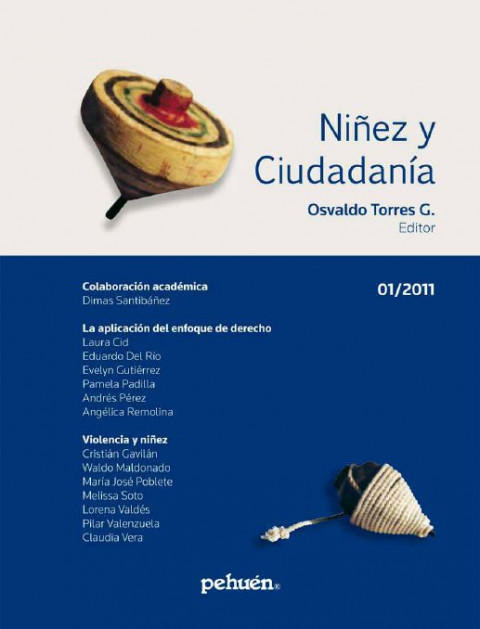 Childhood and Citizenship Année de publication: 2011 Auteur: Osvaldo Torre G. This publication, Niñez y Ciudadanía, is an effort of the Postgraduate Diploma, "Childhood and Public Policies", taught by the Department of Anthropology of the Faculty of Social Sciences of the University of Chile. This course has been held for 5 years, in partnership with the Chilean Association for the United Nations, ACHNU. This first publication presents a selection of those works developed by students graduated from the Diploma in 2010, in which a subject of interest for the researcher is tested and on which a rights approach is applied, which tends to evaluate the situation of the boys and girls in a different way than traditional childhood views; these works are the product of their dissertations to approve this post-title. Also included are some brief essays on the relationship between childhood and violence, elaborated by some of the students of the 2011 generation, in the idea of making available to the interested public a sample of the different forms that acquire the uses of violence on children. It also incorporates a collaboration requested to the anthropologist Dimas Santibáñez, member of the Academic Committee of the Diploma. Niñez y Ciudadanía Année de publication: 2011 Auteur: Osvaldo Torre G. Esta publicación, Niñez y Ciudadanía, es un esfuerzo del Diplomado de postítulo, “Niñez y Políticas Públicas”, que imparte el Departamento de Antropología de la Facultad de Ciencias Sociales de la Universidad de Chile. Este curso se realiza desde hace 5 años, en alianza con la Asociación Chilena pro Naciones Unidas, ACHNU. Esta primera publicación presenta una selección de aquellos trabajos desarrollados por estudiantes egresados del Diplomado en el año 2010, en los cuales se ensaya un tema de interés para el investigador y sobre el cual aplica un enfoque de derechos, que tiende a evaluar la situación de los niños y niñas de una forma distinta a como lo hacen las miradas tradicionales sobre la infancia; estos trabajos son el producto de sus tesinas para aprobar este postítulo. También se incluyen algunos breves ensayos sobre la relación entre la niñez y la violencia, elaborados por algunos de los y las estudiantes de la generación 2011, en la idea de poner a disposición del público interesado una muestra de las diversas formas que adquieren los usos de la violencia sobre los niños. También se incorpora una colaboración solicitada al antropólogo Dimas Santibáñez, miembro del Comité Académico del Diplomado.
 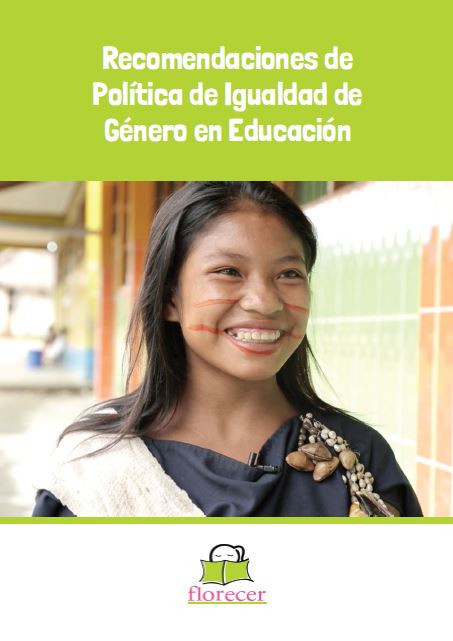 Policy Recommendations of Gender Equality in Education Année de publication: 2015 Auteur: Teresa Tovar Samanez Auteur institutionnel: United Nations Children's Fund (UNICEF) This document synthesizes the proposals of the Florecer Network to advance in gender equality, because we are convinced that the commitment to a more just and more human world necessarily implies the assumption of equality between men and women. Recomendaciones de Política de Igualdad de Género en Educación Année de publication: 2015 Auteur: Teresa Tovar Samanez Auteur institutionnel: United Nations Children's Fund (UNICEF) Este documento sintetiza las propuestas de la Red Florecer para avanzar en la igualdad de género, porque estamos convencidas y convencidos de que la apuesta por un mundo más justo y más humano implica necesariamente por la asunción de la igualdad entre hombres y mujeres.