
Ressources
Explorez une large gamme de ressources sur le GCED afin d’approfondir votre compréhension et de renforcer vos activités de recherche, de plaidoyer, d’enseignement et d’apprentissage.
115 résultats trouvés
 Survey on Privacy in Media and Information Literacy with Youth Perspectives Année de publication: 2017 Auteur: Sherri Hope Culver | Alton Grizzle Auteur institutionnel: UNESCO Media and information literate individuals are more empowered to make informed decisions about their privacy online and offline, among other things. Accordingly, governments and policy-makers who are committed to ensuring that the privacy of citizens is respected should also be committed to media and information literacy (MIL) for all. If they are not, then their efforts will be less sustainable. Equally, private and public enterprises that genuinely want to respect the privacy of citizens should purposefully contribute to MIL awareness among users qua citizens. Two research surveys are referenced in this report. The first investigated youth attitudes towards MIL and social and democratic discourses. One of the seven themes addressed in the context of social and democratic discourses was privacy. The research was carried out by UNESCO. The second survey studied privacy in MIL courses globally and was conducted for UNESCO by the UNESCO-UNAOC University Network on Media and Information Literacy and Intercultural dialogue (MILID Network), and members of the Global Alliance for Partnerships in Media and Information Literacy (GAPMIL). The report responds to UNESCO’s efforts to stimulate global research into privacy in MIL. Ultimately, this report aims to provide conceptual, development and policy recommendations to foster privacy in MIL, while enabling the critical engagement of people, including young women and men, in an environment conducive to sustainable development and to freedom of expression online and offline. It seeks to provide clarity on the complex issue of how MIL and privacy intersect.
  Education for 'Global Citizenship': A Framework for Discussion Année de publication: 2013 Auteur: Sobhi Tawil Auteur institutionnel: UNESCO The notion of ‘global citizenship’ has recently gained prominence in international development discourse with the recently-adopted United Nations Secretary-General’s Global Education First Initiative (2012). Among the three priority areas outlined in this global initiative, the third aims to ‘foster global citizenship’.The notion of ‘global citizenship’, however, remains very broad, if not contested, and consequently difficult to operationalize in education. There are two possible reasons for this. Firstly, it is unclear whether the very notion of ‘global citizenship’ is a metaphor, a contradiction of terms, or an oxymoron (Davies, 2006). Secondly, when applied to education, the notion of ‘global citizenship’ implies a certain degree of confusion. This paper discusses the following questions. What does ‘global citizenship’ possibly imply both from a legal perspective, as well as from that of collective identity, sense of belonging, and civic engagement? Is ‘global citizenship education’ (or ‘education for global citizenship’) merely an expression of a fundamental purpose of education systems? Does it also refer to a broad area of teaching and learning? If so, what are the contours of this domain? How does it relate to other often overlapping areas of learning associated with civic and political socialization?
  International Task Force on Teachers for Education 2030 Strategic Plan 2018–2021 Année de publication: 2018 Auteur institutionnel: UNESCO With the end of the EFA era, the TTF has decided to articulate its activities around the newly adopted international education goals. The Strategic Plan 2018–2021 builds on the Sustainable Development Goals (SDGs), especially the SDG 4.c target on teachers, and the Education 2030 Incheon Declaration and Framework for Action adopted in 2015. Plan stratégique 2018 - 2021. Équipe spéciale internationale sur les enseignants pour Éducation 2030 Année de publication: 2018 Auteur institutionnel: UNESCO Avec la fin de l'ère EPT, l'Équipe spéciale sur les enseignants a décidé d'articuler ses activités autour des objectifs d'éducation internationale nouvellement adoptés. Le Plan stratégique 2018-2021 se fonde sur les Objectifs de Développement Durable (ODD), en particulier sur la cible 4.c de l'ODD 4 sur les enseignants, ainsi que sur la Déclaration d'Incheon et le Cadre d'action Éducation 2030 adoptés en 2015. Ce nouveau plan stratégique a été informé par une évaluation externe réalisée en 2016-2017. Les conclusions et les recommandations de l'évaluation ont été discutées par le comité directeur du de l'Équipe spéciale sur les enseignants en mai 2017 et donnent certaines des orientations de ce plan stratégique. Plan Estratégico 2018 - 2021. Equipo especial internacional sobre docentes para Educación 2030 Année de publication: 2018 Auteur institutionnel: UNESCO Con el final de la era de la EPT, la TTF ha decidido articular sus actividades en torno a los objetivos educativos internacionales recientemente adoptados.El Plan Estratégico 2018-2021 se basa en los Objetivos de Desarrollo Sostenible (ODS), especialmente en la meta del ODS 4.c sobre docentes, y en la Declaración de Incheon y el Marco de Acción para la realización del Objetivo de Desarrollo Sostenible 4 adoptados en 2015.Este nuevo Plan Estratégico fue informado por una evaluación externa realizada en 2016-2017. Las conclusiones y recomendaciones de la evaluación fueron discutidas por el Comité Directivo de la TTF en mayo de 2017 e impulsan algunas de las direcciones estratégicas de este Plan Estratégico.
 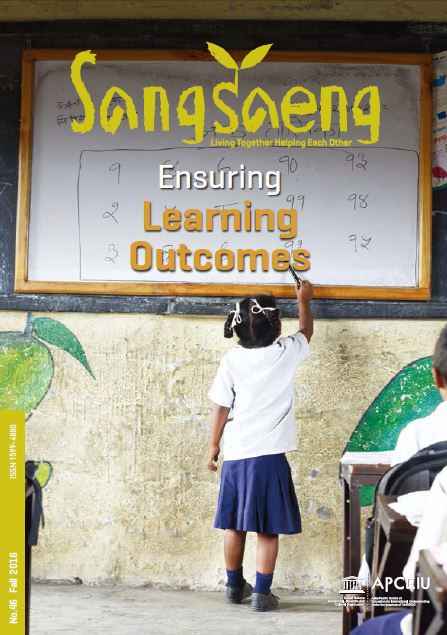 학습 성과의 강화 (상생 제46호 2016년 가을호) Année de publication: 2016 Auteur institutionnel: 유네스코 아시아태평양 국제이해교육원 46호 <상생>이 “학습 성과의 강화 (Ensuring Learning Outcomes)”라는 주제로 발간되었다. 교육 2030 실행계획에서 양질의 교육을 확보하고 평가하는 업적에 집중함에 따라, 이번 <상생> 가을호는 현재의 교육 평가 시스템을 재검토하고 더 나은 평가 체계를 개발하기 위한 다양한 연구와 노력을 소개하고자 한다. 3 발간사4 스페셜 칼럼상생하기: 교육의 기둥은 ‘학습’에서 시작한다8 포커스: 학습 성과의 강화8 새로운 미래에 대비하기: 신교육시대의 지속가능개발과 세계시민의식을 위한 모니터링14 학습 성과물 개선을 위한 지식의 모니터링: ‘동남아시아권 기초교육 학습지표’의 세계시민의식 지수 측정18 민주적 문화의 역량강화: 민주적 역량의 교육과 측정을 위한 유럽의회 프로젝트24 21세기 역량, 그리고 세계시민의식과 글로벌 역량 28 스페셜 리포트키르기스스탄 학생들의 사회문화적 역량 강화하기34 국제이해교육 모범사례34 지속가능성 받아들이기: 여러분도 변화를 만들 수 있다39 가치의 실천을 통한 학생 역량강화 (SEVA): 학교에서 의견 표출, 비판적 사고, 관용의 정신 가르치기44 APCEIU에 보내는 편지따뜻한 마음으로 세계시민이 되어요46 내 기억 속의 평화21세기 평화를 위한 식생활50 교육원 활동
 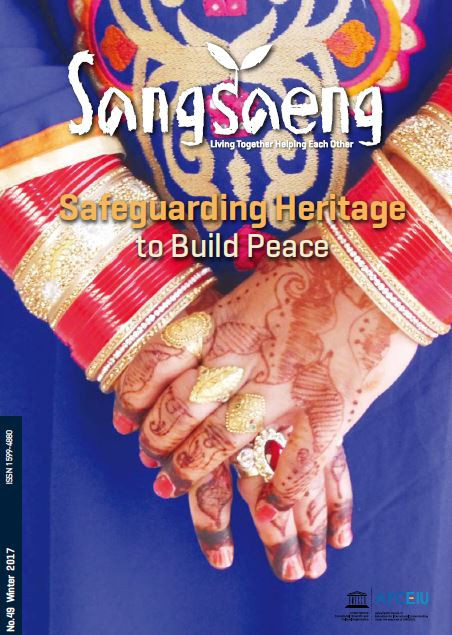 Safeguarding Heritage to Build Peace (SangSaeng no. 49 Winter 2017) Année de publication: 2017 Auteur institutionnel: APCEIU The 49h issue of SangSaeng, “Safeguarding Heritage to Build Peace,” has been published. All ancient civilizations have contributed in some way to the development of modern society. Therefore, all are equally deserving of study. This edition of SangSaeng aims to examine heritage in its different contexts and to help identify our responsibilities as a global community to understand and tolerate other people’s heritages. 3 Director’s Message4 Special Column4 Taking Stewardship of Our Planet8 Focus: Heritage8 Heritage for Peace and Prosperity12 Heritage Education: Opportunity to Enhance Cultural Literacy17 Photo Essay: World Heritage Sites of 2017 21 Special ReportUNAI Impacts Scholarship, Research for Greater Good24 Best Practices24 Frontier Education on the Frontier for Life29 Encouraging the Heart of the Matter33 InterviewGCED Challenge Issued36 Youth NetworkYouth Building Peace 40 LetterJourney to the Heart of Peace42 Peace in My MemoryPeace in a World of Violence46 Understanding the Asia-Pacific RegionEgg, Tambourine and Commemoration49 APCEIU in Action Sauvegarder le patrimoine pour consolider la paix (SangSaeng no. 49 Hiver 2017) Année de publication: 2017 Auteur institutionnel: Centre Asie-Pacifique d'éducation pour la compréhension internationale (APCEIU) 03 MESSAGE DU DIRECTEUR04 RUBRIQUE SPECIALEPrendresoin de notreplanète08 LE PATRIMOINE POUR LA PAIX ET LA PROSPÉRITÉApporter de la valeurajoutée avec uneéducationappropriéeet des services d’interprétation sur les sites de tourisme patrimonial12 EDUCATION AU PATRIMOINE: UNE OPPORTUNITÉ POUR ACCROITRE L'ALPHABÉTISATION CULTURELLEReconnaître la valeur de la communautécommeespaced’apprentissage17 REPORTAGE PHOTOSites du patrimoinemondial 2017 21 REPORTAGE SPÉCIALL’UNAI influence l’enseignementet la recherche pour le biencommun24 BONNES PRATIQUES24 Éducationen zone frontalière: à la frontière de la vie29 Encourager le coeur du sujet33 ENTRETIENLe défi de l’ECMestlancé !36 RÉSEAU DE JEUNESLes jeunes édifient la paix 40 LETTRE42 LA PAIX DANS MA MÉMOIRELa paixdansun monde de violence46 COMPRENDRE LA REGION ASIE-PACIFIQUEOEuf, tambourinetcélébration49 APCEIU EN ACTION 평화를 구축하기 위한 유산 보호 (상생 제49호 2017년 겨울호) Année de publication: 2017 Auteur institutionnel: 유네스코 아시아태평양 국제이해교육원 49호 <상생>이 “평화를 구축하기 위한 유산 보호”라는 주제로 발간되었다. 모든 고대 문명은 현대 사회 발전에 어떤 방식으로든 영향을 준다는 점에서 연구의 가치가 있다. 이번 호 상생은 다양한 맥락에서 유산을 살펴보고, 글로벌 사회의 일원으로서 책임을 다하기 위해 나와 다른 유산을 이해하고 관용하도록 돕는다. 3 발간사4 스페셜 칼럼4 우리 지구의 청지기로서 살아가기8 포커스: 평화를 구축하기 위한 유산 보호8 평화와 번영을 위한 유산12 유산 교육: 문화 리터러시 강화의 기회17 포토 에세이: 2017 세계 유산21 스페셜 리포트대의를 위한 학문과 연구에 영향을 미치는 UNAI활동24 국제이해교육 모범사례24 경계선에 있는 사람들을 위한 최전선의 교육29 학생들의 감성과 열망 자극하기 33 인터뷰세계시민교육에 대한 도전들36 유스네트워크평화를 구축하는 청년40 APCEIU에 보내는 편지평화의 마음을 향한 여정42 내 기억 속의 평화폭력적인 세상에서의 평화46 아시아태평양 지역 이해하기계란, 탬버린 그리고 기념49 교육원 활동
 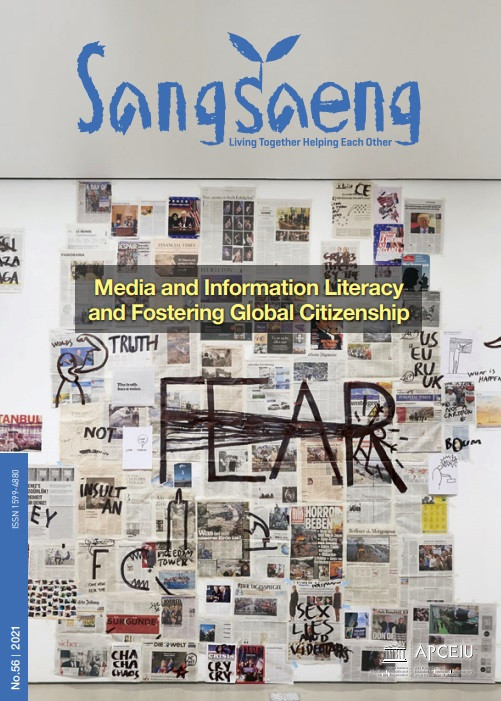 Media and Information Literacy and Fostering Global Citizenship (SangSaeng no.56, 2021) Année de publication: 2023 Auteur institutionnel: APCEIU In today’s digital age, we increasingly rely on media content and information mostly shared online to keep us informed and connected. Those issues of hate speech and stigma during the COVID-19 pandemic are closely related to the spread of fake news and disinformation. Thus, media and information literacy (MIL) has become more crucial than ever for global citizenship. In this context, the 56th edition of SangSaeng focuses on “Media and Information Literacy and Fostering Global Citizenship.” Contents 03 Editor’s Note 04 Special Column Media and Information Literacy to Ensure Rights, Freedoms / Milena Dragicevic Sesic 09 FOCUS: Media and Information Literacy and Fostering Global Citizenship09 Inclusive Media Education Promotes Media and Information Literacy / Sirkku Kotilainen13 Emotional Awareness in Age of Misinformation and Media and Information Literacy / Lisa van Wyk17 Empowering Youth to Shape Our Digital Future / Amie Kim20 A Narrative in Peace(s) / Bushra Ebadi 25 Best Practices25 Building a FaMiLLi* of MIL Educators in Namibia and Beyond / Uajorokisa Akwenye29 Youth Promoting Literacy for Life through HILA Alliance / Beatrice Bonami 33 Special Report33 Peace as an End and a Process – Dialogue with Dr. Betty Reardon on Peace Education / APCEIU38 Learn for Our Planet, Act for Sustainability – Highlights of World Conference on ESD / Alexander Leicht and Won Jung Byun 42 Story TimeGalap & Jomo / Sirhajwan Idek 44 GCED Youth NetworkYes, We Hear You, We See You / GCED Youth Network Core Group 48 LetterFostering Cultural and Language Diversity in Georgia / Marika Sikharulidze 50 APCEIU in Action