
Ressources
Explorez une large gamme de ressources sur le GCED afin d’approfondir votre compréhension et de renforcer vos activités de recherche, de plaidoyer, d’enseignement et d’apprentissage.
8 résultats trouvés
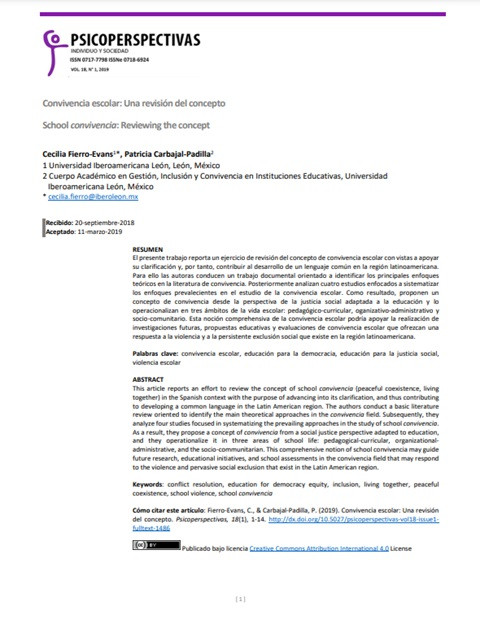 School Convivencia : Reviewing the Concept (Psicoperspectivas; No. 18, Vol. 1) Année de publication: 2019 Auteur: Cecilia Fierro-Evans | Patricia Carbajal-Padilla Auteur institutionnel: Catholic University of Valparaíso. School of Psychology This article reports an effort to review the concept of school convivencia (peaceful coexistence, living together) in the Spanish context with the purpose of advancing into its clarification, and thus contributing to developing a common language in the Latin American region. The authors conduct a basic literature review oriented to identify the main theoretical approaches in the convivencia field. Subsequently, they analyze four studies focused in systematizing the prevailing approaches in the study of school convivencia. As a result, they propose a concept of convivencia from a social justice perspective adapted to education, and they operationalize it in three areas of school life: pedagogical-curricular, organizationaladministrative, and the socio-communitarian. This comprehensive notion of school convivencia may guide future research, educational initiatives, and school assessments in the convivencia field that may respond to the violence and pervasive social exclusion that exist in the Latin American region. Convivencia escolar: Una revisión del concepto (Psicoperspectivas; No. 18, Vol. 1) Année de publication: 2019 Auteur: Cecilia Fierro-Evans | Patricia Carbajal-Padilla Auteur institutionnel: Catholic University of Valparaíso. School of Psychology El presente trabajo reporta un ejercicio de revisión del concepto de convivencia escolar con vistas a apoyar su clarificación y, por tanto, contribuir al desarrollo de un lenguaje común en la región latinoamericana. Para ello las autoras conducen un trabajo documental orientado a identificar los principales enfoques teóricos en la literatura de convivencia. Posteriormente analizan cuatro estudios enfocados a sistematizar los enfoques prevalecientes en el estudio de la convivencia escolar. Como resultado, proponen un concepto de convivencia desde la perspectiva de la justicia social adaptada a la educación y lo operacionalizan en tres ámbitos de la vida escolar: pedagógico-curricular, organizativo-administrativo y socio-comunitario. Esta noción comprehensiva de la convivencia escolar podría apoyar la realización de investigaciones futuras, propuestas educativas y evaluaciones de convivencia escolar que ofrezcan una respuesta a la violencia y a la persistente exclusión social que existe en la región latinoamericana.
  التربية على التسامح وتجسيد ثقافة العيش المشترك من التسامح إلى التعايش Année de publication: 2022 Auteur institutionnel: Democratic Arab Center حظى مفهوم التسامح باهتمام كبير في ضوء المتغيرات المجتمعية المعاصرة من أجل ضمان استقرار المجتمع، وتعايش أفراده في وئام وسلام بالإضافة إلى أهميته على مستوى العلاقات بين الدول وبعضها. التسامح قيمة إنسانية ذات طابع عالمي، ولقد ظهر مفهوم التسامح من حاجة المجتمعات الغارقة في الحروب والاقتتال الأهلي، وهو أعطى تقدما باهرا للمجتمعات والمؤسسات في الغرب، وحرّر الإنسـان من قيود الخوف، لقد أرسى مفهوم التسامح قوانين أكثر إنسانية، وفرض على الـدول أنماطا جديدة مـن التفكير وإعمال العقل لاستنباط مخارج تجنب البشرية العنف والتعصب، وقـد التزمت الأمـم المتحدة بتدعيم التسامح من خلال تعزيز التفاهم المتبادل بين الثقافات والشعوب . وقد تنبهت منظمة اليونسكو للتربية والثقافة والعلـوم التابعة للأمم المتحدة، إلى موضوع ثقافة التسامح فأصدرت في السادس عشر من تشرين الثاني لعام 1995، إعلاناً يتضمـن الـمبـادئ الأساسية للتسامح كثقافة تربوية ونفسية و اجتماعية. وقـد أصبح هذا اليوم ومنذ المؤتمر العام لليونسكو في دورته الثامنة والعشرين، يوماً عالمياً للتسامح Tolerance Education and the Embodiment of Coexistence Culture: From Tolerance to Coexistence Année de publication: 2022 Auteur institutionnel: Democratic Arab Center The concept of tolerance has received great attention in light of contemporary societal changes in order to ensure the stability of society and the coexistence of its members in harmony and peace, in addition to its importance at the level of relations between countries.Tolerance is a human value of a universal nature. The concept of tolerance emerged from the need of societies mired in war and civil strife. It gave remarkable progress to societies and institutions in the West, and liberated people from the shackles of fear. The concept of tolerance established more humane laws and imposed on countries new patterns of thinking. And using reason to devise ways to avoid violence and intolerance for humanity. The United Nations has committed to strengthening tolerance by promoting mutual understanding between cultures and peoples.The United Nations Educational, Scientific and Cultural Organization, UNESCO, became aware of the issue of the culture of tolerance and issued, on November 16, 1995, a declaration containing the basic principles of tolerance as an educational, psychological and social culture. Since the twenty-eighth session of the UNESCO General Conference, this day has become an international day for tolerance.
  Guide to Coexistence and Restorative Practices Année de publication: 2020 Auteur: Juan de Vicente Abad Auteur institutionnel: Assembly of Cooperation for Peace This guide to coexistence and restorative practices aims to join this collective movement that places coexistence as the central axis of teaching practice. Its objective is to provide teachers with very practical and useful strategies to effectively manage coexistence in the classroom. It is a proposal to address coexistence from a preventive, participatory and people-centered dimension, which conceives coexistence not only as an objective but as an object of intentional learning, which perceives conflict as an opportunity and with an inclusive and restorative perspective, betting on a restorative approach. In the guide you can find practical activities, the purpose of which is to guide educational centers to know and implement the restorative model, through a series of resources that range from the analysis of coexistence to restorative conversations to resolve daily conflicts. Guía de convivencia y prácticas restaurativas Année de publication: 2020 Auteur: Juan de Vicente Abad Auteur institutionnel: Assembly of Cooperation for Peace Esta guía de convivencia y prácticas restaurativas quiere sumarse a este movimiento colectivo que sitúa la convivencia como eje central de la práctica docente. Cuyo objetivo es dotar al profesorado de estrategias muy prácticas y útiles para gestionar de forma eficaz la convivencia en las aulas. Es una propuesta para abordar la convivencia desde una dimensión preventiva, participativa y centrada en las personas, que concibe la convivencia no solo como un objetivo sino como un objeto de aprendizaje intencional, que percibe el conflicto como oportunidad y con una perspectiva inclusiva y reparadora, apostando por un enfoque restaurativo. En la guía se pueden encontrar actividades prácticas, cuya finalidad es orientar a los centros educativos a conocer e implementar el modelo restaurativo, a través de una serie de recursos que van desde el análisis de la convivencia hasta las conversaciones restaurativas para resolver conflictos cotidianos.
  التسامح (اللاعنف) في مناهج المرحلة الابتدائية للمدرسة الجزائرية (مجلة حقول معرفية للعلوم الاجتماعية والإنسانية vol.2, no.1) Année de publication: 2021 Auteur: Morad Fatima Zahra | Fantazi Karima Auteur institutionnel: Algeria. Ministry of Higher Education and Scientific Research جاءت هذه الدراسة بهدف الكشف عن وجود وكيفية تناول المقررات الدراسية للمرحلة الابتدائية لقيمة التسامح بشقيها الضمني والصريح وتحديدا مقررات التربية الإسلامية بوصفها أكثر المواد تأكيدا على التعايش مع الآخر والتسامح معه نظرا لما للتربية على التسامح والإقرار بوجود الآخر ووجوب احترامه والاعتراف به من أهمية. ولانجاز هذه الدراسة تم إتباع المنهج الوصفي وتقنية تحليل المحتوى أداة على عينة للمقرر السالف ذكره للسنوات الخمسة المشكلة للمرحلة الابتدائية، كما تم تطبيق التكرارات والنسب المئوية كأسلوب إحصائي. وقد توصلت الدراسة الى ان تناول المقررات الدراسية الوطنية للمرحلة الابتدائية لقيمة التسامح) اللاعنف (جاء متأرجحا بين الطرح الصريح والضمني على الرغم من أهمية الطرح الصريح في مثل هذه المرحلة العمرية وما يتركه من اثر في المتلقي أي التلميذ، كما تم استخلاص ان التربية على التسامح تعد مسؤولية المجتمع ككل وليس المدرسة فقط. Tolerance (Non violence) in the Curricular of Algerian Primary Schools (vol.2, no.1; Journal of Cognitive Fields for Social and Human Sciences) Année de publication: 2021 Auteur: Morad Fatima Zahra | Fantazi Karima Auteur institutionnel: Algeria. Ministry of Higher Education and Scientific Research This study aims to identify tolerance values within primary school curricula in two ways: explicitly and implicitly, focusing specifically on Islamic books due to their significant role in instilling values, particularly respect. The study utilizes the descriptive method and content analysis to analyze primary school books spanning five years. Statistical analysis is conducted using duplicates and percentages. The findings indicate that these books predominantly convey tolerance values implicitly rather than explicitly, which is believed to be more readily accepted by children of this age group. It is concluded that fostering tolerance values should be a shared responsibility of both the community and the school, not solely the latter.