
Ressources
Explorez une large gamme de ressources sur le GCED afin d’approfondir votre compréhension et de renforcer vos activités de recherche, de plaidoyer, d’enseignement et d’apprentissage.
29 résultats trouvés
 Learning to live together: education for conflict resolution, responsible citizenship, human rights and humanitarian norms Année de publication: 2013 Auteur: Margaret Sinclair Auteur institutionnel: Education Above All (Qatar) L'éducation ne peut offrir des remèdes immédiats aux problèmes locaux et mondiaux que nous voyons sur les écrans d'information tous les jours, mais elle peut contribuer à les résoudre sur le long terme. Ce livre examine spécifiquement la contribution que l'éducation peut apporter pour vivre ensemble même dans les pays où la formation des enseignants et les ressources en classe sont limitées.De nombreux pays ont des populations diverses (ethniques, linguistiques, religieuses, etc.) cherchent à maintenir l'harmonie entre les différents groupes. Dans certains pays, cependant, en particulier lorsque le stress économique ou les changements climatiques ont intensifié les arguments sur les ressources, les tensions ont conduit à des conflits armés. Cela apporte avec elle toute la misère de la mort, les blessures, le déplacement et la pauvreté, ainsi que la perturbation des systèmes éducatifs. Dans certains cas, l'éducation elle-même a été un facteur contributif à l'éclatement du conflit, notamment grâce à des possibilités d'éducation inégales pour les différents groupes, et à travers les programmes scolaires biaisés.La guerre civile a causé des souffrances indicibles au cours des dernières années, et dans un monde globalisé, il a des effets négatifs de débordement vers les pays voisins et d'autres pays. Il est essentiel d'élaborer des politiques de l'éducation et la réforme des programmes qui peuvent aider à transmettre les valeurs et les compétences pour apprendre à vivre ensemble pour les jeunes, pour aider à réduire les tensions, à l'intérieur et entre les pays.Education décideurs politiques peuvent aider à jeter les bases d'un avenir meilleur en ajustant le contenu et le processus de l'éducation afin de refléter les compétences et les valeurs des droits de l'homme, des normes humanitaires, la résolution pacifique des conflits, le développement durable et d'autres questions comme éléments de local, national et citoyenneté mondiale.Réforme de l'éducation ne suffit pas, bien sûr, de résoudre les nombreux problèmes de notre temps. L'objectif de ce volume est sur la contribution qui peut être faite par le biais d'aligner le contenu de l'éducation à l'objectif d'apprendre à vivre ensemble. Ce travail aura un plus grand impact quand il a lieu au sein des systèmes et politiques d'éducation qui sont conformes aux valeurs des droits de l'homme et bien sûr, quand d'autres secteurs en dehors de l'éducation font leurs contributions respectives.Ce livre montre que l'éducation transformatrice pour la résolution des conflits et la paix, à la citoyenneté locale, nationale et mondiale, des droits de l'homme et des valeurs humanitaires peut être appliqué même dans des conditions difficiles, s'il y a un engagement politique de le faire. Les auteurs ont fourni des exemples et les enseignements tirés de leurs propres expériences en tant que praticiens éminents dans le domaine.
 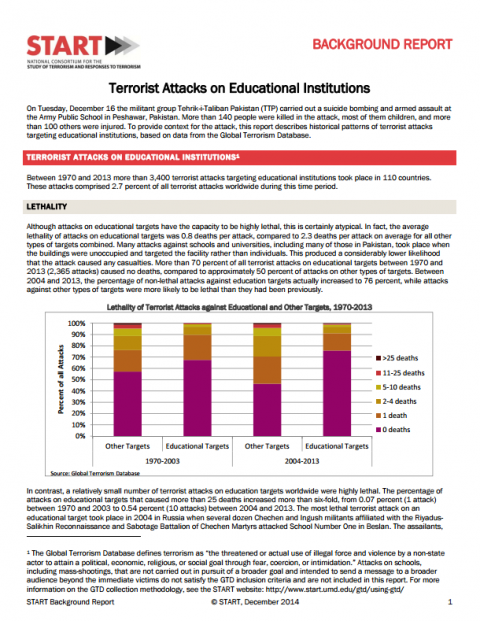 Terrorist Attacks on Educational Institutions Année de publication: 2014 Auteur: Erin Miller Auteur institutionnel: National Consortium for the Study of Terrorism and Responses to Terrorism (START) | Department of Homeland Security Science and Technology The report describes historical patterns of terrorist attacks targeting educations institutions dating back to 1970. Since that year, more than 3,400 terrorist attacks targeting educations institutions took place in 110 countries. These attacks comprised 2.7 percent of all terrorist attacks worldwide during this time period. Terrorist Attacks on Educational Institutions Année de publication: 2014 Auteur: Erin Miller Auteur institutionnel: National Consortium for the Study of Terrorism and Responses to Terrorism (START) | Department of Homeland Security Science and Technology Le rapport revient sur les attaques terroristes qui ont ciblé les institutions éducatives depuis 1970. A partir de cette année, on dénombre plus de 3.400 attaques terroristes qui avaient pour cible les institutions éducatives, dans 110 pays. Ces attaques représentent 2,7 % de l’ensemble des attaques terroristes perpétrées à travers le monde au cours de cette période.
  Education for Democratic Citizenship and a Culture of Peace Année de publication: 2022 Auteur: Jéssica Marisol Vera Carrera Auteur institutionnel: University of Santiago de Cali Education for peace and citizen training as a promotion of peace construction. It is a global need in educational centers, particularly when making a comparison in Colombia and Mexico, to understand that education is a dynamic, continuous and permanent educational process by playing a fundamental role in the formation of the citizen; It is also the conducive setting for the promotion of socio-emotional skills that allow students to have sufficient tools to be a citizen agent of peace. Educación para la ciudadanía democrática y cultura de paz Année de publication: 2022 Auteur: Jéssica Marisol Vera Carrera Auteur institutionnel: University of Santiago de Cali La educación para la paz y formación ciudadana como fomento de construcción de paz. Es una necesidad global en los centros educativos, particularmente al realizar un comparativo en Colombia y México, comprender que la educación es un proceso educativo, dinámico, continuo y permanente al desempeñar un papel fundamental en la formación del ciudadano; además es el escenario propicio para el fomento de habilidades socioemocionales que le permitan a los estudiantes contar con las herramientas suficientes para ser un ciudadano agente de paz.
 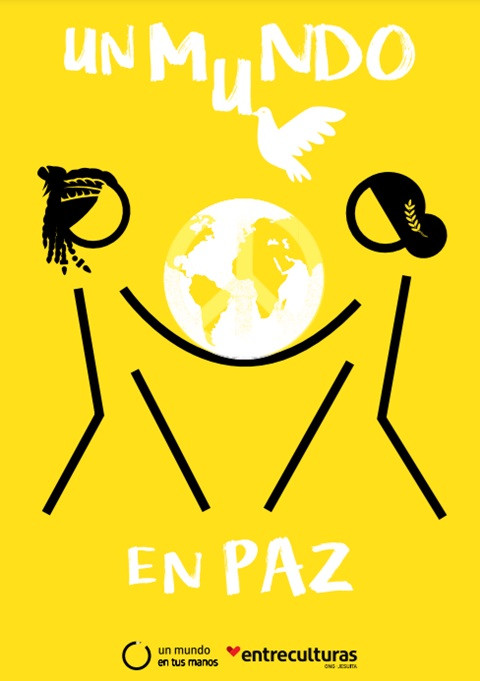 A World at Peace Année de publication: 2022 Auteur institutionnel: Entreculturas A world in peace is part of “A world in your hands”, Entreculturas’ pedagogical proposal to educate in global citizenship. With it we aim to contribute to the training of people capable of exercising active and committed citizenship, of transforming their environment and of assuming as their own the global challenges of our time such as the fulfillment of the 2030 Agenda and the Sustainable Development Goals. In this publication we collect proposals to work on the culture of peace and develop knowledge, values and social and civic skills that allow people who work on them to actively commit to coexistence, conflict resolution and the creation of a culture of peace in their environments and at a global level. Un mundo en paz Année de publication: 2022 Auteur institutionnel: Entreculturas Un mundo en paz forma parte de “Un mundo en tus manos”, la propuesta pedagógica de Entreculturas para educar en una ciudadanía global. Con ella pretendemos contribuir a la formación de personas capaces de ejercer una ciudadanía activa y comprometida, de transformar su entorno y de asumir como suyos tantos los retos globales de nuestro tiempo como el cumplimiento de la Agenda 2030 y de los Objetivos de Desarrollo Sostenible. En esta publicación recogemos propuestas para trabajar la cultura de paz y desarrollar conocimientos, valores y competencias sociales y ciudadanas que permitan a las personas que los trabajen comprometerse de forma activa con la convivencia, la resolución de conflictos y la creación de cultura de paz en sus entornos y a nivel global.
  Evaluating the Link between Conflict and Education Année de publication: 2005 Auteur: Lynn Davies Auteur institutionnel: SAGE Publishing This paper examines two areas of important evaluation: the impact of education on peace and the impact of education on conflict, and argues that they are not necessarily the same type of evaluation. Evaluating the Link between Conflict and Education Année de publication: 2005 Auteur: Lynn Davies Auteur institutionnel: SAGE Publishing Cet article examine deux domaines importants d’évaluation : l'impact de l'éducation sur la paix et l'impact de l'éducation sur les conflits ; il démontre ensuite que le même type d'évaluation ne s’applique pas nécessairement au deux.
  Education in the twenty‐first century: Conflict, reconstruction and reconciliation1 Année de publication: 2005 Auteur: Alan Smith Auteur institutionnel: Taylor & Francis This paper is an attempt to map out an emerging and increasingly important field of study concerning the relationship between education and conflict. The paper argues that actions through various ‘entry points’ at each of these levels carry the potential to exacerbate or ameliorate conflict and suggests that a systemic analysis of investments in education systems from a conflict perspective should be a routine part of educational planning.