
Ressources
Explorez une large gamme de ressources sur le GCED afin d’approfondir votre compréhension et de renforcer vos activités de recherche, de plaidoyer, d’enseignement et d’apprentissage.
178 résultats trouvés
 Discours de Mme Irina Bokova, Directrice générale de l'UNESCO à l'occasion de la Conférence sur l'éducation au service du développement durable à l'appui de la diversité culturelle et biologique; Oman, 24 janvier 2011 Année de publication: 2011 Auteur institutionnel: UNESCO. Director-General, 2009-2017 (Bokova, I.G.) Cette allocution a été donnée par Irina Bokova, Directrice générale de l'UNESCO, à l'occasion de la Conférence sur l'éducation au développement durable à l'appui de la diversité culturelle et biologique.
 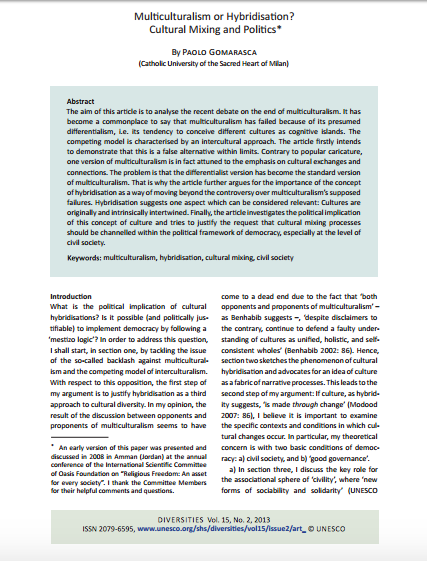 Multiculturalism or Hybridisation?: Cultural Mixing and Politics Année de publication: 2013 Auteur: Paolo Gomarasca The aim of this article is to analyse the recent debate on the end of multiculturalism. It has become a commonplace to say that multiculturalism has failed because of its presumed differentialism, i.e. its tendency to conceive different cultures as cognitive islands. The competing model is characterised by an intercultural approach. The article firstly intends to demonstrate that this is a false alternative within limits. Contrary to popular caricature, one version of multiculturalism is in fact attuned to the emphasis on cultural exchanges and connections. The problem is that the differentialist version has become the standard version of multiculturalism. That is why the article further argues for the importance of the concept of hybridisation as a way of moving beyond the controversy over multiculturalism’s supposed failures. Hybridisation suggests one aspect which can be considered relevant: Cultures are originally and intrinsically intertwined. Finally, the article investigates the political implication of this concept of culture and tries to justify the request that cultural mixing processes should be channelled within the political framework of democracy, especially at the level of civil society.
  문화다양성협약 국내 이행을 위한 논의: 유튜브에서 AI까지, 21세기 한국에서의 문화다양성 Année de publication: 2020 Auteur: 김재인 | 염신규 | 이광석 | 이동연 | 이상욱 | 홍성수 | 황승흠 Auteur institutionnel: 대한민국 문화체육관광부 | 한국문화예술위원회 | 유네스코한국위원회 「문화다양성협약 국내 이행을 위한 논의 - 유튜브에서 AI까지, 21세기 한국에서의 문화다양성」는 모두 세 차례에 걸쳐 진행된 전문가회의에서 각 분야 전문가들이 발표하고 토론한 내용을 담은 종합보고서입니다. 올해는 문화다양성협약의 이행과 관련된 이슈들 중 특히 디지털플랫폼의 급부상, 인공지능 기술의 급격한 발달에 초점을 두어 논의하는 한편, 우리들의 일상을 송두리째 바꿔놓은 코로나19가 낳은 불안과 공포, 이로 인한 적대감이 초래한 소외와 고립, 혐오와 갈등의 문제를 짚어보았습니다. 전문가회의에서 나온 전문가들의 진단과 논의가 앞으로 한국사회에서 문화다양성협약 이행 관련 의제를 주도하는 데 있어서 필요한 비전과 전략 수립에도 기여하기를 기대합니다.
  Multicultural Education and Its Implications for Educational Leadership as an Introduction to Stimulating Management Quality: A Proposed Vision Année de publication: 2011 Auteur: Essam Jamal Selim Ghanem Auteur institutionnel: Al-Azhar University The study discusses multiculturalism. It also works as an analytical review of the literature that dealt with multicultural education in terms of historical development, concept, dimensions, fields, roles of teachers, students, and multicultural educational programs, and the implications of that for educational leadership and the role they can play in activating the application of education multicultural. التعليم المتعدد الثقافات ومضامينه للقيادة التربوية كمدخل لحفز الجودة الإدارية: رؤية مقترحة Année de publication: 2011 Auteur: Essam Jamal Selim Ghanem Auteur institutionnel: Al-Azhar University تناقش الدراسة التعددية الثقافية، حيث تعمل على مراجعة تحليلية للأدبيات التي تناولت التعليم المتعدد الثقافات من حيث التطور التاريخي، والمفهوم، والأبعاد، والمجالات، وأدوار المعلمين، والطلاب، والبرامج التعليمية المتعددة الثقافات، ومضامين ذلك للقيادة التربوية والدور الذي يمكن أن تلعبه في تفعيل تطبيق التعليم المتعدد الثقافات.
  Echoing Voices: Tenth Anniversary of the Adoption of the UNESCO Universal Declaration on Cultural Diversity Année de publication: 2011 Auteur institutionnel: UNESCO This founding text was the first to acknowledge cultural diversity as “the common heritage of humanity”. It is with great pride that UNESCO is commemorating the 10th anniversary of the Declaration. Commemorate – from the Latin cum memorare – means quite literally “to remember together” or “to remember with”. This collection is compiled the voices of all those who have contributed to the heightening of human awareness by throwing into relief the inestimable value of cultural diversity. These excerpts from books, articles and statements by global intellectual and political leaders, artists and Nobel Prize-winners all call for the safeguarding of cultural diversity, which is inseparable from respect for human dignity. Their voices resound in bearing witness to the strength of cultural diversity and to its capacity to enlighten the minds of women and men. We are duty-bound to ensure that it is central to public policies and a resource for development and dialogue among nations. The United Nations was born of the determination of men and women “to save succeeding generations from the scourge of war...”. In accordance with that principle, UNESCO was established on a key idea, expressed at the very beginning of its Constitution: “... since wars begin in the minds of men, it is in the minds of men that the defences of peace must be constructed”. In the world today, globalized, connected and interdependent as never before, this mission is more vital than ever. The rapprochement of peoples and cultures requires a commensurately global awareness. Cultural diversity has always been at the heart of international relations. It is also, increasingly, a feature of the contemporary mixed and plural societies in which we live. In view of this reality, we must formulate appropriate public policies and rethink the mechanisms of social cohesion and civic participation. How can we build common ground on the basis of such diversity? How can we construct genuine moral and intellectual solidarity of humanity? Any new vision of humanism must be grounded itself in the dynamism and diversity of cultural heritage. It is a source of inspiration and knowledge to be shared and a means of broadening our horizons. The goal of the UNESCO Universal Declaration on Cultural Diversity is to provide keys and benchmarks for capitalizing on this wealth. There can be no sustainable governance if cultural diversity is not acknowledged. There can be no economic and social development if specific features of every culture are belittled and ignored. Resonancias: Décimo Aniversario de la Adopción de la Declaración Universal de la UNESCO sobre la Diversidad Cultural Année de publication: 2011 Auteur institutionnel: Organización de las Naciones Unidas para la Educación, la Ciencia y la Cultura (UNESCO) This founding text was the first to acknowledge cultural diversity as “the common heritage of humanity”. It is with great pride that UNESCO is commemorating the 10th anniversary of the Declaration. Commemorate – from the Latin cum memorare – means quite literally “to remember together” or “to remember with”. This collection is compiled the voices of all those who have contributed to the heightening of human awareness by throwing into relief the inestimable value of cultural diversity. These excerpts from books, articles and statements by global intellectual and political leaders, artists and Nobel Prize-winners all call for the safeguarding of cultural diversity, which is inseparable from respect for human dignity. Their voices resound in bearing witness to the strength of cultural diversity and to its capacity to enlighten the minds of women and men. We are duty-bound to ensure that it is central to public policies and a resource for development and dialogue among nations. The United Nations was born of the determination of men and women “to save succeeding generations from the scourge of war...”. In accordance with that principle, UNESCO was established on a key idea, expressed at the very beginning of its Constitution: “... since wars begin in the minds of men, it is in the minds of men that the defences of peace must be constructed”. In the world today, globalized, connected and interdependent as never before, this mission is more vital than ever. The rapprochement of peoples and cultures requires a commensurately global awareness. Cultural diversity has always been at the heart of international relations. It is also, increasingly, a feature of the contemporary mixed and plural societies in which we live. In view of this reality, we must formulate appropriate public policies and rethink the mechanisms of social cohesion and civic participation. How can we build common ground on the basis of such diversity? How can we construct genuine moral and intellectual solidarity of humanity? Any new vision of humanism must be grounded itself in the dynamism and diversity of cultural heritage. It is a source of inspiration and knowledge to be shared and a means of broadening our horizons. The goal of the UNESCO Universal Declaration on Cultural Diversity is to provide keys and benchmarks for capitalizing on this wealth. There can be no sustainable governance if cultural diversity is not acknowledged. There can be no economic and social development if specific features of every culture are belittled and ignored. Résonances: Dixième Anniversaire de l'Adoption de la Déclaration Universelle de l'UNESCO sur la Diversité Culturelle Année de publication: 2011 Auteur institutionnel: UNESCO This founding text was the first to acknowledge cultural diversity as “the common heritage of humanity”. It is with great pride that UNESCO is commemorating the 10th anniversary of the Declaration. Commemorate – from the Latin cum memorare – means quite literally “to remember together” or “to remember with”. This collection is compiled the voices of all those who have contributed to the heightening of human awareness by throwing into relief the inestimable value of cultural diversity. These excerpts from books, articles and statements by global intellectual and political leaders, artists and Nobel Prize-winners all call for the safeguarding of cultural diversity, which is inseparable from respect for human dignity. Their voices resound in bearing witness to the strength of cultural diversity and to its capacity to enlighten the minds of women and men. We are duty-bound to ensure that it is central to public policies and a resource for development and dialogue among nations. The United Nations was born of the determination of men and women “to save succeeding generations from the scourge of war...”. In accordance with that principle, UNESCO was established on a key idea, expressed at the very beginning of its Constitution: “... since wars begin in the minds of men, it is in the minds of men that the defences of peace must be constructed”. In the world today, globalized, connected and interdependent as never before, this mission is more vital than ever. The rapprochement of peoples and cultures requires a commensurately global awareness. Cultural diversity has always been at the heart of international relations. It is also, increasingly, a feature of the contemporary mixed and plural societies in which we live. In view of this reality, we must formulate appropriate public policies and rethink the mechanisms of social cohesion and civic participation. How can we build common ground on the basis of such diversity? How can we construct genuine moral and intellectual solidarity of humanity? Any new vision of humanism must be grounded itself in the dynamism and diversity of cultural heritage. It is a source of inspiration and knowledge to be shared and a means of broadening our horizons. The goal of the UNESCO Universal Declaration on Cultural Diversity is to provide keys and benchmarks for capitalizing on this wealth. There can be no sustainable governance if cultural diversity is not acknowledged. There can be no economic and social development if specific features of every culture are belittled and ignored.
  Dialogue: cultural diversity and globalization, the Arab-Japanese experience; proceedings Année de publication: 2005 Auteur institutionnel: UNESCO The symposium on “Cultural Diversity and Globalization: the Arab-Japanese Experience, a Cross-Regional Dialogue”, organized on 6 - 7 May 2004 at UNESCO in Paris with the purpose of promoting dialogue and cooperation between the Arab world and Japan, gave its participants an opportunity to lay the groundwork for thinking about the key concepts enshrined in the UNESCO Universal Declaration on Cultural Diversity adopted by the General Conference at its 31st session, on 2 November 2001. Education, diversité et cohésion sociale en Méditerranée occidentale Année de publication: 2010 Auteur: Sobhi Tawil | Abdeljalil Akkari | Bouthaïna Azami Auteur institutionnel: UNESCO La diversité culturelle constitue une caractéristique essentielle des différentes sociétés de la région de la Méditerranée occidentale où une multitude de traditions religieuses et culturelles se sont côtoyées et réciproquement influencées, créant ainsi une mosaïque sociale particulièrement intéressante. Or, la diversité, source de créativité et d'enrichissement culturel, peut aussi amener à renforcer les tensions sociales et creuser les divisions, menaçant ainsi la cohésion sociale à l'intérieur des sociétés comme entre les pays de la région. En effet, des événements récents ont attiré l'attention sur des tensions sociales et politiques liées à l'identité et à la cohésion sociale dans un contexte de mondialisation, d’accroissement des disparités des niveaux de développement économique entre les deux rives de la Méditerranée occidentale et de diversification grandissante des flux migratoires, contexte trop souvent marqué, par ailleurs, par une exacerbation du phénomène de l’exclusion sociale, de la montée de la xénophobie et de l’extrémisme religieux. Conscients de l’importance de la contribution essentielle de l’éducation pour promouvoir un dialogue interculturel axé sur les principes d’équité, de justice, et de respect de la dignité et de la diversité culturelle, la Chaire UNESCO Droits de l’homme et éthique de la coopération internationale de l’Université de Bergame, le Bureau multipays de l’UNESCO à Rabat, et l’ISESCO ont conjointement lancé, en 2007, le projet Education, diversité et cohésion sociale en Méditerranée occidentale. Le projet s’inscrit dans une dynamique de recherche, de dialogue et d’action, renforçant ainsi les efforts de chacun des trois partenaires visant à promouvoir la culture de la justice et de la paix. Cette recherche propose de nouveaux éclairages sur le rôle des systèmes éducatifs nationaux dans la promotion du respect de la diversité et le renforcement de la cohésion sociale, et esquisse des pistes d’action et de coopération. Nous formons le vœu que cet ouvrage commun, fruit des travaux de recherche se rapportant au projet, puisse contribuer à la promotion du respect de la diversité et de la cohésion sociale en Méditerranée occidentale.