
Ressources
Explorez une large gamme de ressources sur le GCED afin d’approfondir votre compréhension et de renforcer vos activités de recherche, de plaidoyer, d’enseignement et d’apprentissage.
137 résultats trouvés
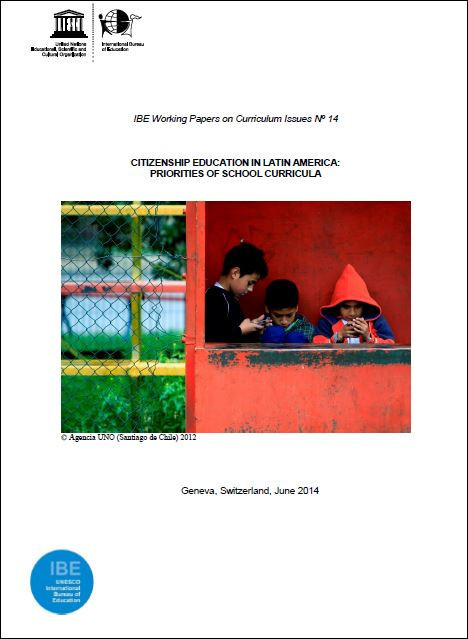 Citizenship education in Latin America: Priorities of School Curricula Année de publication: 2014 Auteur: Cristián Cox | Martín Bascopé | Juan Carlos Castillo | Daniel Miranda | Macarena Bonhomme Auteur institutionnel: UNESCO International Bureau of Education (IBE) This work focuses on the curricula of six Latin American countries – Colombia, Chile, the Dominican Republic, Guatemala, Mexico and Paraguay – which at the close of the past decade agreed to be part of the project Regional System of Evaluation and Development of Citizenship Competencies (SREDECC). With the support of the Inter-American Development Bank, SREDECC developed the Latin American module of the International Civic and Citizenship Study (ICCS- 2009) undertaken by the International Association for the Evaluation of Educational Achievement (IEA), in addition to encouraging the participation of the countries in that study (Cox 2010; Schulz, Ainley, Friedman and Lietz 2011). This document comprises four parts. The first section takes stock of the state of democratic belief in the region, drawing upon the most significant opinion studies of the past decade, so as to offer broader meaning bases for curriculum analysis and, more generally, for educational work in the field of citizenship. The second section describes the organizational (or structural) characteristics of the curricula of the six countries and presents a framework of categories for their comparative analysis. The subsequent section describes and analyses the contents of the six curricula examined and how they deal with the values, institutions and citizenship relations in their civic (political) and civil (coexistence) dimensions. On the basis of the most significant findings, the closing section includes some reflections regarding curriculum development with regard to citizenship. Educación Ciudadana en América Latina: Prioridades de los Currículos Escolares Année de publication: 2014 Auteur: Cristián Cox | Martín Bascopé | Juan Carlos Castillo | Daniel Miranda | Macarena Bonhomme Auteur institutionnel: UNESCO International Bureau of Education (IBE) El documento se organiza en cuatro partes. En la primera se da cuenta del estado de la creencia democrática en la región, recurriendo a evidencia de los estudios de opinión más importantes de la última década, de modo de ofrecer contexto y bases de significado amplios al análisis curricular, así como, más en general, al trabajo educativo en el área de ciudadanía. En la segunda sección se describe las características organizativas (o de estructura) de los currículos de los seis países y se presenta un esquema de categorías para el análisis comparado de los mismos. La sección siguiente describe y analiza los contenidos de los seis currículos examinados y su tratamiento de los valores, las instituciones y las relaciones de ciudadanía, en su dimensión cívica (política) y civil (convivencia). A partir de los hallazgos más importantes, la sección de cierre ofrece unas reflexiones orientadas al desarrollo curricular en el área.
  World citizenship education and teacher training in a global context: Canada, India and South Africa Année de publication: 2011 Auteur: George Cappelle | Gary Crippin | Ulla Lundgren Auteur institutionnel: Children's identity and Citizenship in Europe (CICE) In this study we change our focus from a European setting to a global one. We were interested to see how our observations from the first study would be reflected in a more global context with focus on the cases of Canada, India and South Africa looking at both the models for world citizenship education and the influence of contextual factors.In choosing these countries we were interested in:Countries on different continentsCountries in different stages of national, social and economic developmentCountries in which there was considerable diversity in the populationCountries in which citizenship and world citizenship education was seen as an important priorityCountries, because of the limitations of researchers, which used English as a primary language.In addition to background research we asked for assistance from professors in the field of teacher education in the three countries to provide us with information on key questions related to citizenship education and teacher training. Mondiale l'éducation civique et la formation des enseignants dans un contexte mondial: le Canada, l'Inde et l'Afrique du Sud Année de publication: 2011 Auteur: George Cappelle | Gary Crippin | Ulla Lundgren Auteur institutionnel: Children's identity and Citizenship in Europe (CICE) Dans cette étude, nous changeons notre objectif d'un cadre européen pour une approche globale. Nous nous sommes intéressés de voir comment nos observations de la première étude serait reflétée dans un contexte plus global en mettant l'aCECnt sur les cas du Canada, l'Inde et l'Afrique du Sud qui cherchent à la fois les modèles pour l'éducation à la citoyenneté mondiale et l'influence des facteurs contextuels. Dans le choix de ces pays, nous étions intéressés à: ● Les pays sur différents continents ● pays à différents stades de développement national, social et économique ● Les pays dans lesquels il y avait une grande diversité dans les populations ● Les pays dans lesquels la citoyenneté et la citoyenneté mondiale l'éducation a été considérée comme une priorité ● importants pays, en raison des limitations des chercheurs, qui ont utilisé l'anglais comme langue principale. Outre la recherche de fond, nous avons demandé l'aide de professeurs dans le domaine de la formation des enseignants dans les trois pays pour nous fournir des informations sur des questions clés liées à l'éducation à la citoyenneté et à la formation des enseignants.
  التربية على المواطنة العالمية: مواضيع وأهداف تعلمية Année de publication: 2015 Auteur institutionnel: UNESCO هذا الدليل "التربية على المواطنة العالمية: المواضيع والأهداف التعلمية" هو أول التوجيهات التربوية لليونسكو حول تعليم المواطنة العالمية. أتى هذا الدليل نتيجة لبحوث معمقة وعملية استشارية مع خبراء من مختلف أصقاع العالم. يرتكز هذا التوجيه على دليل اليونسكو» التربية على المواطنة العالمية: تحضير المتعلمين لتحديات القرن الواحد والعشرين " ومخرجات الأحداث لليونسكو حول التربية على المواطنة العالمية: المشاورة الفنية حول التربية على المواطنة العالمية (أيلول/سبتمبر 2013) وندوة اليونسكو الأولى والثانية حول التربية على المواطنة العالمية، واللتين عقدتا في كانون الأول/ديسمبر 2013 وكانون الثاني/يناير من العام 2015 على التوالي. قبل الانتهاء من العمل على هذا التوجيه، اختبره أصحاب المصلحة في المجال التعليمي اختباراً ميدانياً في عدد من الدول المنتقاة بغية الحرص على ملاءمته للسياقات الجغرافية والاجتماعية الثقافية المختلفة. تهدف التربية على المواطنة العالمية إلى أن تشكل قوة تحويلية، وبناء المعرفة والمهارات والقيم والسلوكيات التي يحتاج إليها المتعلمون ليتمكنوا من المساهمة في عالم أكثر دمجاً وعدلا وسلاماً. ويقدم هذا الدليل اقتراحات لترجمة مفاهيم التربية على المواطنة العالمية إلى مواضيع وأهداف تعلمية عملية ومراعية للأعمار بطريقة تسمح بمواءمتها مع السياقات المحلية. ويهدف الدليل إلى أن يشكل مورداً للمربين ومطوري المناهج والمدربين، بالإضافة إلى صانعي السياسات، فضلا عن كونه مهماً أيضاً لغيرهم من أصحاب المصلحة في المجال التعليمي، العاملين في أطر نظامية أو غير نظامية. يعرّف الدليل بالتربية العالمية ومقوماتها التعلمية وكيفية إدماجها في النطم التربوية وتطبيقها داخل الصف.
  Global Citizenship Education: Topics and Learning Objectives Année de publication: 2015 Auteur institutionnel: UNESCO This publication, titled Global Citizenship Education: Topics and learning objectives, is the first pedagogical guidance from UNESCO on global citizenship education. It is the result of an extensive research and consultation process with experts from different parts of the world. This guidance draws on the UNESCO publication Global Citizenship Education: Preparing learners for the challenges of the 21st century and the outcomes of three key UNESCO events on global citizenship education: the Technical Consultation on Global Citizenship Education (September 2013), as well as the First and Second UNESCO Fora on Global Citizenship Education, organized in December 2013 and January 2015 respectively. Before it was finalized, the guidance was field-tested by education stakeholders in selected countries in all regions to ensure its relevance in different geographical and socio-cultural contexts. Following the foundational work of UNESCO to clarify the conceptual underpinnings of global citizenship education and provide policy and programmatic directions, this document has been developed in response to the needs of Member States for overall guidance on integrating global citizenship education in their education systems. It presents suggestions for translating global citizenship education concepts into practical and age-specific topics and learning objectives in a way that allows for adaptation to local contexts. It is intended as a resource for educators, curriculum developers, trainers as well as policy-makers, but it will also be useful for other education stakeholders working in non-formal and informal settings.
  Educación para la ciudadanía mundial: temas y objetivos de aprendizaje Année de publication: 2015 Auteur institutionnel: UNESCO La educación para la ciudadanía mundial aspira a ser un factor de transformación, inculcando los conocimientos, las habilidades, los valores y las actitudes que los educandos necesitan para poder contribuir a un mundo más inclusivo, justo y pacífico.La presente publicación, titulada Educación para la ciudadanía mundial: Temas y objetivos de aprendizaje, es la primera guía de la UNESCO al respecto. Se presentan sugerencias para plasmar los conceptos de la educación para la ciudadanía mundial en temas y objetivos de aprendizaje específicos para cada grupo de edad de un modo que facilita su adaptación a las circunstancias locales. Es un recurso para los educadores, los responsables de la elaboración de programas de estudios, los instructores y los encargados de la formulación de políticas, pero también será de utilidad para otros copartícipes en la educación que trabajan en contextos no formales e informales.
  Éducation à la citoyenneté mondiale: thèmes et objectifs d'apprentissage Année de publication: 2015 Auteur institutionnel: UNESCO Le présent ouvrage, intitulé Éducation à la citoyenneté mondiale : Thèmes et objectifs d’apprentissage, est le premier guide pédagogique de l’UNESCO sur l’éducation à la citoyenneté mondiale. Il est le fruit d’un processus approfondi de recherche et de consultation avec des spécialistes de différentes régions du monde. Ce guide s’inspire de la publication de l’UNESCO intitulée Éducation à la citoyenneté mondiale : Préparer les apprenants aux défis du XXIe siècle ainsi que des résultats de trois événements clés de l’UNESCO sur l’éducation à la citoyenneté mondiale : la Consultation technique sur l’éducation à la citoyenneté mondiale (septembre 2013) et les premier et deuxième Forums de l’UNESCO sur l’éducation à la citoyenneté mondiale, organisés en décembre 2013 et en janvier 2015. Avant sa finalisation, le guide a été expérimenté sur le terrain par des acteurs de l’éducation dans différents pays de chaque région, afin de veiller à ce qu’il soit adapté à des contextes géographiques et socioculturels divers. Inspirée des travaux de base de l’UNESCO visant à clarifier les fondements conceptuels de l’éducation à la citoyenneté mondiale, et à fournir des orientations politiques et programmatiques, cette publication a été élaborée pour répondre aux besoins des États membres, en leur donnant des indications générales sur l’intégration de l’éducation à la citoyenneté mondiale dans leurs systèmes éducatifs. Elle propose des moyens de transposer l’éducation à la citoyenneté mondiale dans des thèmes et des objectifs d’apprentissage pratiques et tenant compte de l’âge de l’apprenant, qui puissent être adaptés aux contextes locaux. Cette publication a été conçue pour servir de document de référence aux éducateurs, aux concepteurs de programmes éducatifs, aux formateurs et aux décideurs, mais elle sera également utile à d’autres acteurs de l’éducation travaillant dans des contextes non formels et informels.
  세계시민교육: 학습 주제 및 학습 목표 Année de publication: 2015 Auteur institutionnel: UNESCO 세계시민교육은 학습자들이 더 포용적이고, 정의롭고, 평화로운 세상을 만드는 데 이바지할 수 있도록 필요한 지식, 기능, 가치, 태도를 길러줌으로써 변혁적인 교육을 달성하고자 한다.이 책 『세계시민교육 : 학습 주제 및 학습 목표』는 세계시민교육에 대한 유네스코의 첫 교수·학습 지침서이다. 세계시민교육의 개념을 지역적 맥락에 맞게 활용할 수 있도록 실제 연령별 학습 주제 및 학습 목표로 구체화한 제안을 담고 있다. 교육자, 교육과 정 개발자, 교사교육자 및 정책입안자를 대상으로 개발된 본 지침서는 무형식 및 비형식 교육환경에 있는 교육 관계자들에게도 유용한 자료가 될 것이다.
  Воспитание глобальной гражданственности: темы и цели обучения Année de publication: 2015 Auteur institutionnel: UNESCO Данная публикация, озаглавленная «Воспитание глобальной гражданственности: темы и цели обучения» является первым, подготовленным ЮНЕСКО, педагогическим руководством в области воспитания глобальной гражданственности. Она является результатом обширных исследований и консультаций с участием экспертов из разных частей мира. Это руководство основывается на публикации ЮНЕСКО «Воспитание глобальной гражданственности: подготовка учащихся к проблемам XXI века» и результатах трех ключевых мероприятий ЮНЕСКО в области воспитания глобальной гражданственности: технической консультации по воспитанию глобальной гражданственности (сентябрь 2013 г.), а также первого и второго форумов ЮНЕСКО по воспитанию глобальной гражданственности, прошедших в декабре 2013 г. и январе 2015 г. До составления окончательного варианта руководства оно было протестировано заинтересованными сторонами в области образования в отдельных странах во всех регионах для обеспечения его актуальности в различных географических и социо-культурных ситуациях.