
Ressources
Explorez une large gamme de ressources sur le GCED afin d’approfondir votre compréhension et de renforcer vos activités de recherche, de plaidoyer, d’enseignement et d’apprentissage.
58 résultats trouvés
 Quelques réflexions sur le progrès, le développement durable et la citoyenneté globale Année de publication: 2013 Auteur: Georges Haddad Auteur institutionnel: UNESCO The arguments developed in this concise presentation demonstrate that sustainable development, progress and global citizenship, efficiently embedded in the context of the Knowledge Society, undeniably participate in the development of the New Humanism promoted by the Director-General of UNESCO, and which we all agree to consider essential for the wealth and prosperity of Humanity in an agreeable, peaceful and friendly common environment.
 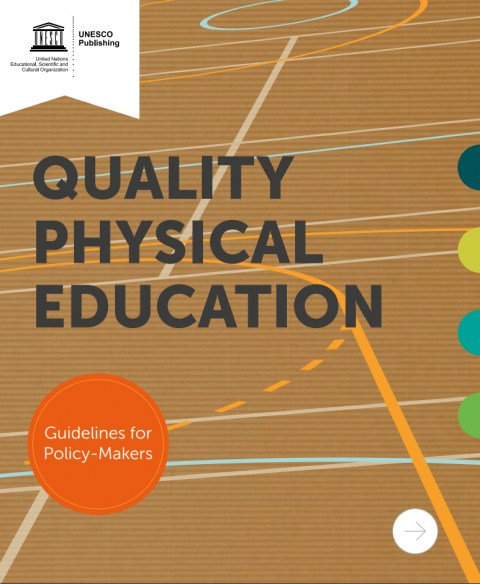 L'Education physique de qualité (EPQ): directives à l'intention des décideurs Année de publication: 2015 Auteur: Nancy, McLennan | Jannine, Thompson Auteur institutionnel: UNESCO A key feature of the Post-2015 Development Agenda is sustainable development. Sustainable development starts with safe, healthy, well-educated children. Participation in quality physical education (QPE), as part of a rounded syllabus, enhances young peoples’ civic engagement, decreases violence and negative patterns of behaviour, and improves health awareness. The UNESCO QPE Policy Package is an original piece of work, which draws upon results from extensive global research (including the Worldwide Survey of School Physical Education). These guidelines, designed for global application and local adaptation, provide a means of analysing current policy through practical guidance and a ‘how-to’ approach. The materials have been developed in consultation with key partners including the European Commission, the International Council for Sport Science and Physical Education (ICSSPE), UNDP, UNICEF, UNOSDP and WHO.
 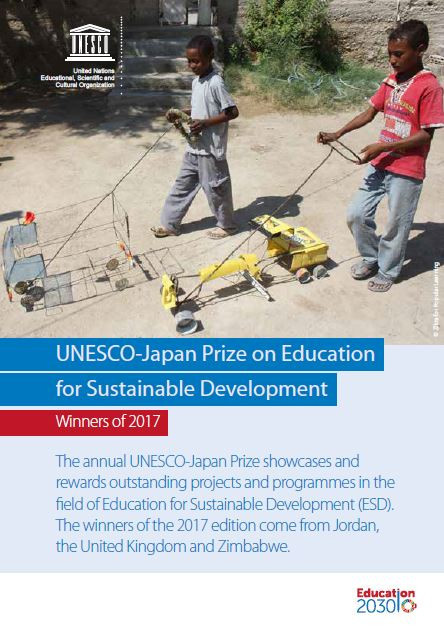 Prix UNESCO-Japon D'éducation en vue du Développement Durable: Lauréats de 2017 Année de publication: 2017 Auteur institutionnel: UNESCO L’année 2017 marque la troisième édition du Prix UNESCO-Japon. Les lauréats ont été sélectionnés parmi plus de 100 candidatures présentées par des gouvernements d’États membres de l’UNESCO et par des organisations non gouvernementales en partenariat officiel avec l'UNESCO. Les candidatures ont été évaluées par un jury indépendant composé de cinq experts internationaux de l’EDD, qui ont recommandé les trois lauréats à la Directrice générale de l’UNESCO.Parmi les lauréats de cette année figurent une école, une entreprise et une organisation à but non lucratif oeuvrant à la promotion de l’EDD, respectivement à l’échelle locale, régionale et internationale : l’école primaire Sihlengeni (République du Zimbabwe) ; l’entreprise sociale Zikra (Royaume hachémite de Jordanie) ; et le projet Hard Rain (Royaume-Uni de Grande-Bretagne et d'Irlande du Nord). Chaque lauréat recevra une récompense d’un montant de 50,000 dollars des États-Unis.La Directrice générale de l’UNESCO et le Ministre de l’éducation japonais remettront le Prix aux trois lauréats au cours d’une cérémonie qui se tiendra le 3 novembre 2017 au Siège de l’UNESCO à Paris, lors de la 39e session de la Conférence générale.
 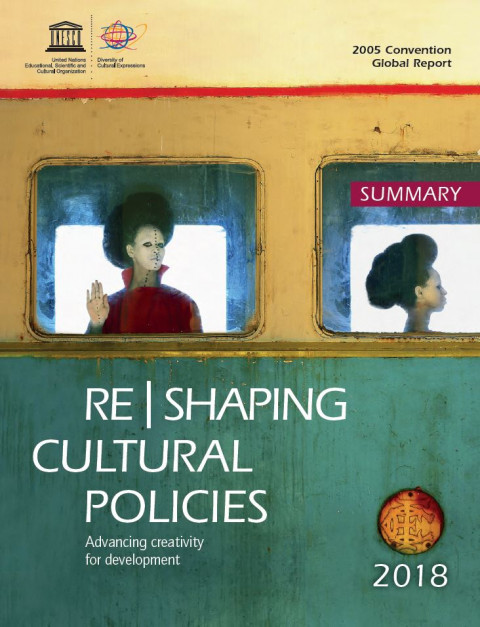 [Résumé] Re|penser les politiques culturelles: la créativité au coeur du développement, Rapport mondial Convention 2005, 2018: résumé Année de publication: 2017 Auteur institutionnel: UNESCO Le Rapport mondial 2018 analyse les progrès accomplis dans la mise en oeuvre de la Convention de 2005 depuis la publication du premier Rapport mondial en 2015.A partir des rapports périodiques quadriennaux soumis par les Parties à la Convention et de nouvelles analyses, ce Rapport examine comment la Convention de 2005 a inspiré des changements politiques aux niveaux mondial et national dans dix domaines clés de l’action politique. Il propose un ensemble de recommandations politiques pour le futur et met l’accent sur l’adaptation des politiques culturelles, fondées sur les droits de l’homme et les libertés fondamentales, afin de faire face aux transformations rapides suscitées par l’environnement numérique.Prises ensemble, les deux éditions du Rapport mondial offrent un ensemble de données et d’informations nouvelles et précieuses qui permettent d’éclairer l’élaboration des politiques culturelles et de placer la créativité au coeur du développement.
 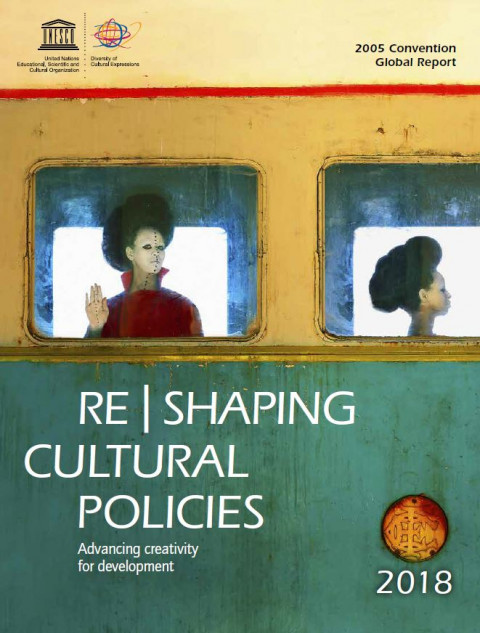 Repenser les politiques culturelles: la créativité au coeur du développement; Rapport mondial Convention 2005, 2018 Année de publication: 2018 Auteur institutionnel: UNESCO La série des Rapports mondiaux a été conçue pour faire le suivi de la mise en oeuvre de la Convention de l’UNESCO sur la protection et la promotion de la diversité des expressions culturelles (2005). Elle sert également à montrer comment ce processus contribue à la réalisation des Objectifs de développement durable des Nations Unies à l’horizon 2030.Le Rapport mondial 2018 analyse les progrès accomplis dans la mise en oeuvre de la Convention de 2005 depuis la publication du premier Rapport mondial en 2015.A partir des rapports périodiques quadriennaux soumis par les Parties à la Convention et de nouvelles analyses, ce Rapport examine comment la Convention de 2005 a inspiré des changements politiques aux niveaux mondial et national dans dix domaines clés de l’action politique. Il propose un ensemble de recommandations politiques pour le futur et met l’accent sur l’adaptation des politiques culturelles, fondées sur les droits de l’homme et les libertés fondamentales, afin de faire face aux transformations rapides suscitées par l’environnement numérique.
  Re|penser les politiques culturelles: 10 ans de promotion de la diversité des expressions culturelles pour le développement Année de publication: 2015 Auteur institutionnel: Organisation des Nations Unies pour l'éducation, la science et la culture (UNESCO) This Report presents the work of fourteen independent experts, as well as the Secretary of the Convention and the Principal Editor, who have analysed the implementation of the Convention on the Protection and Promotion of the Diversity of Cultural Expressions. Its purpose is to move forward the process of monitoring the Convention’s implementation that was put in place by a mechanism of Quadrennial Periodic Reports (QPRs) approved by the Convention’s Conference of Parties in 2011. The contributors have consulted the 71 reports submitted by Parties, but have also used data derived from other, non-official sources and have drawn upon their own expert experience.
  Élaboration et révision des programmes d'enseignement pour l'éducation à la citoyenneté démocratique et aux droits de l'homme Année de publication: 2016 Auteur institutionnel: UNESCO | Conseil de l'Europe | Organization of American States (OAS) | OSCE. Office for Democratic Institutions and Human Rights (ODIHR) Education for democratic citizenship and human rights education are vital for peaceful, sustainable and inclusive societies based on respect for the human rights of every person. Effective teaching and learning processes require well-trained teachers, positive learning environments and high-quality learning materials. This is underpinned by education policy, including curriculum development and review, which is the main focus of this book. The strengthening of education policies in the fields of education for democratic citizenship and human rights lies at the very heart of the efforts of the Council of Europe, the United Nations Educational, Scientific and Cultural Organization, the Office for Democratic Institutions and Human Rights of the Organization for Security and Co-operation in Europe, and the Organization of American States. These organisations have jointly produced this publication in order to support states’ commitment to fostering citizenship and human rights education and improving access to quality education for all. Allocution de M. Koïchiro Matsuura, Directeur Général de l'UNESCO, à l'Occasion du Séminaire International sur l'Education au Changement Climatique, UNESCO, 27 Juillet 2009 Année de publication: 2009 Auteur institutionnel: UNESCO This document is the address of Mr Mr Koïchiro Matsuura, Director-General of UNESCO, on the occasion of the International Seminar on Climate Change Education; UNESCO, 27 July 2009. He presented the climate change issues and highlighted the importance of education for sustainable future. Address by Mr Koïchiro Matsuura, Director-General of UNESCO, on the occasion of the International Seminar on Climate Change Education; UNESCO, 27 July 2009 Année de publication: 2009 Auteur institutionnel: UNESCO Ce document est l'adresse de M. Koïchiro Matsuura, Directeur général de l'UNESCO, à l'occasion du Séminaire international sur les changements climatiques de l'éducation; UNESCO, le 27 Juillet 2009. Il a présenté les questions liées au changement climatique et a souligné l'importance de l'éducation pour un avenir durable. Apprendre à s'adapter au changement climatique et à atténuer ses effets: l'UNESCO et l'éducation au changement climatique Année de publication: 2009 Auteur institutionnel: UNESCO This report is a result of the UNESCO International Seminar on Climate Change Education at UNESCO Headquarters in Paris, 27-29 July, 2009. Over the past 30 years, UNESCO has actively contributed to building the global knowledge base on climate change. Primarily through its contribution to climate science (global ocean observation systems, assessment and monitoring) and secondarily by promoting education, capacity development, public awareness and access to information. As Task Manager of Chapter 36 of Agenda 21 – which relates to the promotion of education, public awareness and training – and lead agency for the UN Decade of Education for Sustainable Development (DESD, 2005-2014), the Organization plays a lead role in promoting Education for Sustainable Development (ESD). Climate change is one of the key action themes of the Decade, as was reaffirmed at the World Conference on Education for Sustainable Development held in Bonn in April 2009. Education has a central role to play in understanding, mitigating and adapting to the changing climate. While education at all levels and in both formal and informal settings is needed, instilling climate change awareness and understanding at a young age is ultimately the best way to change behaviours and attitudes. What children learn today will shape tomorrow’s world. Through the New Delhi work programme – which is a flexible programme for country-driven action engaging all stakeholders on education, training and public awareness on climate change, UNESCO supports its Member States to implement Article 6 of the United Nations Framework Convention on Climate Change. Similarly, the UNESCO Enhanced Plan of Action for the Strategy for Action on Climate Change recognizes the importance of and outlines action for education in promoting mitigation of and adaptation to climate change.