
Ressources
Explorez une large gamme de ressources sur le GCED afin d’approfondir votre compréhension et de renforcer vos activités de recherche, de plaidoyer, d’enseignement et d’apprentissage.
249 résultats trouvés
 Second collection of good practices: education for sustainable development Année de publication: 2009 Auteur institutionnel: UNESCO Associated Schools Project Network (ASPnet) This second collection of ASPnet good practices for quality education takes stock of some of the contributions being made by UNESCO Associated Schools in support of the United Nations Decade of Education for Sustainable Development (DESD). Address by Irina Bokova, Director-General of UNESCO on the occasion of the Conference on Education for Sustainable Development in Support of Cultural and Biological Diversity; Oman, 24 January 2011 Année de publication: 2011 Auteur institutionnel: UNESCO. Director-General, 2009-2017 (Bokova, I.G.) This address was given by Irina Bokova, Director-General of UNESCO on the occasion of the Conference on Education for Sustainable Development in Support of Cultural and Biological Diversity. Regional workshop on enhancing teachers' competencies in education for sustainable development, Alexandria, Egypt, 7-9 May 2007: final report Année de publication: 2007 Auteur institutionnel: UNESCO Beirut | University of Alexandria In the framework of the UN decade of education for sustainable development, the UNESCO offices in the Arab region held their first workshop in September 2005 on the role of education and training for sustainable development. This second workshop was inaugurated in May 2007 on Enhancing Teachers’ Competencies in Education for sustainable Development. The choice of the teacher to be at the center of this workshop stresses the role teacher plays in development programs. Address by Mr Koïchiro Matsuura, Director-General of UNESCO, on the occasion of the Opening Ceremony of the UNESCO World Conference on Education for Sustainable Development: Moving into the Second Half of the UN Decade, delivered on his behalf by Mr Nicholas Burnett, Assistant Director-General for Education; Bonn, Germany, 31 March 2009 Année de publication: 2009 Auteur institutionnel: UNESCO. Director-General, 1999-2009 (Matsuura, K.) This address by Mr Koïchiro Matsuura, Director-General of UNESCO, on the occasion of the opening ceremony of the UNESCO World Conference on Education for Sustainable Development: Moving into the Second Half of the UN Decade, was delivered on his behalf by Mr Nicholas Burnett, Assistant Director-General for Education; Bonn, Germany, 31 March 2009.
  Education for intercultural understanding Année de publication: 2010 Auteur: Joy de Leo Auteur institutionnel: UNESCO Bangkok The theme of intercultural understanding and respect for cultural diversity falls within the social dimension of peace, equality and human rights, underpinned by the cultural context, within and through which learning occurs, and which forms the basis for inter-linkages between the various sustainability dimensions (i.e., socio-political, environmental and economic). Within the International Implementation Scheme, the value of respect is seen as central to all aspects of sustainable development: respect for self, for others and for all life on earth. Address by Mr Koïchiro Matsuura, Director-General of UNESCO, on the occasion of the International Forum on ESD dialogue 2008: to be delivered by Mr Mark Richmond, Director of Division for the Coordination of United Nations Priorities in Education Année de publication: 2008 Auteur institutionnel: UNESCO. Director-General, 1999-2009 (Matsuura, K.) This address by Mr Koïchiro Matsuura, Director-General of UNESCO, on the occasion of the International Forum on ESD Dialogue 2008 was delivered by Mr Mark Richmond, Director of Division for the Coordination of United Nations Priorities in Education. UNESCO world conference on education for sustainable development: 31 March-2 April 2009, Bonn, Germany: proceedings Année de publication: 2009 Auteur institutionnel: German Federal Ministry of Education and Research (BMBF) | German Commission for UNESCO As the United Nations Decade of Education for Sustainable Development (DESD) approached its midpoint, the “UNESCO World Conference on Education for Sustainable Development – Moving into the Second Half of the UN Decade” was held from 31 March to 2 April 2009 in Bonn, Germany. It brought together 900 participants from 147 countries, among them 49 Ministers and Deputy-Ministers. Participants included representatives of UNESCO Member States, UN agencies, civil society organizations, education institutions, youth, and the private sector, as well as individual experts. The Conference was organized by UNESCO and the German Federal Ministry of Education and Research, in cooperation with the German Commission for UNESCO. The programme was developed in consultation with an international advisory group.
 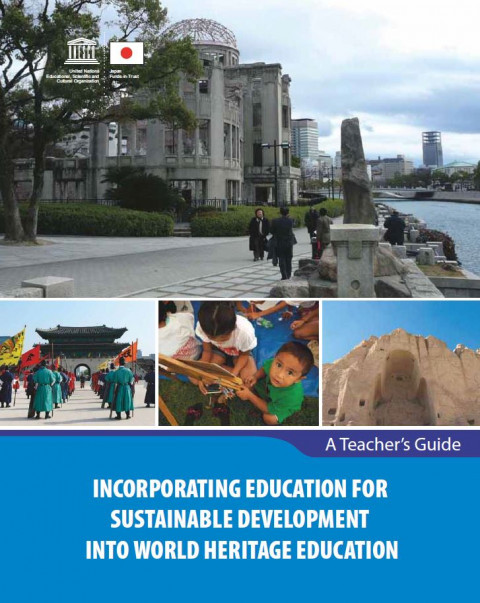 Incorporating education for sustainable development into world heritage education: a teacher's guide Année de publication: 2010 Auteur institutionnel: UNESCO Bangkok This publication, A Teacher’s Guide: Incorporating Education for Sustainable Development into World Heritage Education, represents the collective efforts of workshop participants to produce a practical tool for teachers to modify available curricula and incorporate ESD concepts and principles into WHE. It has taken a long time for the guide to be available in print. Nonetheless, the content of the guide remains practical and relevant in incorporating Education for Sustainable Development into World Heritage Education.
 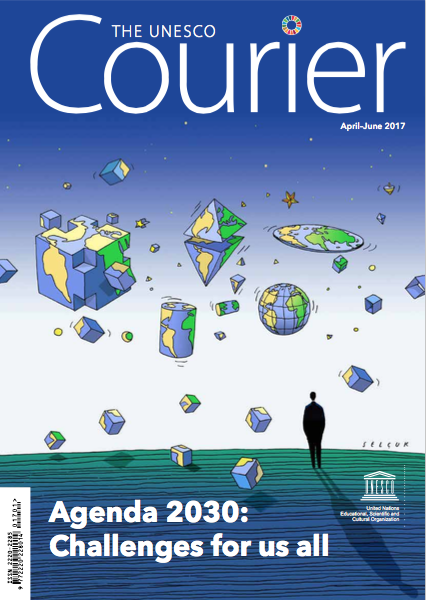 2030 Agenda: Challenges for us all Année de publication: 2017 Since 1948, the UNESCO Courier has served as a platform for international debates on issues that concern the entire planet. This first issue of 2017, which marks the Courier’s revival after
a five-year break, is no exception to the rule: experts, public figures, artists and journalists from around the world have come together to discuss topical issues. Climate change and sustainable energy (p. 23), the future of cities and Smart Cities (p. 15), access to water and the state of groundwater (p. 19), educational policies and the importance they give to girls (p. 8), new technologies and their role in establishing efficient democratic institutions (p. 27), alliances and partnerships that must be forged to advance towards a better world
(p. 31) — these are some of the subjects that constitute the main dossier,
Wide angle, of this issue dedicated to Sustainable Development Goals (SDGs). UNESCO is closely associated with the development and implementation of this international road map that aims
to achieve the seventeen objectives established by the UN, which is convinced that culture, though officially absent from the SDGs, is at the heart of sustainable development policies (p. 12). Elyx, the jovial character created by Yacine Ait Kaci (YAK) and designated virtual ambassador of the UN, supports the Courier in its mission to make palpable the different realities around the world. These are illustrated by a number of SDGs and highlight the players who participate in achieving this agenda for everyone. These include the international community, states, civil society, local communities and authorities, the private sector, and the partnerships that these players set up between each other. The Ideas section, which is dedicated
to another highly topical issue — the current perception of Islam — suggests considering a reinterpretation of the Koran (p. 42) and the sharia (p. 48).
This issue of the Courier also features a reference text on the Different Aspects of Islamic Culture. Launched in 1977, in the wake of a monumental work produced by UNESCO Publishing on general and regional histories, this comprehensive work was completed in November 2016, with the publication of two volumes that constitute an important contribution to the current debate on Islam. In the Current affairs section for the April-June 2017 quarter, the Courier
will celebrate the launch of the World Book Capital programme in Conakry
on 23 April (p. 70) and the International Jazz Day, with the Cuban pianist Chucho Valdés (p. 58) on 30 April in Havana. The Courier will also participate in the celebration of several other international days such as the World Press Freedom Day on 3 May (p. 62), the World Oceans Day on 8 June (p. 65), and the International Day for the Elimination of Sexual Violence in Conflict on 19 June (p. 61). This issue of the Courier also invites you to delve into the peculiar and largely unknown world of Jeju Island’s haenyeo, the women divers from the Republic of Korea. Discover, through the stunning images in the Zoom section, the exceptional destinies of these extraordinary women (p. 36). We hope you enjoy reading this issue!
2030 Agenda: Challenges for us all Année de publication: 2017 Since 1948, the UNESCO Courier has served as a platform for international debates on issues that concern the entire planet. This first issue of 2017, which marks the Courier’s revival after
a five-year break, is no exception to the rule: experts, public figures, artists and journalists from around the world have come together to discuss topical issues. Climate change and sustainable energy (p. 23), the future of cities and Smart Cities (p. 15), access to water and the state of groundwater (p. 19), educational policies and the importance they give to girls (p. 8), new technologies and their role in establishing efficient democratic institutions (p. 27), alliances and partnerships that must be forged to advance towards a better world
(p. 31) — these are some of the subjects that constitute the main dossier,
Wide angle, of this issue dedicated to Sustainable Development Goals (SDGs). UNESCO is closely associated with the development and implementation of this international road map that aims
to achieve the seventeen objectives established by the UN, which is convinced that culture, though officially absent from the SDGs, is at the heart of sustainable development policies (p. 12). Elyx, the jovial character created by Yacine Ait Kaci (YAK) and designated virtual ambassador of the UN, supports the Courier in its mission to make palpable the different realities around the world. These are illustrated by a number of SDGs and highlight the players who participate in achieving this agenda for everyone. These include the international community, states, civil society, local communities and authorities, the private sector, and the partnerships that these players set up between each other. The Ideas section, which is dedicated
to another highly topical issue — the current perception of Islam — suggests considering a reinterpretation of the Koran (p. 42) and the sharia (p. 48).
This issue of the Courier also features a reference text on the Different Aspects of Islamic Culture. Launched in 1977, in the wake of a monumental work produced by UNESCO Publishing on general and regional histories, this comprehensive work was completed in November 2016, with the publication of two volumes that constitute an important contribution to the current debate on Islam. In the Current affairs section for the April-June 2017 quarter, the Courier
will celebrate the launch of the World Book Capital programme in Conakry
on 23 April (p. 70) and the International Jazz Day, with the Cuban pianist Chucho Valdés (p. 58) on 30 April in Havana. The Courier will also participate in the celebration of several other international days such as the World Press Freedom Day on 3 May (p. 62), the World Oceans Day on 8 June (p. 65), and the International Day for the Elimination of Sexual Violence in Conflict on 19 June (p. 61). This issue of the Courier also invites you to delve into the peculiar and largely unknown world of Jeju Island’s haenyeo, the women divers from the Republic of Korea. Discover, through the stunning images in the Zoom section, the exceptional destinies of these extraordinary women (p. 36). We hope you enjoy reading this issue! 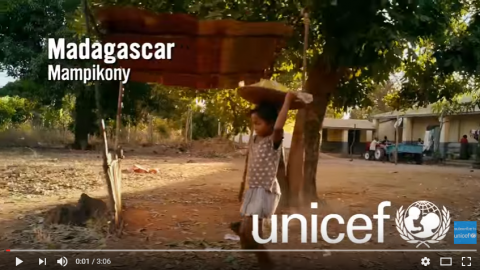 Educating the next generation of a Madagascar family Année de publication: 2015 Auteur institutionnel: United Nations Children's Fund (UNICEF) One million. That’s how many children are out of school in Madagascar. However, Lantonirina, 11, is focused on finishing school and dreams of becoming a teacher: "I don't plan to marry very early because I want to continue my studies.” Lantonirina’s mother and sister were both married as adolescents and had to leave school so she is determined to break the cycle.