
Ressources
Explorez une large gamme de ressources sur le GCED afin d’approfondir votre compréhension et de renforcer vos activités de recherche, de plaidoyer, d’enseignement et d’apprentissage.
23 résultats trouvés
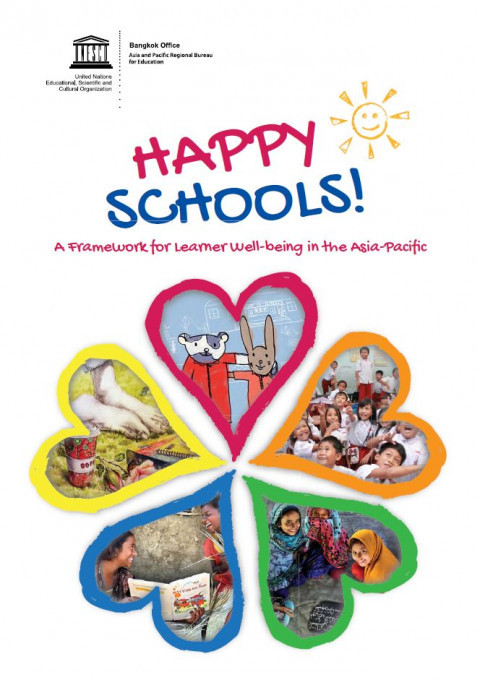 Happy Schools!: A Framework for Learner Well-being in the Asia-Pacific Année de publication: 2016 Auteur institutionnel: UNESCO Bangkok The Happy Schools Project was launched in June 2014 in the aim of promoting learner well-being and holistic development. It follows on the findings of UNESCO Bangkok’s research on ‘Learning to Live Together’, which examined the ways in which education systems can promote peace through education in the Asia-Pacific region. While the concept of ‘Learning to Live Together’ is often reflected at policy level, there is little evidence as to how it is implemented in practice. Therefore, the Happy Schools Project aims to identify and recognize proven practices at school level that integrate this concept. Écoles Heureux: Un cadre pour l'apprenant Bien-être dans la région Asie-Pacifique Année de publication: 2016 Auteur institutionnel: UNESCO Bangkok Le projet Bonne écoles a été lancé en Juin 2014, le but de promouvoir l'apprenant le bien-être et le développement holistique. Il en résulte sur les résultats de la recherche de l'UNESCO à Bangkok sur «Apprendre à vivre ensemble», qui a examiné la manière dont les systèmes éducatifs peuvent promouvoir la paix par l'éducation dans la région Asie-Pacifique. Bien que le concept de «Apprendre à vivre ensemble» se traduit souvent au niveau politique, il y a peu de preuves quant à la façon dont il est mis en œuvre dans la pratique. Par conséquent, des écoles Heureux vise à identifier et reconnaître les pratiques éprouvées au niveau des écoles qui intègrent ce concept. Счастливые школы: Основа благополучия учащихся в Азиатско-Тихоокеанском регионе Année de publication: 2016 Auteur institutionnel: UNESCO Bangkok Этот региональный доклад был подготовлен Региональным бюро ЮНЕСКО по образованию в Азиатско-Тихоокеанском регионе (ЮНЕСКО, Бангкок). В нем представлены результаты исследования проведенного в рамках проекта «Счастливые школы». Этот отчет, основанный на результатах серии мероприятий, проводимых в рамках проекта «Счастливые школы», признает важную взаимосвязь между счастьем и качеством образования. Он объединяет эти два элемента и призывает системы образования выходить за рамки традиционных областей обучения, чтобы охватить разнообразие талантов и умений, признавая ценности, сильные стороны и компетенции, которые способствуют как повышению счастья, так и благополучию учащихся, но также и их процветать и праздновать свои достижения.
  Happy Schools Art E-Exhibition Année de publication: 2016 Auteur institutionnel: UNESCO Bangkok Happy Schools Art E-Exhibition What does a Happy School look like to you? A happy learner is more likely to be a thriving one – better able to solve problems and apply critical thinking skills, more self-confident and likelier to form and foster positive relationships with others. Happy learners require Happy Schools, those that ensure the holistic development and well-being of students and the wider school community. In today’s rapidly changing world, we are faced with increasing mobility, life stress, competition, information overload, inequalities and environmental concerns. As these symptoms of ‘unhappiness’ begin to emerge, the Happy Schools Project calls for the need for education systems to reposition the school as more than a service for educational instruction, but rather, an environment which allows for social and emotional growth and development for learners to contribute to a more peaceful, just and equitable world. As part of UNESCO Bangkok’s Happy Schools Project, the Happy Schools team hosted an art contest in early 2016 in an effort to capture actions, moments and ideas that are promoting happiness in schools. All residents of the Asia-Pacific region were invited to submit images of any kind (photos, drawings, cartoons, paintings, graphics, and posters) along with a caption/description that captures the concept of Happy Schools. Thirty winners were selected from the pool of entries for the Happy Schools Art Exhibition and Report Launch (of the Happy Schools: A Framework for Learner Well-being in the Asia-Pacific report. The artwork will be on display for the Happy Schools Art Exhibition from 25 March to 3 April, 2016 at The Commons in Bangkok, Thailand, and available to view here as an e-exhibition. Écoles Heureux Art E-Exhibition Année de publication: 2016 Auteur institutionnel: UNESCO Bangkok Heureux Écoles d'art E-Exposition, qu'est-ce qu'une école heureux ressemble pour vous? Un apprenant heureux est plus susceptible d'être une entreprise florissante un - mieux à même de résoudre les problèmes et appliquer la pensée critique, plus confiant et plus susceptibles de former et de favoriser des relations positives avec les autres. Apprenants Heureux exigent l’écoles Heureux, ceux qui assurent le développement holistique et le bien-être des élèves et la communauté scolaire. Dans le monde en évolution rapide d'aujourd'hui, nous sommes confrontés à la mobilité croissante, le stress de la vie, la concurrence, la surcharge d'information, les inégalités et les préoccupations environnementales. Comme ces symptômes de «malheur» commencent à émerger, le projet Bonne écoles appelle à la nécessité pour les systèmes éducatifs pour repositionner l'école comme plus qu'un service pour l'enseignement de l'éducation, mais plutôt, un environnement qui favorise la croissance et le développement social et affectif pour apprenants de contribuer à un monde plus pacifique, juste et équitable. Dans le cadre du projet Écoles heureux de l'UNESCO à Bangkok, l'équipe Ecoles Heureux a organisé un concours d'art au début de 2016 dans le but de capturer des actions, des moments et des idées qui font la promotion du bonheur dans les écoles. Tous les résidents de la région Asie-Pacifique ont été invités à soumettre des images de toute nature (photos, dessins, bandes dessinées, peintures, graphiques et affiches) avec une légende / description qui capture le concept des écoles Heureux. Trente gagnants ont été sélectionnés à partir du pool d'entrées pour les écoles Bonne Exposition Art et Rapport de lancement (des écoles Heureux:. Un cadre pour l'apprenant le bien-être dans le rapport Asie-Pacifique, l'œuvre sera exposée pour l'Exposition Heureux Ecoles d'Art du 25 Mars au 3 Avril, 2016 au The Commons à Bangkok, en Thaïlande et à la disposition de la considérer comme un e-exposition)
  Educating for global competence: preparing our youth to engage the world Année de publication: 2011 Auteur: Veronica Boix Mansilla | Anthony Jackson Auteur institutionnel: Asia Society | Council of Chief State School Officers (CCSSO) Contemporary societies are marked by new global trends - economic, cultural, technological, and environmental shifts that are part of a rapid and uneven wave of globalization. The growing global interdependence that characterizes our time calls for a generation of individuals who can engage in effective global problem solving and participate simultaneously in local, national, and global civic life. Put simply, preparing our students to participate fully in today's and tomorrow's world demands that we nurture their global competence.This document introduces a definition of global competence developed by the Global Competence Task Force - a group of state education agency leaders, education scholars, and practitioners - under the auspices of the Council of Chief State School Officers EdSteps initiative (CCSSO-EdSteps) and the Asia Society Partnership for Global Learning (see page (iv) for task force participants). The definition builds on seminal work within the states and a broad range of organizations working to advance global knowledge and critical thinking skills. A process of careful articulation and vetting yielded the definition of global competence here proposed:Global competence is the capacity and disposition to understand and act on issues of global significance.Globally competent individuals are aware, curious, and interested in learning about the world and how it works. They can use the big ideas, tools, methods, and languages that are central to any discipline (mathematics, literature, history, science, and the arts) to engage the pressing issues of our time. They deploy and develop this expertise as they investigate such issues, recognize multiple perspectives, communicating their views effectively, and taking action to improve conditions.Educating for Global Competence: Preparing Our Youth to Engage the World is intended for classroom teachers, administrators, informal educators, policymakers, community leaders, researchers, parents, students, and all other stakeholders interested in preparing our youth for the 21st century. Becoming better at education for global competence involves rethinking practices and recognizing that there are no simple recipes for success. As such, this book is meant to be used flexibly - browse, make connections, and concentrate on the chapters that you find most pertinent to your work. Experiment with ideas, challenge concepts, and share with colleagues. Ultimately this book must work for you. It is meant to be read in the way that best meets your needs, inspires your curiosity, and proves fruitful in the classroom.Chapter one offers a rational for global education in our nation and worldwide. Chapter two introduces a conceptual framework for global competence and explains the key role of disciplinary and interdisciplinary foundations in student learning. Chapter three, four, five and six focus, respectively, on four core capacities associated with global competence: investigating the world, recognizing perspectives, communicating ideas, and taking action. Chapter seven considers core principles of instruction for teaching global competence. Chapter eight looks at what students and education institutions can do to promote global competence - and how they might create a culture of global competence for youth and adults. Finally, chapter nine places global competence in the larger framework of public education systems in and beyond the United States. Eduquer pour compétence globale: préparer nos jeunes à engager le monde Année de publication: 2011 Auteur: Veronica Boix Mansilla | Anthony Jackson Auteur institutionnel: Asia Society | Council of Chief State School Officers (CCSSO) Les sociétés contemporaines sont marquées par de nouvelles tendances mondiales - changements économiques, culturels, technologiques et environnementaux qui font partie d'une vague rapide et inégal de la mondialisation. L'interdépendance mondiale croissante qui caractérise notre temps appelle à une génération de personnes qui peuvent se livrer à la résolution de problème mondial efficace et participer simultanément à la vie civique locale, nationale et mondiale. Simplement, la préparation de nos étudiants de participer pleinement au monde les exigences d'aujourd'hui et de demain que nous entretenons leur compétence mondiale. Ce document présente une définition de la compétence globale développée par le Groupe de travail mondial Compétence - un groupe de chefs d'Etat de l'agence de l'éducation, spécialistes de l'éducation, et les praticiens - sous les auspices du Conseil de l'école Chief State initiative des officiers de EdSteps (CCSSO-EdSteps) et la Asia Partnership Society for global Learning (voir page (iv) pour les participants du groupe de travail). La définition se fonde sur le travail séminal dans les états et un large éventail d'organisations de travail pour faire avancer les connaissances mondiales et de la pensée critique. Un processus d'articulation minutieuse et vetting a abouti à la définition de la compétence globale proposée ici: la compétence globale est la capacité et la disposition pour comprendre et agir sur les questions d'importance mondiale. Globalement les personnes compétentes sont au courant, curieux et intéressés à en apprendre sur le monde et comment il fonctionne. Ils peuvent utiliser les grandes idées, des outils, des méthodes et des langues qui sont au cœur de toutes les disciplines (mathématiques, la littérature, l'histoire, la science et les arts) pour engager les questions pressantes de notre temps. Ils déploient et développer cette expertise comme ils enquêtent sur ces questions, reconnaissent de multiples points de vue, de communiquer leurs points de vue de manière efficace, et prendre des mesures pour améliorer les conditions. Eduquer pour Global Competence: Préparer les jeunes d'engager le monde est destiné aux enseignants, administrateurs, éducateurs informels, les décideurs, les leaders communautaires, les chercheurs, les parents, les étudiants et toutes les autres parties intéressées à préparer nos jeunes pour le 21e siècle. Devenir meilleur à l'éducation pour la compétence globale implique de repenser les pratiques et en reconnaissant qu'il n'y a pas de recettes simples pour le succès. En tant que tel, ce livre est destiné à être utilisé avec souplesse - parcourir, faire des liens, et de se concentrer sur les chapitres que vous trouverez les plus pertinents pour votre travail. Expérience avec des idées, des concepts de défi, et de partager avec des collègues. En fin de compte ce livre doit travailler pour vous. Il est destiné à être lu de la manière qui répond le mieux à vos besoins, inspire votre curiosité, et prouve fructueuse dans la salle de classe. Le premier chapitre offre un rationnel pour l'éducation mondiale dans notre pays et dans le monde. Le deuxième chapitre présente un cadre conceptuel pour la compétence globale et explique le rôle clé des fondations disciplinaires et interdisciplinaires dans l'apprentissage des élèves. Chapitre trois, quatre, cinq et six focus, respectivement, sur quatre capacités essentielles associées à la compétence mondiale: enquête dans le monde, reconnaissant les perspectives, communiquer des idées, et de prendre des mesures. Le chapitre sept considère les principes de base de l'enseignement pour l'enseignement de la compétence globale. Chapitre huit examine ce que les étudiants et les établissements d'enseignement peuvent faire pour promouvoir la compétence globale - et comment ils pourraient créer une culture de compétence globale pour les jeunes et les adultes. Enfin, le chapitre neuf places compétence globale dans le cadre plus large des systèmes d'éducation du public dans et au-delà des États-Unis.
  Education 21st Century Children: Emotional Well-being in the Digital Age (Educational Research and Innovation) Année de publication: 2019 Auteur institutionnel: Organisation for Economic Co-operation and Development (OECD) This report examines modern childhood, looking specifically at the intersection between emotional well-being and new technologies. It explores how parenting and friendships have changed in the digital age. It examines children as digital citizens, and how best to take advantage of online opportunities while minimising the risks. The volume ends with a look at how to foster digital literacy and resilience, highlighting the role of partnerships, policy and protection.
  Human rights education in the school systems of Europe, Central Asia and North America: a compendium of good practice Année de publication: 2009 Auteur institutionnel: Council of Europe | UNESCO | UN. Office of the United Nations High Commissioner for Human Rights (UN. OHCHR) | OSCE. Office for Democratic Institutions and Human Rights (ODIHR) “Human Rights Education in the School Systems of Europe, Central Asia and North America: A Compendium of Good Practice” is a compilation of 101 examples of good practice in human rights education in primary schools, secondary schools and teacher training institutions in the Organization for Security and Co-operation in Europe (OSCE) area, which is also covered by the United Nations Educational, Scientific and Cultural Organization (UNESCO), the Office of the United Nations High Commissioner for Human Rights (OHCHR) and, partially, the geographical mandate of the Council of Europe (CoE).The term “human rights education” is often used in this resource in a broader sense, to also include educationfor democratic citizenship and education for mutual respect and understanding, which are all based on internationally agreed human rights standards. These three areas are seen as interconnected and essential within educational systems in order to prepare youth to be active, responsible and caring participants in their communities, as well as at the national and global levels.Human rights education has been defined as education, training and information aimed at building a universal culture of human rights. A comprehensive education in human rights not only provides knowledge about human rights and the mechanisms that protect them, but also imparts the skills needed to promote, defend and apply human rights in daily life. Education for democratic citizenship focuses on educational practices and activities designed to help young people and adults to play an active part in democratic life and exercise their rights and responsibilities in society. Education for mutual respect and understanding highlights self-respect, respect for others, and the improvement of relationships between people of differing cultural traditions.This book aims to support quality teaching in these areas and to inspire educational policymakers (those working in education ministries and local school boards) and administrators, teachers, teacher trainers, non-formal educators and all other interested actors, as well as to facilitate networking and the exchange of experience among education professionals.
  Thinkpiece on education and conflict Année de publication: 2009 Auteur: Lynn Davies Auteur institutionnel: UNESCO This paper looks first at the learning sites generally (violent schools, schools as a weapon of war, curriculum and textbooks). It then focuses on specific groups in conflict – gender, language, refugees, child soldiers. Thirdly it discusses education policy and donor intervention; and finally talks of the role of research. All these overlap hugely. This is not a prescription for how the Global Monitoring Report should be structured, but identification of themes and lessons learned that seem the most significant.