
Ressources
Explorez une large gamme de ressources sur le GCED afin d’approfondir votre compréhension et de renforcer vos activités de recherche, de plaidoyer, d’enseignement et d’apprentissage.
201 résultats trouvés
 Developing Adult Education and Training Policies for Sustainable Development: A Case Study of the State of Kuwait Année de publication: 2017 Auteur: Sabika Hussain Bursli Auteur institutionnel: Tanta University In this article, the author presents the case of Kuwait in relation to adult education. The article analyzes the current Kuwaiti policies related adult education in light of sustainable development requirements.
  Enseignement de l'Holocauste et prévention du genocide: guide à l'intention des décideurs politiques Année de publication: 2017 Auteur institutionnel: UNESCO Le present document a pour objectif de guider les responsables politiques qui souhaitent organiser ou renforcer l’etude de l’Holocauste et, plus generalement, du genocide et des crimes de masse, dans le systeme educatif de leur pays. Il y est explique pourquoi et comment l’enseignement et l’apprentissage relatifs a l’Holocauste peuvent contribuer a la realisation des priorites strategiques mondiales par l’education, notamment en cultivant la citoyennete mondiale, en promouvant les droits de l’homme et en instaurant une culture de paix et de prevention du genocide.Le document est principalement axe sur l’enseignement de l’Holocauste, et s’appuie sur des decennies de recherches, d’allocations de ressources et de pratiques pedagogiques qui en demontrent l’efficacite. Il prodigue des conseils sur la maniere de fixer des objectifs d’apprentissage clairs, realistes et adaptes au contexte, afin de promouvoir un enseignement de qualite dans ce domaine.
  L'éducation à la citoyenneté dans l'école en Europe Année de publication: 2005 Auteur institutionnel: Eurydice. European Unit Cette analyse comparative est basée sur les descriptions de pays fournies par les Unités nationales d'Eurydice. Afin de recueillir des informations à leur sujet, un Guide du contenu, comprenant des lignes directrices et des définitions communes, a été élaboré par l'Unité Européenne d'Eurydice (UEE) en consultation avec les Unités nationales au début de 2004. Le Guide du contenu visait à garantir que Les descriptions de pays ont été rédigées conformément à une structure commune pour faciliter la comparaison entre pays des informations fournies. Citizenship education at school in Europe Année de publication: 2005 Auteur institutionnel: Eurydice. European Unit This comparative analysis is based on country descriptions supplied by the Eurydice National Units.To collect information for them, a Guide to Content, including common guidelines and definitions, was prepared by the Eurydice European Unit (EEU) in consultation with the National Units at the beginning of 2004.The aim of the Guide to Content was to ensure that the country descriptions were drafted in accordance with a common structure to facilitate subsequent cross-country comparison of the information provided.
  Mainstreaming SDG4-Education 2030 in sector-wide policy and planning: technical guidelines for UNESCO field offices Année de publication: 2016 Auteur institutionnel: UNESCO The main responsibility for implementing the SDG4-Education 2030 Agenda lies with governments, with UNESCO and partners providing support through coordinated policy advice, technical assistance, capacity development and monitoring of progress at global, regional and national levels. By their position, UNESCO field offices have a key role to play in providing such support at country level and therefore require adequate technical capacity to fulfil their mission.These guidelines aim at providing a basic resource to field offices for ensuring adequate technical support to national authorities in this process. In doing so, it takes into account different profiles of country needs and capacities, thus avoiding a one-size-fits-all approach. Countries may have different levels of awareness of, or political commitment to, Sustainable Development Goal 4 (SDG4). In all cases, UNESCO is expected to ensure that all the relevant information about SDG4-Education 2030 is properly disseminated and that national authorities and stakeholders are reminded of its importance. To assist field offices in this task UNESCO has developed and made available a number of resources and support materials, notably the Unpacking SDG4-Education 2030 Guide, parts of which are excerpted here, and will continue coordination efforts in this respect.Inevitably, field staff will have to adapt the guidelines provided here to the reality of the country they are serving. That is why this document is full of resources and pointers that can be combined and tailored to fit the particular context of each country. At the same time, field staff are invited to require additional technical guidance from the corresponding regional bureaus, which can rely on the backstopping of Headquarters services and support from the specialized institutes.These guidelines represent a first attempt to provide specific directions and resources to allow field offices to technically support Member States. After a first evaluation, in which all field staff are invited to participate, the guidelines will be improved so as to make them even more suitable and useful. They will also be supplemented with other material to ensure that UNESCO plays its role as the leading United Nations agency in the field.
  Citizenship education and coexistence: workshop reports Année de publication: 2014 Auteur institutionnel: Bogotá. Secretaría de Educación del Distrito (SED) The present document contains the reports of the work and conclusions built during the Technical Workshop on Education for Citizenship and coexistence, for which were raised the following objectives:Assess the relevance of Education for Citizenship and coexistence proposed by the District Education Secretary,assess the training materials of the Toolbox produced for the implementation of Education for Citizenship and coexistence,and strengthen and consolidate this proposal. Memorias taller técnico: educación para la ciudadanía y la convivencia Année de publication: 2014 Auteur institutionnel: Bogotá. Secretaría de Educación del Distrito (SED) The present document contains the reports of the work and conclusions built during the Technical Workshop on Education for Citizenship and coexistence, for which were raised the following objectives:Assess the relevance of Education for Citizenship and coexistence proposed by the District Education Secretary,assess the training materials of the Toolbox produced for the implementation of Education for Citizenship and coexistence,and strengthen and consolidate this proposal. Souvenirs atelier technique: éducation à la citoyenneté et de la coexistence Année de publication: 2014 Auteur institutionnel: Bogotá. Secretaría de Educación del Distrito (SED) Le présent document contient les rapports sur les travaux et les conclusions construit dans l'atelier technique sur l'éducation à la citoyenneté et de la coexistence, pour lesquels ont été soulevées les objectifs suivants: évaluer la pertinence de l'éducation pour la citoyenneté et de la coexistence proposée par le Secrétaire d'éducation de district, d'évaluer la formation matériaux de la boîte à outils produits pour la mise en œuvre de l'éducation pour la citoyenneté et la coexistence, et de renforcer et de consolider cette proposition. Global education in Austria Auteur institutionnel: North-South Centre of the Council of Europe This National Report on Global Education in Austria is part of the European Global Education Peer Review Process, which was initiated in 2002 with the purpose of increasing and improving global education in Council of Europe member states. This report is the culmination of a peer review process led by an international peer review team. Through research and interviews with key stakeholders, information was gathered and critical perspectives developed about the current state of, and the future prospects for, global education in Austria. This year–long process, facilitated by the North-South Centre of the Council of Europe, was developed in partnership with the Austrian Strategy Group for Global Education as the national counterpart in the process. It involved the Ministry of Foreign Affairs, the Ministry of Education, the Austrian Development Agency (ADA), KommEnt, and the NGO and academic communities.This Peer Review report recognises the relatively strong tradition of global education in Austria. Austrian support for GE is reflected in the range of committed organisations involved in GE, and the many initiatives and projects in the formal and non-formal education sectors, and in civil society. Chapter 1 below provides an introduction to the report and the process generally. Chapter 2 outlines the context of global education in Austria. Chapter 3 examines global education in the formal education sector. Chapter 4 focuses on the important and varied work taking place in non-formal education, civil society organisations and other sectors in this field. Chapter 5 provides, in summary fashion, an outline of the key observations and recommendations of the Peer Review.
 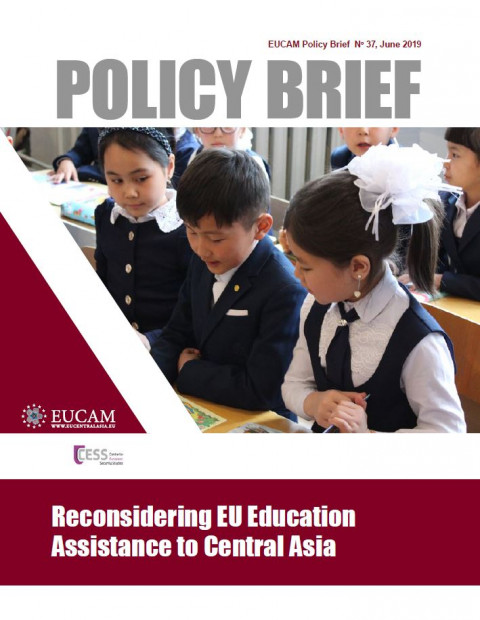 Reconsidering EU Education Assistance to Central Asia (EUCAM Policy Brief No. 37, June 2019) Année de publication: 2019 Auteur: Sebastien Peyrouse Auteur institutionnel: Europe-Central Asia Monitoring (EUCAM) This paper is based on broader research on education in Central Asia that includes interviews with local stakeholders (teachers, parents and students) in Kazakhstan, Kyrgyzstan and Uzbekistan. Some views were taken from Sebastien Peyrouse, ‘How to Strengthen Western Engagement in Central Asia: Spotlight on EU Education Assistance in Uzbekistan’, PONARS Policy Memo, no. 524, April 2018,http://www.ponarseurasia.org/memo/strengthen-western-engagement-central-asia-spotlight-eu-education-assistance-uzbekistan.