
Ressources
Explorez une large gamme de ressources sur le GCED afin d’approfondir votre compréhension et de renforcer vos activités de recherche, de plaidoyer, d’enseignement et d’apprentissage.
105 résultats trouvés
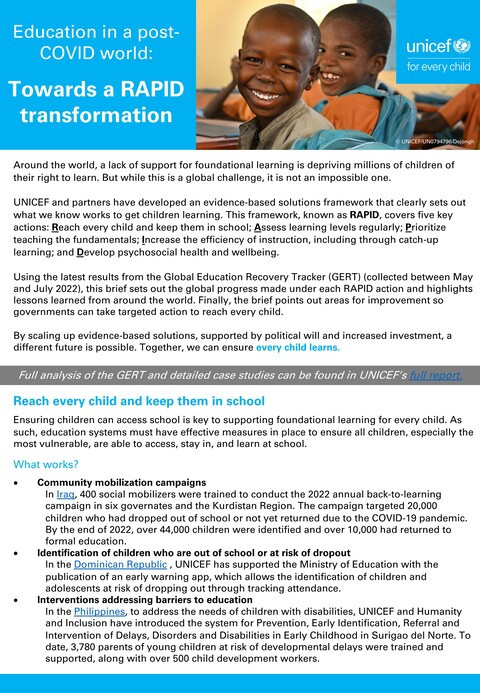 Education in a Post-COVID World: Towards a Rapid Transformation; Advocacy Brief Année de publication: 2023 Auteur institutionnel: United Nations Children's Fund (UNICEF) Around the world, a lack of support for foundational learning is depriving millions of children of their right to learn. But while this is a global challenge, it is not an impossible one. UNICEF and partners have developed an evidence-based solutions framework that clearly sets out what we know works to get children learning. This framework, known as RAPID, covers five key actions: Reach every child and keep them in school; Assess learning levels regularly; Prioritize teaching the fundamentals; Increase the efficiency of instruction, including through catch-up learning; and Develop psychosocial health and wellbeing. Using the latest results from the Global Education Recovery Tracker (GERT) (collected between May and July 2022), this brief sets out the global progress made under each RAPID action and highlights lessons learned from around the world. Finally, the brief points out areas for improvement so governments can take targeted action to reach every child.
 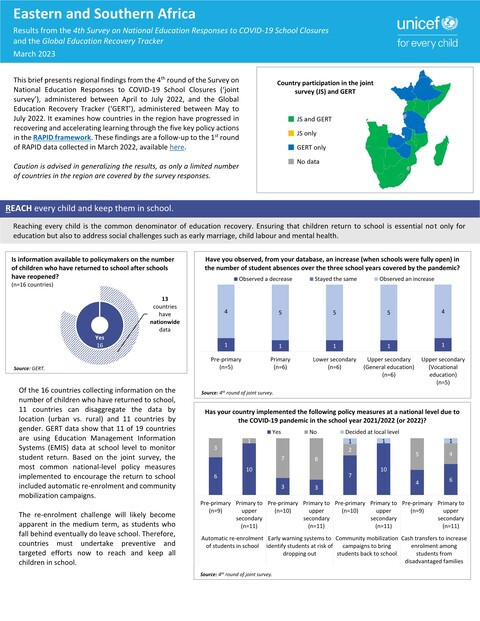 Education in a Post-COVID World: Towards a Rapid Transformation; Eastern and Southern Africa Regional Brief Année de publication: 2023 Auteur institutionnel: United Nations Children's Fund (UNICEF) On March 11, 2020, the World Health Organization declared COVID-19 a global pandemic, resulting in disruptions to education at an unprecedented scale. In response to the urgent need to recover learning losses, countries worldwide have taken RAPID actions to: Reach every child and keep them in school; Assess learning levels regularly; Prioritize teaching the fundamentals; Increase the efficiency of instruction; and Develop psychosocial health and wellbeing. This brief presents regional findings from the 4th round of the Survey on National Education Responses to COVID-19 School Closures (‘joint survey’), administered between April to July 2022, and the Global Education Recovery Tracker (‘GERT’), administered between May to July 2022. It examines how countries in the region have progressed in recovering and accelerating learning through the five key policy actions in the RAPID framework. These findings are a follow-up to the 1st roundof RAPID data collected in March 2022.
 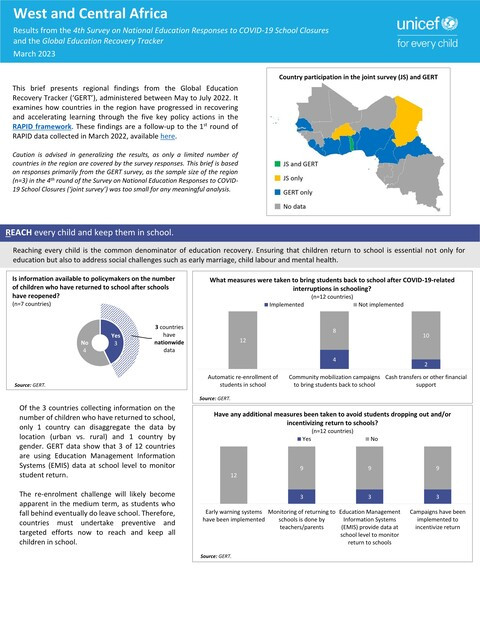 Education in a Post-COVID World: Towards a Rapid Transformation West and Central Africa Regional Brief Année de publication: 2023 Auteur institutionnel: United Nations Children's Fund (UNICEF) On March 11, 2020, the World Health Organization declared COVID-19 a global pandemic, resulting in disruptions to education at an unprecedented scale. In response to the urgent need to recover learning losses, countries worldwide have taken RAPID actions to: Reach every child and keep them in school; Assess learning levels regularly; Prioritize teaching the fundamentals; Increase the efficiency of instruction; and Develop psychosocial health and wellbeing. This brief presents regional findings from the Global Education Recovery Tracker (‘GERT’), administered between May to July 2022. It examines how countries in the region have progressed in recovering and accelerating learning through the five key policy actions in the RAPID framework. These findings are a follow-up to the 1st round of RAPID data collected in March 2022.
 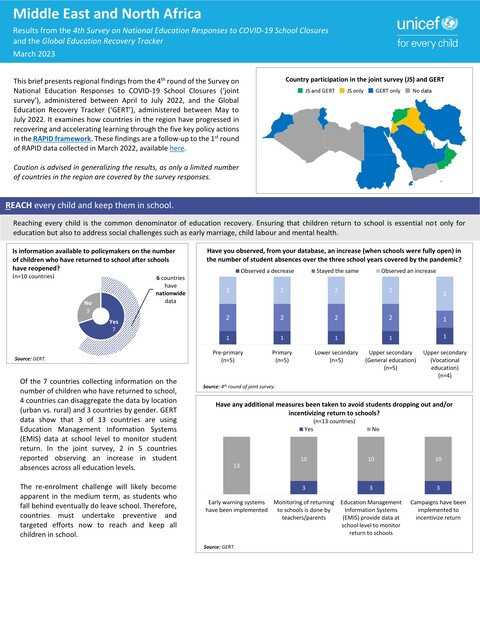 Education in a Post-COVID World: Towards a Rapid Transformation; Middle East and North Africa; Regional Brief Année de publication: 2023 Auteur institutionnel: United Nations Children's Fund (UNICEF) On March 11, 2020, the World Health Organization declared COVID-19 a global pandemic, resulting in disruptions to education at an unprecedented scale. In response to the urgent need to recover learning losses, countries worldwide have taken RAPID actions to: Reach every child and keep them in school; Assess learning levels regularly; Prioritize teaching the fundamentals; Increase the efficiency of instruction; and Develop psychosocial health and wellbeing. This brief presents regional findings from the 4th round of the Survey on National Education Responses to COVID-19 School Closures (‘joint survey’), administered between April to July 2022, and the Global Education Recovery Tracker (‘GERT’), administered between May to July 2022. It examines how countries in the region have progressed in recovering and accelerating learning through the five key policy actions in the RAPID framework. These findings are a follow-up to the 1st round of RAPID data collected in March 2022.
 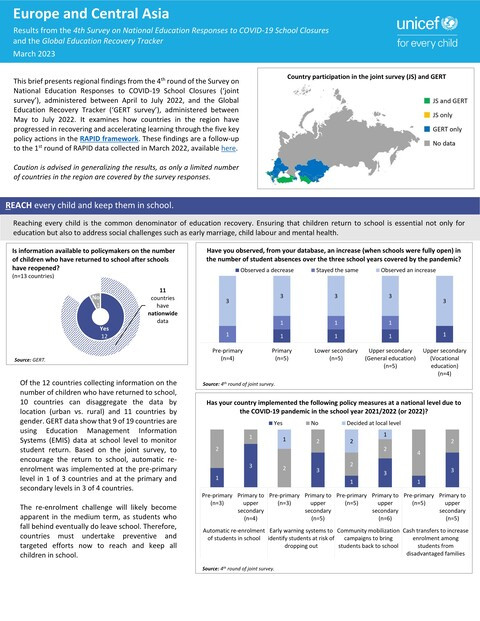 Education in a Post-COVID World: Towards a Rapid Transformation; Europe and Central Asia Regional Brief Année de publication: 2023 Auteur institutionnel: United Nations Children's Fund (UNICEF) On March 11, 2020, the World Health Organization declared COVID-19 a global pandemic, resulting in disruptions to education at an unprecedented scale. In response to the urgent need to recover learning losses, countries worldwide have taken RAPID actions to: Reach every child and keep them in school; Assess learning levels regularly; Prioritize teaching the fundamentals; Increase the efficiency of instruction; and Develop psychosocial health and wellbeing. This brief presents regional findings from the 4th round of the Survey on National Education Responses to COVID-19 School Closures (‘joint survey’), administered between April to July 2022, and the Global Education Recovery Tracker (‘GERT survey’), administered between May to July 2022. It examines how countries in the region have progressed in recovering and accelerating learning through the five key policy actions in the RAPID framework. These findings are a follow-up to the 1st round of RAPID data collected in March 2022.
  The Impact of Holocaust education: how to assess policies and practices? International Seminar, 27 January 2014, UNESCO, Paris; Report Année de publication: 2014 Auteur institutionnel: UNESCO International Bureau of Education (IBE) | Georg Eckert Institute for International Textbook Research (Germany) | Hungary. Permanent Delegation to UNESCO UNESCO, which is charged with “promoting awareness of Holocaust remembrance through education” by resolution 34 C/61 of its General Conference, marked the International Day of Commemoration in Memory of Victims of the Holocaust on 27 January 2014 by convening an international seminar for members of the global community who are involved with and committed to this mandate. The event, titled “The Impact of Holocaust Education: How to Assess Policies and Practices”, aimed at highlighting current practices and debates in the field of research in Holocaust education. It was organized in partnership between UNESCO, including its International Bureau of Education, and the Georg Eckert Institute for International Textbook Studies with the support of the Delegation of Hungary to UNESCO.
 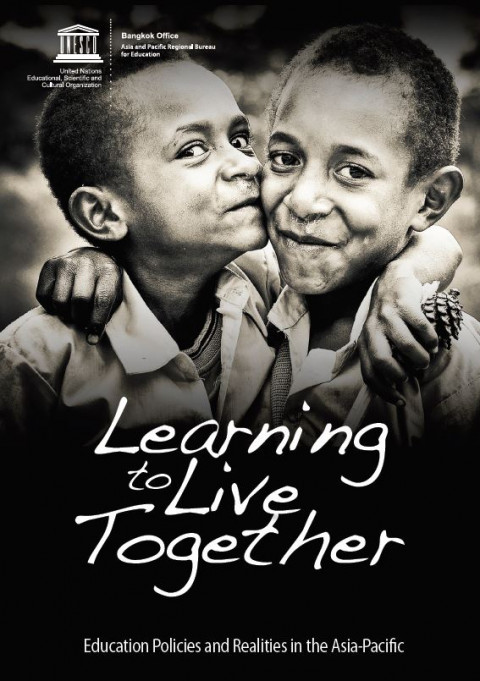 Learning to live together Année de publication: 2014 Auteur institutionnel: UNESCO Bangkok The importance of LTLT has increased in recent years. Indeed, relevant competencies appear to be gaining focus in international frameworks and educational initiatives across countries. This is all the more necessary as Voogt and Roblin (2012) argue, given the demands of our increasingly knowledge-based society in which “ideas and knowledge function as commodities” (p. 299 –300) and to which effective social and emotional skills are critical. It is perhaps all the more critical given the multivariate global challenges in the 21st Century and the need for unified global commitment to effectively combat these challenges. In this context, the significance of LTLT is reflected in both the rise of and growing interest in Global Citizenship Education (GCE), Education for Sustainable Development (ESD), Education for International Understanding (EIU) as well as peace and human rights education. The UN Secretary-General’s Global Education First Initiative, which lists ‘Fostering Global Citizenship’ as one of its three global priorities, also implicitly recognizes the significance of LTLT as a precursor to the building of a more peaceful society, one in which discrimination is intolerable and common challenges such as climate change and abject poverty are tackled together.Yet despite the significance of LTLT in the 21st Century, and despite numerous international initiatives to foster LTLT competencies, there is a large gap of evidence identifying how this supposition is translated into effective policy and curricula, and eventually into the reality of schools, teachers and learners. This report is a response to this gap, and attempts to understand how ten selected countries in the Asia-Pacific region – Afghanistan, Australia, Indonesia, Malaysia, Myanmar, Nepal, The Philippines, Republic of Korea, Sri Lanka and Thailand – have reflected and integrated LTLT into their education policies and initiatives. This variety of countries aims to reflect their diverse experiences in terms of reflecting LTLT through their education systems. By exploring a number of areas, namely policy, curricula, teachers and assessment, this study aims to identify what has so far been achieved in education systems of the Asia-Pacific region in the area of LTLT.This report is therefore targeted predominantly at education policy makers, researchers, academics as well as education practitioners of the Asia-Pacific region. Given its connection to Global Citizenship Education and other relevant international initiatives around sustainability and peace education, this report is also relevant to UNESCO’s partner organizations and the broader educational development community.This report will first present the research framework for the study, before exploring the social and economic contexts in the ten selected countries and wider regional factors in the Asia-Pacific in relation to global challenges in Chapter Two. Chapter Three will then examine national policy frameworks, including the vision of those policies in defining LTLT in education. Chapter Four focuses on the national curriculum in selected countries and the extent to which they incorporate learning objectives, subjects, and extra-curricular activities reflecting the concept of LTLT and related skills and competencies. In Chapter Five, teaching practices are examined, including the role of teachers and teacher education, as well as teaching methods and application of media and information literacy (MIL) in the classroom. Chapter Six then looks at assessment, and how far countries have attempted to develop assessment frameworks that measure the skills and competencies related to LTLT. Finally, Chapter Seven provides reflections and conclusions based on the main findings of the study, while also identifying trends across policy domains, shortcomings and some policy considerations.
  Learning to live together: have we failed? A summary of the ideas and contributions arising from the forty-sixth session of UNESCO's International Conference on Education, Geneva, 5-8 September 2001 Année de publication: 2003 Auteur institutionnel: UNESCO International Bureau of Education (IBE) | UNESCO Brasilia The present book is based mainly on the work of the forty-sixth session of the International Conference on Education (ICE), organized by UNESCO’s International Bureau of Education (IBE) and held in Geneva from 5 to 8 September 2001. The theme of the conference was ‘Education for All for Learning to Live Together: Contents and Learning Strategies - Problems and Solutions’. Unless stated otherwise, the numerous quotations chosen to illustrate the points made in this book are from ICE documents and contributions. The Conclusions and Proposals for Action adopted by the 2001 ICE are provided in Chapter V.The ICE is the only regularly occurring event during which Ministers of Education from all over the world can meet. It therefore serves as a unique and highly appreciated international forum for high-level dialogue on educational issues and their policy implications.The 2001 ICE brought together over 600 participants from 127 countries, including in particular 80 Ministers and 10 Vice-Ministers of Education, as well as representatives of intergovernmental and non-governmental organizations. The themes of the 2001 ICE were, and still are, very relevant all over the world: those in charge of education have become well aware of the necessity and complexity of living together, as well as of the role and limits of education in this respect.The ICE was inspired by abundant literature dealing with the principle issues that participants debated, including: Preparatory reports; National reports presented by the Member States; Examples of initiatives and good practice (including those presented at the conference as video case studies); Messages from Ministers of Education attending the Conference; And contributions from the numerous researchers, experts, educationists and decision makers at all levels of education who also participated in the Netforum between April and August 2001. More information and opinions on the vast issue of Education for All for Learning to Live Together were added during the Conference itself, in the form of keynote addresses, presentations and debates during the two plenary sessions, six thematic workshops and the special session devoted to partnerships with civil society.The present book draws on this wealth of experience, research, opinions, ideas and visions of the future. It seeks to contribute to bringing the debate on Education for All for Learning to Live Together closer to actors of the global educational community. By setting out ins concise way the key issues and proposed actions, and illustrating them with concrete examples, numerous quotations and a number of questions, this book is intended particularly for teacher trainers, teachers themselves and their professional organizations, as well as for all actors in civil society who endeavour to improve the quality of education, to encourage dialogue and to foster in this way the capacity for living together.Neither a ‘conference report’ nor a scientific or academic work, this book is intended to be a sort of ‘gallery of photographs’ of the forty-sixth session of the ICE – its atmosphere of dialogue, the themes of its debates, and the first-hand descriptions and experiences exchanged. Far from prescribing norms or standards, it intends to share information, ideas and practices, rather like the ICE itself, in a spirit of exchange and dialogue. Education for citizenship and democracy in a globalized world: a comparative perspective Année de publication: 2005 Auteur institutionnel: Inter-American Development Bank The present document, Education for Citizenship and Democracy in a Globalized World: A Comparative Perspective, was developed in response to a request from the members of the Regional Policy Dialogue/Education Network. The studies in this document were presented and discussed during the VII Regional Policy Dialogue meeting held in January 2005 at the Inter-American Development Bank ’s headquarters in Washington, D.C. Within the general context of recent economic and political developments in Latin America and the Caribbean, experts regard free market and democracy as the fundamental economic and political paradigm leading to modernization and development in the global market. There is a concern in a number of democratic nation-states about levels of political engagement, particularly among the youths. This is cited as a reason for strengthening citizenship education.The studies presented in this document discuss Education for Citizenship and Democracy and the role of schools as systematic providers of the civic knowledge and the participatory practices that are the foundation of democracy. Among all of the institutions that facilitate the acquisition and development of skills for democratic participation, the school is the one that provide students with the competencies to effectively participate as citizens in a democracy. There has been an increasing interest in citizenship education both in the national and international contexts. At the national level, the aim is to pursue commitment and political participation, particularly from youth. In the international sphere, the objective is to find answers to the challenges such as immigration, global communications and trade across international borders and to a new level of awareness and appreciation for human rights. By providing a comprehensive overview of progress made by industrialized countries in the field of citizenship education, this study intents to share lessons learnt and effective practices which may be applied in the context of Latin America and the Caribbean. In addition, this study includes three experiences from Latin American countries (Chile, Colombia and Mexico) that were presented during the VII Regional Policy Dialogue. The three experiences show a practical and positive approach to the feasibility of introducing citizenship education in the schools of the Region. The cases present examples of reforms that evolved from the traditional civic education into an engaging education for citizenship and democracy. The Inter American Development Banks trusts that this publication will contribute to the discussions among member countries and create alternatives for the strengthening of democracy in the Region through education and citizenship.
 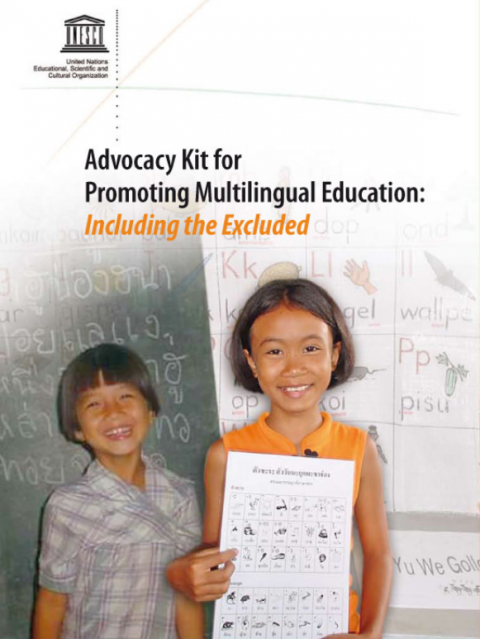 Advocacy kit for promoting multilingual education: including the excluded Année de publication: 2007 Auteur institutionnel: UNESCO Bangkok Who Can Use This Kit? This kit was prepared for all of those who want to ensure that “Education for All” does, indeed, include everyone! The kit will be especially valuable for policy makers, education practitioners and specialists who want to improve access to and quality of education for those excluded by language. It will also be helpful for speakers of ethnic minority languages who want to improve the education situation in their own communities.This kit is designed to raise awareness on the importance of mother tongue-based multilingual education (MLE). It presents key arguments and facts about MLE and provides important insights about the value and benefits of providing education in learners’ mother tongue. The kit also presents ideas, research findings and concrete examples that you can use to think about your own situation and suggests steps for taking actions to make your school system more responsive to linguistic diversity.The kit is not a definitive textbook, and it will not have an answer for every problem that you might face. To help you as much as possible, at the end of each booklet we have included lists of references. In addition, each booklet contains a glossary of terms and, at the front of each booklet is a one-page summary of its contents.How Can You Use This Kit? This kit contains three main booklets. Each booklet has a designated audience: 1) policy makers, 2) education programme planners and practitioners and 3) community members. Please remember that developing MLE requires contributions from everyone at all levels. For that reason, we encourage you to use all three booklets along with other available resources as you work together to plan, implement and sustain your MLE programmes.This kit can be used in many different ways. For those who are already involved in MLE programmes, you might use these ideas to help you to promote mother tongue instruction and strengthen your programme. Those who are not familiar with multilingual education but want to improve educational access for minority language students might use these booklets to identify specific points that they can investigate and discuss in their own contexts.