
Ressources
Explorez une large gamme de ressources sur le GCED afin d’approfondir votre compréhension et de renforcer vos activités de recherche, de plaidoyer, d’enseignement et d’apprentissage.
19 résultats trouvés
 A Study on the Influential Factors of E-learning Opportunity for Elementary School Students: Perspectives from Students, Parents and Schools (Educational Journal ; Vol.45, No.1) Année de publication: 2017 Auteur: 陈宇芃 | 林丰政 Based on the data from students, parents and schools of the 2013 Survey of Student Digital Ability and e-Learning Opportunity from the Academia Sinica’s Survey Research Data Archive, this article constructed a hierarchical linear model to analyze how students’ e-learning opportunity is related to the multilevel influence effects of school- and parent-level covariates. Quantile regression was also used to study different covariate effects at different quantile levels of student e-learning opportunity. Results indicate that: (1) Digital Level Area is a very important influential factor for students’ e-learning opportunity due to the reason that schools in higher Digital Level Area have more digital resources, and students are likely to have more opportunity for access to and frequent use of e-learning; (2) the more IT equipment or IT literacy students have can greatly affect their possession of e-learning opportunity; (3) parents should pay special attention to problems of their children resulting from overuse of e-learning resources which could cause harm to their children both mentally and physically; moreover, schools should widely promote the awareness of personal information security to students; (4) in order to eliminate the digital divide caused by Digital Level Area, schools need to strengthen the integration of software and information technology into instruction as far as possible. 国小学生数位学习机会影响因素之研究: 以学生、家长与学校观点探讨 (教育学报; Vol. 45, No.1) Année de publication: 2017 Auteur: 陈宇芃 | 林丰政 本研究以中央研究院学术调查研究资料库中「102年[2013年]学生数位学习及数位机会」的学生、家长、学校三方调查资料为基础,整合建立「学校给予学生数位学习机会」对「家庭数位学习机会影响学生数位学习机会」阶层线性模式,探讨当中的影响;亦进一步于学生数位学习机会的不同分量下,探究影响因素的变化。结果显示:(1)数位级区对于学生数位学习机会影响力极大,原因可能是数位级区愈高的学校可提供的数位资源较多,学生接触数位学习的机会亦较频繁;(2)学生拥有的设备愈齐全及对基本技能有一定素养,对其数位学习机会相对影响较大;(3)家长须留意学生的数位学习情形,防止因过度使用反而造成身心损害,学校亦应向学生加强宣导个人资料隐私的重要性;(4)学校应尽可能强化软体与科技融入教学,期能消弭因数位级区造成的差距。
  Smart Education Strategies for Teaching and Learning: Critical Analytical Framework and Case Studies Année de publication: 2022 Auteur: Shafika Isaacs | Sanjaya Mishra Auteur institutionnel: UNESCO Institute for Information Technologies in Education (IITE) | Beijing Normal University This electronic publication about smart education strategies for building the resilience of education and training systems in the postpandemic environment provides a framework to develop appropriate policy and strategy in existing and emerging forms of schooling, higher education, technical and vocational education, and training (TVET), adult education and lifelong learning, including formal, nonformal and informal educational environments. The publication reviews the status of smart education policies in 10 countries. It includes 15 case studies within the six policy themes: infrastructure, curriculum and pedagogy, digital education resources and platforms, skills and competencies, governance, management and administration, and partnership.
 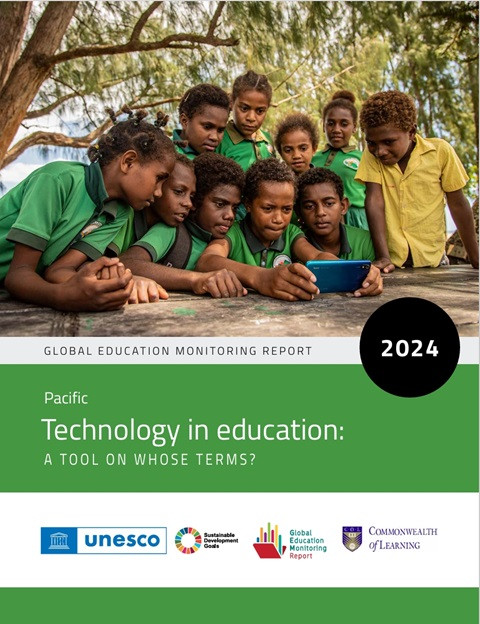 Global Education Monitoring Report 2024, Pacific: Technology in Education; A Tool on Whose Terms? Année de publication: 2024 Auteur institutionnel: UNESCO | Global Education Monitoring Report Team | Commonwealth of Learning Information transmission and connectivity is crucial in the Pacific, a region characterized by high geographic dispersion. While the application of ICT in education has significant potentials, it is hindered by the region's limited and costly infrastructure. This edition accompanies the 2023 Global Education Monitoring Report, which acknowledges technology as a useful tool but invites the education community to question on whose terms it is deployed. The report considered four key policy areas of the Pacific Regional Education Framework (PacREF) (2018–2030): In terms of quality and relevance, mobile technology has offered an affordable and flexible approach to learning, and social media have improved communication between institutions, parents and learners. Moodle is the most widely used digital platform in the region. Textbooks are being digitalised and digital resources made available. Yet content is not always developed or adapted to local languages and cultural contexts. Open and distance learning has historically expanded learning pathways in the Pacific, specially in higher education and as a response to natural hazards. The University of South Pacific is a leading example of open and distance learning connecting campus across 12 countries. With the aim to enhance student outcomes and well-being, efforts have been made to incorporate digital skills into curricula and initiatives have increased outside formal education. Yet regulations do not adequately address threats from the use of technology to privacy, safety and well-being. With a focus on the teaching profession, countries leverage technology to provide training opportunities and transform the teaching profession. However, ICT training varies greatly across the region and limited digital infrastructure hinders technology integration into classrooms and teacher training. Three conditions need to be met for technology's potential to be fulfilled: equitable access to technology, appropriate governance and regulation, and sufficient teacher capacity. Supporting this publication is seven background thematic studies that provide a comprehensive overview of education technology issues; Commonwealth of Learning’s short case studies on some of its projects; a survey administered to key informed respondents from the region; and a series of country profiles on PEER, a policy dialogue resource describing policies and regulations related to technology in the region’s education systems.
  Youth Report 2024: Technology in Education; A Tool on Our Terms! Année de publication: 2024 Auteur institutionnel: UNESCO | Global Education Monitoring Report Team | Restless Development The 2024 Youth Report on technology in education is the result of an extensive consultation process in partnership with Restless Development involving +1500 youth and students across 8 regions. The consultations invited participants to reflect on the key challenges and opportunities for the use of technology in education in their regions through the lenses of the recommendations in the global 2023 Global Education Monitoring Report on technology in education: Technology on our terms. The discussions centred on the need for the use of technology in education to be appropriate for national and local contexts and to be equitable and leave no one behind. The report calls for decisions about technology in education to keep learners at the centre when deciding whether the use of technology in education would be appropriate, equitable, evidence-based, and sustainable. Through this report, young people have described what technology on their terms would look like. It concludes with a call to action calling which highlights concrete recommendations that governments can follow to ensure that technology in education is on youth terms.
  Global Education Monitoring Report 2023, Southeast Asia: Technology in Education; A Tool on Whose Terms? Année de publication: 2023 Auteur institutionnel: Global Education Monitoring Report Team | Southeast Asian Ministers of Education Organization (SEAMEO) Developed in partnership with the Southeast Asia Ministers of Education Organization (SEAMEO), and with the contribution of EdTech Hub, the fifth regional report focuses on technology in education in Southeast Asia. Characterized by a variety of contexts and resources, Southeast Asia has experienced a rapid growth in digital technology applications. In education, digital technologies have been identified for their potential to transform education and meet the region’s development aspirations. The regional report investigates both challenges and potentials, which technology as a tool and as a process can potentially contribute to, across and within countries, and education levels. The regional report on Southeast Asia covers 11 countries, Brunei Darussalam, Cambodia, Lao PDR, Indonesia, Malaysia, Myanmar, Philippines, Singapore, Thailand, Timor-Leste and Viet Nam. Extensive background research informs the regional analysis: 9 country case-studies compiled by local research teams and independent experts; 5 thematic studies produced by SEAMEO centers on open and distance learning, technology for students with disabilities, integration of technology in teaching practices, key policies issues in ICT in education; technology in technical and vocational education and training, and 3 research inputs on ICT in education practices produced by SEAMEO affiliate members and partners.
 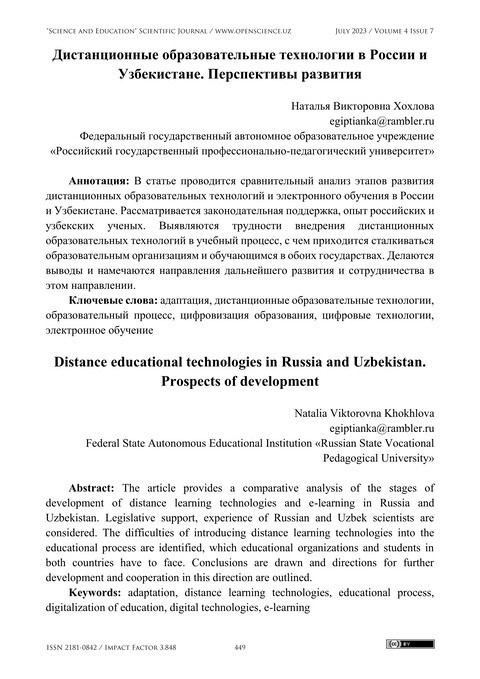 Distance educational technologies in Russia and Uzbekistan: Prospects of development (Science and Education; Vol.4, Issue.7) Année de publication: 2023 Auteur: Наталья Викторовна Хохлова The article provides a comparative analysis of the stages of development of distance learning technologies and e-learning in Russia and Uzbekistan. Legislative support, experience of Russian and Uzbek scientists are considered. The difficulties of introducing distance learning technologies into the educational process are identified, which educational organizations and students in both countries have to face. Conclusions are drawn and directions for further development and cooperation in this direction are outlined. Дистанционные образовательные технологии в России и Узбекистане: Перспективы развития (Science and Education; Vol.4, Issue.7) Année de publication: 2023 Auteur: Наталья Викторовна Хохлова В статье проводится сравнительный анализ этапов развития дистанционных образовательных технологий и электронного обучения в России и Узбекистане. Рассматривается законодательная поддержка, опыт российских и узбекских ученых. Выявляются трудности внедрения дистанционных образовательных технологий в учебном процессе, с чем приходится сталкиваться образовательными организациями и обучающимися в обоих государствах. Делаются выводы и намечаются направления дальнейшего развития и сотрудничества в этом направлении.
  National Distance Learning Programmes in Response to the COVID-19 Education Disruption: Case Study of the Republic of Korea Année de publication: 2022 Auteur institutionnel: UNESCO This document is one of several case studies on national distance learning programmes in response to the COVID-19 education disruptions. The case of the Republic of Korea was drawn from the 2020 edition of Mobile Learning Week, organized online in October 2020 under the theme of 'Beyond Disruption: Technology Enabled Learning Futures'. Envisaged to be a continuously enriched mechanism for knowledge sharing and dissemination, the case studies aim to surface best practices worldwide in leveraging digital technology to build inclusive and crisis-resilient learning systems, and to inform the planning of digital transformation of education towards SDG 4 and the futures of learning. Each case study documents governance and funding mechanisms, needs-driven planning of distance learning solutions, evaluation of digital learning’s effects on mitigating disruptions and ensuring inclusion, and pedagogical innovations to maintain or improve the quality of learning.
  [Résumé] Résumé du rapport mondial de suivi sur l’éducation 2023 : les technologies dans l’éducation; qui est aux commandes? Année de publication: 2023 Auteur institutionnel: UNESCO | Global Education Monitoring Report Team Le rôle de la technologie dans l’éducation suscite depuis longtemps un débat intense. Est-ce qu’elle démocratise le savoir ou menace la démocratie en permettant à quelques-uns de contrôler l’information? Offre-t-elle des opportunités sans limite ou mène-t-elle vers un avenir dépendant de la technologie sans retour en arrière possible ? Est-ce qu’elle égalise les chances ou aggrave les inégalités? Devrait-elle être utilisée pour enseigner aux jeunes enfants ou présente-t-elle des risques pour leur développement? Ce débat a été alimenté par les fermetures d’écoles dues à la COVID-19 et l’émergence de l’intelligence artificielle générative. Mais comme les développeurs sont souvent en avance sur les décideurs, la recherche sur la technologie éducative est complexe. Les preuves solides et impartiales sont rares. Les sociétés posent-elles même les bonnes questions sur l’éducation avant de se tourner vers la technologie comme solution? Reconnaissent-elles ses risques tout en cherchant ses avantages? Les technologies de l’information et de la communication ont le potentiel de favoriser l’équité et l’inclusion en permettant d’atteindre les apprenants défavorisés et de diffuser plus de connaissances dans des formats attrayants et abordables. Dans certains contextes et pour certains types d’apprentissage, elles peuvent améliorer la qualité de l’enseignement et l’apprentissage des compétences de base. De toute évidence, les compétences numériques font désormais partie des compétences de base. La technologie numérique peut également soutenir la gestion et accroître l’efficacité en aidant à traiter de plus grands volumes de données éducatives. Mais la technologie peut également exclure, être inappropriée et pesante, voire carrément nuisible. Les gouvernements doivent veiller à créer les bonnes conditions pour assurer un accès équitable à l’éducation pour tous, réguler l’utilisation de la technologie afin de protéger les apprenants de ses influences négatives, et former les enseignants. Ce rapport recommande que la technologie soit introduite dans l’éducation sur la base de preuves montrant qu’elle serait appropriée, équitable, évolutive et durable. En d’autres termes, son utilisation devrait être dans l’intérêt des apprenants et compléter l’interaction en face-à-face avec les enseignants. Elle devrait être considérée comme un outil à utiliser dans ces conditions. À mi-parcours de l’échéance, le Rapport mondial de suivi sur l'éducation 2023 évalue la distance qu’il reste à parcourir pour atteindre les objectifs éducatifs de 2030. L’éducation est la clé pour débloquer la réalisation d’autres objectifs de développement, notamment le progrès technologique.