
Ressources
Explorez une large gamme de ressources sur le GCED afin d’approfondir votre compréhension et de renforcer vos activités de recherche, de plaidoyer, d’enseignement et d’apprentissage.
12 résultats trouvés
 Aprender a vivir juntos: un programa intercultural e interreligioso para la educacion ética Année de publication: 2008 Auteur institutionnel: Arigatou Foundation (Switzerland) | Interfaith Council on Ethics Education for Children Learning to Live Together has been developed for use in different religious and secular contexts as a resource for everyone concerned with promoting ethics and values. The objective has been to develop a resource that is relevant on a global level and yet flexible enough to be interpreted within different cultural and social contexts. The resource has been tested in many different regions and cultural contexts to assure that it is relevant in regional and local contexts (see ‘We did it like this’, p.187). Test workshops have been held in 10 different countries, where the GNRC was able to bring together various religious and secular organisations working with children. During the test workshops, this resource manual was used to the benefit of more than 300 children and youth, representing African Traditional Religions, Bahá’í Faith, Buddhism, Christianity, Hinduism, Islam, Judaism, members of Brahma Kumaris and a number of people of secular thinking. Test workshops as well as input and comments from experts in the area of education, ethics, spirituality, intercultural and interfaith learning and child rights have contributed important experiences and opportunities for learning for the development of this resource. Learning to Live Together is already having an impact. In a GNRC programme in Israel, the resource material was used during a six-day journey made by a group of Jewish, Christian, and Muslim youth to the historical sites of Israel and Palestine, all of which have symbolic relevance to the conflict in their region. At each stop, youth participants discussed their values and their differing perceptions of their shared history. Learning to Live Together is an adaptable resource that can be used with children from many different cultural, religious and social contexts to nurture common values and a mutual respect for different backgrounds and traditions. The resource provides space for enhancing children’s innate potential for spirituality and hope for a better world, as a contribution to changing the situation for children worldwide. The Users Guide provides all necessary information for its use. UNESCO and UNICEF have been closely involved in developing Learning to Live Together and have endorsed the material as an important contribution to a quality education, which takes a multicultural and multi-religious society into consideration. UNESCO’s Guidelines for Intercultural Education underpin the philosophy and the approach of the resource: “Religious education can be described as learning about one’s own religion or spiritual practices, or learning about other religions or beliefs. Interfaith education, in contrast, aims to actively shape the relations between people from different religions”. Apprendre à vivre ensemble: un programme interculturel et interreligieux pour l'enseignement de l'éthique Année de publication: 2008 Auteur institutionnel: Arigatou Foundation (Switzerland) | Interfaith Council on Ethics Education for Children Learning to Live Together has been developed for use in different religious and secular contexts as a resource for everyone concerned with promoting ethics and values. The objective has been to develop a resource that is relevant on a global level and yet flexible enough to be interpreted within different cultural and social contexts. The resource has been tested in many different regions and cultural contexts to assure that it is relevant in regional and local contexts (see ‘We did it like this’, p.187). Test workshops have been held in 10 different countries, where the GNRC was able to bring together various religious and secular organisations working with children. During the test workshops, this resource manual was used to the benefit of more than 300 children and youth, representing African Traditional Religions, Bahá’í Faith, Buddhism, Christianity, Hinduism, Islam, Judaism, members of Brahma Kumaris and a number of people of secular thinking. Test workshops as well as input and comments from experts in the area of education, ethics, spirituality, intercultural and interfaith learning and child rights have contributed important experiences and opportunities for learning for the development of this resource. Learning to Live Together is already having an impact. In a GNRC programme in Israel, the resource material was used during a six-day journey made by a group of Jewish, Christian, and Muslim youth to the historical sites of Israel and Palestine, all of which have symbolic relevance to the conflict in their region. At each stop, youth participants discussed their values and their differing perceptions of their shared history. Learning to Live Together is an adaptable resource that can be used with children from many different cultural, religious and social contexts to nurture common values and a mutual respect for different backgrounds and traditions. The resource provides space for enhancing children’s innate potential for spirituality and hope for a better world, as a contribution to changing the situation for children worldwide. The Users Guide provides all necessary information for its use. UNESCO and UNICEF have been closely involved in developing Learning to Live Together and have endorsed the material as an important contribution to a quality education, which takes a multicultural and multi-religious society into consideration. UNESCO’s Guidelines for Intercultural Education underpin the philosophy and the approach of the resource: “Religious education can be described as learning about one’s own religion or spiritual practices, or learning about other religions or beliefs. Interfaith education, in contrast, aims to actively shape the relations between people from different religions”. تعلم العيش معا: برنامج التواصل بين الثقافات والأديان لتعليم الأخلاق Année de publication: 2008 Auteur institutionnel: Interfaith Council on Ethics Education for Children | Arigatou Foundation (Switzerland) Learning to Live Together has been developed for use in different religious and secular contexts as a resource for everyone concerned with promoting ethics and values. The objective has been to develop a resource that is relevant on a global level and yet flexible enough to be interpreted within different cultural and social contexts. The resource has been tested in many different regions and cultural contexts to assure that it is relevant in regional and local contexts (see ‘We did it like this’, p.187). Test workshops have been held in 10 different countries, where the GNRC was able to bring together various religious and secular organisations working with children. During the test workshops, this resource manual was used to the benefit of more than 300 children and youth, representing African Traditional Religions, Bahá’í Faith, Buddhism, Christianity, Hinduism, Islam, Judaism, members of Brahma Kumaris and a number of people of secular thinking. Test workshops as well as input and comments from experts in the area of education, ethics, spirituality, intercultural and interfaith learning and child rights have contributed important experiences and opportunities for learning for the development of this resource. Learning to Live Together is already having an impact. In a GNRC programme in Israel, the resource material was used during a six-day journey made by a group of Jewish, Christian, and Muslim youth to the historical sites of Israel and Palestine, all of which have symbolic relevance to the conflict in their region. At each stop, youth participants discussed their values and their differing perceptions of their shared history. Learning to Live Together is an adaptable resource that can be used with children from many different cultural, religious and social contexts to nurture common values and a mutual respect for different backgrounds and traditions. The resource provides space for enhancing children’s innate potential for spirituality and hope for a better world, as a contribution to changing the situation for children worldwide. The Users Guide provides all necessary information for its use. UNESCO and UNICEF have been closely involved in developing Learning to Live Together and have endorsed the material as an important contribution to a quality education, which takes a multicultural and multi-religious society into consideration. UNESCO’s Guidelines for Intercultural Education underpin the philosophy and the approach of the resource: “Religious education can be described as learning about one’s own religion or spiritual practices, or learning about other religions or beliefs. Interfaith education, in contrast, aims to actively shape the relations between people from different religions”.
 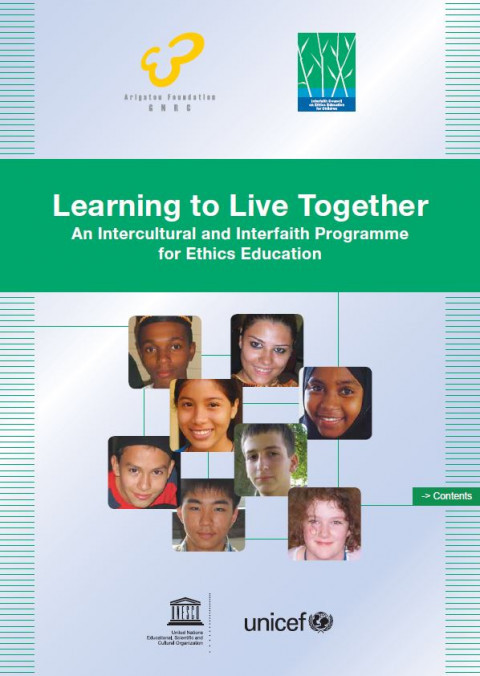 Learning to live together: an intercultural and interfaith programme for ethics education Année de publication: 2008 Auteur institutionnel: Interfaith Council on Ethics Education for Children | Arigatou Foundation (Switzerland) Learning to Live Together has been developed for use in different religious and secular contexts as a resource for everyone concerned with promoting ethics and values. The objective has been to develop a resource that is relevant on a global level and yet flexible enough to be interpreted within different cultural and social contexts. The resource has been tested in many different regions and cultural contexts to assure that it is relevant in regional and local contexts (see ‘We did it like this’, p.187).Test workshops have been held in 10 different countries, where the GNRC was able to bring together various religious and secular organisations working with children. During the test workshops, this resource manual was used to the benefit of more than 300 children and youth, representing African Traditional Religions, Bahá’í Faith, Buddhism, Christianity, Hinduism, Islam, Judaism, members of Brahma Kumaris and a number of people of secular thinking. Test workshops as well as input and comments from experts in the area of education, ethics, spirituality, intercultural and interfaith learning and child rights have contributed important experiences and opportunities for learning for the development of this resource. Learning to Live Together is already having an impact. In a GNRC programme in Israel, the resource material was used during a six-day journey made by a group of Jewish, Christian, and Muslim youth to the historical sites of Israel and Palestine, all of which have symbolic relevance to the conflict in their region. At each stop, youth participants discussed their values and their differing perceptions of their shared history.Learning to Live Together is an adaptable resource that can be used with children from many different cultural, religious and social contexts to nurture common values and a mutual respect for different backgrounds and traditions. The resource provides space for enhancing children’s innate potential for spirituality and hope for a better world, as a contribution to changing the situation for children worldwide. The Users Guide provides all necessary information for its use. UNESCO and UNICEF have been closely involved in developing Learning to Live Together and have endorsed the material as an important contribution to a quality education, which takes a multicultural and multi-religious society into consideration. UNESCO’s Guidelines for Intercultural Education underpin the philosophy and the approach of the resource: “Religious education can be described as learning about one’s own religion or spiritual practices, or learning about other religions or beliefs. Interfaith education, in contrast, aims to actively shape the relations between people from different religions”.
 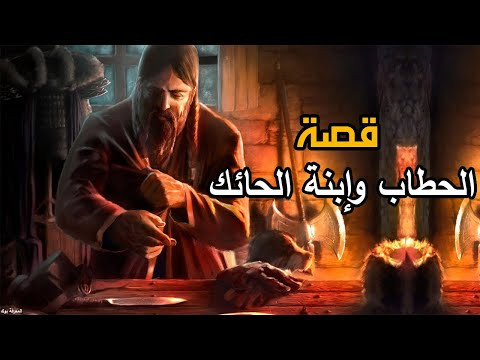 قصة الحطاب وإبنة الحائك Année de publication: 2021 Auteur institutionnel: Alma3rifabook الفيديو عبارة عن قصة هادفة تتمثل في بعض القيم العربية والأخلاق النبيلة. يروى في قديم الزمان، وسالف العصر والاوان أنه كان هناك حطاب شاب يدعى ناصر متزوج حديثاً ويعيش مع زوجته على مشارف قرية ريفية هادئة. وكان ويخرج للعمل كل صباح لتقطيع الحطب وجمعه من الغابة المجاورة ولا يعود للبيت إلا بعد انتصاف النهار. وفي عصر أحد الايام خرج مع زوجته للسوق وهناك قابلا فتاةً شابة اسمها سلوى تبيع السجاد الذي تم حياكته يدويا. The Story of the Woodcutter and the Weaver's Daughter Année de publication: 2021 Auteur institutionnel: Alma3rifabook The video is a purposeful story represented in some Arab values and noble morals. It is said, in the old days, that there was a young woodcutter named Nasir who was newly married and lived with his wife on the outskirts of a quiet rural village. He would go out to work every morning to cut wood and gather it from the nearby forest, and would not return home until after midday. One afternoon, he went out with his wife to the market, and there they met a young girl named Salwa who was selling hand-woven rugs. The Holocaust in the textbooks and in the History and citizenship education program of Quebec This article analyzes the treatment of the Holocaust in Quebec's history textbooks, in view of the subject's potential and actual contribution to human rights education. Given that Quebec's curriculum includes citizenship education in its history programme, it could be argued that the inclusion of the Holocaust has particular relevance in this context, as it contributes to the study of both history and civics, and familiarizes Quebec's youth with representations of Quebec's Jewish community, which is primarily concentrated in Montreal. This article demonstrates that the textbooks' treatment of the Holocaust is often superficial and partial, and prevents Quebec's students from fully grasping the impact of this historical event on contemporary society. (By the publisher)
 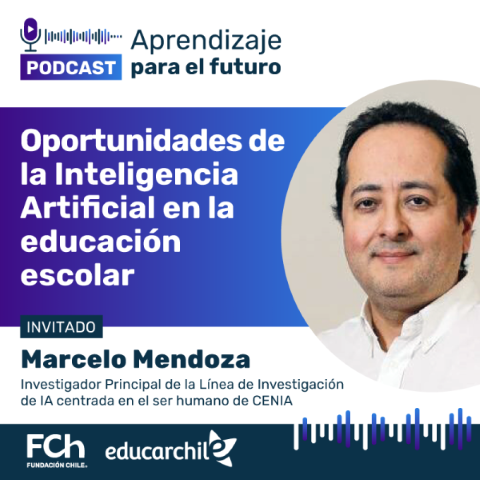 Podcast: Learning for the Future; Opportunities of Artificial Intelligence in School Education Année de publication: 2024 Auteur: Marcelo Mendoza Auteur institutionnel: Chile Foundation | Educarchile In this edition of the podcast: Learning for the Future, we spoke with Marcelo Mendoza, Principal Investigator of the Human-Centered AI Research Line at CENIA, with whom we developed the topic: Opportunities for Artificial Intelligence in school education. We also learned about the experience of the Bicentennial People Help People High School in Pilmaiquén using AI in various processes, together with teacher Cristóbal Morales. Podcast: Aprendizaje para el futuro; Oportunidades de la Inteligencia Artificial en la educación escolar Année de publication: 2024 Auteur: Marcelo Mendoza Auteur institutionnel: Chile Foundation | Educarchile En esta edición del podcast: Aprendizaje para el Futuro, conversamos con Marcelo Mendoza, Investigador Principal de la Línea de Investigación de IA centrada en el ser humano de CENIA, con quien desarrollamos el tema: Oportunidades de la Inteligencia Artificial en la educación escolar. También, conocimos la experiencia del Liceo Bicentenario People Help People de Pilmaiquén usando la IA en diversos procesos, junto al docente Cristóbal Morales.
  Drivers and barriers for implementing learning for sustainable development in pre-school through upper secondary and teacher education Année de publication: 2007 Auteur: Inger Björneloo | Eva Nyberg Auteur institutionnel: UNESCO This publication is the product of the workshop on Drivers and Barriers for Implementing Learning for Sustainable Development in Pre-School through Upper Secondary and Teacher Education held in Göteborg, Sweden in March 2006. The workshop was the second in the series of workshops emanating from the Learning to Change Our World International Consultation on Learning for Sustainable Development, held in Göteborg in May 2004 on behalf of the Swedish Government. The purpose of this paper is to make visible some of the pluralism of different perspectives on education for sustainable development. This pluralism, which, during the workshop seemed to hinder progress, could through this be turned into a forceful driver instead of remaining a frustrating barrier.