
Ressources
Explorez une large gamme de ressources sur le GCED afin d’approfondir votre compréhension et de renforcer vos activités de recherche, de plaidoyer, d’enseignement et d’apprentissage.
170 résultats trouvés
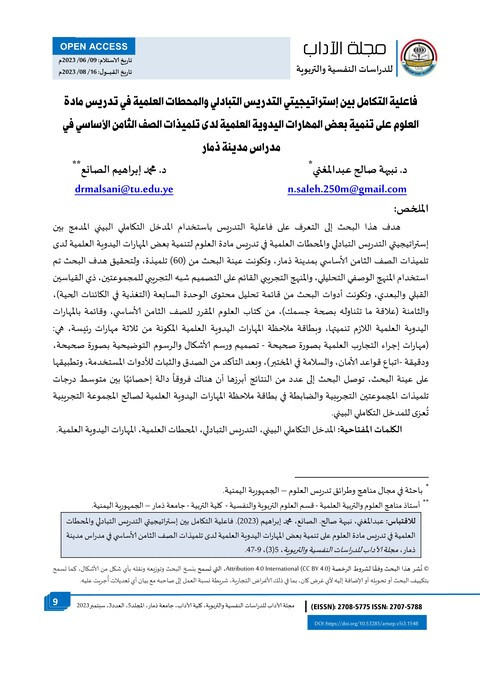 Effectiveness of Integrating Reciprocal Teaching and Science Stations Strategies in Teaching Science on Developing Some Science Hand Skills among Eighth Grade Female Pupils in Thamar City (Arts for Educational & Psychological Studies; Vol.5, No.3) Année de publication: 2023 Auteur: Nabeeha Saleh Abdulmoghni, Mohammed Ebrahim Al-San Auteur institutionnel: Dhamar University This study aimed to identify the impact of integrating reciprocal teaching and science stations strategies in teaching science on developing some science hand skills among Eighth-grade female pupils in Thamar City. To achieve the study objectives, the descriptive analytical method and the quasi-experimental design of the two groups, with pre and post measurements, were used. The data collection tools included: a checklist for analyzing Unit 7 (Nutrition in Living Organisms), and unit 8 (The Relationship of what you eat to your Health) in the respective textbook; a checklist of science hand skills to be developed; and an observation sheet of the skills, covering three main skills: (carrying out scientific experiments correctly- designing and drawing shapes and illustrations correctly- following safety rules in the laboratory). After testing the validity and reliability of the tools, and administering them to the study sample, a number of results were revealed. More specifically, there were statistically significant differences between the mean scores of the pupils of the experimental and control groups in the science hand skills, attributed to the experimental group due to the integrative approach.
  Intégrer le genre pour les organisations de la société civile: Réponses pratiques à des questions essentielles Année de publication: 2023 Auteur: Alice Neyret | Melya Allalou | Souâd Belhaddad | Christine Talabard Auteur institutionnel: Fondation Friedrich-Ebert Ce manuel tente d’apporter des réponses aux organisations de la société civiles dans leurs questionnements les plus fondamentaux en proposant des pistes de réflexions concrètes sur : Qu'est-ce que l'approche genre? Comment l'intégrer dans les projets? Comment l'intégrer dans sa gouvernance et sa communication? Ce guide a été élaboré par l'association Citoyenneté Possible en collaboration avec la Fondation Friedrich Ebert.
  Practical Legal Guide for Women in Algeria Année de publication: 2023 Auteur: Fériel Khelil | Saadia Gacem Auteur institutionnel: Fondation Friedrich-Ebert This practical legal guide, in Arabic and French, enables women in Algeria to find out about their rights, the laws that protect them, but also the legislative inequalities they will encounter in their life course, through tools for practical understanding of the laws. It was produced by Feriel Khelil, jurist with the Réseau Wassila/Avife association, and Saadia Gacem, doctoral student in anthropology and feminist activist, and supported by the Friedrich Ebert Foundation. Guide juridique pratique à l'usage des femmes en Algérie Année de publication: 2023 Auteur: Fériel Khelil | Saadia Gacem Auteur institutionnel: Fondation Friedrich-Ebert Ce guide juridique pratique, en arabe et en français, permet aux femmes en Algérie de connaître leurs droits, les lois qui les protègent mais également les inégalités législatives qu’elles rencontreront dans leur parcours de vie, à travers des outils de compréhension pratique des lois. Il a été réalisé par Feriel Khelil, juriste au sein de l’association Réseau Wassila/Avife et Saadia Gacem, doctorante en anthropologie et militante féministe et soutenu par la Fondation Friedrich Ebert.
 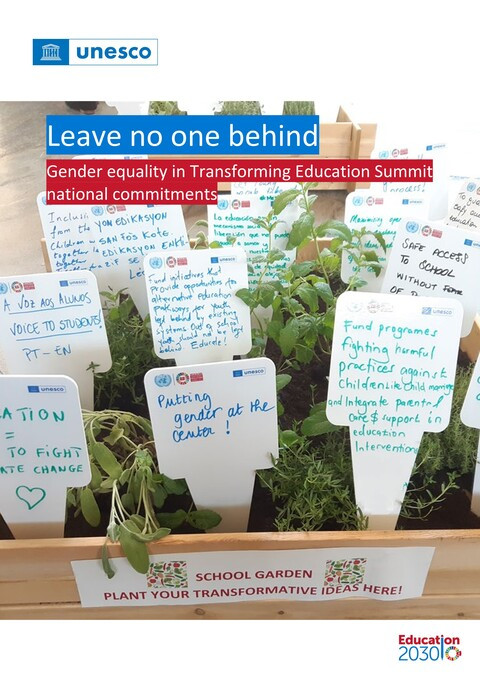 Leave No One Behind: Gender Equality in Transforming Education Summit National Commitments Année de publication: 2023 Auteur institutionnel: UNESCO The Transforming Education Summit was convened in response to a global crisis in education – one of equity and inclusion, quality and relevance. This paper applies a gender lens to the national statements of commitments made by countries during the Summit. It considers the scope of commitments to gender equality and gender- transformative education, common gender themes and considerations emerging across commitments, and notable gaps. It aims to inform future actions by the Global Platform to Drive Leadership and Accountability for Gender Equality and Girls’ and Women’s Empowerment in and through Education, and support to country action to transform education systems to advance gender equality.
 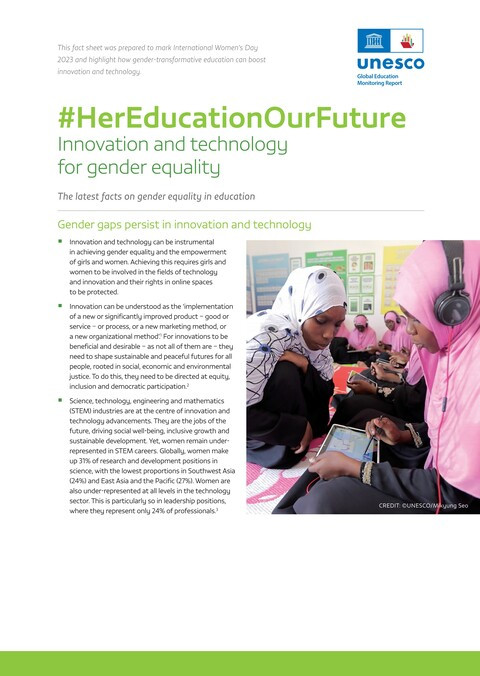 #HerEducationOurFuture: Innovation and Technology for Gender Equality; the Latest Facts on Gender Equality in Education Année de publication: 2023 Auteur institutionnel: UNESCO | Global Education Monitoring Report Team Gender gaps persist in innovation and technology Innovation and technology can be instrumental in achieving gender equality and the empowerment of girls and women. Achieving this requires girls and women to be involved in the fields of technology and innovation and their rights in online spaces to be protected. #SuEducaciónNuestroFuturo: Innovación y tecnología para la igualdad de género: últimos datos sobre la igualdad de género en la educación Année de publication: 2023 Auteur institutionnel: UNESCO | Global Education Monitoring Report Team La brecha de género persiste en la innovación y la tecnología La innovación y la tecnología pueden ser decisivas a la hora de lograr la igualdad de género y empoderar a las niñas y las mujeres. Para lograrlo, es necesario que las niñas y las mujeres participen en los ámbitos de la tecnología y la innovación y que se protejan sus derechos en los espacios en línea. #SonÉducationNotreAvenir: l’innovation et la technologie au service de l’égalité des genres: derniers développements sur l’égalité des genres dans l’éducation Année de publication: 2023 Auteur institutionnel: UNESCO | Global Education Monitoring Report Team Les inégalités entre les genres persistent dans les domaines de l’innovation et de la technologie L’innovation et la technologie peuvent jouer un rôle essentiel en faveur de l’égalité des genres et de l’autonomisation des filles et des femmes. Pour que ces objectifs soient atteints, il faut que les filles et les femmes participent dans les domaines de la technologie et de l’innovation, mais aussi que leurs droits dans les espaces en ligne soient protégés.
 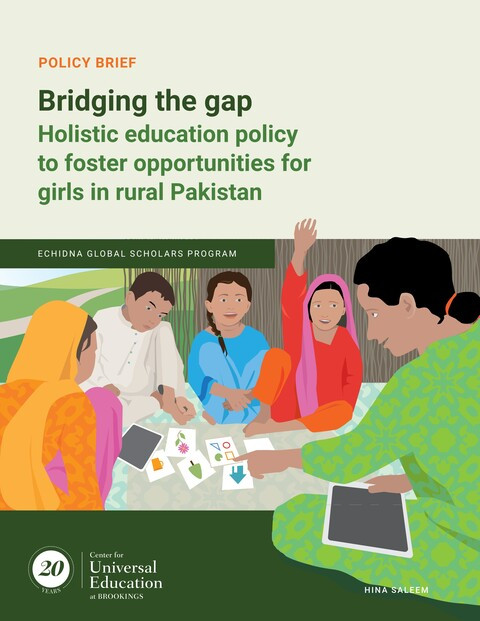 Bridging the Gap: Holistic Education Policy to Foster Opportunities for Girls in Rural Pakistan Année de publication: 2023 Auteur: Hina Saleem Auteur institutionnel: Center for Universal Education at Brookings Seven out of ten girls in rural Sindh are excluded from schooling. This happens for a myriad of reasons and occurs both in the presence and absence of operational school buildings. When schools are present, the challenges that children—especially girls—face due to their economic and social context often go unaddressed; children who are able to enroll in school often find their learning affected by classroom design and practices and experiences that mirror the exclusion they experience outside of school. At the broader level, this exclusion is reflected in limited representation of the needs and aspirations of sizable rural populations in Pakistan’s formal education system and the pathways beyond it. This policy brief presents findings from on-the-ground research in rural settlements in Sindh province that explores the disparities between boys and girls in enrollment and continuation of schooling in addition to overall inadequate education outcomes. It also provides policy recommendations to support all children and particularly girls in meeting their education needs and aspirations. Education policy must respond to these challenges of unmet education needs and aspirations by taking a holistic, welfare-based approach that supports children to overcome the effects of exclusionary conditions to meet their education needs. However, the benefits of such an approach can only be realized if teaching practices and learning experiences are contextualized, build a connection with local knowledge, question root causes of exclusion and support and prepare all children in negotiating pathways beyond education.
 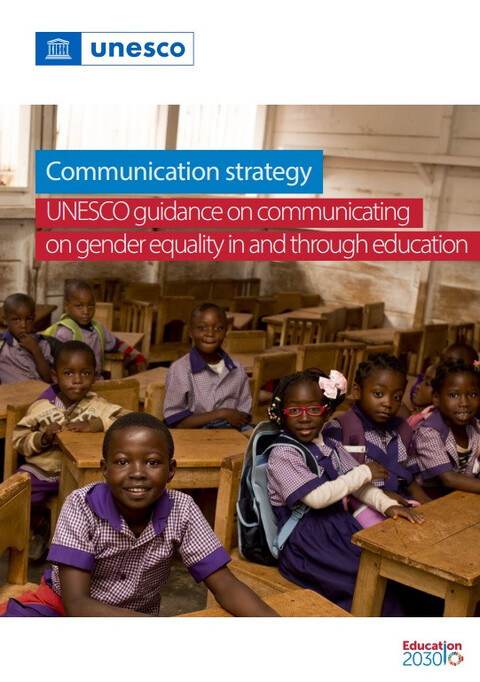 Communication Strategy: UNESCO Guidance on Communicating on Gender Equality in and through Education Année de publication: 2022 Auteur institutionnel: UNESCO About 259 million children and youth are out of school according to the UNESCO Institute for Statistics, including 127 million girls and 132 million boys. Twothirds of the 750 million non-literate adults around the world are women. This gender disparity remains one of the persistent challenges in adult literacy and education. The COVID-19 pandemic has exacerbated existing challenges, disrupting the education of over 1.5 billion learners. UNESCO estimates that close to 24 million children and youth, including over 11 million girls and 13 million boys, may drop out of school due to the pandemic’s economic impact. A window of opportunity is now more than ever open to build back equal. This communication strategy is designed to provide strategic guidance on communicating on gender equality in and through education. While prepared for UNESCO Education Sector staff, including those at Headquarters, in Field/Regional/Cluster Offices and in Institutes as well as for implementing partners, a broader audience of gender focal points, partners, Member States and others with an interest in and commitment to gender equality in and through education may also find this strategy particularly useful.