
Ressources
Explorez une large gamme de ressources sur le GCED afin d’approfondir votre compréhension et de renforcer vos activités de recherche, de plaidoyer, d’enseignement et d’apprentissage.
72 résultats trouvés
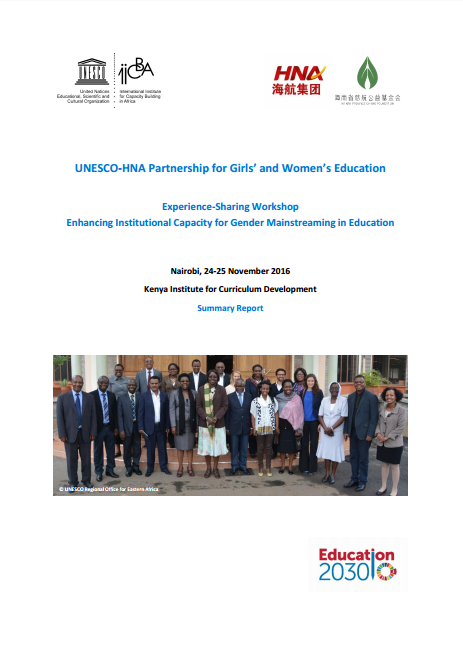 UNESCO-HNA partnership for girls' and women's education: experience-sharing workshop: enhancing institutional capacity for gender mainstreaming in education; summary report Année de publication: 2016 Auteur institutionnel: UNESCO International Institute for Capacity-Building in Africa (IICBA) The first experience-sharing workshop was organised on 24-25 November 2016 in Nairobi, Kenya. The objectives of the workshop were to: v Increase awareness on girls' education activities through South-South interaction. v Exchange experiences and lessons on HFIT project implementation. v Enhance institutional networking and interaction on issues related to girls' education.
 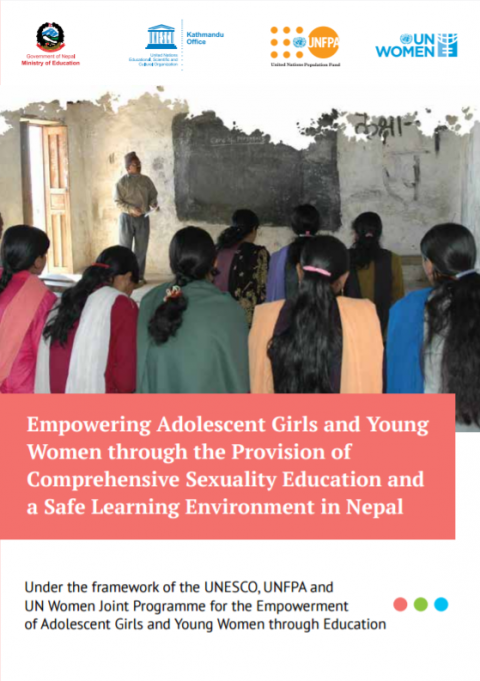 Empowering Adolescent Girls and Young Women through the Provision of Comprehensive Sexuality Education and a Safe Learning Environment in Nepal Année de publication: 2016 Auteur institutionnel: UNESCO Kathmandu | United Nations Entity for Gender Equality and the Empowerment of Women (UN Women) | United Nations Population Fund (UNFPA) There are many challenges for adolescent girls and young women in Nepal in terms of access, participation, and completion of good quality education. Child marriage and early pregnancy, gender-based violence, lack of knowledge or provision of proper hygiene facilities such as WASH (water, sanitation and hygiene) are factors preventing adolescent girls and young women from accessing education. This publication is a project plan for empowering adolescent girls and young women in Nepal.
  Addressed by Irina Bokova, Director-General of UNESCO on the Occasion of Launch of the Joint Programme in Nepal Empowering Adolescent Girls and Young Women through Education; Kathmandu, 18 April 2016 Année de publication: 2016 Auteur institutionnel: UNESCO. Director-General, 2009-2017 (Bokova, I.G.)
  Summary Report of the International Seminar on Girls' and Women's Education, Beijing, P.R. China, 4-7 June 2016 Année de publication: 2016 Auteur institutionnel: National Commission of the People's Republic of China for UNESCO | UNESCO Beijing The International Seminar on Girls’ and Women’s Education, held 4-6 June 2016 in Beijing, explored benefits of education on girls and women along with barriers to the achievement of gender equality in education. It provided a platform for dialogue on the role of education for girls and women, particularly in the context of the 2030 Agenda for Sustainable Development, and specifically in reaching SDG 4 and supporting the achievement of other SDGs. The event also marked the first award ceremony of the UNESCO Prize for Girls’ and Women’s Education, which honoured two laureates for their outstanding innovation and contributions to advancing girls’ and women’s education. This publication presents a synthesis of information that was shared during the seminar’s sessions, and the findings and recommendations originating from the exchanges.
 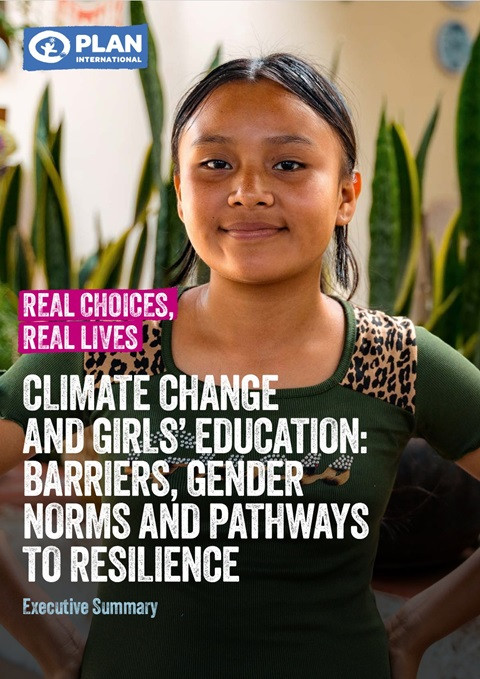 [Executive Summary] Climate Change and Girls' Education: Barriers, Gender Norms and Pathways to Resilience Année de publication: 2023 Auteur institutionnel: Plan International This is the Executive Summary for the report: Climate Change and Girls’ Education: Barriers, Gender Norms and Pathways to Resilience. The full technical report and accompanying synthesis report are also available.
 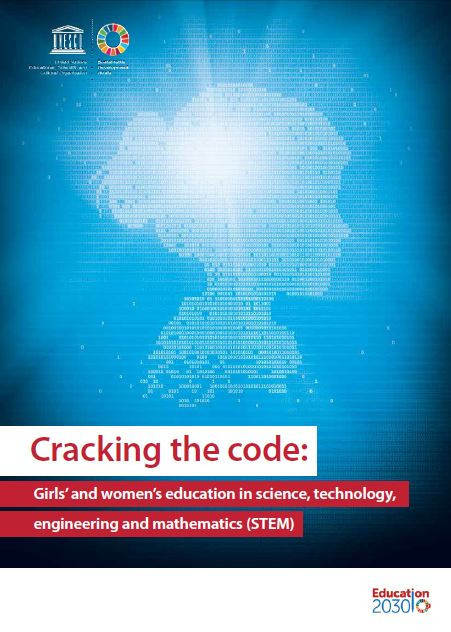 Cracking The Code: Girls’ and Women’s Education in Science, Technology, Engineering and Mathematics (STEM) Année de publication: 2017 Auteur institutionnel: UNESCO Despite significant improvements in recent decades, education is not universally available and gender inequalities persist. A major concern in many countriesis not only limited numbers of girls going to school, but also limited educational pathways for those that step into the classroom. This includes, more specifically,how to address the lower participation and learning achievement of girls in science, technology, engineering and mathematics (STEM) education. STEM underpins the 2030 Agenda for Sustainable Development, and STEM education can provide learners with the knowledge, skills, attitudes and behavioursrequired for inclusive and sustainable societies. Leaving out girls and women in STEM education and careers is a loss for all. This report aims to ‘crack the code’, or to decipher the factors that hinder or facilitate girls’ and women’s participation, achievement and continuation in STEMeducation, and what can be done by the education sector to promote girls’ and women’s interest in, and engagement with, STEM.
 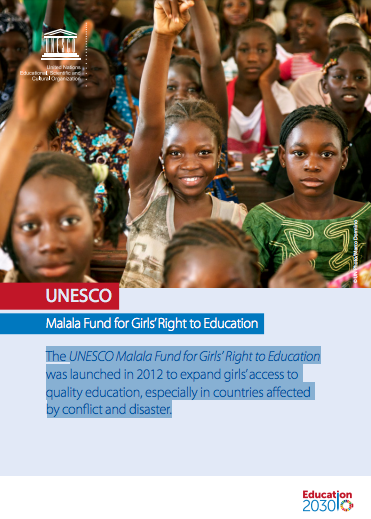 UNESCO Malala Fund for Girls' Right to Education Auteur institutionnel: UNESCO The UNESCO Malala Fund for Girls’ Right to Education was launched in 2012 to expand girls’ access to quality education, especially in countries affected by conflict and disaster.
 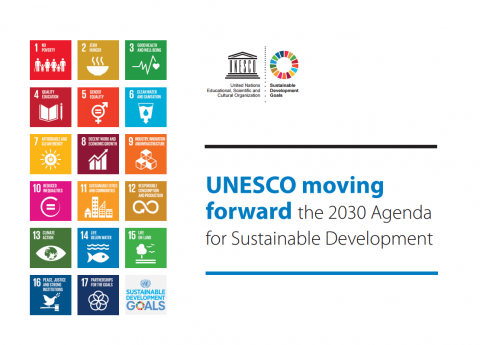 UNESCO moving forward the 2030 Agenda for Sustainable Development Année de publication: 2017 Auteur institutionnel: UNESCO The United Nations 2030 Agenda for Sustainable Development, with its 17 Sustainable Development Goals, sets forth a bold new framework for development cooperation over the next 15 years. This agenda aspires to ensure prosperity and well-being for all women and men, while protecting our planet and strengthening the foundations for peace.
  Education Transforms Lives Année de publication: 2017 Auteur institutionnel: UNESCO This brochure explores UNESCO’s role in leading and coordinating the Education 2030 Agenda, which is part of a global movement to eradicate poverty through 17 Sustainable Development Goals by 2030. Education, essential to achieve all of these goals, has its own dedicated Goal 4, which aims to “ensure inclusive and equitable quality education and promote lifelong learning opportunities for all”. UNESCO is the United Nations’ specialized agency for education and the Education Sector provides global and regional leadership in education and responds to contemporary global challenges through education with a special focus on gender equality and Africa.
 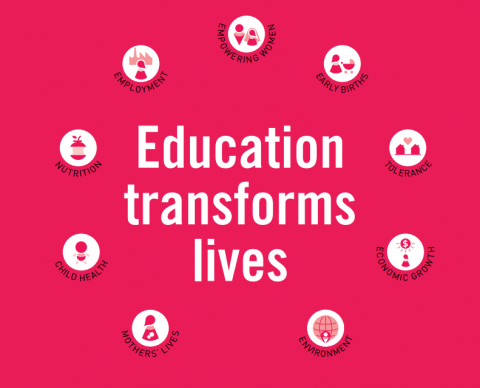 Education Transforms Lives Année de publication: 2013 Auteur institutionnel: UNESCO Education lights every stage of the journey to a better life, especially for the poor and the most vulnerable. Education’s unique power to act as a catalyst for wider development goals can only be fully realized, however, if it is equitable. That means making special efforts to ensure that all children and young people – regardless of their family income, where they live, their gender, their ethnicity, whether they are disabled – can benefit equally from its transformative power. Education empowers girls and young women, in particular, by increasing their chances of getting jobs, staying healthy and participating fully in society – and it boosts their children’s chances of leading healthy lives. To unlock the wider benefits of education, all children need the chance to complete not only primary school but also lower secondary school. And access to schooling is not enough on its own: education needs to be of good quality so that children actually learn. Given education’s transformative power, it needs to be a central part of any post-2015 global development framework.