
Ressources
Explorez une large gamme de ressources sur le GCED afin d’approfondir votre compréhension et de renforcer vos activités de recherche, de plaidoyer, d’enseignement et d’apprentissage.
114 résultats trouvés
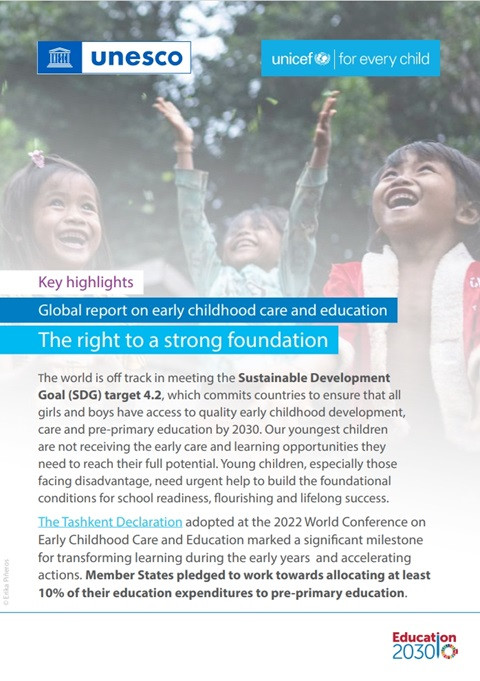 Global Report on Early Childhood Care and Education: The Right to a Strong Foundation; Key Highlights Année de publication: 2024 Auteur institutionnel: UNESCO | United Nations Children's Fund (UNICEF) This document is the key highlights of the Global Report on Early Childhood Care and Education: The Right to a Strong Foundation. Rapport mondial sur l’éducation et la protection de la petite enfance : le droit à une base solide; points saillants Année de publication: 2024 Auteur institutionnel: Organisation des Nations Unies pour l'éducation, la science et la culture (UNESCO) | United Nations Children's Fund (UNICEF) Ce document présente les points clés du Rapport mondial sur l'éducation et la prise en charge de la petite enfance : Le droit à une base solide.
  Recommendation on Education for Peace and Human Rights, International Understanding, Cooperation, Fundamental Freedoms, Global Citizenship and Sustainable Development Année de publication: 2023 Auteur institutionnel: UNESCO Building more peaceful, just, and sustainable societies starts with education. It influences all aspects of our daily lives and our overall prospects while being impacted by our health and environment. In the global landscape of worsening climate change, democratic backsliding, persistent inequalities, rising discrimination, hate speech, violence and conflict, it can be a tool to address and prevent these problems in the future. And it can also be a long-term investment with increasing returns if shaped and deployed effectively. The new UNESCO Recommendation on Education for Peace and Human Rights, International Understanding, Cooperation, Fundamental Freedoms, Global Citizenship and Sustainable Development, which is commonly referred to as the Recommendation on Education for Peace, Human Rights and Sustainable Development is a landmark guidance document that defines what needs to evolve in and through education to accomplish these goals. 평화, 인권, 국제이해, 협력, 기본적 자유, 세계시민성, 지속가능발전을 위한 교육 권고 Année de publication: 2023 Auteur institutionnel: 유네스코 이 권고는 ‘국제이해, 협력, 평화를 위한 교육과 인권, 기본적 자유에 관한 교육 권고(1974)’를 개정하여 2023년 제42차 유네스코 총회가 채택한 것이다.