
Ressources
Explorez une large gamme de ressources sur le GCED afin d’approfondir votre compréhension et de renforcer vos activités de recherche, de plaidoyer, d’enseignement et d’apprentissage.
114 résultats trouvés
 Fostering national and global citizenship: an example from South Africa (Social Studies and the Young Learner, vol 21, no. 1, september/october 2008) Année de publication: 2008 Auteur: Omiunota Nelly Ukpokodu Auteur institutionnel: National Council for the Social Studies Multicultural and global scholars urge that we prepare the young for national and global democratic citizenship given the increasing interdependence and challenging realities for today. Young people desire to be a part of the solution to global problems, but they must be educated about what those problems are and how solutions can be arrived at. As has been seen in the U.S. presidential campaign, young people care about their communities, country, and planet, and they are volunteering and voting at record rates. We must take responsibility to plant the seeds of critical citizenship if we are to foster a more sustainable, peaceful, just, and prosperous world. Educator Sheldon Berman sums it up by writing: It is important for teachers to tell young people about the success stories of others, students who have reclaimed forests, cleaned up rivers, improved their school environment, helped the homeless. They need to hear about the Mother Teresas and the Martin Luther Kings, of course, but also about the people who live down the street who are doing what they can to improve the neighbourhood and about the many organizations that make a difference in our communities. We must put students in touch with these people and organizations so that they can see how deeply people care about their world and how worthwhile it is to participate in creating change. What parents want: the role of schools in teaching about the wider world Année de publication: 2011 Auteur institutionnel: Think Global | Development Education Association This report presents the findings from a YouGov survey of parents’ attitudes towards their children’s education. The results show that parents of schoolage children think it is vital that schools teach about the wider world. At Think Global we know that many schools and teachers already prioritise such teaching, recognising how important it is to prepare their pupils to live in a globalised world and the positive contribution this can make to pupil attainment and behaviour. This report details the high level of support for schools that decide to prioritise this work; we hope it will provide schools and teachers with the information they need to expand this area of their teaching. Ce que les parents veulent: le rôle des écoles dans l'enseignement sur le monde plus large Année de publication: 2011 Auteur institutionnel: Think Global | Development Education Association Ce rapport présente les résultats d'un sondage YouGov des attitudes des parents envers l'éducation de leurs enfants. Les résultats montrent que les parents d'enfants pensent âge scolaire, il est essentiel que les écoles enseignent sur le reste du monde. A Think Global, nous savons que beaucoup d'écoles et les enseignants accordent déjà la priorité de cet enseignement, en reconnaissant combien il est important de préparer leurs élèves à vivre dans un monde globalisé et la contribution positive cela peut faire à élève le niveau et le comportement. Ce rapport détaille le niveau élevé de soutien pour les écoles qui décident de la priorité à ce travail; nous espérons qu'elle fournira aux écoles et aux enseignants les informations dont ils ont besoin pour développer ce domaine de leur enseignement. "Education First" - UN Secretary-General's video message Année de publication: 2012 Auteur: United Nations. Secretary-General, 2007-2016 (Ban, Ki-moon) UN Secretary-General, Mr. Ban Ki-moon launched a Global Initiative on Education (Education First), which aims to achieve quality, relevant and inclusive education for every child on 26 September, 2012. "Education First" - UN Secretary-General's video message Année de publication: 2012 Auteur: United Nations. Secretary-General, 2007-2016 (Ban, Ki-moon) Secrétaire général de l'ONU, M. Ban Ki-moon, a lancé une initiative Mondiale sur lÉducation (Education First), qui vise à atteindre une qualité, une éducation pertinente et inclusive pour tous les enfants le 26 Septembre, de 2012.
 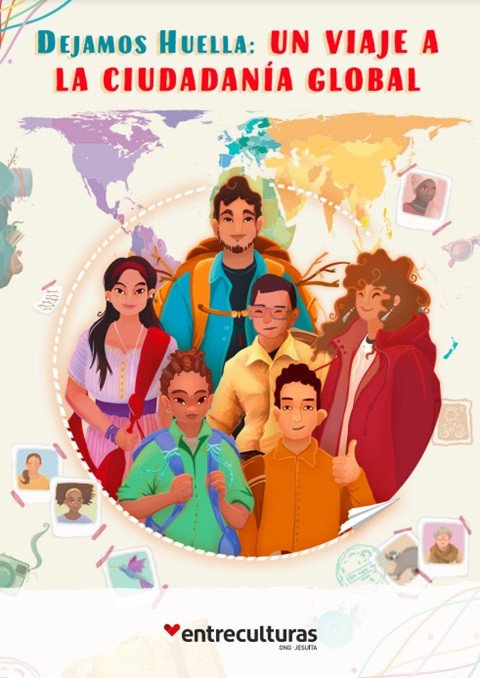 We Leave Our Mark: A Journey to Global Citizenship Année de publication: 2024 Auteur institutionnel: Entreculturas With this educational guide, students will be actively involved in exploring global and local issues with the aim of training agents of change in their own communities. They will take an educational journey through different themes (destinations) of Global Citizenship, such as gender equality, environmental protection, interculturality, inclusion, democratic participation, social justice and culture of peace. Each destination includes activities, games and practical exercises designed to raise students' awareness of the corresponding topic, using participatory dynamics such as games, puzzles, videos, and interactive simulations. Dejamos huella: Un viaje a la ciudadanía Global Année de publication: 2024 Auteur institutionnel: Entreculturas Con esta guía educativa el alumnado se verá involucrado activamente en la exploración de problemas globales y locales con el objetivo de formar agentes de cambio en sus propias comunidades. Realizarán viaje didáctico por diferentes temáticas (destinos) de Ciudadanía Global, como la igualdad de género, la protección del medio ambiente, la interculturalidad, la inclusión, la participación democrática, la justicia social y la cultura de paz. Cada destino incluye actividades, juegos y ejercicios prácticos diseñados para sensibilizar al alumnado sobre el tema correspondiente, utilizando dinámicas participativas como juegos, acertijos, vídeos, y simulaciones interactivas.
 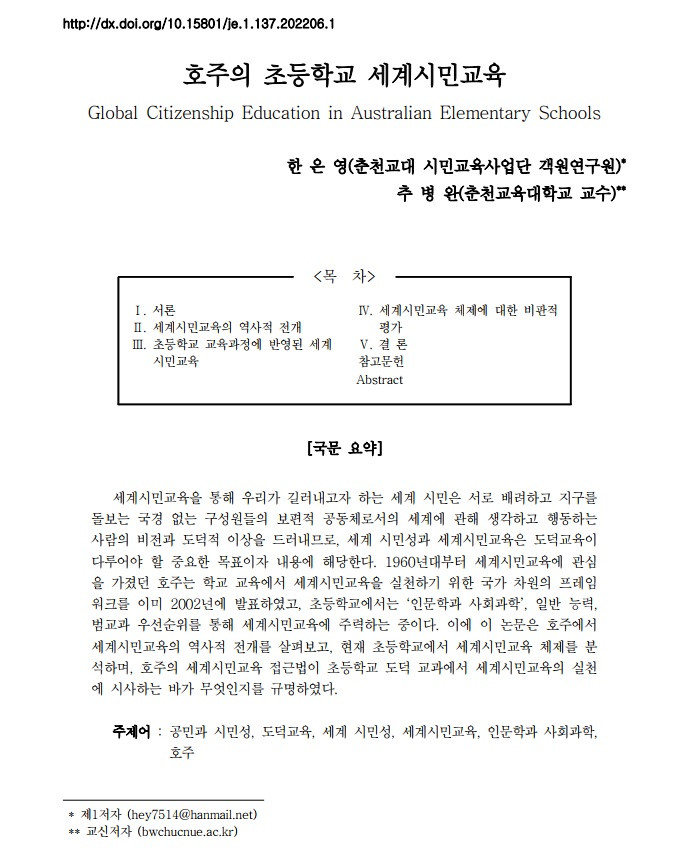 Global Citizenship Education in Australian Elementary Schools(Journal of Ethics; Vol. 137, No 1) Année de publication: 2022 Auteur: 한은영 | 추병완 Auteur institutionnel: 한국윤리학회 Global citizens think and act about the world as a universal community of borderless members who care for each other and are dedicated to taking care of the earth. Considering these visions and moral ideals, global citizenship education is an important goal and content of moral education. However, at present, we do not have a framework for dealing with global citizenship education in moral education. In this regard, Australia is the country we should pay attention to. Australia declared a national statement for global citizenship education in 2002. Since 2009, it has been reflected in the Australian curriculum. This article examines the historical development of global citizenship education in Australia, analyzes the current systems of global citizenship education system in primary schools, and investigates what Australia's approach to global citizenship education suggests for elementary moral education in Korea. In conclusion, we proposed three things. First, we must develop and apply a framework for the practice of global civic education in moral education. Second, we should emphasize the aspects of knowledge and understanding, skills and processing, behavior and participation as well as values and attitudes. Third, we must seek a balance between moderate global citizenship education and critical global citizenship education. 호주의 초등학교 세계시민교육(윤리연구; Vol. 137, No 1) Année de publication: 2022 Auteur: 한은영 | 추병완 Auteur institutionnel: 한국윤리학회 세계시민교육을 통해 우리가 길러내고자 하는 세계 시민은 서로 배려하고 지구를 돌보는 국경 없는 구성원들의 보편적 공동체로서의 세계에 관해 생각하고 행동하는 사람의 비전과 도덕적 이상을 드러내므로, 세계 시민성과 세계시민교육은 도덕교육이 다루어야 할 중요한 목표이자 내용에 해당한다. 1960년대부터 세계시민교육에 관심을 가졌던 호주는 학교 교육에서 세계시민교육을 실천하기 위한 국가 차원의 프레임워크를 이미 2002년에 발표하였고, 초등학교에서는 ‘인문학과 사회과학’, 일반 능력, 범교과 우선순위를 통해 세계시민교육에 주력하는 중이다. 이에 이 논문은 호주에서 세계시민교육의 역사적 전개를 살펴보고, 현재 초등학교에서 세계시민교육 체제를 분석하며, 호주의 세계시민교육 접근법이 초등학교 도덕 교과에서 세계시민교육의 실천에 시사하는 바가 무엇인지를 규명하였다.
 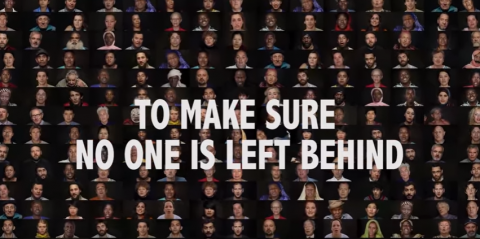 Leave No One Behind Année de publication: 2016 Auteur institutionnel: Global Goals At the heart of the Sustainable Development Goals is a commitment to leave no one behind. That’s because, although we have made huge progress towards a better world, too many people have been left behind because of who they are or where they live.