
Ressources
Explorez une large gamme de ressources sur le GCED afin d’approfondir votre compréhension et de renforcer vos activités de recherche, de plaidoyer, d’enseignement et d’apprentissage.
224 résultats trouvés
 Global citizenship education: goals and challenges in the new millennium Année de publication: 2013 Auteur: Soonyong Pak Auteur institutionnel: APCEIU The research report examines what issues are at stake in delivering global citizenship education, a new emerging education initiative. Revisiting the conceptual and operational framework of global citizenship education, readers can have a broad picture on the current status of global citizenship education and a way forward towards effective implementation of it.
  세계시민을 위한 국제이해교육 Année de publication: 2003 Auteur institutionnel: APCEIU International Commission on Education for the Twenty-first Century of UNESCO proposed “Learning to Live Together” as the worldwide educational goal at the twenty-first century. Also, as many countries have become multiethnic or multicultural societies due to increasing interdependences, globalization and ICT, the necessity and importance of Education for International Understanding (EIU) on how to live in harmony with others is growing. In Korea, EIU was included as a selective subject for creative experience activities in the seventh national curriculum and the number of schools teaching EIU on the ground has been increasing since 2000. However, in many cases what to teach was left up to teachers’ discretion owing to the lack of clear guidelines or materials. This book is comprised of systematized educational goals and contents in accordance with primary and secondary school curricula, and was developed by Asia-Pacific Centre for Education for International Understanding (APCIEU) under the auspices of UNESCO for its first three years since its establishment in 2000. EIU as a school subject aims to provide students with knowledge, values and ethical attitudes needed for the people of global society to move beyond the borders of ethnicity, culture and religion into a life of peaceful coexistence. Within the frame of EIU, students learn about cultural relativity and universal values. Based on holistic perspective, this book is designed with the following five units - multicultural understanding, issues of globalization, respect for human rights, a peaceful world, and sustainable development - to be utilized for learning at the level of primary and secondary level students.
  Final Report: 18th Asia-Pacific Training Workshop on EIU Année de publication: 2018 Auteur institutionnel: APCEIU This report is the summary of the 18th Asia-Pacific Workshop on EIU (APTW) held in the Republic of Korea from 20 to 28 July 2018. Designed as TOT (Training of Trainers), the Workshop has invited 31 teacher educators/trainers from the Asia-Pacific region, strengthening their capacities to carry out Global Citizenship Education in their respective institutions and countries.
 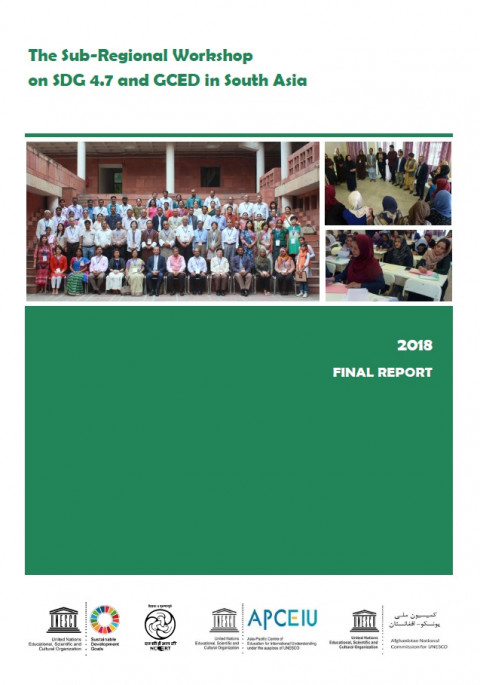 Final Report: 2018 Sub-regional Workshop on SDG 4.7 and GCED Année de publication: 2018 Auteur institutionnel: APCEIU This report is the summary of the Sub-regional Workshop on SDG 4.7 and GCED in South Asia. Implemented by two occasions, the Workshop has offered the platform for the key educators from the South Asian region to discuss GCED in the regional context of achieving SDG 4.7. The report provides the overview of the two workshops held in India and Afghanistan in 2018.
 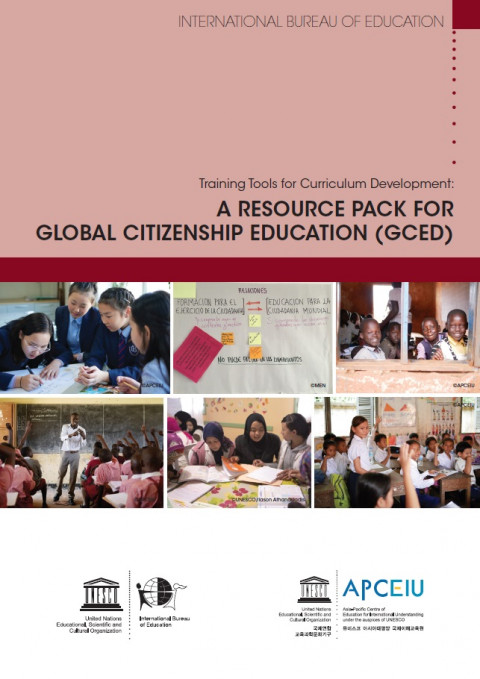 Training Tools for Curriculum Development: A Resource Pack for Global Citizenship Education (GCED) Année de publication: 2018 Auteur institutionnel: UNESCO International Bureau of Education (IBE) | APCEIU The overarching objective of ‘A Resource Pack for Global Citizenship Education (GCED)’ is to share a broader understanding of GCED theory and practice, in order to support its effective development and implementation at the policy, school and classroom levels. The Resource Pack provides comprehensive guidance for national policymakers, curriculum specialists and developers, teacher educators, teachers, school leaders and district level administrators.The key topics covered are:Module 1: IntroductionModule 2: National PoliciesModule 3: CurriculumModule 4: Teaching, Learning and AssessmentModule 5: Teaching and Learning ResourcesModule 6: Whole School ApproachModule 7: Teacher Education and Professional Development
  A Study on the Monitoring Framework of GCED in South Korea Année de publication: 2020 Auteur: Hwanbo Park | Daehoon Jho | Kyunghee Park | Jeongmin Eom Auteur institutionnel: APCEIU The purpose of this study is to establish a feasible monitoring system for the implementation of Global Citizenship Education (GCED) in South Korea that can both align itself with the global indicator (SDG 4.7.1) and reflect the domestic context and feasibility. The study further builds upon previous studies carried out by the Asia-Pacific Centre of Education for International Understanding (APCEIU). Particularly, it aims to refine and validate the GCED indicator system for domestic monitoring as proposed in the previous studies, which are also in line with SDG 4.7.1, the global indicator to monitor the mainstreaming of GCED/ESD.To this end, the study involved a Delphi survey and expert consultation to build the refined list and classification of GCED related thematic areas and keywords contextualized in Korea, and aligned these with global indicators so that it could establish a set of sub-indicators for the South Korean context. Then, it pilot-tested the sub-indicators by codifying and statistically analyzing key policy documents and the curricula of Teacher Education Institutes (TEIs) to validate the sub-indicators and to examine the extent to which GCED is mainstreamed in the given domains of the Korean context. Case analyses with focused interviews for some TEI curricula were also added to enrich the study. Lastly, the study draws key implications and proposes some recommendations for the establishment of a feasible and sustainable GCED monitoring system in South Korea. Considering the importance of national input in initiating the SDG agenda, the research concluded with a proposal on how to manage the global citizenship indicators in South Korea.
  GCED Learning and Assessment: An Analysis of Four Case Studies in Asia Année de publication: 2020 Auteur institutionnel: APCEIU | UNESCO Bangkok “GCED Learning and Assessment: An Analysis of Four Case Studies in Asia” is a result report of research jointly led by UNESCO Asia-Pacific Regional Bureau for Education, the Asia-Pacific Centre of Education for International Understanding (APCEIU) and the Asia-Pacific Regional GCED Network. The report encompasses four case studies of GCED Learning in the region and its assessment. Four leading researchers in the field of GCED, Satya Bushan from the National Council of Educational Research and Training (NCERT), India; Sayaka Matsukura of Ageo Oishi Junior High School, Japan; Dawon Kim from Gwangju National University of Education, Republic of Korea; and Le Anh Vinh from the Vietnam National Institute of Educational Science (VNIES), Viet Nam, contributed to this research. Through presenting and sharing the cases of India, Japan, Republic of Korea and Viet Nam, the publication is expected to shed light on the assessment on how GCED is implemented in the region and further inspire and encourage the GCED practitioners on the ground to take another step forward to reflect GCED in their respective educational systems. <List of Contents>ForewordAcknowledgementsAcronymsExecutive summaryChapter 1: IntroductionChapter 2: Schoollevel approaches at integrating GCEDChapter 3: Assessment of GCED learning Chapter 4: Reflections on GCED learning assessment Chapter 5: Conclusions and recommendations References
 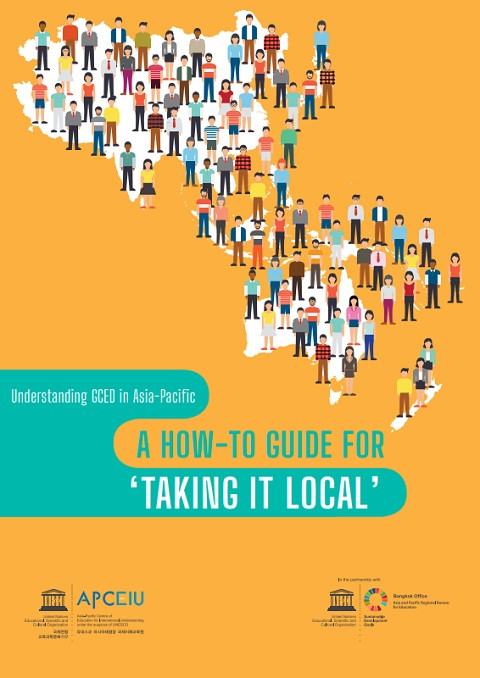 Understanding GCED in Asia-Pacific: A How-to Guide for ‘Taking It Local’ Année de publication: 2020 Auteur institutionnel: APCEIU | UNESCO Bangkok The Asia-Pacific Centre of Education for International Understanding (APCEIU), in partnership with UNESCO Bangkok, has published “Understanding GCED in Asia-Pacific: A How-To Guide for ‘Taking It Local’”, a guidebook for GCED-themed workshop organizations in the region. The publication is developed by UNESCO Asia-Pacific Regional Bureau for Education under the framework of the Asia-Pacific Regional GCED Network that is coordinated by UNESCO Bangkok and APCEIU. Taking stock of the key data from the 2019 publication titled “GCED: Taking it Local in Asia-Pacific”, the guidebook presents full-detailed guidelines on preparing and conducting a ‘Taking it Local’ workshop on GCED with particular focuses on the three core notions of GCED – respect for diversity, solidarity and a shared sense of humanity. The purpose of the publication is to promote GCED in local contexts and support active GCED practitioners on the ground to design and carry out GCED workshops that are translated and designed fully within the local context of the Asia-Pacific region. <Contents>Chapter 1: Introduction1.1 What is GCED?1.2 Purpose of the Guidebook1.3 Pedagogical ApproachChapter 2: Preparing a ‘Taking it Local’ Workshop on GCED2.1 Workshop Objectives2.2 Target Audiences2.3 Workshop Preparation2.4 Tips for a Successful Workshop2.5 Sample Agenda for the WorkshopChapter 3: Conducting a ‘Taking it Local’ Workshop on GCED3.1 Welcome, Overview, and Agreements3.2 Introduction Exercise: Story Circles3.3 GCED in AsiaPacific Exercise3.4 Optional Activities for the Workshop 3.5 Application Exercise 3.6 Closing 3.7 Final Reflection and Workshop Evaluation 3.8 Sharing Reflections 3.9 FollowUp of the WorkshopReferences
  A Study on the Status of Implementation of Global Citizenship Education in Lifelong Education in South Korea Année de publication: 2019 Auteur institutionnel: APCEIU The Asia-Pacific Centre of Education for International Understanding published a report titled "A Study on the Status of Implementation of Global Citizenship Education in Lifelong Education in South Korea". In the recognition of the need for an analysis on the status of implementation for the effective and systematic implementation of Global Citizenship Education (GCED) in the Republic of Korea, APCEIU conducted a study on the status of the implementation of GCED embedded in the curriculum of primary and secondary schools in 2018. As a follow-up study, this research paper examines the practice of civic education in the field of lifelong learning for adults and the formation, status and implementation process of GCED in which it appears and explores the potential for activation.
  Global Citizenship Education: A Handbook for Parents, Community and Learners in Asia-Pacific Année de publication: 2023 Auteur: Darla K. Deardorff | Seek Ling Tan Auteur institutionnel: UNESCO Bangkok | APCEIU This handbook aspires to engage and involve parents, caregivers and the community to join the mission of developing every learner into a global citizen. To achieve this, parents, caregivers and the community will need to be empowered with the necessary GCED knowledge and skills too. In this handbook, GCED related concepts are introduced, alongside adaptable step-by-step action plans and best practices collected across the Asia-Pacific region to support parents and the community to take action in developing GCED competences in learners.