
Ressources
Explorez une large gamme de ressources sur le GCED afin d’approfondir votre compréhension et de renforcer vos activités de recherche, de plaidoyer, d’enseignement et d’apprentissage.
224 résultats trouvés
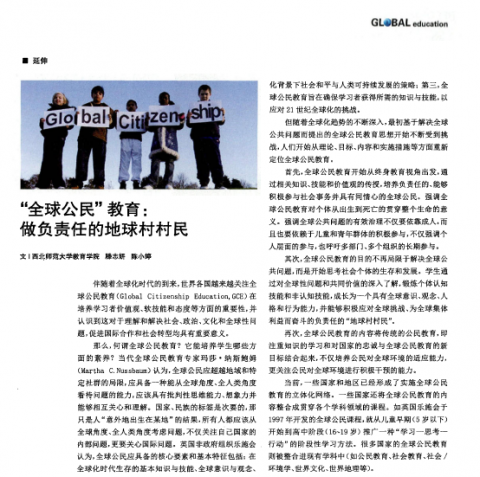 GCED towards Responsible villagers of the Global Village Année de publication: 2015 Auteur: Teng Zhiyan, Chen Xiaoting Global citizenship education has attracted an increasing attention in global era. This essay briefly introduce the definition of global citizenship education and how to develop it in today's society. This article believe that cultivating global citizens not only is a trend, but also is an important result of globalization.
  Research on the Thought of Global Citizenship Education Année de publication: 2006 Auteur: Chen Yicang Based on the literature review, the thesis tries to expound the thought of global citizenship education, by ascending to the its origin and development, exploring the characteristics of the conceptions of global citizenship and education for global citizenship, and examining its influences.The paper is comprised of a preface and four parts. Part 1 mainly examines the origin and development of the thought of global citizenship education. The characteristcs of the thought in different stages are analyzed according to the threestage division of the history: pre-modern times, mordern times and post-modern times. Part2 explores into the characteristics of the conception of global citizenship after analyzing the features of modern citizenship, examining the challenges of globalization for the modern citizenship.Part3 mainly examines and analuzes the conception of education for global citizenship.Part4 provides a brief evaluation of the thought of education for citizenship on the basis of summarizing the characteristics of the thought of education for global citizenship, and examining the effect of the thought upon the educational theory and practice.
  The National Youth White Paper on Global Citizenship Année de publication: 2015 Auteur institutionnel: Centre for Global Citizenship Education and Research (CGCER) On March 20, 2015, over 400 students from five high schools across Canada, in partnership with the Centre for Global Citizenship Education, The Centre for Global Education and TakingITGlobal, came together to collaborate, through the use of technology, in a Virtual Town Hall to discuss the youth’s vision for Global Citizenship Education. From Alberta to Ontario, downtown Toronto to Yellowknife, the youth of Canada exchanged ideas, debated alternatives, and ultimately created a document that represents their voice on the relationship Canadians should have with the rest of the world. The Virtual Town Hall, an “archetype of grassroots democracy,” (Senator Grant Mitchell) was the culmination of over a month of online teamwork, 2000 hours of student collaboration, over 100 hours of teacher facilitation, and the passion of over 1000 youth to engage in a national conversation and have their voices heard.In the month prior to the Virtual Town Hall, student leaders, systematically chosen from each school to represent Canada’s diverse geographic and demographic population, met on a weekly basis to exchange ideas, work with and listen to experts, and create a common framework. Concurrently, the students were trained to use an arsenal of Web 2.0 tools (YouTube, Twitter, cell phone voting, Google Docs, H.323 Video Conference, discussion boards, blogs, etc.) to collaborate, build consensus, and create community regardless of time or location.Equipped with this knowledge and empowered through online technology, the student leaders facilitated a full-day virtual town hall. In the morning, 400 youth peers engaged in a dialogue with local and international experts. Following this session, the youth participated in breakout groups to address three critical questions: What are our obligations as global citizens? What are the rights and responsibilities that we have? To what extent can well-intentioned global citizenship initiatives reinforce or resist power inequities? What types of policies/practices will enable/facilitate global citizenship? The National Youth White Paper on Global Citizenship, written collaboratively by Canadian students, is the direct result of this full-day, interactive event. The evolution of the document involved equipping leaders with knowledge and technology, having those leaders facilitate a larger conversation among their peers, taking the data generated to their community at large for feedback and direction, and then synthesizing the results in the student white paper. It represents the voices of over one thousand youth, introduced to the complexities of global citizenship education, unified through the power of 21st century technology, and sharing a passion to contribute to the dialogue taking place on the future of Canada and its relationship to the rest of the world.
  Global citizenship education: the school as a foundation for a fair world Année de publication: 2009 Auteur institutionnel: Conectando Mundos Consortium (Cidac, inizjamed, Intermon Oxfam, Ucodep) This publication is based on an initiative about the development education, intercultural education, popular education, the education of values, human rights education, education for sustainability, education for peace, education for gender equality, etc. The pedagogical proposal of Global Citizenship Education aspires to integrate in a coherent and challenging vision all these themes, keeping them in a close relationship with one another and taking into consideration the (increasing) interdependence of human beings living in a planet whose sustainability is under threat. This book is the fruit of a process that was triggered off by the joint effort of four European development NGOs, namely Cidac, Inizjamed, Intermón Oxfam and Ucodep within the frame of a project co-financed by the European Commission. These organisations set for themselves the objective to promote the acknowledgment and the inclusion of the contents and the methodology of Global Citizenship Education in the formal educational contexts in their respective countries, in order to kick-start a process of change in attitudes, values, and the beliefs of the pupils. Thanks to the initiative and efforts of the above-mentioned four organisations, and through various meetings and seminars carried out over the last three years in Spain, Italy, Portugal and Malta, groups of educators have been able to come face-to-face with each other, exchange experiences and reflect on the role of formal education with respect to the challenges of our times. Among the other experiences, the publication contains that of a key moment in the process. This took place in July 2008 in Cortona, a small and beautiful Tuscan city close to the border with Umbria, and in which many educators shared the benefit of what was the first international encounter of educators for global citizenship. The Cortona experience, in which around ninety teachers coming from Spain, Portugal, Malta, Italy, the Dominican Republic and Costa Rica have participated, was one of the stages – the starting point, in fact – of a process and a relationship that it is our aim to develop at the regional, national and international levels. In this publication, therefore, one can find theoretical cues put forward at Cortona that encourage educators to share their experiences and to compare the work done by different groups.This publication has two parts. The first part contains contributions of a theoretical type, whereas the second part concentrates on the educational experiences of the participants in the Cortona meeting.
  A Review of Neo-liberal Global Citizenship Education in Western Societies Année de publication: 2016 Auteur: Zhou Xiaoyong Global citizenship education has become an increasingly dominant discourse among western societies. However, practices of global citizenship education assume plural forms, among which neo-liberal global citizenship education is an important one. Neo-liberalism competitiveness emphasizes personal choice based on cometition and access to global competitiveness and global cultural capital guided by competence. If this marked-oriented competition continues to ignore question of power and access, global citizens of this kind will take it for granted that the privilege they enjoyed is a natural result and a symbol of personal success. For people in developing countries, this is an obviously unfair situation.
  On the Value Orientation of Global Citizenship Education in Chinese Colleges and Universities from the Perspective of Globalization Année de publication: 2016 Auteur: Feng Qi | Zhang Wanhong Civic education is not only an educational issue, but also the foundation and development of the country. With the advent of the era of globalization, global civic education has gradually become an inevitable trend in the development of civic education, and it is also the pursuit of modernity in civic education. College students are in the important period of the transformation of their identity relationship. They are experiencing the transformation from “school citizenship” to “social citizenship”. The value orientation of global citizenship education in China's colleges and universities is directly related to the future development of global civil society. Under the background of globalization, global civic education in China's colleges and universities attempts to explore and summarize the five values of orientation based on fairness and justice, guided by democratic rationality, with respect for tolerance, national characteristics and sustainable development. Monitoring education for global citizenship: a contribution to debate Année de publication: 2015 Auteur: Harm-Jan Fricke | Cathryn Gathercole | Amy Skinner Auteur institutionnel: DEEEP | CONCORD DARE Forum 1. This report aims to provide a stimulus for further thought, work and debate in the design of assessment frameworks for an education that supports people in leading fulfilling lives in a changing, globalised world, and in particular within the context of debates around post-2015 universal targets and indicators that are relevant to an education for global citizenship (EfGC). 2. In providing that stimulus the report addresses the following questions: a. What are the key differences and similarities between diverse forms of ‘adjectival educations’ that contribute to, or generally express themselves as allied to an ‘education for global citizenship’? b. What do they contribute to an education for global citizenship? c. How, if at all, do they interpret the notion of ‘transformation’? d. What do practitioners consider to be the major challenges and opportunities for monitoring (transformative) education for global citizenship? e. Which approaches and means of monitoring and assessing transformative education for global citizenship appear to be feasible? 3. The report is based on information obtained from: a. Literature reviews; b. Workshops, involving 65 educators in total, held in Brazil, Tanzania, Zimbabwe, and three locations in Europe; c. Responses to a questionnaire completed by 218 educators working in more than 50 countries, albeit with a predominance of respondents based in Europe. 4. The origins and key characteristics of development education, global education and global learning, human rights education, and education for sustainable development are explored, leading to statements about their commonalities and contributions to an education for global citizenship. These commonalties appear to be particularly in the areas of their shared global orientation, pursuit of personal and/or societal transformation, active and enquiry based teaching and learning methodologies, and overlapping content. 5. The commonalities which the discussed educations contribute to - and share with – education for global citizenship appear to be particularly around: a. values and dispositions which enable a response to, and advocacy for, change, b. engagement with diverse ideas, opinions and understandings, c. a stimulus to investigate and develop creativity by means of learning, d. building skills and capacities as part of a process of lifelong learning, e. a generic educational approach that aims at involvement in an explicit process of change. 6. Within such a context differences appear amongst practitioners and theoreticians in the use, meaning and function of the term ‘global citizenship’, with some seeing it primarily as a tool in advocacy while others view it primarily as a means of explanation of human relations globally. 7. Critique on the usefulness and use of the terms ‘global citizenship’ is outlined and the world-wide, universal, use of the term ‘education for global citizenship’ is questioned. However, its intentions as an approach of transformative education for critical and active engagement in a globalised society are seen as having universal relevance. 8. That approach is described as “a learning process for people’s critical and active engagement in and with global society, involving people in developing their capacities, capabilities and motivation to be actively engaged in personal and collective human development. It does this by drawing on a critical understanding and consideration of global processes and interdependencies, of other people’s perspectives and interests, of environmental opportunities and limitations, and of universal rights.” 9. The approach is further defined by a number of ‘core signifiers’ (which can form the basis for indicators of achievement) relating to: a. pedagogy – characteristics of the teaching process, b. capacities and capabilities – regarding the learner’s competence, c. values – as exhibited in the teaching and learning process, d. content – the learner’s acquisition of core understandings, e. outcome – regarding the learner’s dispositions, f. social transformation – regarding the learner’s contributions to community and wider society. 10. The report continues by providing a summary review of selected literature regarding the design of monitoring frameworks that appear pertinent to an education for global citizenship. It discusses work done in relation to universal targets and indicators, country based frameworks, education institutional monitoring, educator competence, and learner outcomes. It draws particular attention to the importance of quality assessment, the need to involve the range of education stakeholders in the design, application and interpretation of indicators, and the need to enable learning from experiences. 11. Further information about the challenges and opportunities for monitoring education for global citizenship is obtained from ideas and opinions given by workshop participants and questionnaire respondents. Respondents recognise that developing a universal monitoring framework can help to clarify the purpose and meaning of EfGC for both practitioners and policy makers. However, they also recognise that there is a risk that agreement might be reached around a lowest common denominator approach. The importance of participation by practitioners in, and their ownership of, the monitoring content and process is highlighted. The potential uses of monitoring data and analyses in demonstrating the impact of EfGC on broader cross-curricular outcomes and educational achievements, is seen by respondents as a means to gain further recognition of the value of EfGC. 12. Based on the foregoing, the final chapter of the report provides a number of suggestions as a stimulus for further work, thought and debate. These suggestions focus on: a. a monitoring framework that addresses the holistic nature of EfGC; b. an assessment framework to do with learning outcomes that exemplify the core signifiers mentioned in paragraph 9 above; c. indicators and a monitoring approach that is applicable at national levels, enabling monitoring of progress for specific sectoral aspects of EfGC (teacher education is given as an example of such a sectoral aspect); d. a universal target that builds on the description of EfGC given in paragraph 8 above; e. indicator groupings that can show progress against such a universal target. Ecopedagogy and citizenship in the age of globalisation: connections between environmental and global citizenship education to save the planet Année de publication: 2015 Auteur: Greg William Misiaszek Auteur institutionnel: Wiley‑Blackwell Teaching the connections between environmentally-harmful acts and social conflict is essential but is often ignored in education. This article presents two ways in which these are not taught because of the policies of those who benefit from the ignorance of these connections: first, the avoidance of teaching global-local connectivity and second, the devaluing of non-dominant cultures. Ecopedagogy is a democratic, transformative pedagogy centred on increasing justice by critically teaching the politics of environmental issues. I argue that global citizenship education (GCE) must be an element of ecopedagogy to contextually learn globalisation's effects upon local communities. In addition, GCE's goal is to increase students' understanding of diverse cultures to respect them. Ecopedagogy is also essential to GCE to fully teach social conflicts resulting from environmentally harmful acts. I offer policy and pedagogical changes to disrupt reproductive environmental pedagogies that help to sustain environmental ills for ecopedagogy-GCE models to emerge.
 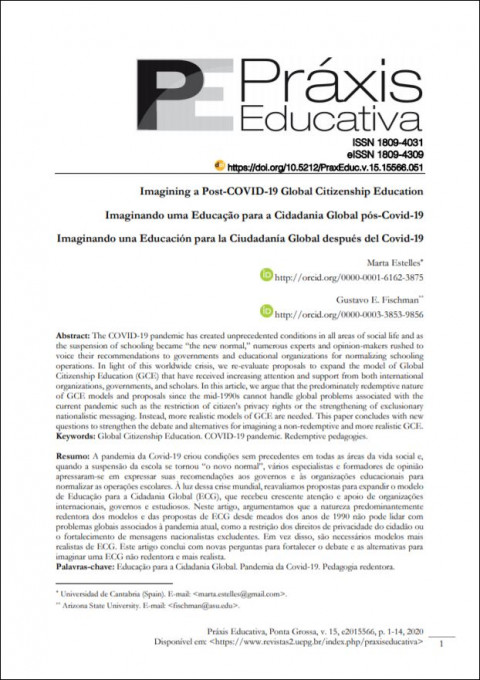 Imagining a Post-COVID-19 Global Citizenship Education Année de publication: 2020 Auteur: Marta Estelles | Gustavo E. Fischman Auteur institutionnel: State University of Ponta Grossa The COVID-19 pandemic has created unprecedented conditions in all areas of social life and as the suspension of schooling became “the new normal,” numerous experts and opinion-makers rushed to voice their recommendations to overnments and educational organizations for normalizing schooling operations. In light of this worldwide crisis, we re-evaluate proposals to expand the model of Global Citizenship Education (GCE) that have received increasing attention and support from both international organizations, governments, and scholars.In this article, we argue that the predominately redemptive nature of GCE models and proposals since the mid-1990s cannot handle global problems associated with the current pandemic such as the restriction of citizen’s privacy rights or the strengthening of exclusionary nationalistic messaging. Instead, more realistic models of GCE are needed. This paper concludes with new questions to strengthen the debate and alternatives for imagining a non-redemptive and more realistic GCE.
  Evaluating the Impact of Global Citizenship Education on Young People’s Attitudes Towards Equality, Diversity and Tolerance Année de publication: 2019 Auteur: Oakleigh Welply | Abderrahim Taamouti | Gabriel Bracons Font Auteur institutionnel: WISE | Durham University This research aims to address questions around the implementation, measurement, and success of Global Citizenship Education (GCE) as a response to the global challenges of the twenty-first century. GCE aims to foster peaceful, inclusive, tolerant, sustainable, and socially just societies; yet despite its centrality in international policy discourse and academic research, the impact of GCE on young people’s attitudes towards inequalities in society or human rights remains relatively unexplored.