
Ressources
Explorez une large gamme de ressources sur le GCED afin d’approfondir votre compréhension et de renforcer vos activités de recherche, de plaidoyer, d’enseignement et d’apprentissage.
169 résultats trouvés
 COMPASS: a manual on human rights education with young people Année de publication: 2012 Auteur: Patricia Brander Auteur institutionnel: Council of Europe Compass was first published in 2002 within the framework of the Human Rights Education Youth Programme of the Directorate of Youth and Sport of the Council of Europe. The programme was created because human rights education – meaning educational programmes and activities that focus on promoting equality in human dignity – was and remains of incalculable value in shaping a dimension of democratic citizenship for all young people and in promoting a culture of universal human rights.Compass has become a reference manual for many young people involved in value-based youth work and non-formal education. It is currently available in more than 30 languages, ranging from Arabic and Japanese to Icelandic and Basque. In some countries it has become part of the resources for human rights education in schools and in some others it is not possible to use it in schools. The adventures of Compass across Europe often mirror the contrasted reality of human rights education: promoted here and combated there, praised by some and despised by others.The success of Compass has been followed by its younger sibling, Compasito – a manual for human rights education with children is already available in several languages and on the way to becoming another bestseller for human rights education. More importantly, Compass and its publication in various language versions has been the medium through which human rights education has been brought onto the agenda of youth work and into the programme of many schools. National networks for human rights education have been created in several countries, where they reinforce the work done by human rights organisations and educational professionals in making the right to human rights education a reality to more children and young people across Europe. The forum on human rights education with young people, Living, Learning, Acting for Human Rights, held in Budapest in 2009, stressed the importance of human rights education today. COMPASS: un manuel sur l'éducation aux droits de l'homme avec les jeunes Année de publication: 2012 Auteur: Patricia Brander Auteur institutionnel: Conseil de l'Europe Compass a été publiée en 2002 dans le cadre du Programme Jeunesse d'Éducation aux Droits de l'Homme de la Direction de la Jeunesse et du Sport du Conseil de l'Europe. Le programme a été créé parce que l'éducation aux droits de l'homme - à savoir les programmes et les activités qui mettent l'accent sur la promotion de l'égalité dans la dignité humaine éducation - a été et reste d'une valeur inestimable dans l'élaboration d'une dimension de la citoyenneté démocratique pour tous les jeunes et à promouvoir une culture des droits humains universels. Compass est devenu un manuel de référence pour de nombreux jeunes impliqués dans le travail de la jeunesse fondée sur des valeurs et de l'éducation non formelle. Il est actuellement disponible dans plus de 30 langues, allant de l'arabe et le japonais à l'islandais et le basque. Dans certains pays, il est devenu une partie des ressources pour l'éducation aux droits de l'homme dans les écoles et dans certains autres, il est impossible de l'utiliser dans les écoles. Les aventures de Compass en Europe reflètent souvent la réalité contrastée de l'éducation aux droits de l'homme: promotion ici et là combattu, loué par les uns et méprisé par les autres. Le succès de Compass a été suivi par son frère cadet, Compasito - un manuel pour l'éducation aux droits de l'homme avec les enfants est déjà disponible en plusieurs langues et sur la façon de devenir un autre best-seller pour l'éducation aux droits de l'homme. Plus important encore, Compass et sa publication dans différentes versions linguistiques a été le moyen par lequel l'éducation aux droits de l'homme a été mis sur l'ordre du jour du travail de jeunesse et dans le programme de nombreuses écoles. Les réseaux nationaux pour l'éducation aux droits de l'homme ont été créés dans plusieurs pays, où ils renforcent le travail accompli par les organisations des droits humains et professionnels de l'éducation à faire du droit à l'éducation des droits de l'homme une réalité à plus d'enfants et de jeunes à travers l'Europe. Le forum sur l'éducation aux droits de l'homme avec les jeunes, la vie, l'apprentissage, agir pour les droits de l'homme, tenue à Budapest en 2009, a souligné l'importance de l'éducation aux droits de l'homme aujourd'hui. Education for a culture of peace, human rights, citizenship, democracy and regional integration: ECOWAS reference manual, for use by trainer of trainers Année de publication: 2013 Auteur institutionnel: UNESCO Dakar | Economic Community of West African States (ECOWAS) The manual comprises seven modules dealing with the Culture of Peace and Conflict Management; Human Rights; Civism and Citizenship; Democracy and Good Governance; Gender and Development; Public Health, Environment and Sustainable Development; and Regional Integration. Each module has sub-themes with introductions, reference materials, general objectives to guide the trainer and generic pedagogical tables that are flexible enough to be adapted to available teaching resources in the different ECOWAS countries. It is also suitable and adaptable to the training of teachers involved in both formal and non-formal education delivery at different levels of teaching and learning. The ultimate goal of the Manual is to build a critical mass of ECOWAS citizens equipped with competent skills, not only for cognitive and psycho-motor domains of education, but also affective skills for positive values, attitudes and behaviors that promote peace, tolerance and peaceful co-existence of community citizens. L'éducation pour une culture de la paix, les droits de l'homme, la citoyenneté, la démocratie et l'intégration régionale: manuel de référence de la CEDEAO, pour une utilisation par le formateur de formateurs Année de publication: 2013 Auteur institutionnel: UNESCO Dakar | Economic Community of West African States (ECOWAS) Le manuel comprend sept modules traitant de la culture de la paix et gestion des conflits; Droits de l'homme; Civisme et citoyenneté; Démocratie et bonne gouvernance; Genre et développement; La santé publique, l'environnement et le développement durable; et l'intégration régionale. Chaque module comporte des sous-thèmes avec des introductions, des documents de référence, des objectifs généraux pour guider le formateur et tables pédagogiques génériques qui sont suffisamment souples pour être adaptés aux ressources pédagogiques disponibles dans les différents pays de la CEDEAO. Il est également adapté et adaptable à la formation des enseignants impliqués à la fois dans la prestation de l'éducation formelle et non formelle à différents niveaux d'enseignement et d'apprentissage. Le but ultime du Manuel est de construire une masse critique de citoyens de la CEDEAO dotés de compétences compétentes, non seulement pour les domaines cognitif et psycho-moteur de l'éducation, mais aussi des habiletés affectives pour les valeurs positives, les attitudes et les comportements qui favorisent la paix, la tolérance et pacifique co-existence des citoyens communautaires. Guide d'utilisation du manuel d'apprentissage de la démocratie pour les jeunes en Tunisie, à l'attention des formateurs et adultes-relais Année de publication: 2013 Auteur institutionnel: UNESCO Rabat As part of its project to support education for democracy for young people in Tunisia, UNESCO has developed in cooperation with the Ministry of Education, the National Commission for Education, Science and Culture, CAWTAR, IADH, CNIPRE and UNI, a handbook on democracy for young people in Tunisia.This handbook is composed of twenty factsheets illustrated with drawings by Plantu. It popularizes the standards and universal principles, as well as major international instruments that protect and emphasize the national legal framework, key issues and challenges and good practices in Tunisia. One of the comparative advantages of this module is the fact that it highlights local issues and ongoing legal reforms in Tunisia.The present handbook has been developed as a pedagogical tool to help adult intermediaries (teachers, social educators etc…) responsible for the training of young people in school and community settings. It provides a series of exercises and situations to facilitate the learning and acquisition of knowledge in the field of democracy.The contents of this guidebook develops an approach based on "the discovery by oneself" which offers to participants activities, exercises and situations that require the mobilization of resources and contents of the training handbook on democracy for young people in Tunisia.Its use requires flexibility and creativity on the part of the trainer to enrich and/ or adapt the proposed exercises. It is in the light of the training context, prior knowledge of the concerned learners, the level of engagement of participants and according to thematic representations, that the trainer designs the training content. دليل لفائدة المكونين و الوسطاء لإستعمال " دليل شباب تونس في تعلم الديمقراطية " Année de publication: 2013 Auteur institutionnel: UNESCO Rabat As part of its project to support education for democracy for young people in Tunisia, UNESCO has developed in cooperation with the Ministry of Education, the National Commission for Education, Science and Culture, CAWTAR, IADH, CNIPRE and UNI, a handbook on democracy for young people in Tunisia.This handbook is composed of twenty factsheets illustrated with drawings by Plantu. It popularizes the standards and universal principles, as well as major international instruments that protect and emphasize the national legal framework, key issues and challenges and good practices in Tunisia. One of the comparative advantages of this module is the fact that it highlights local issues and ongoing legal reforms in Tunisia.The present handbook has been developed as a pedagogical tool to help adult intermediaries (teachers, social educators etc…) responsible for the training of young people in school and community settings. It provides a series of exercises and situations to facilitate the learning and acquisition of knowledge in the field of democracy.The contents of this guidebook develops an approach based on "the discovery by oneself" which offers to participants activities, exercises and situations that require the mobilization of resources and contents of the training handbook on democracy for young people in Tunisia.Its use requires flexibility and creativity on the part of the trainer to enrich and/ or adapt the proposed exercises. It is in the light of the training context, prior knowledge of the concerned learners, the level of engagement of participants and according to thematic representations, that the trainer designs the training content. Educação para a cultura da paz, os direitos humanos, a cidadania, a democracia e a integração regional: manual de referência da CEDEAO, à intenção do(a) formador/formador(a) de formadores/formadoras Année de publication: 2013 Auteur institutionnel: UNESCO Dakar | Economic Community of West African States (ECOWAS) The manual comprises seven modules dealing with the Culture of Peace and Conflict Management; Human Rights; Civism and Citizenship; Democracy and Good Governance; Gender and Development; Public Health, Environment and Sustainable Development; and Regional Integration. Each module has sub-themes with introductions, reference materials, general objectives to guide the trainer and generic pedagogical tables that are flexible enough to be adapted to available teaching resources in the different ECOWAS countries. It is also suitable and adaptable to the training of teachers involved in both formal and non-formal education delivery at different levels of teaching and learning. The ultimate goal of the Manual is to build a critical mass of ECOWAS citizens equipped with competent skills, not only for cognitive and psycho-motor domains of education, but also affective skills for positive values, attitudes and behaviors that promote peace, tolerance and peaceful co-existence of community citizens. Education à la culture de la paix, aux droits humains, à la citoyenneté, à la démocratie et à l'intégration régionale: manuel de référence de la CEDEAO, à l'usage de la formatrice/du formateur de formateurs/formatrices Année de publication: 2013 Auteur institutionnel: UNESCO Dakar | Economic Community of West African States (ECOWAS) The manual comprises seven modules dealing with the Culture of Peace and Conflict Management; Human Rights; Civism and Citizenship; Democracy and Good Governance; Gender and Development; Public Health, Environment and Sustainable Development; and Regional Integration. Each module has sub-themes with introductions, reference materials, general objectives to guide the trainer and generic pedagogical tables that are flexible enough to be adapted to available teaching resources in the different ECOWAS countries. It is also suitable and adaptable to the training of teachers involved in both formal and non-formal education delivery at different levels of teaching and learning. The ultimate goal of the Manual is to build a critical mass of ECOWAS citizens equipped with competent skills, not only for cognitive and psycho-motor domains of education, but also affective skills for positive values, attitudes and behaviors that promote peace, tolerance and peaceful co-existence of community citizens.
 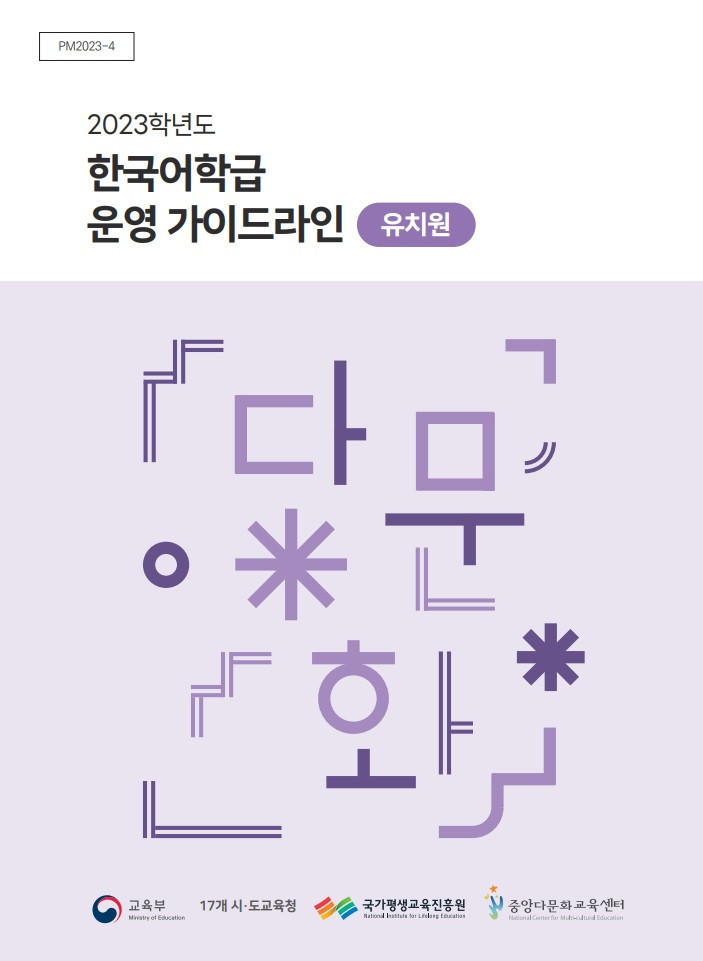 2023학년도 한국어학급 운영 가이드라인: 유치원 Année de publication: 2023 Auteur institutionnel: 국가평생교육진흥원 | 중앙다문화교육센터 본 자료는 다문화교육 정책학교 및 한국어학급 담당 교사의 사업에 대한 이해를 제고하고 운영에 도움을 드리고자 제작하였습니다. 본 자료에서 정하는 바를 참고하되, 학교(유치원)의 여건과 다문화학생(유아)의 특성 등을 종합적으로 고려하여 운영하시기 바랍니다. 더욱 자세한 사항은 시·도교육청 및 국가평생교육진흥원 중앙다문화교육센터를 통해 안내받으실 수 있습니다.
 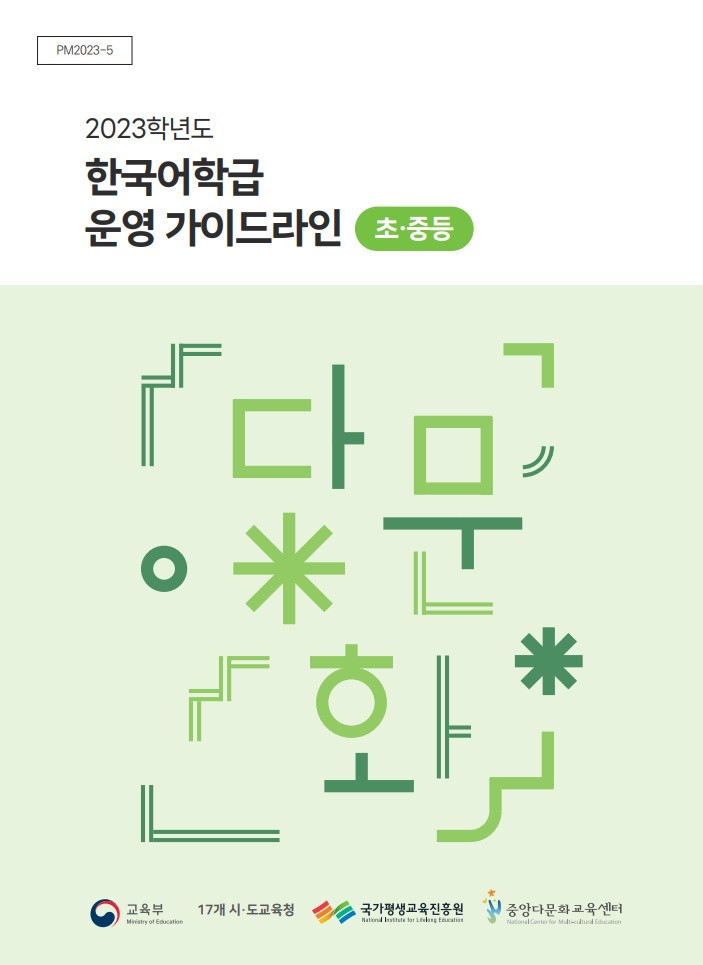 2023학년도 한국어학급 운영 가이드라인: 초중등 Année de publication: 2023 Auteur institutionnel: 국가평생교육진흥원 | 중앙다문화교육센터 본 자료는 다문화교육 정책학교 및 한국어학급 담당 교사의 사업에 대한 이해를 제고하고 운영에 도움을 드리고자 제작하였습니다. 본 자료에서 정하는 바를 참고하되, 초·중·고등학교의 여건과 다문화학생(초·중·고등학생)의 특성 등을 종합적으로 고려하여 운영하시기 바랍니다. 더욱 자세한 사항은 시·도교육청 및 국가평생교육진흥원 중앙다문화교육센터를 통해 안내받으실 수 있습니다.