
Ressources
Explorez une large gamme de ressources sur le GCED afin d’approfondir votre compréhension et de renforcer vos activités de recherche, de plaidoyer, d’enseignement et d’apprentissage.
169 résultats trouvés
 Envisioning education beyond 2015: Asia-Pacific regional perspectives; final report Année de publication: 2014 Auteur institutionnel: UNESCO Bangkok This report provides a thorough account of the discussions and deliberations that led to the construction of the Asia-Pacific Statement on Education Beyond 2015 (Bangkok Statement), the outcome document of this historic event. Participants reviewed in fine detail EFA progress across the Asia-Pacific region and debated key thematic areas of basic education, skills and competencies, global citizenship education, education for sustainable development, teachers, governance and finance. Participants also looked into implementation strategies, and education ministers from across the region shared their views on remaining challenges, future priorities and strategies for education beyond 2015. Envisager l'éducation au-delà de 2015: Perspectives Régionales Asie-Pacifique; rapport final Année de publication: 2014 Auteur institutionnel: UNESCO Bangkok Ce rapport fournit un compte rendu détaillé des discussions et délibérations qui ont conduit à la construction de la Déclaration de l'Asie-Pacifique sur l'éducation Au-delà de 2015 (Déclaration de Bangkok), le document final de cet événement historique. Les participants ont examiné en cours détail EPT bien dans toute la région Asie-Pacifique et ont débattu des domaines thématiques clés de l'éducation de base, les compétences et les compétences, l'éducation à la citoyenneté mondiale, l'éducation pour le développement durable, les enseignants, la gouvernance et les finances. Les participants ont également examiné les stratégies de mise en œuvre, et les ministres de l'éducation de toute la région ont partagé leurs points de vue sur les défis restant à relever, des priorités et des stratégies futures pour l'éducation au-delà de 2015.
 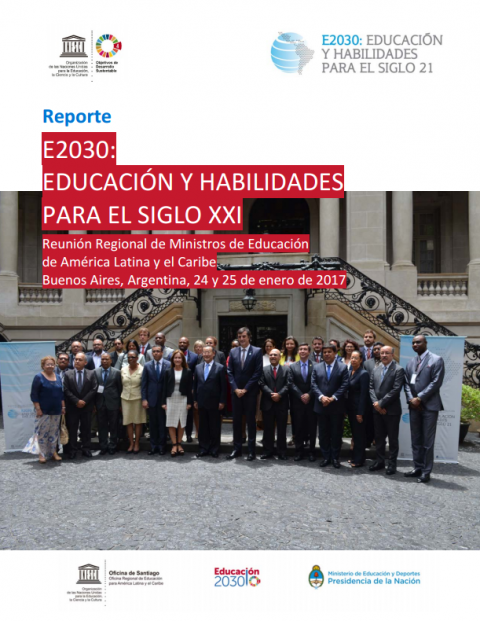 E2030: education and skills for the 21st century: Regional Meeting Année de publication: 2017 Auteur institutionnel: UNESCO Santiago This report provides a systematization of the discussions at the Regional Meeting of Ministers of Education of Latin America and the Caribbean “E2030: Education and skills for the 21st century” held 24‐25 January 2017 in Buenos Aires, Argentina. The objectives of the meeting were to: • adopt a Ministerial Declaration on a joint approach to achieve the SDG4-E2030 Agenda in the region, including means of implementation, technical instruments of support and follow-up mechanisms. • agree on a roadmap for the implementation of E2030, including a contextualized followup mechanism that responds to the region’s educational challenges and expectations. Reporte: Educación y habilidades para el siglo XXI; Reunión Regional de Ministros de Educación de América Latina y el Caribe, Buenos Aires, Argentina, 24 y 25 de enero 2017 Année de publication: 2017 Auteur institutionnel: UNESCO Santiago This report provides a systematization of the discussions at the Regional Meeting of Ministers of Education of Latin America and the Caribbean “E2030: Education and skills for the 21st century” held 24‐25 January 2017 in Buenos Aires, Argentina. The objectives of the meeting were to: • adopt a Ministerial Declaration on a joint approach to achieve the SDG4-E2030 Agenda in the region, including means of implementation, technical instruments of support and follow-up mechanisms. • agree on a roadmap for the implementation of E2030, including a contextualized followup mechanism that responds to the region’s educational challenges and expectations.
 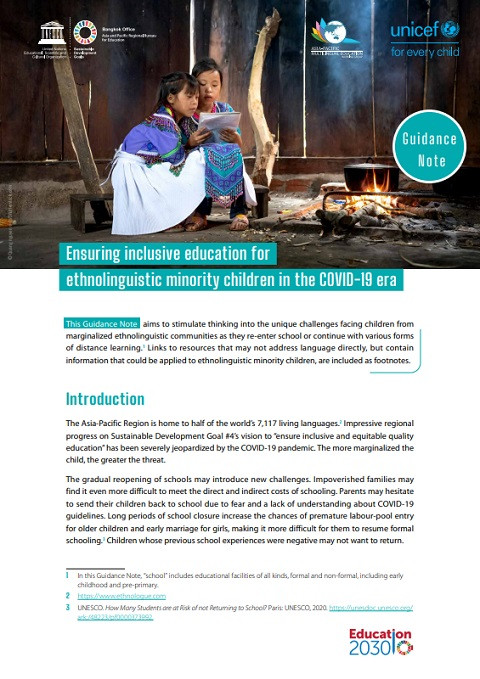 Ensuring Inclusive Education for Ethnolinguistic Minority Children in the COVID-19 Era: Guidance Note Année de publication: 2021 Auteur institutionnel: UNESCO Bangkok This Guidance Note aims to stimulate thinking into the unique challenges facing children from marginalized ethnolinguistic communities as they re-enter school or continue with various forms of distance learning. Links to resources that may not address language directly, but contain information that could be applied to ethnolinguistic minority children, are included as footnotes.
  School for all: experiences of municipal public schools with inclusion of students with disabilities, ASD, GDD and high ability/giftedness Année de publication: 2017 Auteur: Carla Mauch | Wagner Santana Auteur institutionnel: UNESCO Brasilia This publication is the result of a research project entitled Good Practices in Inclusive Education: the experience of Brazilian municipalities with the inclusion of students with disabilities, Autism Spectrum Disorder (ASD), Global Developmental Disorder (GDD) and of high ability/giftedness students (Boas Práticas em Educação Inclusiva: a experiência de municípios brasileiros na inclusão de alunos com deficiência, transtornos do espectro autista (TEA), transtorno global do desenvolvimento (TGD) e altas habilidades/superdotação). The study set out to identify and analyse the practices of municipal public-school networks in Brazil concerning the educational inclusion of students with disabilities, ASD and GDD, as well as gifted/talented students. The initiative arose out of a will to subsidise and strengthen processes for the formulation and implementation of policies, programmes and projects aligned with the principles of the Convention on the Rights of Persons with Disabilities (United Nations, 2006; Brazil, 2009) and the National Special Education Policy in the Perspective of Inclusive Education (Política Nacional de Educação Especial na Perspectiva da Educação Inclusiva) (Brasil. MEC/SEESP, 2008c). It is important to point out that those normative frameworks bring principles and presuppositions that have been reaffirmed in more recent documents such as the Incheon Declaration (World Education Forum, UNESCO, 2015) and the Sustainable Development Goals (SDG) (United Nations, 2015).
  Curriculum in the Education 2030 Agenda: Latin America and the Caribbean Année de publication: 2017 Auteur: Renato Opertti Auteur institutionnel: UNESCO International Bureau of Education (IBE) “Curriculum in the Education 2030 Agenda: Latin America and the Caribbean”1 discusses the importance of rethinking the curriculum in light of a transformational, humanistic and holistic vision of education. The Education 2030 Agenda, which emerged from the World Education Forum (WEF) 2015 held in Incheon, Republic of Korea, positions curriculum as a powerful education policy tool leading the way to effective, relevant and sustainable learning opportunities, processes and outcomes. Curricula have a positive effect as levers for the sustainable, inclusive, fair and cohesive development of a country. They reflect and help to construct the type of society envisioned. The article provides recommendations to strengthen the positioning of curriculum toward an inclusive and equitable quality education in Latin America and the Caribbean. It therefore addresses the following questions: 1) How is curriculum currently conceived?; 2) What role does it play in the reforms aimed at improving equity and quality of the learning processes?; 3) What are the main regional challenges in relation to curriculum development?; and 4) How could countries align their curricula with their development needs?
  The Role of Education in Preventing Violent Radicalisation: A Review for Europe (The Journal of Education; No.397, 2022) Année de publication: 2022 Auteur: Arantxa Azqueta | Adoración Merino-Arribas Auteur institutionnel: Spain. Ministry of Education This research analyses government documents addressing the prevention of radicalisation in 16 European countries, differentiated according to the presence or absence of fatalities in attacks. The aim to identify the presence of the attitudes which PISA 2018 identifies as key to define a democratic and interculturally competent citizenry and guide integration-friendly policies: openness, respect, civic awareness, responsibility, self-efficacy and tolerance. A comparative methodology is employed, using a lexicographical content analysis through Iramuteq software together with a critical-interpretative analysis of the texts.
  Construction / Emerging Invention of Unequal Populations in Latin American Education Année de publication: 2017 Auteur: Jesús Aguilar Nery Auteur institutionnel: Universidad de San Andrés | Arizona State University This text explores the emergent construction of “unequal” populations in Latin-America, focusing on three national traditions: Argentina, Brazil and Mexico. It compares who has been named as unequal in educational research and under what categories, and treats this comparison as an indicator for understanding the phenomenon of educational inequalities in the region between 1960 and 1970. It is concluded that the rules used to enforce inclusion, equality and equity are, at the same time, standards and divisions that involve the construction of systems of reasoning that also simultaneously include and exclude. Construcción/Invención Emergente de Poblaciones Desiguales en la Educación Latinoamericana Année de publication: 2017 Auteur: Jesús Aguilar Nery Auteur institutionnel: Universidad de San Andrés | Arizona State University En este texto se indaga la emergencia de la construcción/invención de poblaciones “desiguales” en Latinoamérica, enfocando tres tradiciones nacionales: Argentina, Brasil, y México. Se compara quiénes han sido denominados como desiguales en la investigación educativa, y bajo qué categorías, esto como un indicador para la comprensión del fenómeno de las desigualdades educativas en la región entre las décadas de 1960 y 1970. Se concluye que las reglas utilizadas para ampliar la inclusión, la igualdad o la equidad son, al mismo tiempo, estándares y divisiones, que implican la construcción de sistemas de razonamiento que incluyen tanto como excluyen.