
Ressources
Explorez une large gamme de ressources sur le GCED afin d’approfondir votre compréhension et de renforcer vos activités de recherche, de plaidoyer, d’enseignement et d’apprentissage.
169 résultats trouvés
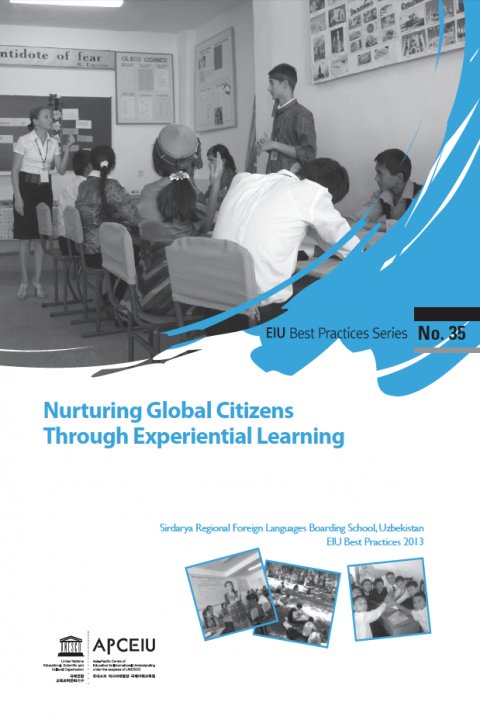 Nourrir les citoyens du monde par l'apprentissage expérientiel (ECI Série des Meilleures Pratiques no.35) Année de publication: 2013 Auteur: Ildar Yusupov | Feruza Ahmedova Auteur institutionnel: Centre Asie-Pacifique d'éducation pour la compréhension internationale (APCEIU) Le cas suivant est réglé en Ouzbékistan où les groupes sociaux évidemment diverses vivent en harmonie malgré leurs différences. Parmi les écoles du pays, les langues régionales Sirdarya étrangères pensionnat de Gulistan ville est sans doute une école exceptionnellement unique en raison de la collaboration étroite des parents avec les activités ECI-thème de l'école d'embarquement. Les activités vont des activités extra-scolaires, y compris art et du sport, aux activités en salle de classe tels que des jeux de rôle et des activités de sensibilisation internationales. Chaque activité est soigneusement conçu pour susciter l'intérêt des étudiants dans les thèmes ECI-connexes tels que la tolérance, la compréhension et le développement durable. Dans le processus, les étudiants deviennent très motivés à prendre des rôles de premier plan en tant que citoyens du monde responsables dans la création d'un monde plus pacifique.
 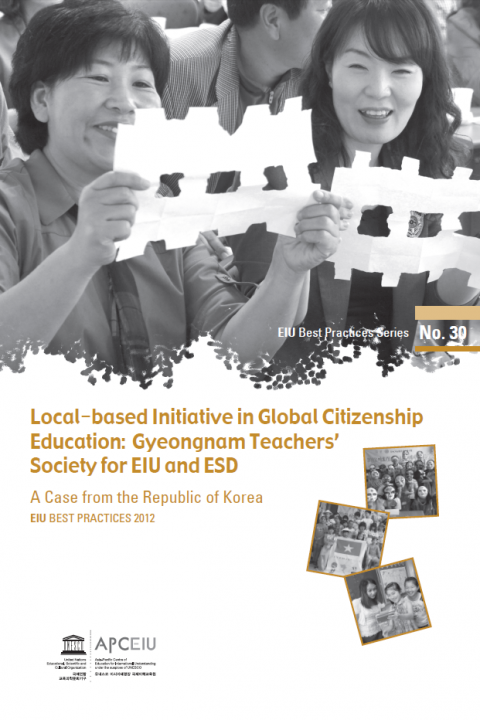 EIU Best Practice Series No.30: Local-based initiative in global citizenship education: Gyeongnam teachers’ society for EIU and ESD Année de publication: 2012 Auteur: Byeongseob Choi Auteur institutionnel: APCEIU Issue No. 30 introduces a case in the Republic of Korea on the local-based initiatives of school teachers to promote EIU and ESD in their local community. The case illustrates the taken steps and efforts made by the respective teachers when elaborating innovative approaches to promote EIU and ESD, led by the intention to create a more open and locally relevant educational setting for students as well as teachers in response to the growing globalization. Especially the Gyeongnam Province, where the teachers are based, is experiencing a rapid demographic change due to the high influx of foreigners, which calls upon the educators to prepare their students to effectively cope with these changes and become global citizens. Local à base initiative en matière d'éducation à la citoyenneté mondiale: la société des enseignants Gyeongnam pour ECI et EDD (ECI Série des Meilleures Pratiques no.30) Année de publication: 2012 Auteur: Byeongseob Choi Auteur institutionnel: Centre Asie-Pacifique d'éducation pour la compréhension internationale (APCEIU) Question n ° 30 introduit un cas en République de Corée sur les initiatives locales à base des enseignants des écoles pour promouvoir ECI et EDD dans leur communauté locale. Ce cas illustre les étapes et les efforts déployés par les enseignants respectifs lors de l'élaboration d'approches novatrices pour promouvoir ECI et EDD, menés par l'intention de créer un cadre éducatif plus ouvert et pertinent au niveau local pour les étudiants ainsi que les enseignants en réponse à la mondialisation croissante prises. En particulier, la province de Gyeongnam, où les enseignants sont basés, connaît une évolution démographique rapide en raison de l'afflux massif d'étrangers, qui invite les éducateurs à préparer leurs élèves à faire face efficacement à ces changements et à devenir des citoyens du monde.
 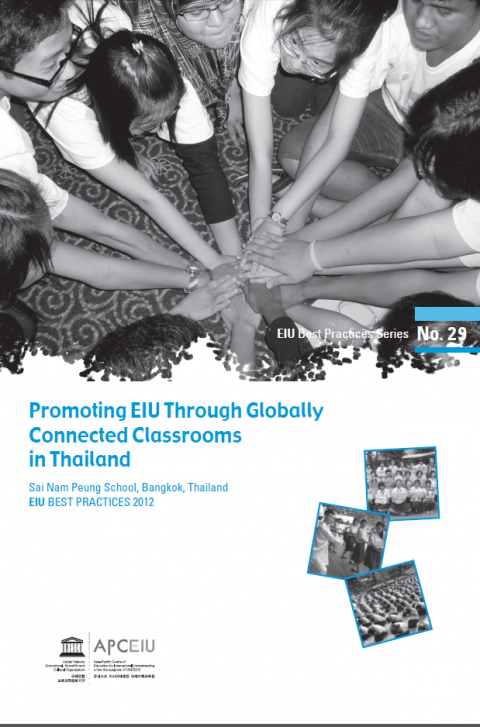 EIU Best Practice Series No. 29: Promoting EIU through globally connected classrooms in Thailand Année de publication: 2012 Auteur: Ajarn Kanchaphat Chaoplaina Auteur institutionnel: APCEIU This issue presents a multilateral project in Thailand, which interconnected students from Thailand, United Kingdom, Korea, Indonesia, Malaysia, Taiwan, and Vietnam to share their values and thoughts on EIU issues. Through the portals of connection, students from different regions were able to collaborate in doing group works and activities, which were focused on sharing ideas on students’ interest and every day experiences. This case highlights the specific practice that encouraged students to actively learn from one another and understand the cultural diversity, which optimized the outcome of the students’ capacity in communication skills, language skills, and personal development as global citizens. In addition to strengthening the network among participating schools, the impact of the multilateral project extended to teachers while they were engaged in exchanging pedagogical methods and knowledge to support and inspire each other. Promouvoir ECI travers les salles de classe branchés sur le monde en Thaïlande (ECI Série des Meilleures Pratiques no.29) Année de publication: 2012 Auteur: Ajarn Kanchaphat Chaoplaina Auteur institutionnel: Centre Asie-Pacifique d'éducation pour la compréhension internationale (APCEIU) Cette question présente un projet multilatéral en Thaïlande, qui interconnectée étudiants en provenance de Thaïlande, Royaume-Uni, la Corée, l'Indonésie, la Malaisie, Taïwan et le Vietnam pour partager leurs valeurs et leurs réflexions sur les questions ECI. A travers les portails de connexion, les étudiants de différentes régions ont été en mesure de collaborer à faire des travaux et des activités de groupe, qui ont été axées sur le partage des idées sur l'intérêt des élèves et expériences quotidiennes. Ce cas met en lumière la pratique spécifique qui a encouragé les élèves à apprendre activement les uns des autres et de comprendre la diversité culturelle, qui a optimisé le résultat de la capacité des étudiants en techniques de communication, les compétences linguistiques et le développement personnel en tant que citoyens. En plus de renforcer le réseau entre les écoles participantes, l'impact du projet multilatéral étendu aux enseignants alors qu'ils étaient engagés dans l'échange de méthodes et de connaissances pédagogiques pour soutenir et inspirer les uns des autres.
 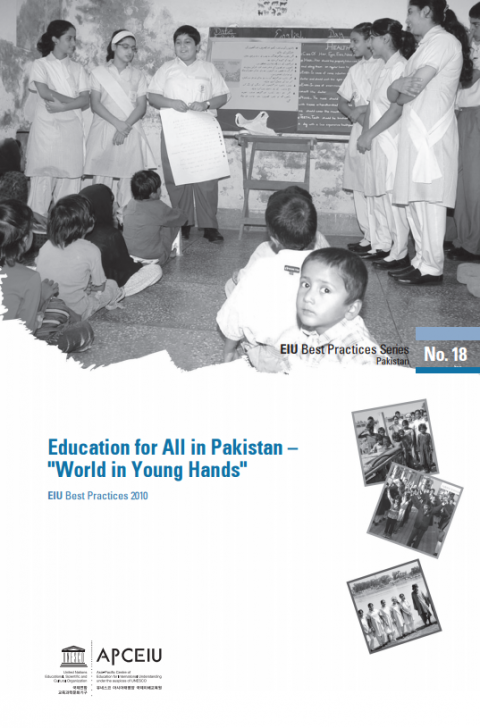 EIU Best Practices Series No.18: Education for All in Pakistan - "world in young hands" Année de publication: 2010 Auteur: Ayesha Saqib Auteur institutionnel: APCEIU The programme provides a student-participatory approach to face local problems that stem from ignorance and have roots in poverty. Bridging the school with the local community, Social Action Program (SAP) aims to inspire students with keen awareness on problems that threaten our community as well as to equip them with necessary tools to deal with challenges they may face. Through practices, SAP integrates EIU into curriculum that emphasizes maintaining peace and harmony among different folds of religions, ethnicity, and sects, dissipating the elements of hate and intolerance. The major areas of concern are Literacy for All, Sustainable Development, Cultural Diversity, and Peace Education. Éducation pour tous au Pakistan - «monde aux mains des jeunes» (ECI Série des Meilleures Pratiques no.18) Année de publication: 2010 Auteur: Ayesha Saqib Auteur institutionnel: Centre Asie-Pacifique d'éducation pour la compréhension internationale (APCEIU) Le programme offre une approche étudiant-participative pour faire face à des problèmes locaux qui découlent de l'ignorance et ont des racines dans la pauvreté. Combler l'école avec la communauté locale, le programme d'action sociale (PAS) vise à inspirer les élèves ayant conscience aiguë des problèmes qui menacent notre communauté ainsi que de les doter des outils nécessaires pour faire face aux défis auxquels ils peuvent être confrontés. Grâce à des pratiques, PAS intègre EIU dans les programmes qui met l'accent maintenir la paix et l'harmonie entre les différents plis de religions, l'origine ethnique, et les sectes, dissipant les éléments de la haine et de l'intolérance. Les principaux domaines de préoccupation sont l'alphabétisation pour tous, le développement durable, la diversité culturelle et éducation à la paix.
  School, Identity and Discrimination Année de publication: 2011 Auteur: Néstor López Auteur institutionnel: UNESCO IIEP Office for Latin America and the Caribbean Education, identity and school is just one more link, within the many wills that work for full equality of opportunities. As in other publications of the Institute, the wealth of perspectives is added, which give shape to sometimes pressing realities with a demand for urgent action. The publication is a new opportunity for the voices of different interlocutors to give an account, in their countries and contexts, both of the construction of identity processes, and of their recognition and respect. This also implies raising the obstacles, the contributions and the advances, to face the challenges still pending. In each work presented here, the authors-whose participation and effort we deeply appreciate-offer sharp insights on various tasks and contexts. We wish, to conclude, that this text also contributes to the reflection on the possible courses that have been adopted or that require a deepening of the educational policies, specifically in the agendas related to the themes of this publication. Escuela, identidad y discriminación Année de publication: 2011 Auteur: Néstor López Auteur institutionnel: UNESCO IIEP Oficina para América Latina y el Caribe Educación, identidad y escuela es solo un eslabón más, dentro de las muchas voluntades que trabajan por la plena igualdad de oportunidades. Como en otras publicaciones del Instituto, se suma la riqueza de perspectivas, que dan forma a realidades en ocasiones acuciantes con demanda de urgente acción. La publicación supone una nueva oportunidad para que las voces de distintos interlocutores den cuenta, en sus países y contextos, tanto de la construcción de procesos identitarios, como de su reconocimiento y respeto. Ello implica también plantear los obstáculos, los aportes y los avances, para afrontar los desafíos aún pendientes. En cada trabajo que aquí se presenta, los autores –cuya participación y esfuerzo agradecemos profundamente– ofrecen agudas miradas sobre diversos quehaceres y contextos. Deseamos, para concluir, que este texto también contribuya a la reflexión sobre los posibles rumbos que se han adoptado o que requieren profundización en las políticas educativas, específicamente en las agendas vinculadas con las temáticas de esta publicación.
 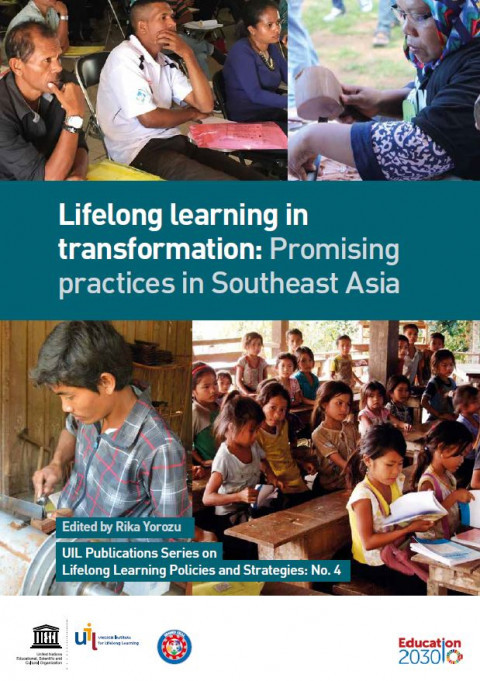 Lifelong Learning in Transformation: Promising Practices in Southeast Asia Année de publication: 2017 Auteur: Rika Yorozu Auteur institutionnel: UNESCO Institute for Lifelong Learning (UIL) This report is an outcome of a project on building a lifelong learning agenda in Southeast Asian countries, which aims to address the region’s remaining educational challenges in ensuring ‘inclusive and equitable quality education and promot[ing] lifelong learning opportunities for all’ (Goal 4 of the 2030 Agenda for Sustainable Development). By sharing promising policies and practices in implementing integrated lifelong learning from different perspectives, countries can learn from one another and move their visions for lifelong learning fully into practice. The publication documents a variety of promising practices from 11 countries, focusing particularly on the features critical to the promotion of lifelong learning for all; namely, inclusive and gender-responsive teaching and learning practices, recognition of learning outcomes from non-formal and informal learning, collaboration between social and economic development sectors and coherent national government policies and strategies. The report comprises three main sections: a reflection on lifelong learning in international and national documents, a collection of good practice drawn from their national reports, and a set of recommendations for policies and programmes promoting lifelong learning. It is hoped that these recommendations will stimulate discussion and new developments, in both policy and practice, in the region.